Little and large

Blog branding

Amo Spooner from the Museum’s Life Collections has been out in the Museum sharing some of her favourite objects. Here’s the latest in our Spotlight Specimens series…

**
P1090762

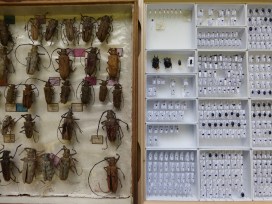
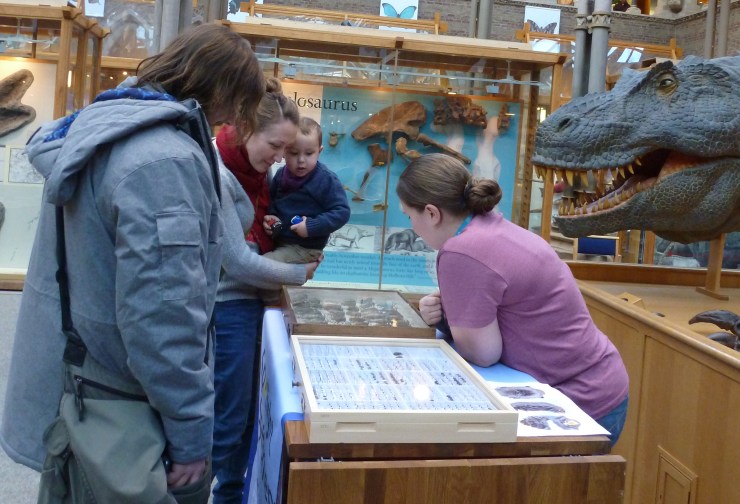
Big impressive beetles or small shiny ones? That is the question. For me it’s all about the small ones, but here I am getting people’s (and the T. rex’s) attention with the big ones. It’s my tactic for engaging their interest before I try to convince them that the small ones are so much cooler!

Monday – Thursday at 2.30pm a member of the Museum’s collections staff can be found out in the Museum talking about something interesting. For my latest session of Spotlight Specimens I chose to show off drawers of my favourite beetles.
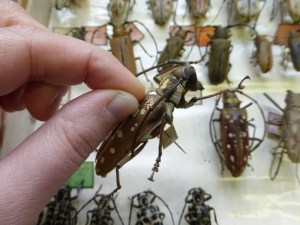
P1020715The big ones are from a family of beetles called Cerambycidae or Longhorn Beetles. This family is found all over the world and varies greatly in size and colour. These ones are particularly interesting to me because of the historic collection they are from. The vast Baden-Sommer collection, containing many different beetle families, came to the museum via a dealer in 1910 and unusually it is still in its original layout. The labels you can see in the drawer were written by the two entomologists that collected the specimens, J. Baden and M. Sommer.

The one you see in my hand (above) is in the subfamily Lamiinae – also charmingly known as Flat Faced Longhorns.

Part of my job is to re-curate and move historic specimens into pest-proof housing –  I am currently writing a blog post explaining this, so watch this space! In a nutshell, the Baden-Sommer Longhorns are a good example of drawers in need of some TLC. This leads me nicely on to my second choice of drawer, the Histeridae.
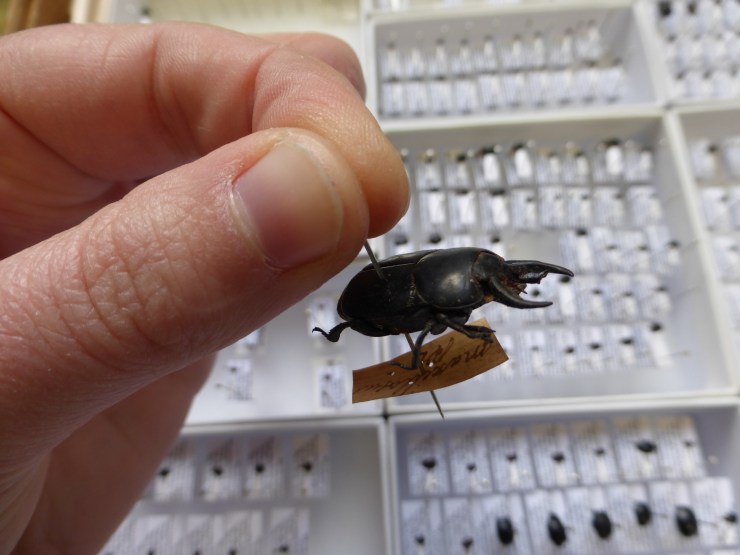
P1020717These are my first love when it comes to beetles. The Histeridae, or Clown Beetles, vary a lot in size; the one in my hand (below) is about as big as they get, but they can be as small as 1 mm in length.
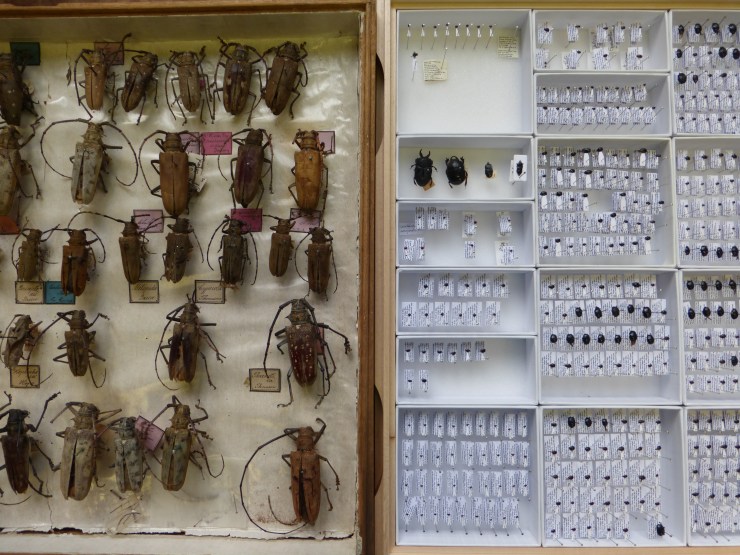
P1020709I have re-curated all of the Museum’s historic Histeridae specimens and mounted up many modern ones, like you can see above. This modern system of trays and pest proof drawers ensures the longevity of specimens, as well as making them easier to access.

So what makes the little ones so special? During the afternoon I met visitors from home and abroad, young and old. I convinced them to to look a little closer, admiring their shiny black armour and fascinating adaptations. I think they finally agreed that big isn’t always best.

Amo Spooner, Collections assistant (Life)

Museum à la mode

Credit- Julia Cleaver www.JuliaCleaver.com
Image: © Julia Cleaver 2015 http://www.JuliaCleaver.com

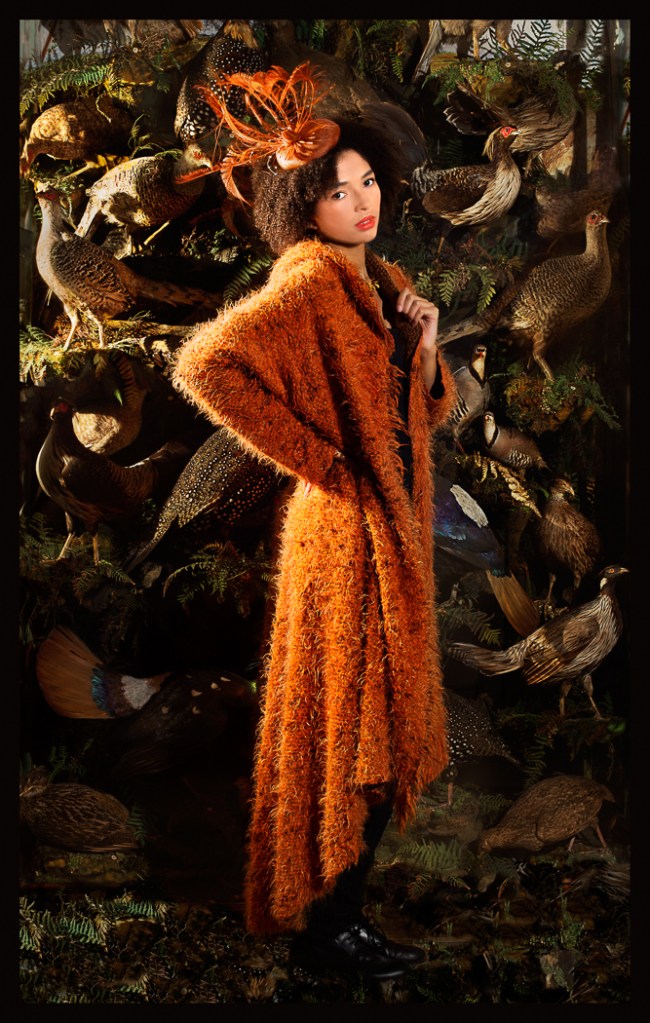
I’ve just received some fabulous pictures from a photo shoot here in the Museum. The building and its specimens are shown at their very best and the model’s striking looks add a sheen of glamour to each photo. But what makes these images really special is that the model is one of our own; Aisling Serrant is better known to Museum staff as a trainee education officer on the HLF Skills for the Future programme.

Oxford University Museum of Natural History,
Image: © Julia Cleaver 2015 http://www.JuliaCleaver.com

Aisling spent four months in the Public Engagement team in 2014, largely working with school groups and families. Not always the most glamorous job. In November 2014 we had the opportunity to see her in a completely new light. Oxford Fashion Week was coming to the Museum and they were running open casting sessions for models. Aisling remembers how she got involved:

**

When the initial meetings started taking place between the Fashion Week organisers and the Museum staff, my ears pricked up. Alongside studying or working I have modelled for years. My degree is in archaeology, so people have always found the combination with fashion modelling quite funny – perhaps imagining me standing knee-deep in a muddy trench in stilettos! It seemed too good to be true – could there really be a chance for me to bring my two contrasting types of work together?

Aisling in the Oxford Fashion Week shows
Aisling in the Oxford Fashion Week shows. Credit: Mark Hemsworth

I was delighted when I was asked to model in all three shows that were to be held at the Museum. They took place on Friday 7 and Thursday 8 November.

Friday night was a busy one with two shows in one night. I felt right at home, with the familiar faces of old friends like the T.rex and Iguanodon (oh and some of the staff members too!).  However it did all feel a bit surreal.

Getting ready backstage

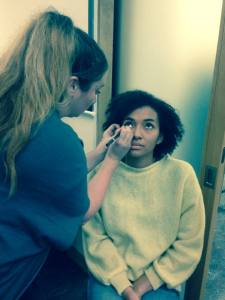
The Museum Annexe had been transformed into the backstage area, but the last time I had spent so much time there I’d been running an archaeological dig activity with year 6 children in the Making Museums project. Now the place couldn’t have looked more different with rails upon rails of clothes, photographers’ flashes and the distinct smell of hairspray in the air.

Saturday night was the big finale to the week – the Birds of Paradise show in the Museum central court. The skeleton parade was parted so we could walk down the middle and the Triceratops skull was moved to become the backdrop for the first part of our walk. The museum was transformed into another world for the evening.

On the runway at the Birds of Paradise show.
On the runway at the Birds of Paradise show. Credit: Mark Hemsworth

The addition of atmospheric music and such stunning outfits was truly breathtaking – enchanting at times, slightly eerie at others – but always fantastically dramatic. The nature-inspired outfits, some smothered in black feathers, others twinkling with jewel beetle shells, served as a reminder of how extraordinarily beautiful the natural world is.

**

Credit- Julia Cleaver www.JuliaCleaver.com
Image: © Julia Cleaver 2015 http://www.JuliaCleaver.com

Photographer Julia Cleaver was here for the shows and was so inspired by the venue and so enjoyed working with Aisling that she returned recently to do an extra photo shoot. These photos are the stunning outcome of that session. Many thanks to Julia for letting us share them here.

Rachel Parle, Interpretation and Education Officer

Top 5 – Lepidoptera

leps

Our monthly staff meetings are a chance to catch up on what’s happening across the Museum. But recently it’s also been used as an opportunity to share some of the hidden gems in the Museum’s collection. Each month, one member of staff selects 5 of their personal favourite specimens to talk about. We thought that you might like to share this experience, so the Top 5 will be blogged here each month for you to enjoy.

With 2 million butterflies and moths in the Museum’s collection, choosing a top 5 is certainly a challenge. But Gina Allnatt is feeling brave…

**

WORKING2
Gina working on a draw of Lepidoptera (moths and butterflies)

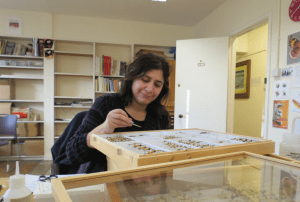
I work on the Lepidoptera Project, which is a two-year project to database, catalogue, re-curate and photograph moths and butterflies in the Life collections. Because it’s such a large and amazing collection, I had trouble deciding what to choose for top five specimens. In fact, I almost wish it had been a top ten. But who knows…maybe there will be a part two to this at some point.

So here goes…

5 – Wallace’s Golden Birdwing (Ornithoptera croesus)

putative_syntype_male

This is a recent discovery and one we’re very excited about. We believe that this is the specimen, or one of the specimens, that Alfred Russel Wallace described so passionately in correspondence to his dealer Samuel Stevens.

The beauty and brilliancy of this insect are indescribable, and none but a naturalist can understand the intense excitement I experienced when I at length captured it. On taking it out of my net and opening the glorious wings, my heart began to beat violently, the blood rushed to my head, and I felt much more like fainting than I have done when in apprehension of immediate death. I had a headache the rest of the day, so great was the excitement produced by what will appear to most people a very inadequate cause. –A.R. Wallace 1859, from Proceedings of the Entomological Society.

Observant Wallace fans may have noticed that it doesn’t have Wallace’s typical round labels. It was re-labelled when it was donated to the Museum in 1871. It seems that Hewitson, a wealthy collector, removed all the original labels when they came into his care – a nightmare for me when I’m trying to trace things!

4. Lampides carissima from the Challenger Expedition

Lampides carissima

One of our volunteers, Willow, was databasing a drawer of Lycaenidae and he asked me why there was one butterfly separate from the main group. He wanted to know what species it was so he could database it. So I picked up the specimen and I immediately saw “Challenger, July 1874”.

Arthur Gardiner Butler

Entomologist Arthur Gardiner Butler, who then worked at the British Museum, produced a paper called “The Lepidoptera collected during the recent expedition of the H.M.S. Challenger,” which lists all the species of butterflies and moths collected on the expedition and where they were found. And there, in the paper, we have; “Jamides carissima, collected Tongatabu, July 1874″. This is the only Challenger specimen we have found so far in the Entomology collections, but there could well be more. We’ll see… challenger

3. Extinct Moths and Butterflies

Kona Giant Looper Moth

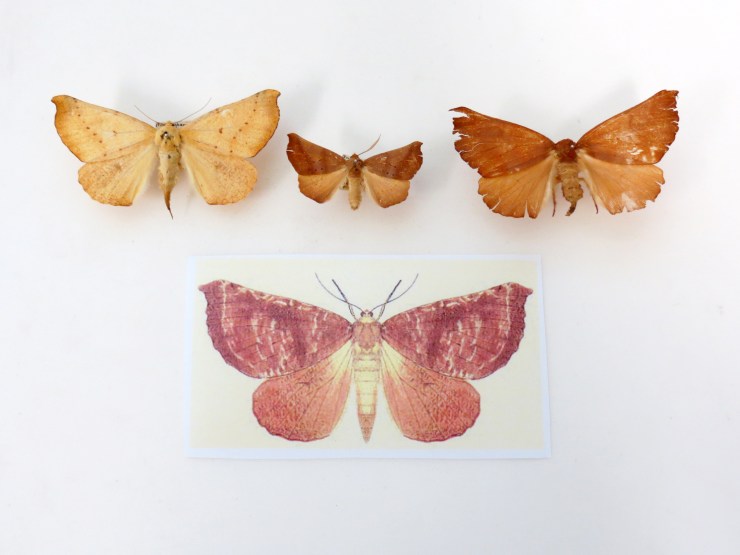
The collection contains some extinct and critically endangered moths, all of which were endemic to particular islands around the world. Above you can see the Kona Giant Looper moth, which was endemic to Hawaii. Two females and one male collected by R.C.L Perkins. This was one of the world’s largest Geometrids. This shows how important historic collections are for reminding us what we have, what we’ve lost and what we need to look after.

2. Wallace’s Sun Moth

sunmoth

This specimen came from the Brazilian orchid house of Alfred Russel Wallace. It’s a moth from the family Castniidae, or Sun Moths. When the moth was first found it caused a bit of confusion; Wallace was thrown by the insect’s moth-like appearance and clubbed antennae. Was it a moth or a butterfly? This reminds us that there are exceptions to every rule – when someone tells you butterflies have clubbed antennae and moths don’t, it’s not always true! Even Wallace got caught out sometimes.

1. World’s Oldest Pinned Insect

Bath WhiteBefore insects were preserved on pins, they were glued onto card or pressed in books, rather like a botanical specimen. This Bath White butterfly (Pontia daplidice) is the oldest known pinned insect and its label suggests is was collected in Cambridge by William Vernon, in 1702.
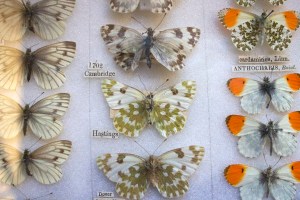
oldest_insect_on_a_pinBut research now suggests that Vernon was capturing Bath Whites as early as 1699, so the specimen could be even older than that. So it’s at least 313 years old this year and is still on its original pin!

To find out more about the Lepidoptera Project, follow us on Twitter @hopeulikemoths

Gina Allnatt, Curatorial assistant (Lepidoptera)

Presenting… Darwin’s Insects

IMG_4273

A new year, a nice new display case. You may already be familiar with the Presenting… series that we’ve been running since March 2013; it started as a way to showcase treasures from the Museum’s collection during our closure year. Something changing and engaging to see as you passed through our darkened museum into the Pitt Rivers. Since re-opening early in 2014, we’ve celebrated significant natural history anniversaries, shared some of the staff’s favourite objects and put on joint displays with other departments in Oxford University. Now, for 2015, Presenting…  is getting a make-over.

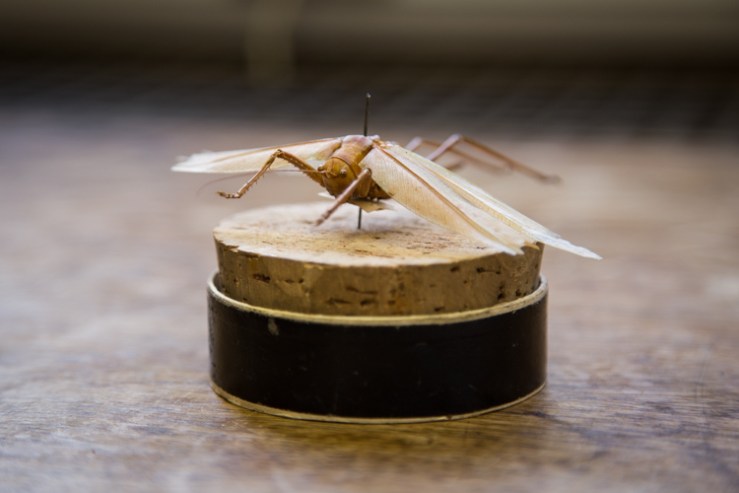
Bush cricket, family Tettigoniidae
IMG_4268
Amoret from Life collections installs a letter from Darwin to Hope

Today we’ve installed a brand new Presenting…  display, in a posh new case. With humidity control and UV protection, this standard-leading unit gives us the opportunity to showcase some of the really special and fragile specimens from the collections. We’re launching tomorrow with a display of insects collected by none other than Charles Darwin.

As well as showing off some specimens collected by the great man in Australia and Tasmania, Darwin’s Insects will tell the story of his close friendship with Frederick William Hope (1797–1862), founder of the Hope Department of Entomology in this Museum. Hope was one of the most eminent entomologists of his time and when Darwin collected insects he often turned to Hope to help identify them.

Preparing specimens in the Life collections

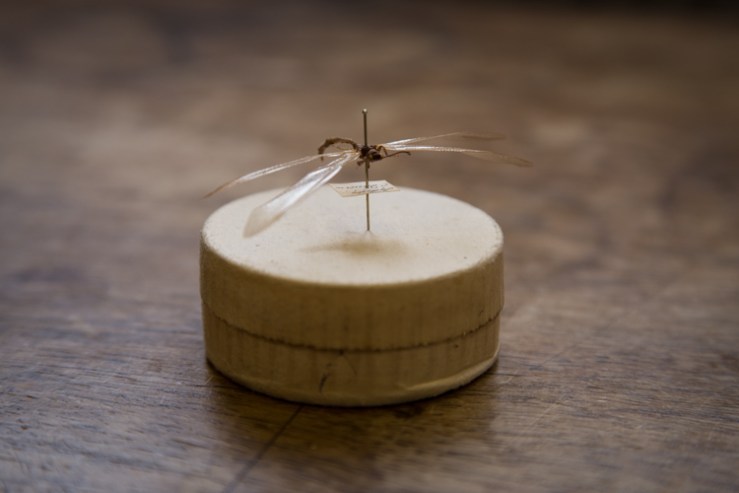
Darwin’s journey on HMS Beagle began in 1831 and towards the end of the trip he travelled around parts of Australia and Tasmania observing and collecting many species, including the insects you can see on display. They’re displayed in pill boxes similar to the type Darwin would have used to collect the specimens originally, and you can see Darwin’s handwriting on the tiny labels.

Ant lion, family Myrmeleontidae

Alongside the pinned insects, you can see one of Darwin’s letters to Hope, sent in 1837. He mentions insects that he collected between January and April 1836, which include the specimens on display. He is asking for Hope’s assistance, because so many of these insects are unknown to science. Hope was always keen to help identify new species and in another correspondence, from 1834, he promised to give Darwin “all assistance in my power” with this task.

The insects and letter will be on display from tomorrow (10 January) until 8 March. Pop in and take a look!

Rachel Parle, Interpretation and Education Officer

Humpback in action

IMG_4010

The sight of a huge Sperm Whale jaw soaring up to the roof is a familiar welcome to our visitors. But this spectacular specimen now has a companion. Resting against the opposite side of the cast iron column is a Humpback Whale skull.

9 mandibleThe skull was donated back in the 19th Century by well-known scientist Professor Eschricht of Copenhagen.

Over the decades the specimen has been displayed in all sorts of places and positions around the Museum – laid flat on the floor, upright and on top of cases. Last year, as part of our Once in a Whale project, the specimen joined our other whale skeletons in undergoing some much-needed conservation treatment. You can find out the story of its big clean-up on the project blog.

The skull is now displayed beautifully on a stand – but it was no mean feat to get it there. Bill Richey, the Museum’s Cabinet Maker, and Peter Johnson, Workshop & Maintenance, have carefully moved the specimen from the corner of the Museum where it was undergoing conservation treatment, reconstructed the complex structure and built a bespoke stand to support its huge weight. Here’s a step by step guide to rebuilding a Humpback Whale skull:

1 Base_smallFirst, Bill used his years of experience in the Museum to build a display stand that perfectly held the complex contours of the bone. He scribed around the base of the skull, making a layer of MDF to fit each curve. Once he was confident of the perfect fit, he screwed them all together (see left photo), before returning to the workshop to square it all up, sand and paint the finished thing. He added a cushioning layer of Plastazote foam to the top surface, which would touch the skull.

Now to move the skull to its new location…

3 moving_small

Because Bill and Pete had no idea how heavy the specimen would be, they decided not to take any risks and used the lifting machine to carry the weight. Keeping the specimen and themselves safe throughout the process was the most important thing.

Once they’d lowered the skull down to the floor, they used ratchets to hold it in place and secure the new base, using pieces of Plastazote foam to protect the sharp edges of the bone.

5 moving_small

They then used the lift to tilt the skull into an upright position… to the point of no return. Bill says at this moment he was thinking;

I just hope it doesn’t crush Pete!

6 upright_small

7 upright_small

There was a sense of enormous relief at this point – the skull was upright, stable and fully supported by the new base. But Pete explained that the pressure was heightened throughout the process, because it was all so public. As it took several days, a lot of the work had to be done during normal opening hours, leading to a lot of intrigued visitors watching with great interest. No room to make a mistake without it being very obvious!

10 mandible_small

With the skull now safely in its new location, the construction began. Fitting the jaw bones was a serious jigsaw puzzle – working out which bits slotted in where and how to secure them safely to the column without any further damage.

IMG_4018

To everyone’s relief, the Humpback Whale skull is now sitting proudly in its new stand, beautifully mirroring the neighbouring jaw. I’m sure Pete and Bill are hoping it won’t need moving again for quite some time…

Final photo_small

Rachel Parle, Interpretation and Education Officer

Presenting… pine cones great and small

IMG_4248

The Museum’s architecture is adorned with plants. Stone ferns carved by the O’Shea brothers unfurl from the capitals and wrought iron palm fronds embellish the roof. But we actually have very few botanical specimens on display in the Museum itself. The Oxford University Herbaria, by contrast, have around 1 million plant specimens in their collection and, established in 1621, they boast the oldest herbarium in the United Kingdom.

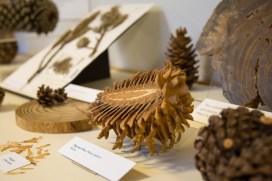
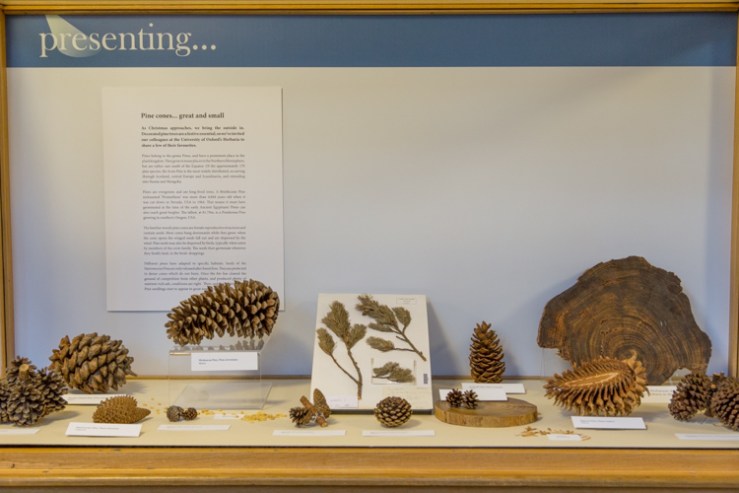
As Christmas approaches, we bring the outside in, with decorated pine trees a festive essential. This seemed like the perfect opportunity to invite our colleagues at the Herbaria to share a few of their favourites, by installing a display in our Presenting… case. James Ritchie, Herbarium apprentice, revealed the story behind these fabulous pine cones.

IMG_4249Pines belong to the genus Pinus, and have a prominent place in the Plant Kingdom. They grow in many places in the northern hemisphere, but are quite rare south of the Equator. Of the approximately 170 pine species, the Scots Pine is the most widely distributed; occurring through Scotland, central Europe and Scandinavia, and extending into Russia and Mongolia.
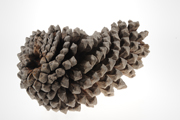
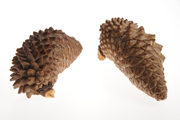
Michoacan Pine cone
Michoacan Pine cone

Pines are evergreens and are long-lived trees. A Bristlecone Pine nicknamed ‘Prometheus’, was more than 4,844 years old when it was cut down in Nevada, USA in 1964 . That means it must have germinated at the time of the early Ancient Egyptians!

Pines can also reach great heights. The tallest, at 81.79 m, is a Ponderosa Pine growing in southern Oregon, USA.

The familiar woody pine cones are female reproductive structures and contain seeds. Most cones hang downwards while they grow; when the cone opens the winged seeds fall out and are dispersed by the wind. Pine seeds may also be dispersed by birds, typically when eaten by members of the crow family. The seeds germinate wherever they finally land, in the birds’ droppings.

Narrowcone pine cone

Different pines have adapted to specific habitats. Seeds of the Narrowcone Pine are only released after forest fires. They are protected in dense cones which do not burn. Once the fire has cleared the ground of competition from other plants, and produced plenty of nutrient-rich ash, conditions are right for the Narrowcone Pine seedlings to flourish.

You can see the pine cones on display in the Museum until early in the New Year. Next in the Presenting... series will be a special selection of insects collected by none other than Charles Darwin – on show from 10th January.

Rachel Parle, Interpretation and Education Officer