When is a kiwi not a kiwi?

IMG_8129

by Mark Carnall, Collections Manager, Life Collections

When is a kiwi not a kiwi? Aside from when it is a fruit, of course. I was prompted to ask myself this question when I received an email from Rod Forder after a visit to the Museum last year. Rod and his wife were visiting from New Zealand on holiday and described the Museum as perfect, with one exception:

Unfortunately  I must take issue with one exhibit, the New Zealand Kiwi bird.

It is displayed standing up straight up in the air. This posture is totally wrong for a Kiwi. If you were ever lucky enough see one in real life or on any photo of one, they are always bending down with their beak in the ground searching for food.

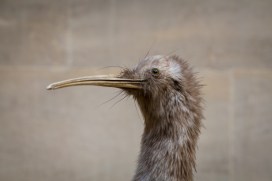
Below is an image of the Southern Brown Kiwi taxidermy we have on display and a photo of a living one for reference. As Rod points out, it has been mounted in a very un-kiwi-like pose, resembling a wingless heron or a penguin more than the animal it’s supposed to represent.

The Museum's Southern Brown Kiwi
The Museum’s Southern Brown Kiwi

By Glen Fergus (Own work, Stewart Island, New Zealand) [CC BY-SA 2.5 (http://creativecommons.org/licenses/by-sa/2.5)], via Wikimedia Commons
Southern Brown Kiwi in the wild. Credit: Glen Fergus (Own work, Stewart Island, New Zealand) via Wikimedia Commons
Why might this be? The reason might be because a lot of early taxidermy, particularly animals new to science from Australia, New Zealand and South America, had never been seen by the taxidermists in Europe who were making these preparations. A quick search on the Internet today will bring up hundreds of images of kiwis in their natural habitat, but in the past taxidermists would have been working from written descriptions, drawings and widely reproduced prints of exotic animals, which themselves may not have been made from life study of the animal.

This specimen was given to the museum in 1934 from the Natural History Museum in London and sadly we don’t have any further information about when this specimen was prepared or who prepared it. But the position almost perfectly matches widely circulated illustrations of the kiwi from the 1830s. Interestingly, in the book A History of the Birds of New Zealand, one of the seminal volumes of New Zealand birds, published in 1873, kiwis are illustrated in much more lifelike positions. Presumably, this specimen must date back to before then.

In particular, older museum preparations of Australasian animals tend to be very oddly shaped, as the strange animals were so unlike the European fauna that it was hard to fathom birds and mammals. This is why you might find rabbit-like kangaroos, dog-like wombats and indeed heron-like kiwis.

However, this example and Rod’s email raise some interesting questions about how we display historically inaccurate animals in the Museum, if at all? Is the history of reconstructing animals as important as the facts we normally present? Is this specimen misleading even if we carefully label it as inaccurate? Should a natural history museum only display accurate specimens, in which case what should we do with the grimacing bats, boss-eyed badgers and podgy armadillos?
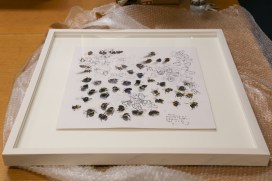
The calm before the swarm

IMG_7427
Juliet and Pete painting wooden panels ready to hang Kurt’s work

In just 24 hours, our brand new exhibition will be open to the public. Bees (and the odd wasp) in my bonnet has been over a year in the making, but it’s all finally falling into place and an unexpected calm has set in.

The exhibition is an arts/science collaboration, with vibrant artwork by Kurt Jackson alongside bee specimens from the Museum’s collection and the latest scientific research on threats to British bee populations. Pop in and see it between 18 March and 29 September.

But let’s lift the gallery barrier and take a peek at some of the hard work that goes into putting an exhibition like this together.

IMG_7586
One of Kurt Jackson’s paintings is unwrapped

Back in November 2014, we first met with Kurt Jackson to discuss a new direction in his work. Famous for dramatic, dynamic landscape paintings, he had recently become particularly fascinated by bees.

He thought the Museum would be the perfect place to exhibit his new paintings and sculptures and, of course, we agreed.

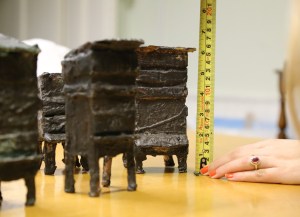
Measuring 'Hives' bronze sculptures
Measuring ‘Hives’ bronze sculptures

Fast forward 15 months and these works arrived at the Museum, couriered all the way from Kurt’s home and studio in Cornwall. We then spent several days unpacking, measuring, examining and photographing each of the pieces.

When the Museum takes on loan items, we need to fill in object condition reports so we can be sure how they come into the building… and how they leave at the end of the show! With 57 pieces to work through, it was a painstaking process, but we all relished the opportunity to get up close to the beautiful artworks. Holding them in our hands and visualising them on display was a special experience.

Examining the back of one of the largest paintings in the exhibition, "Vespa".
Examining the back of one of the largest paintings in the exhibition, “Vespa”.

While Kurt was painting, drawing and sculpting to create these works, we were also working hard preparing the exhibition space to show them off. Pete Johnson and Adam Fisk, from the Museum’s workshop, created large wooden panels to hang paintings, installed all sorts of intriguing 3D works and suspended fabric banners, to name but a few challenges. They’ve done a great job in creating a contemporary art gallery space in a Victorian museum.

IMG_7842
One specimen for each of the 270 British bee species

Bees are fascinating for artists and scientists alike. The scientific specimens and text panels interspersed among the artworks draw attention to the amazing diversity of British bees (almost 270 species in total) and explore the causes of population decline.

This was put together by James Hogan, in our Life Collections, but included further expert advice from Professor Dave Goulson of the University of Sussex and Professor Charles Godfray of Oxford University, to ensure all of the research was accurate and right up to date.

As we tick off the last tasks on our to do list, I can’t wait to see the exhibition buzzing with visitors from tomorrow morning.

Rachel Parle, Interpretation and Education Officer

Introducing Steven Matthews

Poets in Residence header image

As mentioned in a blog post a little while ago, we’ve launched Visions of Nature, a special programme of exhibitions, talks and workshops by artists and writers whose varied work celebrates the natural environment. Things will come and go throughout 2016 but one thread will weave throughout the season – our Poets in Residence.

We welcome three poets, who will work alongside staff in our collections and out in the Museum itself to gain inspiration for their writing: John Barnie, Steven Matthews, and Kelley Swain.

But as the poets begin exploring the possibilities of their residency, we’ve asked them each to introduce themselves. The final ‘hello’ comes from Steven Matthews.

**

Steven MatthewsAs a poet, I am particularly drawn by the interconnections we have with place, landscape, the shifting tides and weather, and their encapsulation in literature and art across history. My book Skying (Waterloo Press, 2012), for instance, comes back repeatedly to the work, and working practice, of the painter John Constable, who is a presiding spirit in the North Essex-Suffolk countryside near where I grew up.

‘Skying’ is Constable’s own word for the exhilaration of artistic creation – yet an acknowledgement also that creation of any kind is about ‘conquering difficulties’. I take it that those difficulties are to do with the medium, partly; the struggle with, in his case, the rendition of complex light and shadow, cloud-movements, perspectives across flat vistas of landscape, with oil paint as an awkward medium for capturing a moment in time.

For the poet, those difficulties are similarly with the medium – the struggle with words and form to capture the shifting moods inspired by landscape and family, the struggle to write directly and deeply about our relationships to the world when that world itself has become sensationally pixel-thin.

It is therefore a particular and a humbling thrill to be a poet-in-residence for what I see as the indoor-outdoor world of the ‘Visions of Nature’ project at the Oxford University Museum of Natural History. The building itself, with its iron-arched interior courtyard roof, gives the impression of an exposed nature caught beneath changeable skies.

My first experiences of the collections have been of their overwhelming abundance and of their daunting history, from insects captured by Charles Darwin on his Beagle voyage, to a new find of an immense sea-dinosaur, a plesiosaur, which we were privileged to see being cleaned. I have seen thousands of beautiful butterflies, hundreds of miraculously-coloured marble slabs, eerie animals in spirit jars.

The Museum building's natural forms are a source of inspiration for Steven.
The Museum building’s natural forms are a source of inspiration for Steven.

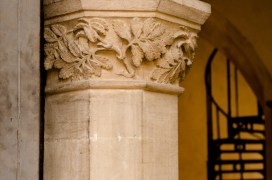
What strikes me so far most strongly, though, are the shapes and forms all around the museum. And the juxtapositions of these shapes, which force their own rhythms. The Gothic arches against the angled diamonds of the glass in the courtyard roof; the straight lines of the lovely old display cases against the whirls and whorls of ammonites and stone carvings of plants on columns.

I’m looking forward to the difficult task of trying to capture something of those juxtapositions, and of those exciting shapes and stories, in the architecture of new poems.

Introducing Kelley Swain

Poets in Residence header image

As part of our Visions of Nature programme, we will be joined by three poets in residence: John Barnie, Steven Matthews, and Kelley Swain. They will work alongside staff in our collections and out in the Museum itself to gain inspiration for their writing.

As the poets begin exploring the possibilities of their residency, we’ve asked them each to introduce themselves. Here we meet Kelley Swain, a poet, writer and editor, particularly in art-science crossover genres.

**

My first collection of poetry grew out of spending my final year of university in the zoology and biology laboratories – even though I was completing a degree in English. Darwin’s Microscope was published by Flambard Press in 2009, two years after I graduated, and I was fortunate to take part in many ‘Darwin 200’ celebrations, events and readings.

Kelley2This led me to fashion a niche as a ‘science poet’, and I spent four years volunteering as Poet-in-Residence at Cambridge University’s Whipple Museum of the History of Science, running public engagement events for the Cambridge Festival of Ideas and Cambridge Science Festival each year. Being affiliated with the Whipple also contributed to my first novel, Double the Stars (Cinnamon Press, 2014) about the Georgian astronomer Caroline Herschel.

For my next book, I immersed myself in the science of human anatomy, writing a verse drama, Opera di Cera, about the famous, life-sized anatomical wax Venus in the Florentine Museum of Physics and Natural History. The Museum opened in 1775, and the Venus, along with hundreds of other anatomical waxworks, are still in situ today, used as training tools for medical students, and serving as marvellous examples of artistic sculpture and the history of medicine. Opera di Cera won the Templar Poetry Prize in 2013, and was published in full by Valley Press in 2014. A long-term aim is for it to become a real opera, and I’ve met a marvellous composer who is keen to make this happen.

It was particularly significant to be invited as one of the Poets-in-Residence for Visions of Nature. I feel no more at home than in a Museum of Natural History, and after my time at Cambridge, it felt very special to be invited to get to know Oxford University better. The unique smells of the Museum’s Spirit Stores and specimen cabinets are – perhaps oddly – incredibly comforting and familiar, whispering of care, of travel, and of old knowledge patiently waiting to be unwrapped.

A good natural history museum is a microcosm of the world itself, and like Darwin preparing to set sail on the Beagle, I’m excited about the year ahead – what treasures will I find in the ship of this Museum of Natural History, and who will I meet along the way? I’m especially interested in botany, geology, cetaceans and cephalopods, but open to inspiration from any perspective.  Let’s set sail!

Introducing John Barnie

Poets in Residence header image

As mentioned in a blog post a little while ago, we’ve launched Visions of Nature, a special programme of exhibitions, talks and workshops by artists and writers whose varied work celebrates the natural environment. Things will come and go throughout 2016 but one thread will weave throughout the season – our Poets in Residence.

We welcome three poets, who will work alongside staff in our collections and out in the Museum itself to gain inspiration for their writing: John Barnie, Steven Matthews, and Kelley Swain. In the autumn, they will take part in a number of events and activities to present their work, and will be publishing a small anthology at the end of the year.

But as the poets begin exploring the possibilities of their residency, we’ve asked them each to introduce themselves. First up is John Barnie, poet and essayist from Abergavenny, Monmouthshire.

**

I grew up in a small market town in the Usk valley at the edge of the Black Mountains, a place of rivers and streams, hill farms and upland moors, which shaped me both as a person and as a writer, for though I spent some twenty years living in cities, I was always drawn back to the only world in which I truly felt at home. It eventually became the deepest source for the kind of poetry I write.

John Barnie
John Barnie

I was educated in the Humanities but sometime in the 1980s it dawned on me that my ignorance of science was an appalling gap in my knowledge, and I spent many years reading around in evolutionary theory, palaeontology and especially palaeoanthropology which fascinated me, and continues to do so. Inevitably, this was very much the reading of an amateur, but it opened new ways of thinking for me about the evolution of humans and what that evolution means for our ability to solve the global crises we currently face. Understanding something of the history of life on Earth also gave me new perspectives on religion and its role in human affairs.

Digital reconstruction of a 425 million year old pycnogonid (sea spider), Haliestes dasos, from the Silurian Herefordshire Lagerstätte
A fossil that John saw behind the scenes: Digital reconstruction of a 425 million year old pycnogonid (sea spider), Haliestes dasos.

The opportunity to be a poet in residence at the Museum of Natural History is something I had never anticipated. Judging from my visits to the Museum so far, the experience is likely to lead me in new directions in my writing. It has been extremely interesting to go behind the scenes of the Museum’s public façade to get a sense of the extraordinary array of natural treasures that it holds, and even more so to be introduced by some of the scientists to their research — to follow the patient re-creation of a fossil sea-spider from a lagerstätte, for example, as a three-dimensional image on a computer, revealing the long-dead animal in the finest of detail.

Already my head is buzzing with images, impressions, and ideas, and I know that this is going to be an exciting year which may take me in directions I hadn’t previously thought possible.

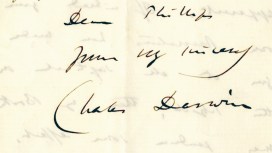
“My dear Phillips…”

Phillips_Darwin9001_signature

Today, across the world, a birthday is celebrated. It’s that of Charles Darwin, perhaps the best-known naturalist to have ever lived, and he would have been 207 years old this year. This Darwin Day, Kate Diston, Head of Archives and Library shares a very special letter from the man himself.

**

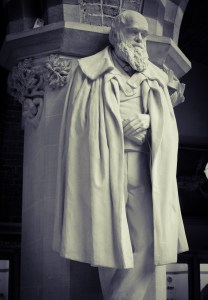
The Museum's statue of Darwin
The Museum’s statue of Darwin

In 1859 Darwin published his best-known book, On the Origin of Species, which presented his theory of evolution for the first time. While his book caused quite a stir, Darwin’s conclusions were the result of years of travel, observation and communication with other scientists in various fields.

One of those scientists was Oxford Professor of Geology, John Phillips. In 1859, Phillips was overseeing the final stages of the construction of this Museum, before taking up the position as its first Keeper.

A record of correspondence between Darwin and Phillips was recently rediscovered in the archive and highlights an interesting relationship between the two iconic men of science. Strikingly, the letter was sent less than two weeks before ‘On the Origin of Species’ was to be released.

I fear that you will be inclined to fulminate awful anathemas against it.

John Phillips
John Phillips, a few years after the book’s publication

Darwin knew that Phillips was not going to like his book. He had corresponded with him over many years about geology, recognizing that Phillips was one of the leading minds on the geological timescale. Phillps’ work had provided him with an understanding of the potential age of the Earth, and the implications this may have had on his theories. Phillips, however, would remain a man of faith.

Yours very sincerely

While Darwin knew that Phillips was not necessarily going to take his work at face value, it is clear from the letter that Darwin respected him immensely. This letter is almost a perfect snapshot of what was happening in science at that precise moment in history. Darwin’s book was about to call into question not just what was commonly understood about the natural world at the time, but also the very core of beliefs for most of society.

It is also a letter that reminds me how remarkable the collection I have the privilege to care for really is.

Kate Diston, Head of Archives and Library