As part of the Museum’s Visions of Nature year in 2016, we have had the pleasure of hosting three poets in residence: John Barnie, Steven Matthews, and Kelley Swain. During the year the poets worked alongside staff in the collections and out in the Museum itself to gain inspiration for their writing. A small anthology of the resulting poetry is published at the end of 2016.
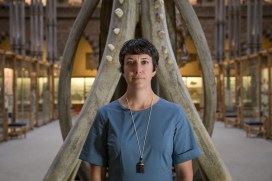
In this video Kelley Swain reads two of her poems To The Palaeontologists and Rorqual. Kelley is a poet, writer and editor.
You can meet Kelley at the Museum for National Poetry Day on Thursday 6 October 2016.
As part of the Museum’s Visions of Nature year in 2016, we have had the pleasure of hosting three poets in residence: John Barnie, Steven Matthews, and Kelley Swain. During the year the poets worked alongside staff in the collections and out in the Museum itself to gain inspiration for their writing. A small anthology of the resulting poetry is published at the end of 2016.
In this video John Barnie reads his poem The Grand Concourse, inspired by the Museum’s main space. Listen out for other references to the Museum in the poem. John is a poet and essayist from Abergavenny, Monmouthshire.
You can meet John on National Poetry Day on Thursday 6 October 2016, when he will be at the our special event during the morning.
I have recently finished my PhD in the Department of Biochemistry at the University of Oxford, working under the supervision of Alison Woollard (Royal Institution Christmas Lecturer in 2013). I specialised in a species of very small (1mm long) nematode worm called Caenorhabditis elegans. These animals may sound exotic, but in reality, they are found at the bottom of nearly every garden in the world. Intriguingly, the worms’ characteristics vary according to their nationality: those found in Hawaii tend to be more promiscuous than their British counterparts, and Australian worms contain a mutation that not only makes them more social, but also increases their alcohol tolerance.
In this short video you can see worms crawling around under a dissecting microscope, which is how we visualise them. The biggest worms you can see are, in fact, only 1mm long! The worms eat bacteria (E. coli, non-pathogenic), which is growing in this petri dish full of bacteria.
The great thing about these worms is that they’re in many respects like small humans: they have a nervous system, a gut, muscles, skin, stem cells, and in addition they sleep and even grow old in much the same way we do. How do you spot an old worm? Like us, they get wrinkles and slow down, don’t move as much, and their organs start to fail. However, there are many advantages of looking at all these systems and processes in worms rather than humans – they only live for around 20 days (no waiting around for them to slowly age), they lay 300 eggs in the first few days of adulthood (there are always lots of them to look at), and they’re much smaller, simpler and easier to manipulate. This is not to mention that most humans would probably object to being grown in a lab.
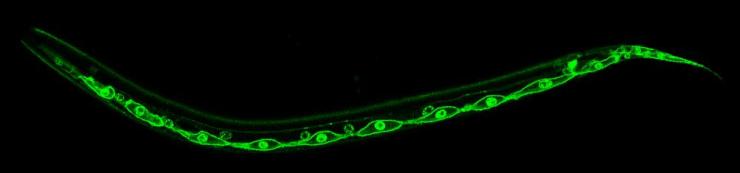
Stem cells visible inside a worm
Recently, I volunteered to bring the worms – and my colleagues – to Super Science Saturday at the Museum of Natural History, during which we explained to families how we use C. elegans to study the genetics of ageing: parents tend to show a particular interest in this topic. Until relatively recently, it was believed that ageing was an inevitable consequence of living – an unfortunate response to environmental stress and general wear-and-tear. Remarkably, it has now been discovered that many aspects of ageing are actually encoded in our DNA: changing just one gene can have a drastic effect, either shortening or extending our lifetime. We can use worms to explore this effect – and we can also use worms to discover new genes and processes that underlie healthy ageing.
Sophie and colleagues at Super Science Saturday, March 2016
Being able to demonstrate this rapidly expanding research field – as well as the worms themselves – to the public, especially to children, allows people to learn enough about biology to appreciate both its social and economic value, as well as giving us as scientists an invaluable insight into why our research is important. Next time, however, I might include a new warning sign for the microscope: “Look, don’t lick!”
Over the past six months we’ve been trying something new at the Museum, working with an enthusiastic group of young people who have come to call themselves The Dodo Crew. Otherwise known as the Museum Youth Forum, the group meets up with us once a month to discuss ideas, plan events, see the collections, and generally have a dialogue about the Museum and its activity.
The Crew is made up of eleven 14-19 year olds who are already passionate about natural history and we’re really pleased to have them on board. Many museums across the UK run youth forums to engage the young people within their community, who are often underrepresented in museum audiences.
In fact, I was on a Museum Youth Forum at Norwich Castle Museum and found the experience very valuable as I had the opportunity to express my opinion, contribute and be part of a community, and make new friends. The group also enabled me to find my passion for working in museums, which I did not get from formal education or at home.
By joining the forum our Dodo Crew gets a chance to be involved in what we do as a museum, which I think is very important. And it will hopefully help us to be more successful in attracting people aged 14-19 years.
Going behind the scenes is great- seeing objects and talking to people.
It really felt like a unique opportunity and made me feel special.
Members of the Dodo Crew get down to some planning in the Museum court
So what exactly have we been doing? The Crew has been enjoying taking part in various activities, from live animal handling and taxidermy demos, to planning events and meeting scientists. They will also be helping with programmed events, designing their own events, contributing to temporary exhibitions, and much more.
And their very first event is this Saturday 16 April, all about skin and bones. Everyone is welcome between 2-4pm, so come and meet the Dodo Crew and see their great ideas in action (and if that doesn’t entice you, there will also be a live chameleon!).
Getting up close and personal with a friendly skunk
We recently hosted freelance photographer Asher Svidensky for a free public lecture at the Museum, on 16 March 2016, in a talk about photography, people, storytelling, fish, fire, and some rather impressive birds.
Asher’s work has been featured by National Geographic, the BBC, the Guardian and many other media outlets, and includes projects on Mongolian eagle hunters, Yin-Bou fisherman, and the Miao ‘goddess’ in China. The talk offered a good opportunity to hear Asher discussing some of these projects, talking about his methods, and explaining why he thinks photography can be the “eye candy” which lures you into the fuller story.
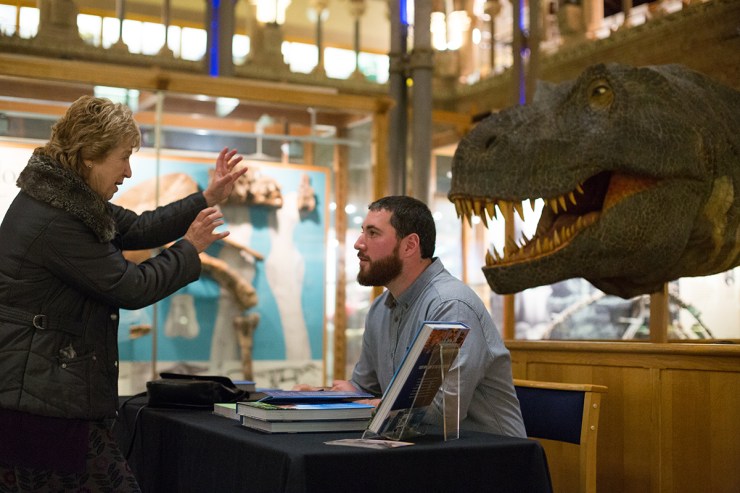
Asher Svidensky chats with a visitor after his talk at the MuseumAs a photographer and sometime journalist I found this a refreshingly honest appraisal of the types of images he is making: sumptuous, atmospheric, pooled with light and colour, and beautiful, but ultimately designed to make you swoon a little.
Rather than big up his photographic prowess, Asher instead presented his photography mostly as a means to an end. It is the people and their stories, he explained, which interest him more than photography, but striking imagery attests to a strong story.
Some photographers take a lot of time and effort into getting to know the people they are photographing; into creating those relationships and creating the understandings and learning about the culture so they can get more from it and make a better image.
So the image stems from the photographer’s submersion in people and culture, or in the ‘story’, and then itself becomes the route into that story for the reader – the irresistible “eye candy” that whets your appetite. On a slightly less adventurous level we aim to do the same with the natural history collections images on this blog.
This year promises to be a little bit different. We’re looking at the Museum and its collections from a new point of view – through the eyes of artists, photographers and writers. We’re presenting different ‘visions’ of the natural world in a series we’ve called Visions of Nature. With a title borrowed from John Ruskin, there’s a definite nod to our Pre-Raphaelite roots, but there will be plenty of opportunities for an up-to the minute look at natural history, too. Here’s a few more details about what we’re planning…
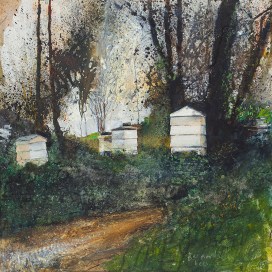
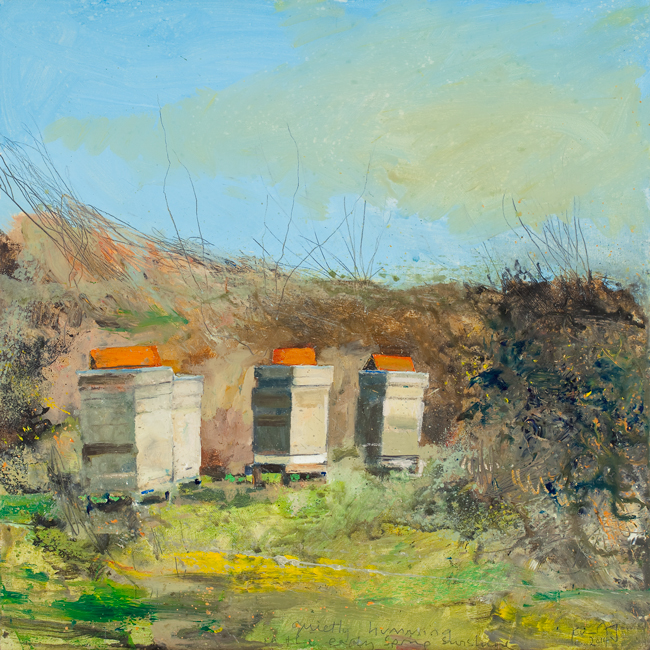
Kicking off this year’s exhibition programme will be a brand new show from artist Kurt Jackson. You may know his dramatic landscapes or even his work as artist in residence at Glastonbury, but this time, insects are the focus for his brush, pencil and chisel.
In Bees (and the odd wasp) in my bonnet, we’re bringing together Jackson’s beautiful paintings, sculptures and sketches with specimens from the Museum’s enormous bee collection and the latest contemporary research into bee population decline.
At the moment we’re choosing which specimens to include and are eagerly looking forward to a trip down to Kurt Jackson’s home in Cornwall to collect the artworks. With each bee pinned in place and every last painting hung perfectly, we’ll be opening the exhibition on Friday 18th March. There are lots of exciting events focussed around bees, too – including a special tour and talk by Jackson himself and a workshop run by a local beekeeper that describes how a bee colony changes over the course of a year. You can book a place on these and more here.
Next up will be Microsculpture; The insect photography of Levon Biss. This really will make you see insects in a different light, with 10mm specimens blown up to 3m prints, all on display in the Museum court. Over the last couple of years, Levon, who is famous for dramatic photographic portraits of sports, music and film stars, has been working with James in our Life Collections team to select bizarre and beautiful insects. The result is a collection of beautifully-lit, high magnification portraiture that celebrates the amazing diversity of the insects and their morphology.
The final third of the year will be centred around a literary vision of nature. We’ll be collaborating with some of our favourite natural history writers from the worlds of fact and fiction to offer an exciting programme of talks, debates and workshops. Key to this part of the year will be our poets in residence. Throughout 2016, three poets, John Barnie, Steven Matthews, and Kelley Swain, will be working alongside staff in our collections and out in the Museum itself to gain inspiration for their writing.
In the autumn, they will take part in a number of events and activities to present their work, and will be publishing a small anthology at the end of the year.
With plenty of other ideas in the mix, including exhibitions by Oxfordshire artists and photographers exploring the natural world and even a possible comedic vision of nature, there’s far too much to include here. So, there’s a dedicated Visions of Nature site, where you can find out about the poets’ latest inspiration, which exhibitions are opening soon, and what events you can sign up for. An exciting year ahead!






 The Crew is made up of eleven 14-19 year olds who are already passionate about natural history and we’re really pleased to have them on board. Many museums across the UK run youth forums to engage the young people within their community, who are often underrepresented in museum audiences.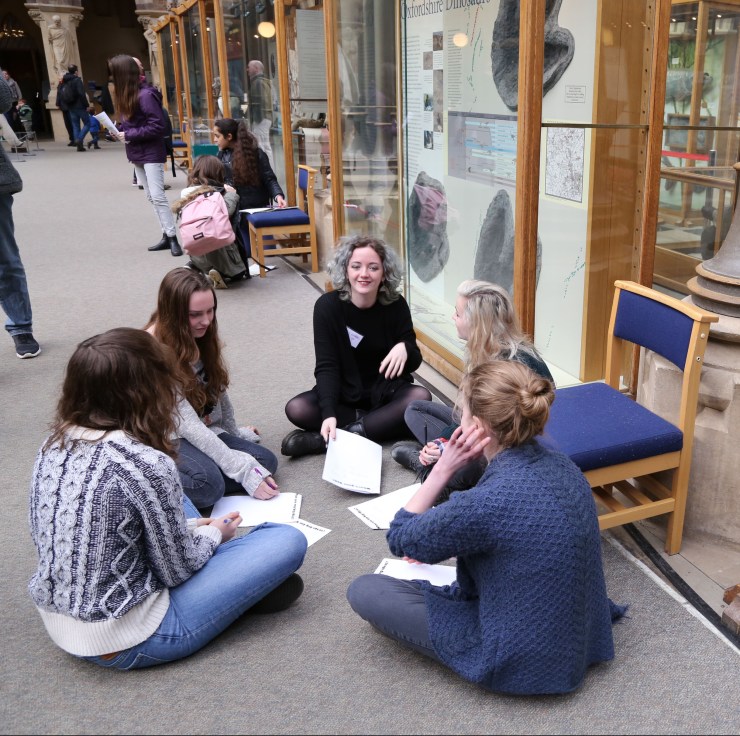






 The final third of the year will be centred around a literary vision of nature. We’ll be collaborating with some of our favourite natural history writers from the worlds of fact and fiction to offer an exciting programme of talks, debates and workshops. Key to this part of the year will be our poets in residence. Throughout 2016, three poets,
  More Than A Dodo