As you can tell from the adornment of our Red Deer, Christmas is upon us, so it’s nearly time to bid farewell to another year. It’s been another remarkable twelve months here at the Museum so here’s a little round up a few highlights from 2015…
As winter gave forth to spring News emerged of a heartwarming thing The Art Fund whispered in our ear
We were nominees for Museum of the Year!
Although eventual winners we were not
It mattered really not one jot
For in celebration we embarked
On the Dodo Roadshow – a tremendous lark
Back in April we’re pleased to say Another award came our way Goes to Town gave creatures free reign
And grabbed a gong for Marketing Campaign
But we weren’t always on the road
In our exhibitions many stories were told
Of evolution, geology and sensory powers
Science and research passed the visitors’ hours
Our doors were open without interruption
While out on the lawn was a volcanic eruption
University scientists had plenty to say
On a really Super Science Saturday
So to our schools, and families, and adults and more
Thank you, cheers, and thank you some more
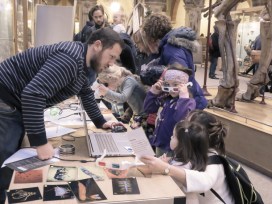
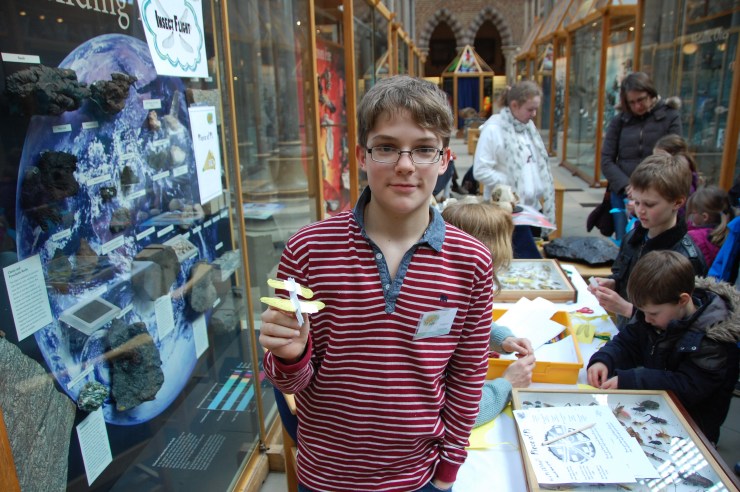
On Saturday 28 November we held the first of our new Super Science Saturdays events – a mini science fair for all the family.
The first event was Earth-themed, and featured many stalls about geology, geography and the natural environment – everything from fossils to earthworms!
Visitors got the chance to chat to University of Oxford scientists, meet people from wildlife organisations, and get their hands on specimens from the Museum collection.
Super Science Saturdays is a souped-up version of our regular Science Saturdays events, where scientists from the University help visitors investigate natural history specimens.
We recently ran a second series of taxidermy workshops here at the Museum, run under the expert guidance of professional taxidermist Derek Frampton. Once again they proved very popular with participants, so we asked one of those budding taxidermists, Kit Collins, to give us a short write-up of the day…
As a child I was always fascinated by nature, finding adders, baby hares, grass snakes, slow worms, and watching dolphins, buzzards, and Red Kites, when they were much rarer. I even once skinned a mouse that had been caught in our mouse trap.
I have always wanted to try taxidermy and I now work at an auctioneers where I regularly see all sorts of taxidermy – skins, horns, and skulls, including a hippopotamus skull. So I was keen to know more about the process. This was the first taxidermy course I’ve seen so I jumped at the chance to try something new and learn from an expert taxidermist.
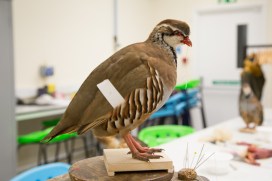
Derek Frampton puts some finishing touches to his partridge
During the workshop we were taken through each step of the process, first watching Derek demonstrating on his bird then copying these steps on our own Red-Legged Partridges.
Kit and his finished specimen regard one another
We could see the finished article that had been made in the previous day’s workshop, sitting watching us on a nearby windowsill. Unfortunately, our specimens looked nothing at all like this at the start and as the morning went by it looked less and less likely that our piece of wet skin and feathers with a few bones attached would end up looking anything like a real bird again…
However, with the help of a blow dryer the feathers regained their soft, striking plumage. We then spent the afternoon piecing the bird back together using a kind of packing straw to recreate the shape of the body, and wire, clay, false eyes, and car body filler to do the rest.
We each ended up with a beautiful bird to take home, as well as the memories of a fun and unusual day out (and anatomy lesson) at the Museum. I would love to do it again.
Handwritten in Stone 9 October 2015 – 31 January 2016
Today sees the opening of our new special exhibition – Handwritten in Stone – celebrating the life and work of William Smith on the bicentenary of his publication of the first geological map of England and Wales.
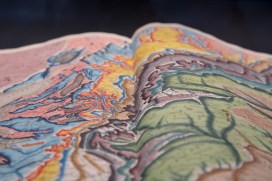
Dubbed ‘The Map that Changed the World’ in Simon Winchester’s book of that title, the beautifully hand-coloured map revealed a three-dimensional arrangement of rock layers, or strata, along with a fourth dimension – time.
This work earned Smith the moniker ‘the father of geology’, an accomplishment all the more impressive given that Smith achieved it single-handedly and with very little formal education.
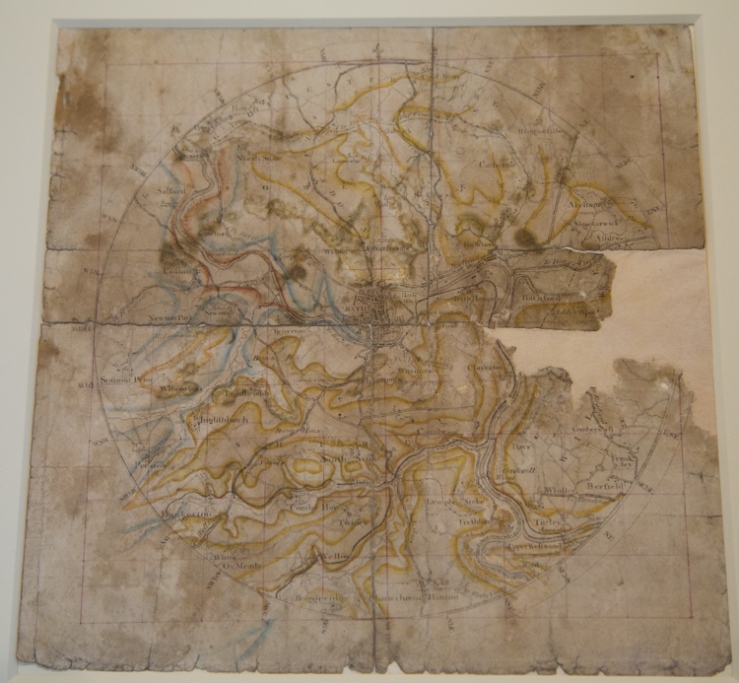
This 1799 map of Bath, on display in the exhibition, is the oldest geological map in the world
The Museum holds the largest archive of Smith material in the world. Alongside the famous 1815 map, shown at the top of the article, are personal papers, drawings, publications, maps and geological sections, most of which are being displayed for the first time. With these we have some fossil material from the collections: Smith realised that particular combinations of fossils were unique to different rock formations and could be used to date the strata.
Design work on the ‘drawing board’, created by Claire Venables at Giraffe Corner. Photo: Claire Venables
Handwritten in Stone, supported by the Heritage Lottery Fund, is the first show in our new special exhibition gallery on the upper east side of the building. Working out how to use the space was a learning process, and the final, elegant design is the work of local consultancy Giraffe Corner.
To bring the final exhibition together we collaborated with writer Rebecca Mileham, an installation team from the Ashmolean Museum, and more than 50 volunteers. Look out for more about the volunteers’ contributions on this blog soon.
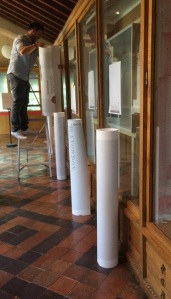
Applying the graphics in the gallery. Photo: Claire Venables
The 1815 map itself takes centre-stage in the exhibition, flanked on one side by the history of Smith’s work building up to its publication, and on the other by the legacy of his techniques, which are still used today.
To discover the full story of William ‘Strata’ Smith head over to the upper east side of the Museum before 31 January.
And don’t forget to look out for our What’s On programme which includes lots of William Smith and geology-focused events, including a public talk by author Simon Winchester on 13 October.
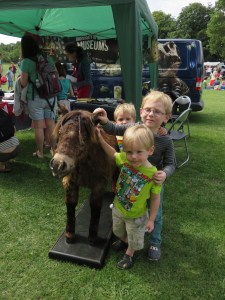
Regular visitors to the Museum will have noticed a certain Shetland Pony hasn’t been seen for a while. After living in Knaresborough Zoo during the 1980s, Mandy went on to spend over 10 years on display as touchable taxidermy – admired, adored and stroked until she could take no more. With the arrival of our new Sensing Evolution displays, it was time for a revamp and Mandy has gone into retirement. But, as our Community Outreach Officers explain, she’s now embarked on a brand new adventure…
**
Mandy hasn’t disappeared! Instead of being in the Museum of Natural History, she now comes out to community family events with Oxford University Museums’ outreach team. This summer she has been all around Oxfordshire at Playdays, organised with Oxfordshire Play Association, and also with us at community festivals such as the Cowley Road Carnival and theLeys Festival. These brilliant indoor and outdoor activities are completely free for everyone to attend.
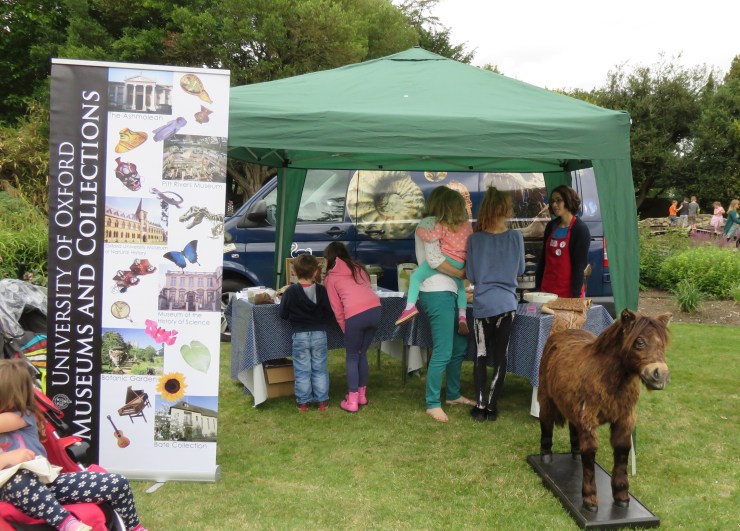
Mandy takes pride of place at an Oxfordshire Playday
Oxfordshire Playdays offer children the support, space and resources to develop play and explore other activities available in Oxfordshire. The carnivals celebrate the places, spaces and communities in which we live, offering people an opportunity to be part of their local community.
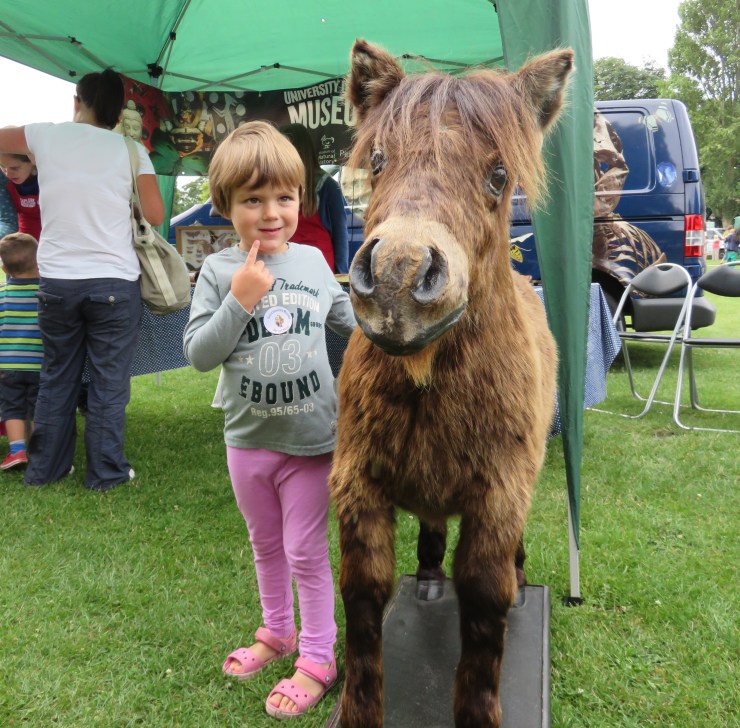
Some of Mandy’s admirers come to say hello
At these events Mandy has pride of place in front of the museums’ outreach gazebo, so everyone can see her. The outreach team represent all the Oxford University Museums and Collections, giving people a flavour of what they can find. So, along with an elephant’s tooth, Megalosaurus footprint and Madagascan Hissing Cockroaches, Mandy comes with us to represent the Museum of Natural History. Once people give Mandy a stroke, they often come and hold a Cockroach or talk to the Outreach Officers about the other objects.
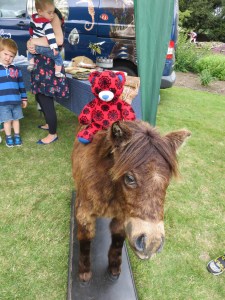
Teddy takes a ride
When parents, children (and dogs!) see Mandy, they are delighted. A lot recognise her from the Museum of Natural History, but others are just drawn to her soft, cuddly fur. Lots of children stroke her, pretend to feed her and put their teddies on her to give them a ride. Often we hear:
It’s the horse from the museum! Is she alive? How did she die? Where did she live?
So Mandy has not been forgotten. Instead she’s roaming Oxfordshire, bringing smiles to lots of children’s faces and has become a very valued member of Oxford University Museums’ outreach team!
Nicola Bird and Susan Griffiths, Community Outreach Officers
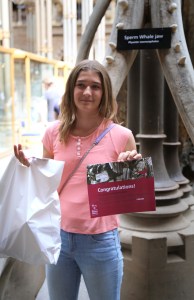
Meet Daisy. She’s a very special visitor. We enjoy welcoming each and every one of the people who come through the doors; from just round the corner or right across the globe. But Daisy stands out because she’s the millionth person to step inside since we re-opened in February 2014. Yes, 1,000,000 visitors in just 18 months! Ready and waiting with certificate and goodie bag, we ambushed the 13 year old and her family as they arrived this afternoon.
Daisy and her brother George have travelled a long way for their first visit to the Museum. They live on the outskirts of San Francisco, California, and are spending summer with their grandparents in Cassington, just outside Oxford. Daisy says she loves exploring the variety of museums in her home town, so was excited to start looking around what she called the “impressive” museum. George (visitor 1,000,001) likes “museums with exciting things”, so we hope he finds enough to excite him here!
Since February 2014, many of our 1 million visitors have joined in with our plentiful programme of public engagement projects. We aim to entice the widest possible range of ages and interests.
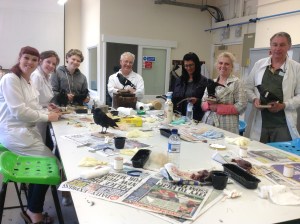
Taxidermy Creations workshop
Hundreds of family friendly events have educated and entertained the little ones, with new programmes for the under 5s and the ever-popular half term extravaganzas.
But the last 18 months has seen much more on offer for our adult audiences. Who says grown-ups don’t like getting messy and making something to take home? The popularity of the taxidermy workshops in June 2014 proved that they love nothing more.
School children have poured in for secondary and primary sessions alike. With evolution now featuring on the primary curriculum, we’ve been working with teachers to support them in this new area and developing a brand new primary workshop called ‘Evolve, Adapt, Survive’.
We know that curiosity doesn’t end when the school bell rings. Natural History Investigators, a new science club for 14-16 year olds, has given young people special access to museum collections and staff expertise on Saturday mornings. Achieving a national Crest Award in recognition of their achievements was the icing on the cake.
Natural History Investigators doing a spot of their own public engagement
Fashion shows, contemporary science lectures and late night pub quizzes were some of the eclectic public events on offer.
So Daisy is number 1 million and we were delighted to meet her today, but she represents all of our visitors. It’s the quality that really matters to us, not just the quantity!
Rachel Parle, Interpretation and Education Officer









 More Than A Dodo