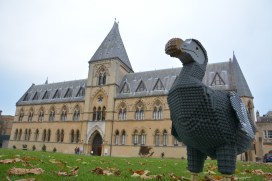
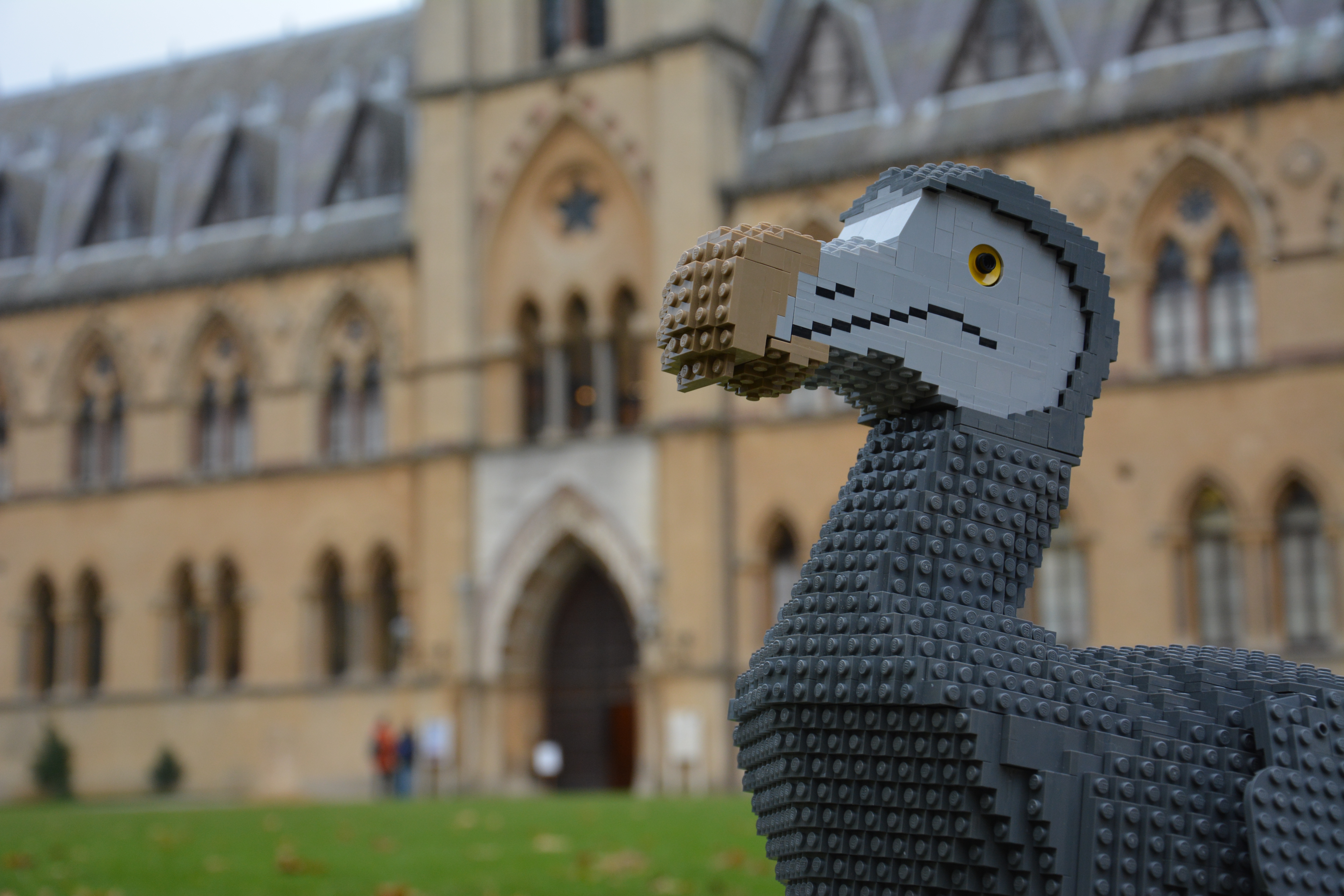
Back in late 2013, I was outside the Museum when I spotted this fantastic Lego dodo standing proudly on the lawn. After speaking to his keepers, I discovered that he was to become part of an exhibition at Milestones Museum in Basingstoke, and this was his publicity shoot. It’s fitting that the Lego dodo came to visit the home of the famous Oxford Dodo; we have the most complete remains of a single dodo anywhere in the world!
The Lost World Zoo dodo on the Museum lawn
Milestones is a living history museum, which is part of the Hampshire Museums service, and has fascinating Victorian streets you can wander and an Edwardian pub you can relax in. The latest addition to the Museum is Lost World Zoo, an exhibition of lifesize Lego models of extinct creatures. You can see giant dragonflies, come face to face with a woolly mammoth and even meet a whole flock of our favourite birds… dodos!
The dodo visits famous Oxford landmarks
They’re also running a variety of exciting family activities, including Lego figurine making. But if you can’t make it to one of those sessions, you could use this great short video to make your own mini dodo.
This weekend is your last chance to walk among these Lego creatures, as the exhibition closes on Sunday 27th April. So get down to Milestones before the dodos disappear again!
Rachel Parle, Interpretation and Education Officer
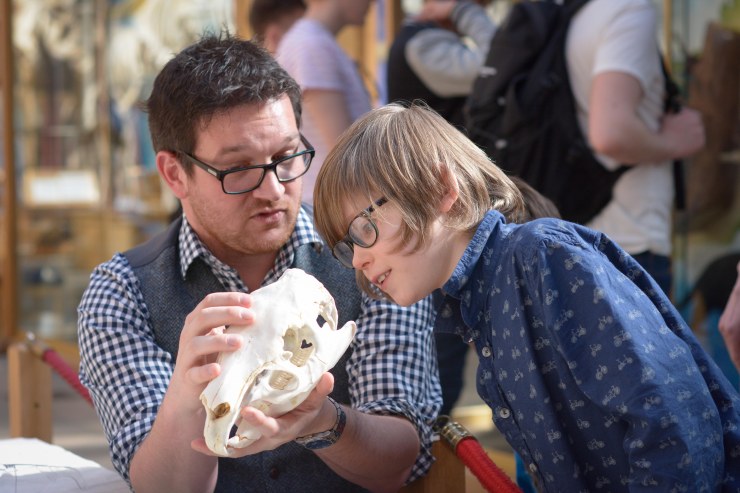
Here’s a little taster of the Capybara Construction event that we held in the Museum last Sunday. Evolutionary biologist and presenter of BBC4’s Secrets of Bones, Ben Garrod, joined our Life Collections conservator Bethany Palumbo and conservation intern Nicola Crompton to attempt the live reconstruction of a capybara skeleton.
This event was part of the week-long Reactions festival – an exploration of science and the arts at the University of Oxford Museums.
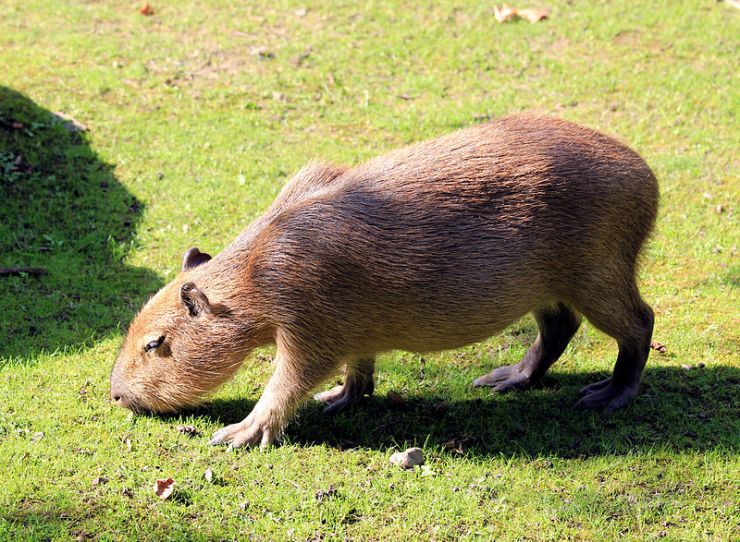
Just in case you don’t know what a capybara is – here’s one. It’s the world’s largest rodent and lives in South America.
We should confess that Ben and Beth did not manage to completely recreate the skeleton, but they had plenty of interesting conversations with visitors about bones, anatomy, capybaras and conservation, so a very successful day nonetheless. Thanks again to Ben for coming along.
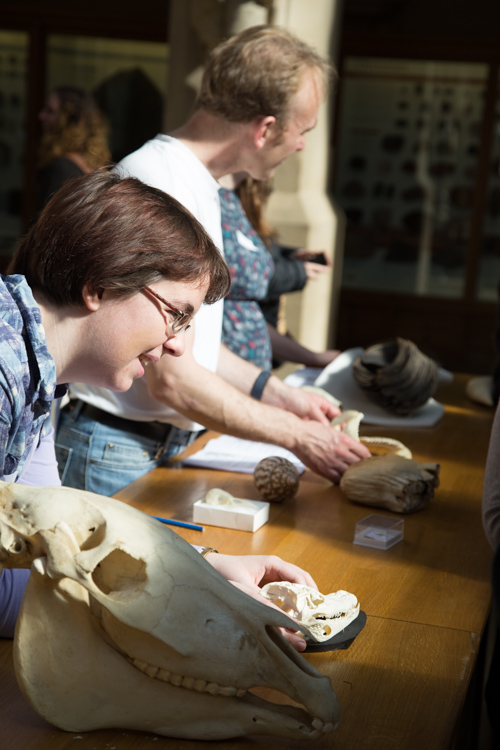
Examining the skull and explaining the capybara jaw movements.
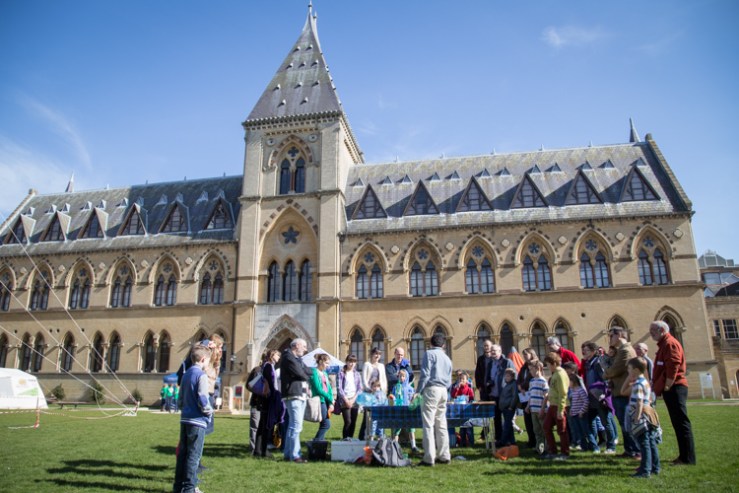
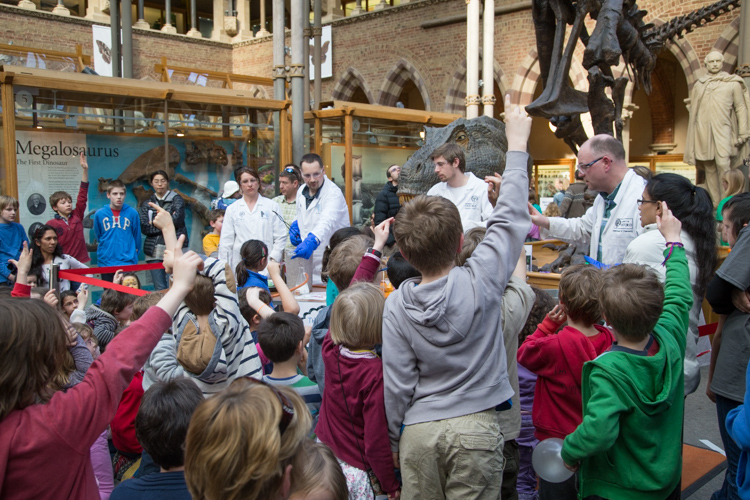
We’re in the middle of National Science and Engineering Week (14 – 23 March), and Oxfordshire Science Festival (7 – 23 March), so it’s not surprising that the Museum has been packed with all sorts of exciting activities. But the big one for us is always our annual Wow!How? family science fair, which took place on Saturday 15 March. With the Museum closure in 2013, it’s had a short break, but the fair returned last weekend with a fizz, pop and a bang!
Volunteers on the What Big Teeth You Have object handling stall
This might have been the tenth Wow!How?, but the set up for such an enormous event never gets any easier. 150 volunteers were involved, running around 40 stalls across the Museum of Natural History and through into the Pitt Rivers Museum.
Education staff Simone Dogherty and Caroline Cheeseman have been working with scientists, staff and volunteers for months to make sure logistics and the all important risk assessments were all under control.
Sally Le Page sets up the forensic science experiments on the Murder Mystery at the Museum stall
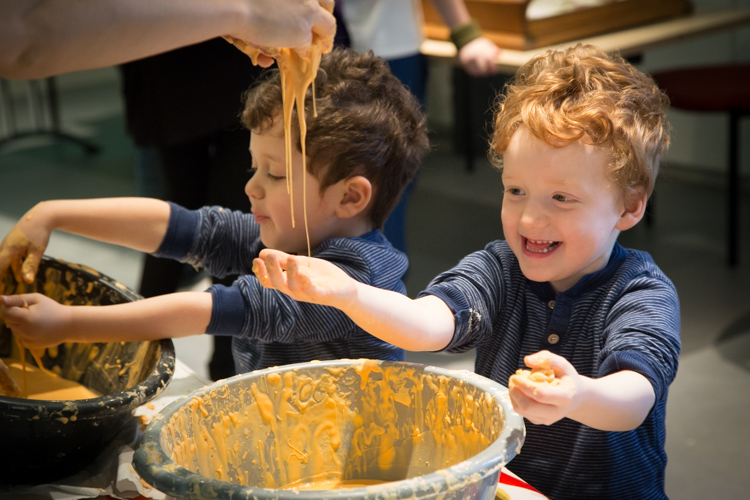
The set up for the fair began a full 24 hours before the event, with most of the Museum’s staff helping to move exhibits and put up tables, gazebos or display stands. Then the scientists arrived with their myriad of exciting and bizarre demonstrations and experiments. From live maggots and rotting meat on the Murder Mystery at the Museum stall, to liquid nitrogen on the Oxford University Chemistry Department’s Supercool Show, or bowls full of custard, there was a lot to think about.
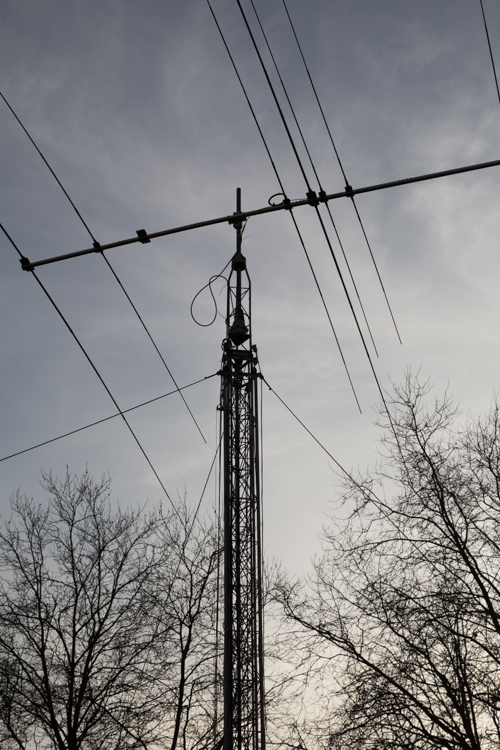
GB4WOW radio mast
There was even a radio mast set up on the lawn, which communicated with radio enthusiasts across the world to tell them all about Wow!How?.
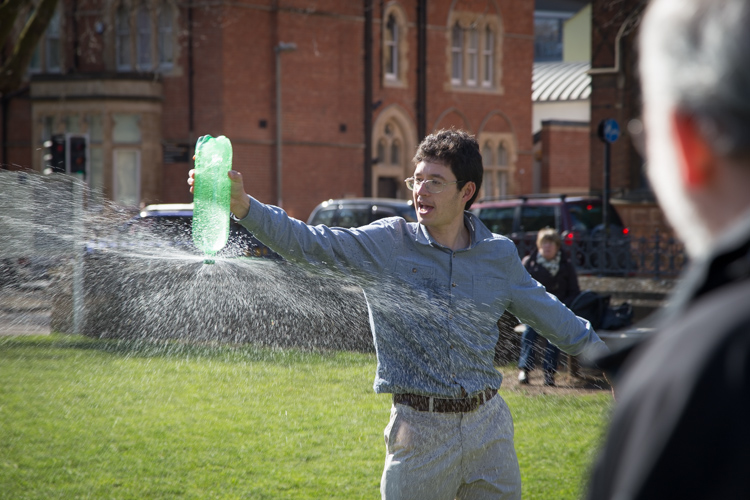
Dr Yan Wong of BBC TV’s Bang Goes the Theory popped up with Street Science – a collection of amazing demos using everyday objects, like setting a bowl full of wire wool on fire using just a battery!
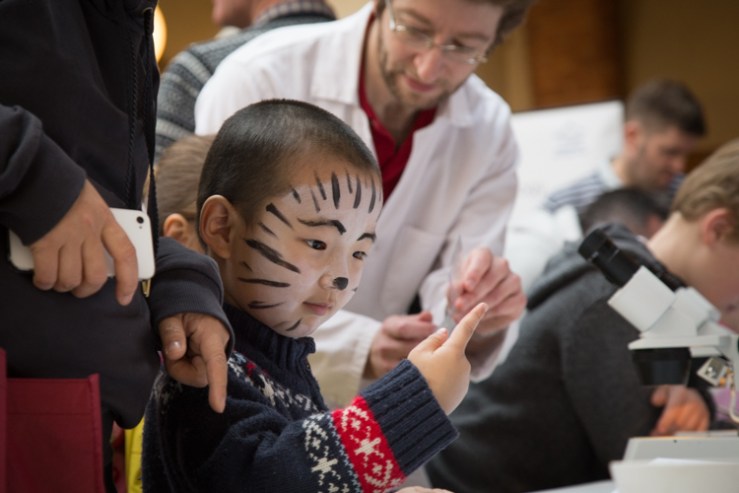
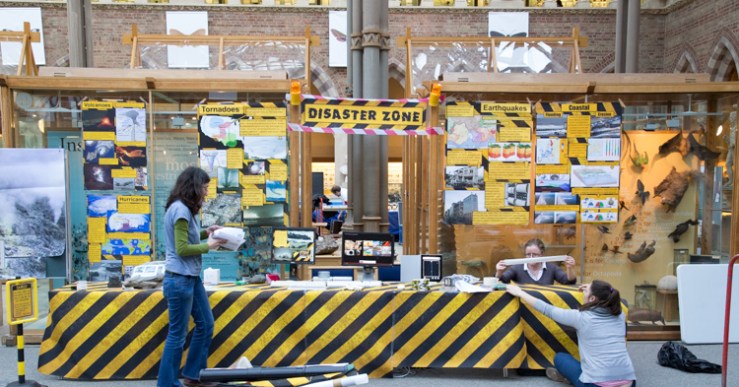
Dr Yan Wong on the Museum lawnThe Supercool Show in actionFacepaints and fingerprintsEarth Sciences Department’s Disaster Zone
On the day itself, 4500 visitors took part in this inspiring and engaging event. Now that the plaster, pipettes and plastic bottles have been put away for another year, Simone has had time to reflect on the success of the event:
Playing with custard is a great way to learn about non-Newtonian fluids
“Wow!How? is very different from the family events we normally run at the Museum of Natural History. Instead of devising and developing the ideas ourselves, we give the opportunity to anyone who is passionate and enthusiastic about science to come up with activities themselves. This means that not only do families get the chance to speak face to face with real scientists, experts and enthusiasts, but also it gives those who really love science the space to talk about what they love best.”
Here’s to next year’s extravaganza!
Rachel Parle, Interpretation and Education Officer
Even the most fleeting visit to the Museum here will reveal the intricate marriage of science and art that the building embodies. Designed by Irish architects Deane & Woodward, the Museum was also influenced by the Victorian art critic and intellectual John Ruskin, whose ideas – and those of the Pre-Raphaelites – promoted art as a form of investigation, a serious study on scientific lines.
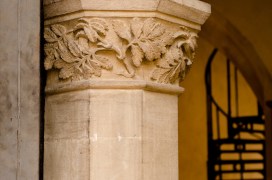
As you look around the building its intricate carvings and the careful selection of materials confirm that the design really was a serious investigation of the natural world, resulting in a beautiful piece of architecture.
Although science and the arts are often seen as the pursuits of opposing camps – one a strict process, the other a free creative expression – the truth of course is that they are intertwined. Science and technology influence and prompt artistic practice, and some of the greatest scientific work is the result of a piece of creative and imaginative flair. Rather than two separate cultures, science and art instead sit on a spectrum of different ways of investigating, and reacting to, the world around us.
Marcus du Sautoy’s talk, The Secret Mathematicians, at the Museum of Natural History on Monday 17 March
Taking this idea, we decided to present a set of events and activities that would explore science and the arts during National Science and Engineering Week and the Oxfordshire Science Festival. It’s called Reactions and is being hosted across all four Oxford University Museums – here, at the Ashmolean Museum, the Museum of the History of Science, and the Pitt Rivers Museum.
Siobhan Davies Dance presents a talk and children’s workshop at the Ashmolean
Running over a whole week, from 15-23 March, the fourteen events in the Reactions programme all address or reflect the connections, opportunities or perceived tensions between science and the arts, some directly, others gently. There’s something for everyone across the week, from a lecture on mathematics and art by Professor Marcus du Sautoy, to a science of pollination dance workshop for children by Siobhan Davies Dance at the Ashmolean, to the live reconstruction of a capybara skeleton by evolutionary biologist and broadcaster Ben Garrod at the Museum of Natural History.
Nathaniel Mann, composer in residence at the Pitt Rivers Museum, presents a performance on Thursday 20 March.
The Pitt Rivers Museum is presenting a performance by its composer in residence, Nathaniel Mann, exploring the science of voice disguisers; and sound artist Ray Lee talks about his fascination with the hidden world of electromagnetic radiation and sound waves, demonstrating the science and philosophy behind his unique installations and strange instruments at the Museum of the History of Science.
Award-winning science filmmaker Sally Le Page offers a workshop for A level and BTEC students at the Museum of Natural History. Contact education@oum.ox.ac.uk to book.
There are family events too – the Wow! How? science fair here and at the Pitt Rivers, and Crystals Day at the Museum of the History of Science.
The full programme lists everything else that is going on and gives links to booking pages for any bookable events. Hopefully you’ll find a few interesting and perhaps thought-provoking things to see and do during the week, all hosted in buildings and collections that themselves reveal many different reactions to the world, both natural and man-made.
Regular readers of our closure blog, Darkened not Dormant, will know all about our Goes to Town project, where twelve plucky specimens escaped from the Museum for an eight month holiday in venues all around Oxford city centre. Like any good treasure hunt, the Goes to Town trail presented a competition which promised a valuable prize…
The framed fragment of roof tile, presented to the Goes to Town competition winners
Each of the twelve specimens carried two ratings, one for Danger and one for Rarity. To enter the competition, trail hunters needed to find all the displays and then tell us which specimen was rated most dangerous and which most rare. The most dangerous was the Snowy Owl, the sharpest living predator on the trail; and the rarest were the animals from Alice’s Adventures in Wonderland which are, of course, completely fictional. If you entered without checking all the specimens and guessed that the Dodo would be the rarest then we caught you out – sorry!
Which is best – piece of glass, or cuddly dino?
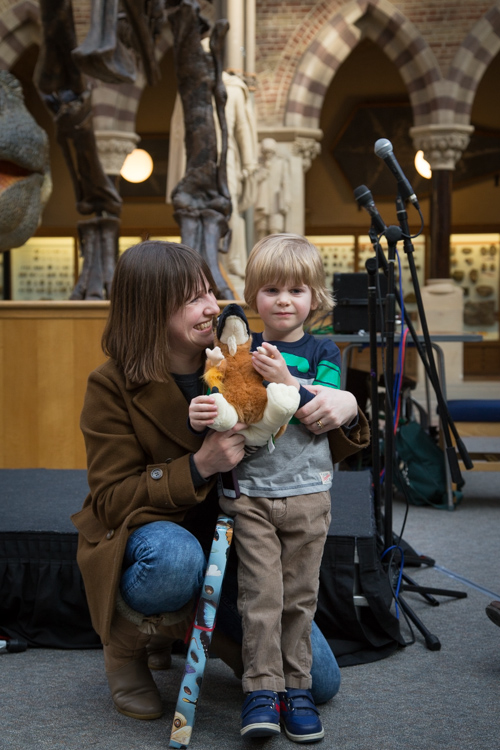
Around 80 people entered the competition and three winners were chosen at random. We held a little award ceremony on our reopening day on Saturday 15 February, where all three winners attended to receive their prizes. And the prizes were quite special. One was a cuddly dinosaur toy (always special, right?) and the other was a small framed, cut fragment of one of the glass tiles from the Museum’s roof.
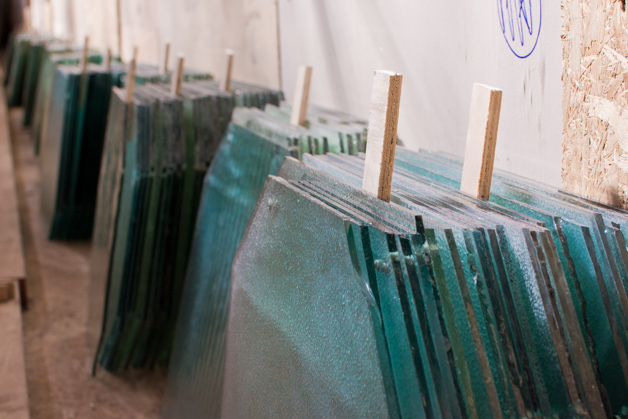
The whole reason for our closure last year was to have the original Victorian roof repaired, so we felt that it was a fitting prize to present a little piece of the fabric of the roof – a little piece of history – to the winners. Congratulations again to the three winners and we hope those small fragments of the Museum are now hanging proudly on three walls somewhere in Oxford.
Adults get the cuddly dino too, of course.Museum director Professor Paul Smith presents the prizes.
What a week indeed. As the dust settles on our reopening celebrations, it’s a chance to step back and regard the blur of activity that has whipped through the Museum since 7am on Saturday 15 February.
As dawn broke on that stormy, flooded, grey and windy morning people were already standing outside in the cold waiting to tuck in to their breakfast bacon bap in the new Museum Café. At first it was a trickle of visitors, but then it was a deluge… People swarmed to the Museum in droves, with more than 5,300 visitors by the end of the first day alone.
One of our more knowledgeable visitors explains the anatomy of a whale to Nicola
The buzz made for a fantastic event, with live music provided by The Alternotives (in full flow in the picture above) and The Knights of Mentis. Staff were on-hand in bright green T-shirts to welcome people and to carry around some intriguing specimens from the collections. There was the ever-popular live bug-handling and generally much merriment occurred.
The frenetic pace continued through the week, with the half-term rush hot on the heels of the reopening day. By the end of the first week more than 30,000 people had been through the doors, which is without a doubt a record for us and way more than we anticipated.
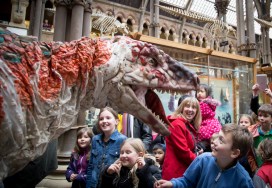
The kids dig Dinosaur Zoo’s Australovenator.
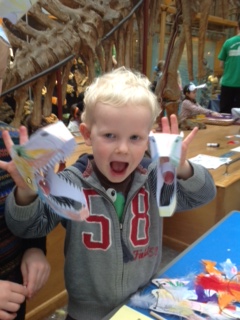
During half term, hundreds of children (and quite possibly a few parents) made Dodo masks and T. rex finger puppets at our Family Friendly activity; then later in the week there was the rather terrifying surprise appearance of creatures from the Dinosaur Zoo stage show. A five metre Australovenator ‘puppet’ marauded through the court, scattering children as it went and earning us a nice spot on the local TV news. The Dinosaur Zoo was visiting the Museum ahead of shows at Oxford’s New Theatre in April, so check that out if you missed the action here.
With around 4,000 visitors a day during the week we have been somewhat taken aback by the enthusiasm that greeted the reopening of the Museum, and at times it has been a struggle to accommodate everyone, especially in the predictably popular café.
T. rex finger puppets!
And with a faulty lift and some plumbing difficulties in the toilets there have been challenges along the way. If you visited and some things weren’t quite working properly, apologies. We have been busily sorting everything out all week, so hopefully the teething troubles have now passed.
Now it’s back to business – no more scaffolding, no more stories from the roof rafters and no more Darkened not dormant, our closure blog. Instead we’ll be telling you about what’s going on at the Museum here, on our new permanent blog. There are lots of events coming up which you might want to come to, but more than that we want this blog to reveal interesting things about the workings of the Museum, from behind-the-scenes and on the periphery of the more visible public events. So stay tuned for that. And if you don’t already, follow our squawks and drop us a line on Twitter @morethanadodo too.














 More Than A Dodo