Bee beautiful

Our conservator Bethany Palumbo tells us how she restored a beautiful 19th-century papier-mâché model of a honeybee hive, created by master model-maker and anatomist Louis Thomas Jérôme Auzoux

Louis Thomas Jérôme Auzoux

Although the Museum’s collections are mostly of organic specimens, we also hold a fascinating collection of scientific models made to represent the natural world, made from all types of materials, from wax and cardboard to plaster and paint.

We are lucky enough to own a model made by esteemed French anatomist Louis Auzoux (1797-1880), who in the late 19th century developed a method of building strong yet light papier-mâché models that could be taken apart and rebuilt, allowing internal elements such as tissues and organs to be studied in detail.

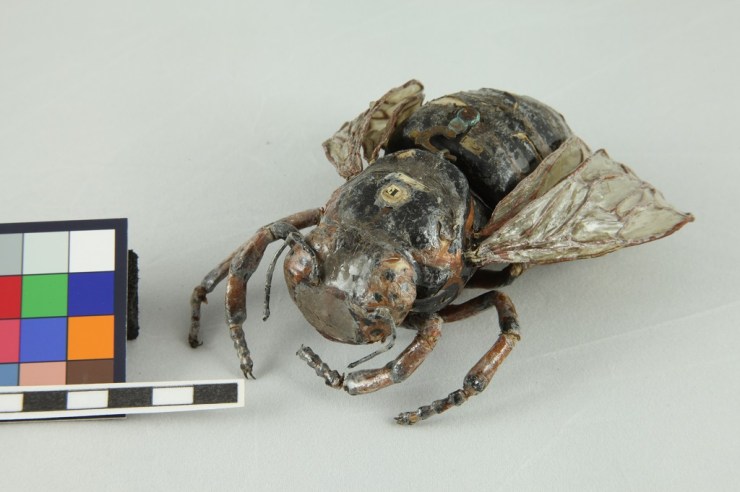
Model of a honeybee hive in box with six bees, by Louis Auzoux

While Auzoux made many models demonstrating human anatomy, he later expanded his business to include magnified models of plants and insects. The model we have is of a honeybee hive, containing six beautiful bees.

The hive, painted with a protein-based paint and varnished with gelatine, is large enough to allow the viewer to see the fine details of the hive, including individual chambers containing tiny larvae.

As you can see in the image at the top of the article, the bees themselves are also intricately painted, with rabbit hair used to simulate their natural fuzz, and delicate wings constructed from metal wire.

While there was much to admire about this model, it was in received in poor condition. Previous restoration attempts had introduced many materials that were now failing. There were fills, constructed of paper, applied to areas in an attempt to hide cracks in the original model. These were covered in oil paint, which was dripping over the original paintwork and had become brittle and discoloured.

Oil paint layers were peeling from the model

The whole hive was coated in a layer of cellulose nitrate film, a popular coating in the mid-20th century which was used as protection and to create a gloss finish. This coating doesn’t age well, resulting in peeling. It had also been applied to the bees themselves, clumping together the bee ‘fuzz’ and disguising the paintwork underneath.

The priority for treatment was to return the model to its original form while stabilising it for the future.

I undertook treatment in several stages over the course of six months. First, the cellulose nitrate film was removed from all areas using acetone, which could be applied with a cotton bud and fortunately didn’t affect the paint layer beneath.
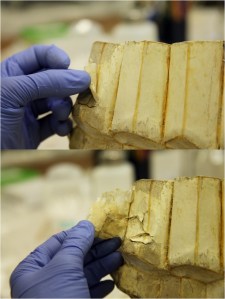
Fill material used to cover previous damage had become discoloured

The next stage was to remove the discoloured oil paint from the hive. This was done manually using metal and wooden tools lubricated with white spirit, which were used to gently scrape the surface under magnification. This revealed old fills on the hive, made from a combination of plastic tape, paper and old adhesives which also needed to be removed. They were easily softened with water and gently peeled away.

Once all unstable introduced materials were removed, work began to stabilise the original model. The bees were suffering from paint cracking and peeling, as seen in the magnified photograph below.

Peeling paint at 6x magnification

We decided to consolidate this using gelatine as it would be in keeping with the original construction and could easily be reversed if necessary. Gelatine was mixed in water and warmed to make it a thin consistency, and then applied with a paintbrush. Once the paint flakes had softened they could be gently pressed down. Gelatine was also used with acid-free tissue to stabilise the cracks and areas of surface loss on the hive.

With the hive and bees now clean and stable, the quality of this piece and its incredible paintwork can really be admired. We hope to put it on display soon for all our visitors to enjoy!

Restoring the Great Lizard of Stonesfield

by Paul Smith, Museum director

One of the unusual things about the collections in the Museum is that some of the specimens date back hundreds of years, and so have been researched by generation after generation. Sometimes these specimens have been damaged and repaired, and in some cases this has happened many times, leaving a complex history of research and conservation.

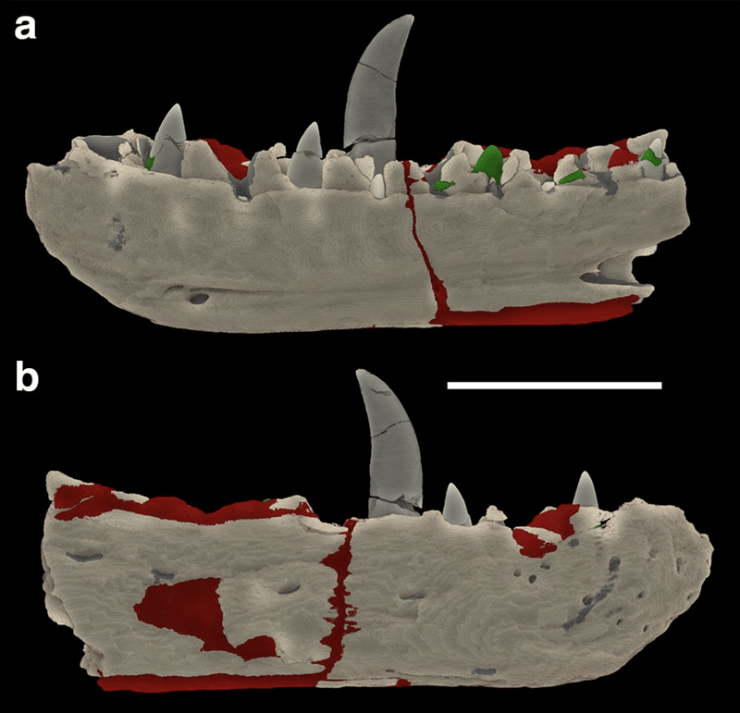
One high profile example is the type specimen of the theropod dinosaur Megalosaurus bucklandii – the world’s first scientifically described dinosaur. This specimen itself is the lower jaw, pictured above, which has been in the collections of Oxford University since 1797 at the latest.

Working with the Centre for Imaging, Metrology, and Additive Technology (CiMAT) at WMG, University of Warwick, we have been unraveling the conservation and repair history of the fossilised jaw using an innovative combination of modern technologies.

Identification of repair using X-ray computed tomography (XCT ) from the Megalosaurus bucklandii type specimen. The two colours indicate two different types of plaster material. Scale bar is 10 cm.

Earlier studies had mapped the presence of plaster used for repair, but X-ray CT scanning of the type used in medical procedures rapidly revealed a number of different phases of repair. In each of these repairs the plaster was of different composition and was used in different places.

One type, shown in red on the image above, was used to infill fractures and to make the specimen more robust; a second type, shown in green, was used to repair the teeth and, in some cases, to recreate the teeth. Interestingly, the extent of plaster revealed by the CT scanning is actually less than previously interpreted with the naked eye.

The two types of plaster were then analysed chemically to better understand their historical use, revealing quite different compositions. The more abundant ‘red’ plaster is mixed with quartz sand and calcite grains, possibly from the rock matrix surrounding the fossil, to make it look more similar.

Carbon is also abundant and grains rich in lead are present. Carbon is not common in the rock itself, and the carbon in the plaster has probably come from a varnish such as shellac being used to coat the repair.  The presence of lead was more puzzling. Further analysis eventually showed that the grains were made of red lead – lead tetroxide – which was used historically as a pigment in paint. The red lead in the repair may have been used to colour the plaster, but it may also have been applied to make the density of the plaster more similar to that of the fossilized bone, and so replicate the weight of the specimen better.

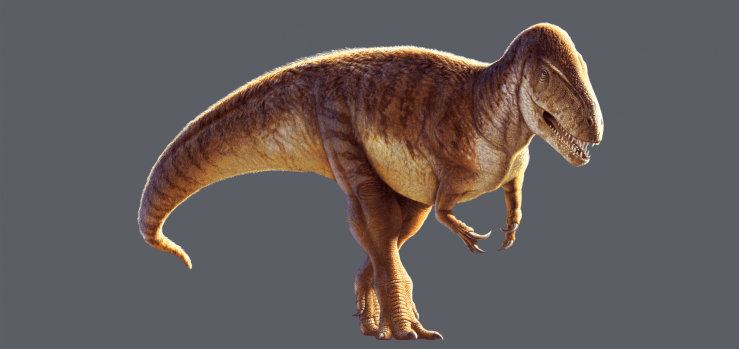
Reconstruction of Megalosaurus bucklandii by Julius T. Csotonyi

The second type of plaster, used to repair the teeth, lacks the lead of the first type but contains barium. Barium hydroxide was often used as a consolidant and sealant for plaster, which would explain its use here.

Having a full understanding of the repair history and the position and extent of plaster helps us in a number of ways. It allows researchers to understand which parts of the lower jaw are original and anatomically reliable, and it helps the curators and conservators to know which parts of the specimen are more fragile during handling and display.

By combining cutting-edge scanning technologies with heritage material we are able to shed new light on the conservation history, and future, of important specimens such as Megalosaurus bucklandii.

Read the full paper here.

Coming out of the shell

Drawer of Lyell’s fossil gastropods

Just over a hundred years ago there was great excitement amongst the staff at Oxford University Museum when they acquired the Charles Lyell Collection of Tertiary molluscs. In his 1903 Annual Report the Professor of Geology, W.J. Sollas, described it as one of the most noteworthy events in the Geological Department that year.

The collection contains over 16,000 fossil specimens, mostly molluscs (bivalves, gastropods and scaphopods) but also shark teeth and other vertebrate remains.  Although some of the specimens are on display in the museum, few people were aware that we had the collection. It wasn’t until the 1990s that the collection was fully catalogued, and it has never been included in the Museum’s main collections databases.

Over the next 18 months we are planning to digitize the collection and create links to our archival material and Lyell’s publications. We want to make the collection accessible to a wider audience (i.e. you) through an image-rich online database including lots of contextual information.

At the same time, we will set up a new framework for digitizing palaeontological specimens using the KE EMu collections management system. This will pave the way for the migration of all our current palaeontology databases into KE EMu, joining records from the archives and other specimen collections. These records will all be available on our new Collections Online site.

IMG_6512_1Small
Books by Charles Lyell in the Museum Library

So who was Charles Lyell?

Charles Lyell (1797-1875) is best known for his book Principles of Geology, in which he popularised one of the key concepts of geology: “the present is the key to the past”. This book combined his own research in geology with ideas developed by the geologists around him, and provided a foundation for the modern study of the science. Lyell kept updating this book as new discoveries were made and his own ideas changed; in fact the last volume was published posthumously.

Lyell read Classics at Oxford, where he also attended the geological lectures of William Buckland. He was a trained lawyer but spent much of his time pursuing his interest in geology, and after 1827 took this up full time. Throughout his life Lyell travelled extensively in Europe and North America, observing geological phenomena, collecting specimens and lecturing to the general public. He was a close and influential friend of Charles Darwin, and Lyell’s Principles was one of the few geological books that Darwin took with him on his voyage on HMS Beagle.

On this blog we will be sharing what we discover in the course of this project: about the collection, the digitization process, and Lyell himself.