Dodo Roadshow: Perth Museum and Art Gallery
Perth Museum and Gallery

To mark our selection as a Finalist in the Art Fund Prize for Museum of the Year 2015 we’re embarking on a unique and ambitious tour of the country – the Dodo Roadshow.

Beginning at Land’s End on 8 June and concluding in John O’Groats one week later, the famous Oxford Dodo will visit more than 20 museums and galleries along the way. At each stop the Dodo will ‘interview’ one of the venue’s star objects.

Perth Museum and Art Gallery: St Madoes Stone

So, tell me about yourself – who are you and where do you come from?
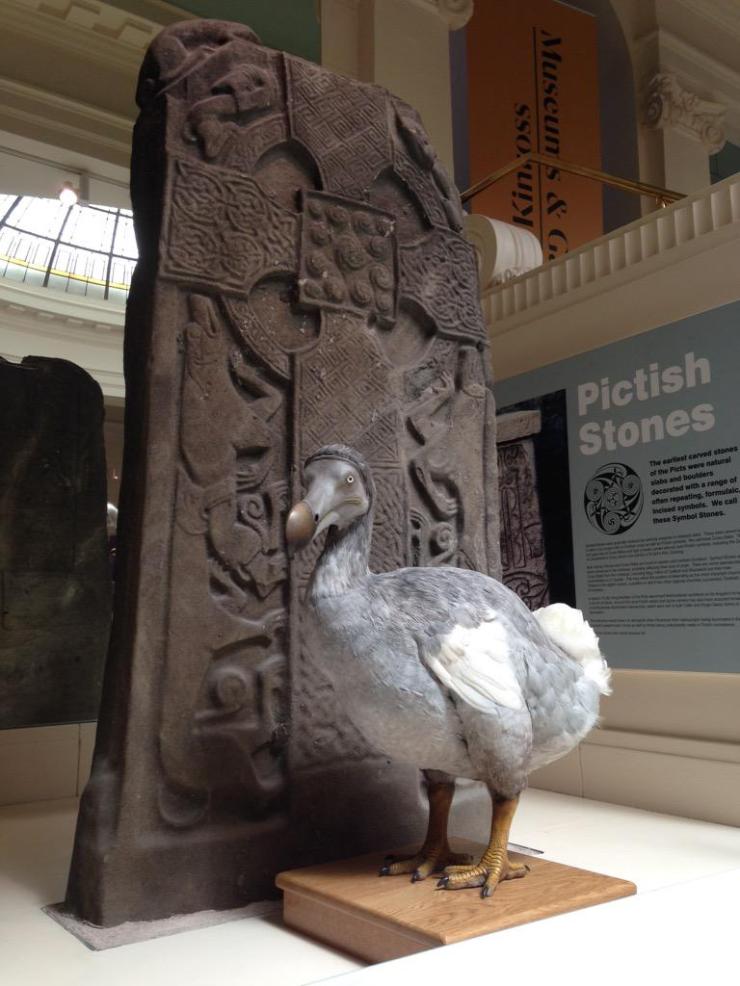
I am a Pictish cross slab in very good condition, considering my age. For centuries I took pride of place in the kirkyard of St Madoes Parish Church, six miles east of Perth in the Tay Valley.

What is it that makes you so special?
I am so special because my embellishments are of both Pictish and Celtic origin reflecting my place in the region, which was ‘the cradle of Scotland’. My front face shows a Celtic cross with interlace and knot work patterns similar to those seen in the Book of Kells or Lindisfarne gospels. Above the beautiful cross I have leaping lions and on each side the cross is guarded by Pictish hunting dogs. On my reverse side there are three cloaked and hooded Pictish horse riders above three of the enigmatic Pictish symbols known today as crescent and v rod, a double disc and a z rod. Don’t ask me what they mean, I knew once but I have now forgotten.

Who looks after you in this place?
In Perth Museum and Art Gallery I come under the curatorship of Mark Hall along with all the other archaeological objects in the museum. On a day to day basis my surroundings are preened and pimped by the wonderful front of house team who polish the large mirror which shows off my Pictish side to make sure I look my best in photographs, and they tell my story as a star object to the visitors to the museum.

Do you remember life before the museum?
Before I came to the museum I stood in the churchyard of St Madoes Church. After many centuries I fell over but remained in the same place. In the 19th century I was raised again and didn’t come to the museum until the 1990s when I was given pride of place in the entrance hall.

What does the future hold for you?
I cannot see far into the future but I know that my place is secure (literally) within the entrance hall. I’m too big and too popular to move easily but it could be that the display around me may change.

Stickers small - Dodo Roadshow_crop

Dodo Roadshow: The Hunterian

Hunterian

To mark our selection as a Finalist in the Art Fund Prize for Museum of the Year 2015 we’re embarking on a unique and ambitious tour of the country – the Dodo Roadshow.

Beginning at Land’s End on 8 June and concluding in John O’Groats one week later, the famous Oxford Dodo will visit more than 20 museums and galleries along the way. At each stop the Dodo will ‘interview’ one of the venue’s star objects.

The Hunterian: Giant Irish Deer

So, tell me about yourself – who are you and where do you come from?
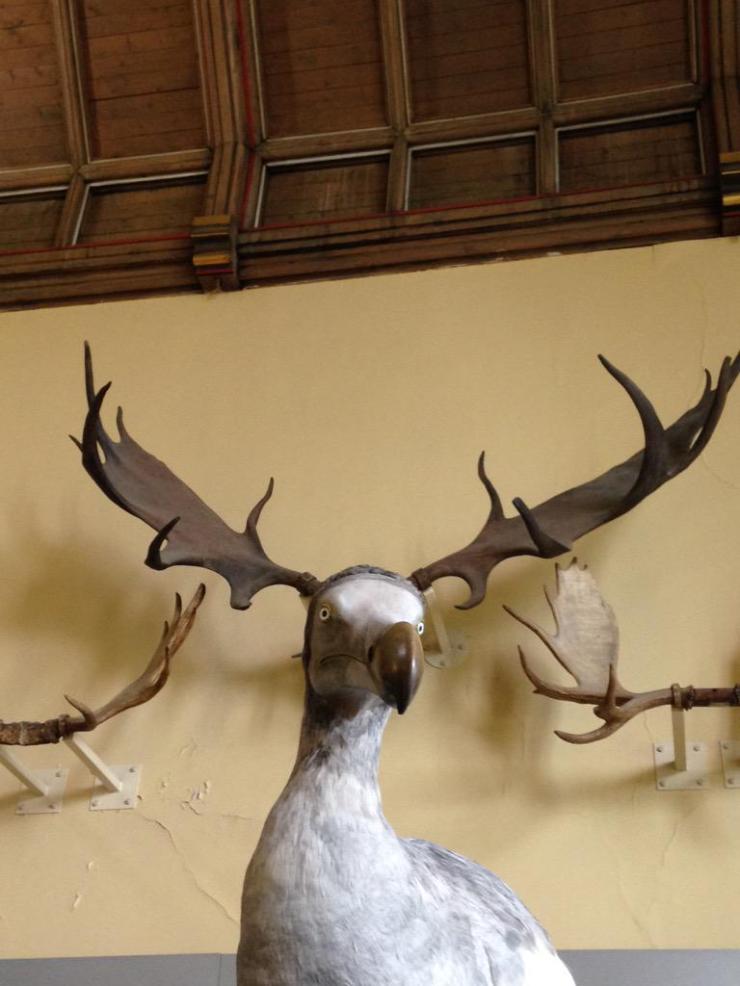
I am a giant Irish deer – they call me Megaloceros giganteus these days. I was found in a peat bog in Ireland, in Limerick I think, but I believe I had lots of relatives across Europe. I have been dead a long time! I was dug out of the bog more than 250 years ago.

What is it that makes you so special?
A Scottish doctor called William Hunter acquired me in the 18th century. He was interested in lots of things apart from medicine and he wanted to know more about moose or elk and me. He made a study of us all and even had the famous George Stubbs make a painting of the moose to help his study!

Who looks after you in this place?
I am looked after by two people – Neil Clark, the Curator of Palaeontology and Maggie Reilly the Curator of Zoology. That probably reflects the fact I have trotted between Zoology and Palaeontology displays over the years! I am a recent extinction after all (geologically speaking that is), though not as recent as you!

Do you remember life before the museum?
I don’t remember very long ago when I was alive, but like you I have been around a bit – after leaving Ireland, I lived in London for a while, then I was taken to Glasgow on a barge and then I was in the first Hunterian Museum down in the middle of Glasgow. Now, after a few years in the Zoology Museum, I am a big star in the main Hunterian Museum. I  have some friends with me now – the moose antlers. We sorted out the puzzle that William was interested in that I mentioned above.

What does the future hold for you?
I think I am probably going to still be on show to the public, though in the future there may be new Hunterian displays in a different building where even more people will be able to come and see me. I have been measured and studied in the past but as you say the scientists may have new things they want to learn so they know where to find me!


Stickers small - Dodo Roadshow_crop

Dodo Roadshow: Kelvingrove

KG013_P01_01(small)

To mark our selection as a Finalist in the Art Fund Prize for Museum of the Year 2015 we’re embarking on a unique and ambitious tour of the country – the Dodo Roadshow.

Beginning at Land’s End on 8 June and concluding in John O’Groats one week later, the famous Oxford Dodo will visit more than 20 museums and galleries along the way. At each stop the Dodo will ‘interview’ one of the venue’s star objects.

Kelvingrove Museum & Art Gallery: Sir Roger the Elephant

SirRoger3So, tell me about yourself – who are you and where do you come from?
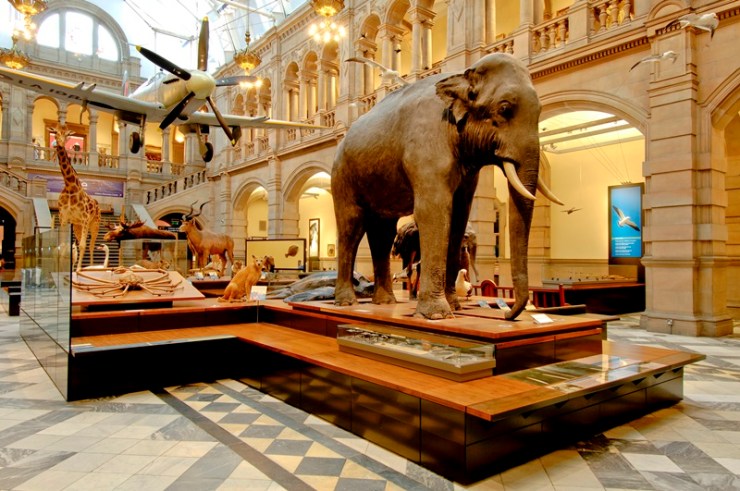
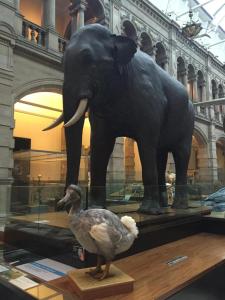
My name is Sir Roger and I’m a male Asian elephant. I may have come from India, but I’m not sure. I used to travel with Bostock and Wombwell’s Menagerie, pulling a wagon as we travelled all round Britain during the 1880s and early 1890s. I came to Glasgow in 1897, when my owner, Edward Henry Bostock decided to set up the Scottish Zoo and Variety Circus in Glasgow.

What is it that makes you so special?
I’m one of the museum’s largest and most iconic animals. Everybody loves me.

Who looks after you in this place?
I’m looked after by the museum’s natural history conservator, Laurence Simmen. He gives me a clean from time to time, and makes sure I look my best. When the museum was closed for three years for refurbishment, I spent the whole time in a big crate (I was one of only a few objects to remain in the building). During this time, Laurence would check the crate to make sure I was alright.

Do you remember life before the museum?
When I was in the Scottish Zoo, I used to be taken out for walks in the countryside for exercise. The zoo wasn’t like modern ones. The cages were very small, and there was very little room to move around. I enjoyed my time there – young boys used to feed me buns! Unfortunately in December 1900, I developed musth – a condition of male elephants during the breeding cycle. This was very painful and I was so uncomfortable, that I wouldn’t let anyone near me. Mr Bostock was worried that I might injure somebody, and unfortunately by accident I did hurt my keeper. Eventually Mr Bostock very reluctantly decided I must be shot – which is how I ended up here in Kelvingrove Museum.

What does the future hold for you?
The gallery I’m in hasn’t been changed since Kelvingrove re-opened in 2006 after its refurbishment. The museum is hoping to change all the displays around about me next year. I might move to a different position, but I’ve been assured that I’ll still be here for everyone to visit – and maybe someone will offer me a bun again!

Stickers small - Dodo Roadshow_crop

Dodo Roadshow: Robert Burns Museum

Auld Lang Syne fragment 850px

To mark our selection as a Finalist in the Art Fund Prize for Museum of the Year 2015 we’re embarking on a unique and ambitious tour of the country – the Dodo Roadshow.

Beginning at Land’s End on 8 June and concluding in John O’Groats one week later, the famous Oxford Dodo will visit more than 20 museums and galleries along the way. At each stop the Dodo will ‘interview’ one of the venue’s star objects.

Robert Burns Birthplace Museum: Auld Lang Syne fragment

Burns2So, tell me about yourself – who are you and where do you come from?
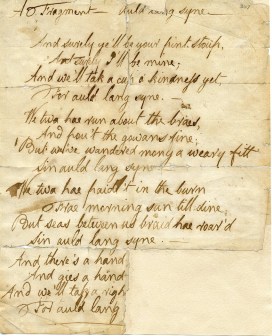
I am a fragment of the world famous song Auld Lang Syne written by the hand of Scotland’s most famous poet Robert Burns.

What is it that makes you so special?
I am sung all over the world to reminisce and think of “old long ago”. I am an international anthem and one of Scotland’s gifts to the world.

Who looks after you in this place?
The RBBM Director, Curator, Conservator, Facilities Manager and Learning Manager all help  ensure my safety.

Do you remember life before the museum?
I was purchased by the Trustees of the Robert Burns Museum from Sotheby’s auction house in 1952.

What does the future hold for you?
I will be enjoyed for many future generations who look back on times (including today) gone by with ardour.

Stickers small - Dodo Roadshow_crop

Dodo Roadshow: Dunham Massey

Dunham Massey 850px

To mark our selection as a Finalist in the Art Fund Prize for Museum of the Year 2015 we’re embarking on a unique and ambitious tour of the country – the Dodo Roadshow.

Beginning at Land’s End on 8 June and concluding in John O’Groats one week later, the famous Oxford Dodo will visit more than 20 museums and galleries along the way. 

Dunham Massey: The Stamford Hospital

As fellow finalists in the Art Fund Museum of the Year 2015, it was great to meet the Oxford Dodo when it called by on Thursday.

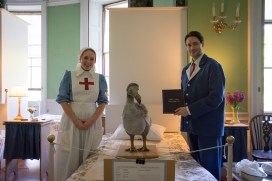
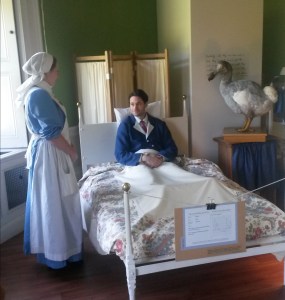
Dunham Massey1Here the Dodo is in the ward of the Stamford Hospital at Dunham Massey Hall, Altrincham. The hall became an auxiliary hospital during the First World War and 282 soldiers were treated here. To mark the centenary of the First World War the clock has been turned back and hospital rooms recreated. Actors playing soldiers, nurses and a variety of other characters perform scenes in the hospital rooms whilst visitors walk through the ward, recreation room, nurses’ station and operating theatre. You can look at letters, photographs and medical notes, listen to recordings that recount a brain operation and experience the house as the hospital that it became for two years.

Dunham Massey has a large archive and collection and the recreation is based on photographs, letters, scrapbooks, oral history recordings, original artefacts such as beds, bedside tables, screens and bedding, and a remarkable log that records of all of the soldiers treated in the hospital. A great deal of research into the archive and the people connected with the hospital was done by Dunham’s volunteer team.

Dunham Massey was given to the National Trust in 1976 after the death of Roger Grey, 10th Earl of Stamford. He was away from Dunham for most of the First World War and served as Aide-de-Camp to General Lloyd. His mother, Penelope, Countess of Stamford, was the hospital’s commandant and his younger sister Lady Jane was a VAD (Voluntary Aid Detachment) nurse. Letters to the family from nurses and soldiers, and correspondence between the family members reveals an insight into life in the house during the war.

The whole Dunham team is delighted to have been shortlisted for the Art Fund Prize for Museum of the Year 2015. The Stamford Hospital will be open until 11 November this year (open Saturday – Wednesday) then the team will be changing the house to tell a new story based on another fascinating chapter in Dunham’s history.

Good luck on your travels, Dodo!

Stickers small - Dodo Roadshow_crop

Dodo Roadshow: Tullie House

Red Kite

To mark our selection as a Finalist in the Art Fund Prize for Museum of the Year 2015 we’re embarking on a unique and ambitious tour of the country – the Dodo Roadshow.

Beginning at Land’s End on 8 June and concluding in John O’Groats one week later, the famous Oxford Dodo will visit more than 20 museums and galleries along the way. At each stop the Dodo will ‘interview’ one of the venue’s star objects.

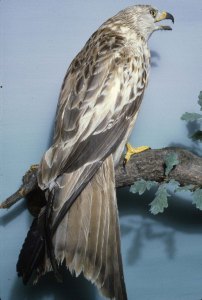
Tullie House: Portinscale Red Kite

Red Kite Portinscale 1840So, tell me about yourself – who are you and where do you come from?
I’m the Portinscale Red Kite and I’m Cumbrian, born and bred. I live in Tullie House Museum and Art Gallery in Carlisle.

What is it that makes you so special?
I was one of the very last native red kites in Cumbria. We suffered intense persecution from humans in the 1800s and were driven to extinction in the county and then England. I am the oldest mounted bird specimen in the Museum here in Carlisle.

Who looks after you in this place?
I’m looked after by the Curator of Natural Sciences. Information about me and other biological specimens, as well as other historical and modern records of Cumbrian wildlife, are looked after by the Cumbria Biodiversity Data Centre. This is the Local Environmental Records Centre for Cumbria, which is based here at the museum and managed by Teresa Frost.

Do you remember life before the museum?
I can remember in the late 1800s the Rev. H. A. Macpherson visiting me whilst researching his book, A Vertebrate Fauna of Lakeland. He wrote “Mr. Sawyer of Threlkeld showed me a fine kite, which he bought for £2 at a sale. This bird had been shot by John Pearson at Portinscale near Keswick, in 1840, and is perhaps the last of the indigenous race of Kites that inhabited the Lake District from prehistoric times.” I can’t remember exactly when I moved to the Museum, but Macpherson campaigned for natural history to be a part of the then new Carlisle Museum and encouraged people to give their collections here.

What does the future hold for you?
I’ll be kept safely here in the Museum and be a reminder of how persecution can drive birds of prey to local extinction; sadly something which is not completely in the past. But the future for Red Kites in Cumbria is looking much brighter these days. Thanks to historic records like mine showing where Kites used to live, 90 birds were released in the Lake District between 2010 and 2012 as part of a nationwide reintroduction programme. Last summer we had wonderful news – 3 chicks hatched from a nest in Grizedale. This was the first confirmed breeding of Red Kites in Cumbria for around 200 years.

Stickers small - Dodo Roadshow_crop