We recently brought you the breaking news that the animals on our Goes to Town trail had escaped from their cases and were planning to return here to reopen the Museum on Saturday 15 February.
We can now reveal that these creatures have been sighted, skulking by the light of the Moon, and making their final preparations for this reopening party. It seems that the Museum will be Darkened no longer, and most certainly not Dormant.
I bring you breaking news from the Museum of Natural History. As you all know, the Museum has been closed for over a year and, during that time, a number of our specimens have been popping up in unlikely places around Oxford city centre.
The Goes to Town project has seen a penguin in the fish mongers, a bank vole in the bank and a book worm in a book shop. All was going swimmingly until today.
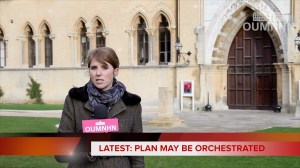
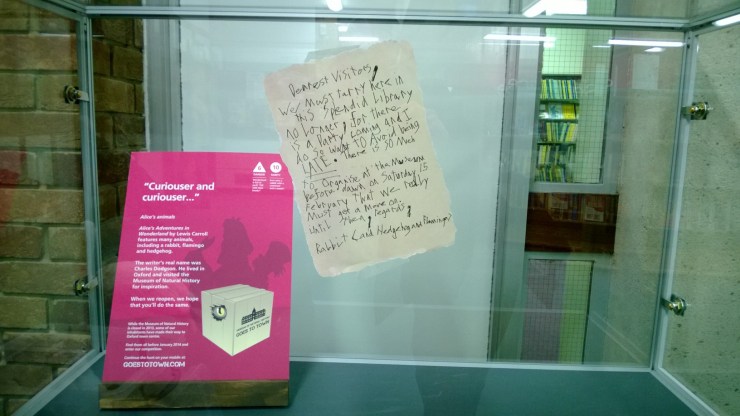
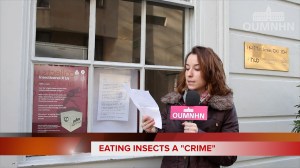
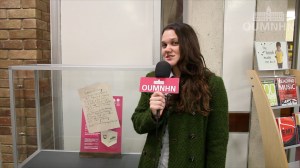
We’ve been receiving reports from several of our Goes to Town venues that there’s been a breakout. The snowy owl has vanished from the University Church, the edible insects have escaped from the Turl St Kitchen and a white rabbit is on the loose from the Central Library. There’s trouble afoot.
Reporters Bethany Palumbo, Jess Suess and Scott Billings joined me to bring you the latest story direct from the scene.
The mystery has been give an even more intriguing twist by the appearance of letters left behind by the escaped specimens. Each creature has its own motive for abandoning its case, but there is a definite theme throughout; they’re all coming home!
A note left behind by the white rabbit, Oxford Central LibraryBethany Palumbo at Turl St Kitchen
As each report unfolds, it’s clear that the specimens have escaped in order to return to the Museum, ready for our re-opening on Saturday 15th February.
So, who is behind this mass escape? Watch the report video to find out.
Jessica Suess at Oxford Central Library
The Museum of Natural History will be the place to be on Saturday 15th February. Even the Goes to Town specimens don’t want to miss out on the action! Join us then, dawn till dusk.
Rachel Parle, Interpretation and Education Officer
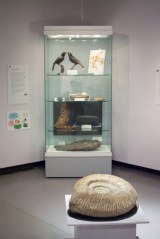
In May this year we opened Natural Histories, our collaborative exhibition with the Museum of the History of Science on Oxford’s Broad Street, who hosted the displays. As we wrote at the time, it was a great opportunity to put on view some lovely and important specimens while we were closed. It also linked nicely with the long history of the museums in Oxford, beginning as far back as 1683.
It was a lot of hard work pulling together all the material, themes, and displays for Natural Histories so we were particularly pleased when Banbury Museum, one of the University museums’ development partners, approached us asking if the exhibition might tour there…
And so it has. It’s a short, one-stop tour admittedly, but with a bit of jiggling and reconfiguration here and there, the whole Natural Histories show is now open to the public in Banbury.
So if you missed it at the Museum of the History of Science, head over to Banbury Museum by 22 February 2014 and have a look.
There’s plenty to see, including the jawbone of the Oxfordshire Megalosaurus, the world’s first scientifically-described dinosaur; creatures collected by Charles Darwin; and a meteorite the age of the Earth itself. With touchable specimens too (of course), Natural Histories explores some big themes and ideas that have shaped our understanding of the natural world.
But as the finished exhibition is now on display for all to see, here instead are a few behind-the-scenes shots of the late night measuring, painting, fixing and adjusting that were needed to get everything ready for opening day last Saturday. Thanks very much to everyone who mucked in and helped out.
Making a few adjustments…Almost ready for closureFinding the spotGlass cleaner at the ready
Seen anything unusual in town recently? If you’re a resident or visitor in Oxford you may have noticed that some strange things have popped up around the city centre. A naked ape-man on the corner of Broad Street and Cornmarket, for example; or a Utahraptor dinosaur in Blackwell’s children’s section. You see, the Museum has had some escapees while we’ve been closed, in a project we’ve called Goes to Town.
Every night, as everyone knows, the specimens in the Museum come alive. And they got talking. And they soon realised they were jealous of their colleagues who had escaped to gallivant around town. In fact, they got so restless being pent up inside the closed Museum, that in the end we thought it best to take them out for a pint.
Have you seen our beer mats advertising Goes for a Pint?
So, over the past four weeks, members of the Education team and some super volunteers have been heading out to local Oxford pubs, armed with some great specimens to show off to unsuspecting pub-goers. But that’s not all – for Museum Goes for a Pint we’ve also been hosting our very own natural history-themed pub quiz!
Each week, we have either joined a pub’s regular quiz, or compiled our own special event. We arrive around 7pm and chat to people in the bar about the Museum and its collections, before diving into the quiz around 8pm. Quiz rounds have been roughly based on the pubs themselves (‘rusty’ coloured animals at the Rusty Bicycle; oak tree teasers at the Royal Oak…you get the idea). We’ve had just as much fun writing the quizzes as we hope the quiz-goers have taking part.
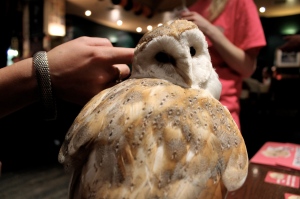
Barny gets a stroke from a quiz-goer.
The idea for Museum Goes for a Pint came from Kathy Clough, a project volunteer, shortly before the Museum closed for the roof repairs. It fit perfectly into our plans to get out and about in the city during the year.
But we’re still only half way through. We’ve got three pubs left to visit. So if you find yourself in the Eagle & Child next Wednesday, the Cape of Good Hope on Tuesday 26 November, or the Big Society on Monday 2 December, look out for some pink t-shirted individuals juggling barn owls and entomology trays.
If you’ve no other plans then do come along and join us. The quizzes are free, and different each week. And where else are you going to get a pint and a puffin?
Last week, members of our conservation team were presented with a wonderful opportunity to get out of the ‘Whale Tank’ and make their way to London to escort some very special specimens to the BBC.
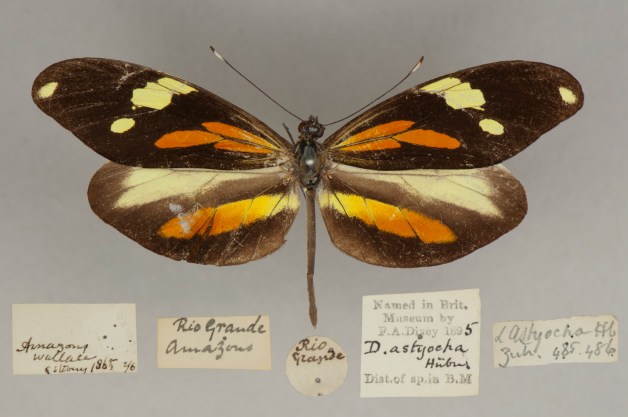
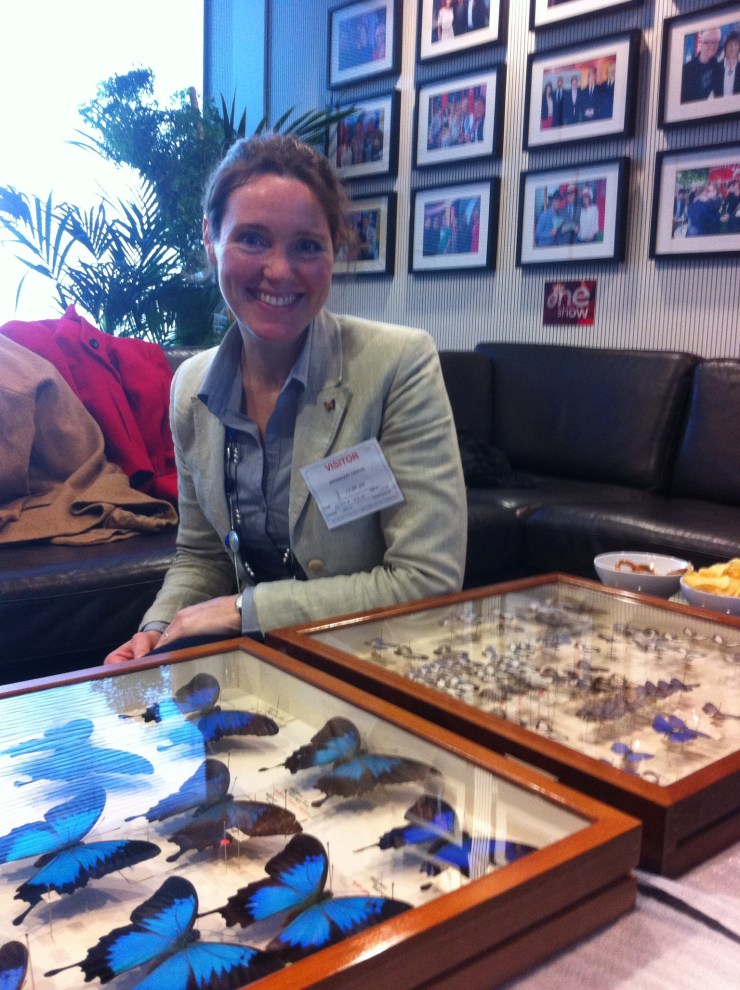
The precious cargo consisted of newly-discovered Alfred Russel Wallace butterfly specimens that were uncovered in the Museum’s Life Collection by 17-year-old Athena Martin, a Nuffield Research Placements work experience student. This story featured on Thursday night’s edition of The One Show, where presenter Mike Dilger spoke about Athena’s project with the Museum and was able to show, on national television, the fruit of her hard work.
Papilio ulysses. Examples collected by Wallace are marked with a red dot.
Two cases of butterflies were used on the programme and contained specimens collected by Wallace during his exploration of the Malay Archipelago. The show focused in particular on Papilioulysses, and it was a joy to witness Mike Dilger’s excitement at discovering Wallace’s handwritten collection labels.
Our specimens, which were shown alongside some wonderful footage of CT scans of a developing chrysalis, made for excellent viewing for anyone with an interest in Lepidoptera.
If you missed it the first time around please do have a look on the BBC iPlayer. The butterfly feature begins at about 15’40”.
Gemma Aboe with the drawers of Wallace specimens.
We are very grateful for coverage on The One Show as it was an excellent opportunity to demonstrate, outside the Museum environment, the significance of natural history specimens, as well as highlight the important work of our conservators. It was also a thrill to be on set and watch the live show, so thanks a lot to the BBC for asking us along.
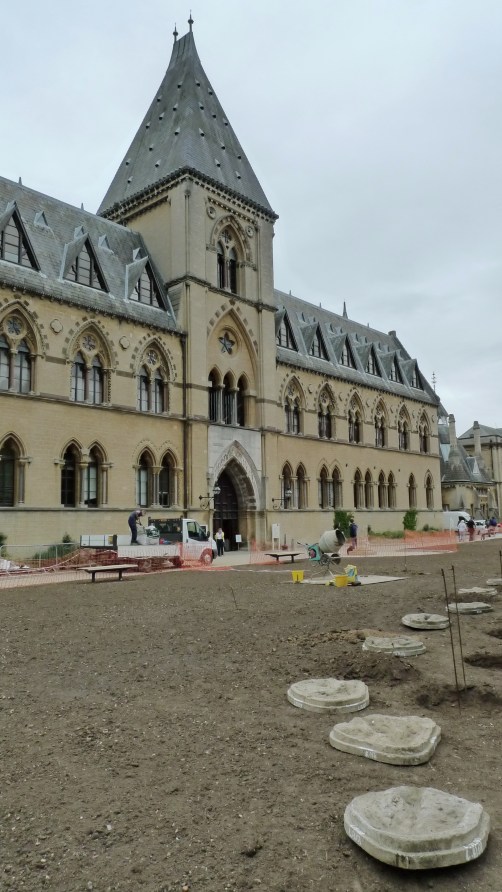
During our closure year, we’ve been having a little landscaping done to our outside space. One of the things I missed while the lawn was being dug up is seeing children hopping, skipping and jumping along the dinosaur footprint casts which cross the grass.
The dinosaur prints provide a lovely introduction to geology, even before you step through the door, so I was delighted to hear that they were included in the new landscaping plan. Even better news was that they were due to be put back in a new formation, which more closely represents the way the dinosaur moved.
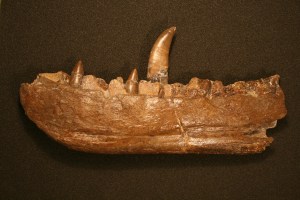
The lower jaw of Megalosaurus bucklandii
The prints are casts taken from a fossilised trackway discovered at Ardley Quarry near Bicester in 1997. It is believed they may have been made by the large three-toed carnivore Megalosaurus bucklandii, which roamed the lagoons of Jurassic Oxfordshire some 166-168 million years ago.
The world-famous lower jaw found by William Buckland in the village of Stonesfield, and pictured here, is one of the treasures of the Museum’s Earth Collections. You can see the Megalosaurus jaw for yourself in our Natural Histories exhibition which is running at the Museum of the History of Science until 29 September.
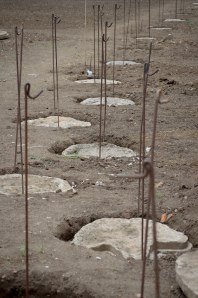
For the past few weeks, Juliet Hay, Preparator and Conservator in the Earth Collections, has been seen diligently measuring and arranging the prints in front of the Museum. Juliet began by plotting out a ‘walking phase’, with a short stride length, and then used research based on an article published in the journal Nature to add in a ‘running phase’. Although the walking and running phases are actually separated at the quarry, GPS data has revealed that they are very likely to have been a continuous trackway, made by the same dinosaur.
Juliet needed to take into consideration the number of casts she had to play with, as well as the lawn’s new sprinkler system, so she emphasises that our trackway is an illustration of the dinosaur’s movements, rather than an exact replica. So now, our lawn footprints show the theropod dinosaur walking at around 4.23mph, breaking into a run reaching 18.14mph, then slowing back down to a walk at the end of its journey.
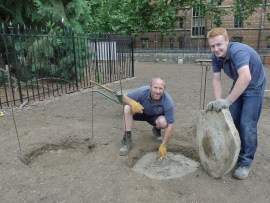
Carl and Richard lower the prints into place. Credit: Mike Peckett
Juliet asked me to thank the University Parks team who helped her to shift the heavy casts into position with good grace. So, thanks go to Walter Sawyer and his intrepid team Carl, Richard, Nolan and Michael. She says “The casts are an important feature as they represent evidence of the first known theropod trackway to show dual speed and an associated change in gait. A pair of Mallard ducks that often visit in the summer seem to enjoy paddling in them too!”
Once our lawn is looking lovely again, do pop along, put your feet in the prints and see if you can keep up with a sprinting, three-toed, meat-eating dinosaur.


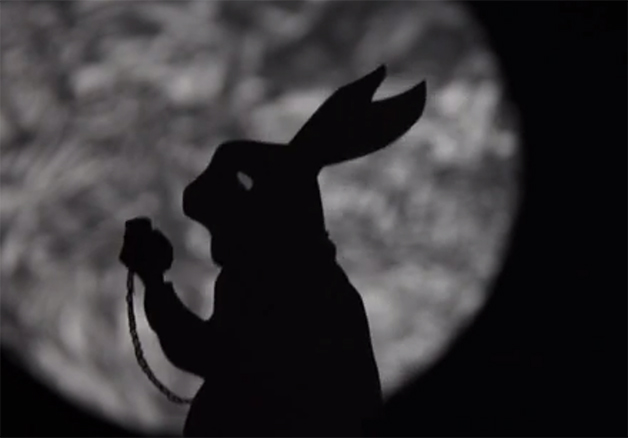


 We’ve been receiving reports from several of our Goes to Town venues that there’s been a breakout. The snowy owl has vanished from the University Church, the edible insects have escaped from the Turl St Kitchen and a white rabbit is on the loose from the Central Library. There’s trouble afoot.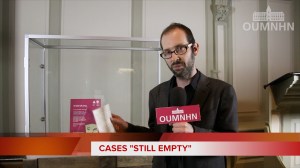

 It was a lot of hard work pulling together all the material, themes, and displays for Natural Histories so we were particularly pleased when
  So if you missed it at the Museum of the History of Science, head over to Banbury Museum by 22 February 2014 and have a look.