Walk this way

DMC-LX3 - 0013
Credit: Mike Peckett

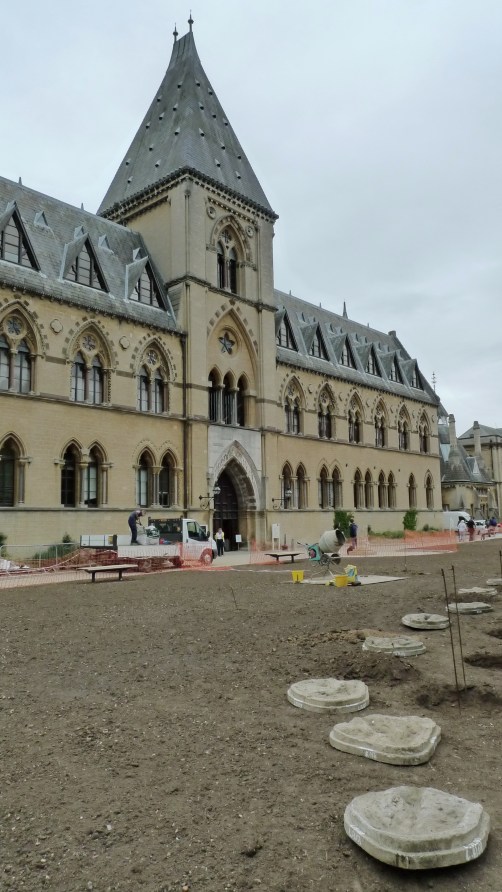
During our closure year, we’ve been having a little landscaping done to our outside space. One of the things I missed while the lawn was being dug up is seeing children hopping, skipping and jumping along the dinosaur footprint casts which cross the grass.

The dinosaur prints provide a lovely introduction to geology, even before you step through the door, so I was delighted to hear that they were included in the new landscaping plan. Even better news was that they were due to be put back in a new formation, which more closely represents the way the dinosaur moved.
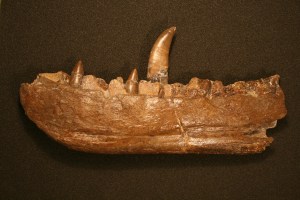
The lower jaw of Megalosaurus Bucklandii
The lower jaw of Megalosaurus bucklandii

The prints are casts taken from a fossilised trackway discovered at Ardley Quarry near Bicester in 1997. It is believed they may have been made by the large three-toed carnivore Megalosaurus bucklandii, which roamed the lagoons of Jurassic Oxfordshire some 166-168 million years ago.

The world-famous lower jaw found by William Buckland in the village of Stonesfield, and pictured here, is one of the treasures of the Museum’s Earth Collections. You can see the Megalosaurus jaw for yourself in our Natural Histories exhibition which is running at the Museum of the History of Science until 29 September.
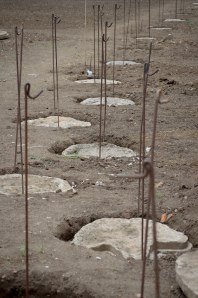
_DSC4457


For the past few weeks, Juliet Hay, Preparator and Conservator in the Earth Collections, has been seen diligently measuring and arranging the prints in front of the Museum. Juliet began by plotting out a ‘walking phase’, with a short stride length, and then used research based on an article published in the journal Nature to add in a ‘running phase’. Although the walking and running phases are actually separated at the quarry, GPS data has revealed that they are very likely to have been a continuous trackway, made by the same dinosaur.

Juliet needed to take into consideration the number of casts she had to play with, as well as the lawn’s new sprinkler system, so she emphasises that our trackway is an illustration of the dinosaur’s movements, rather than an exact replica. So now, our lawn footprints show the theropod dinosaur walking at around 4.23mph, breaking into a run reaching 18.14mph, then slowing back down to a walk at the end of its journey.
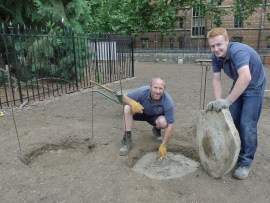
DMC-LX3 - 0022
Carl and Richard lower the prints into place. Credit: Mike Peckett

Juliet asked me to thank the University Parks team who helped her to shift the heavy casts into position with good grace. So, thanks go to Walter Sawyer and his intrepid team Carl, Richard, Nolan and Michael. She says “The casts are an important feature as they represent evidence of the first known theropod trackway to show dual speed and an associated change in gait. A pair of Mallard ducks that often visit in the summer seem to enjoy paddling in them too!”

Once our lawn is looking lovely again, do pop along, put your feet in the prints and see if you can keep up with a sprinting, three-toed, meat-eating dinosaur.

Rachel Parle, Education Officer
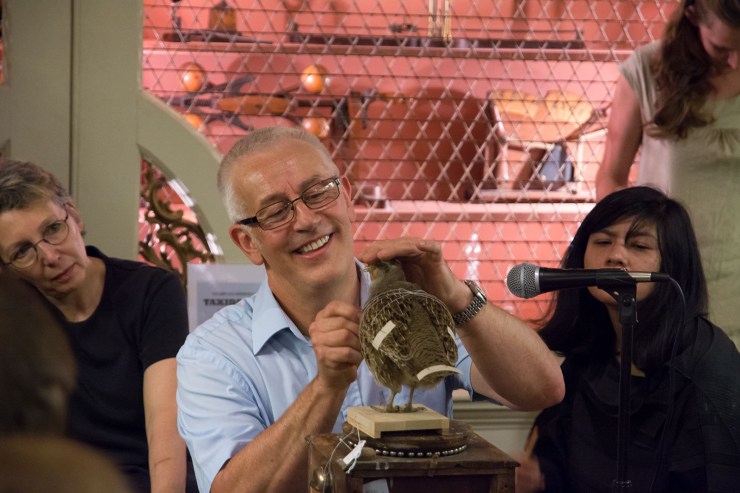
The Art and Science of Taxidermy

Derek Frampton

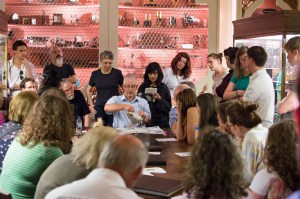
On Sunday 18 August we had the pleasure of welcoming professional freelance taxidermist Derek Frampton to the Museum of the History of Science, where our joint exhibition, Natural Histories, is being shown. As part of the exhibition’s public programme Derek delivered a very popular illustrated Table Talk on the Art and Science of Taxidermy.

An attentive audience

Derek has pretty much been a taxidermist his whole life, having started by collecting, dissecting and drawing animals as a boy. Since then he has done a lot of work for museums, including us and the Natural History Museum in London, where he helped prepare Guy, the Museum’s famous gorilla.

“I really liked drawing and painting animals and would collect things I found. Then I realised I could open them up and became fascinated by the way they worked inside – the mechanics of the muscles and skeleton,” Derek told visitors to the event.

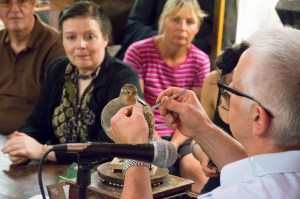
Finishing touches
Finishing touches

“But after a while the specimens started to get smelly and I’d get into trouble with my mum. So I’d have to throw them away and find some new ones. Eventually somebody said to me that the technique for preserving the animals was called taxidermy. I bought a book on it and I have been doing it ever since.”

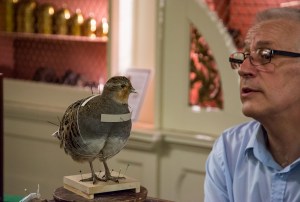
For the Table Talk, Derek brought along the skin of a female partridge which had been killed in a road traffic accident.

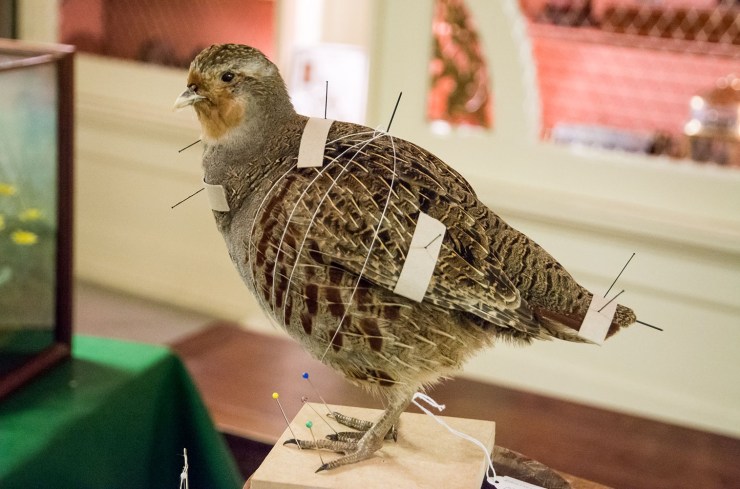
During the hour he went through the process of turning the prepared skin into a finished piece of taxidermy. Using a photograph of a live partridge as a reference, Derek padded the bird with tow, a natural fibre, and inserted florists’ rods to give it a natural shape and posture.

Derek Frampton and the partidge
Partridge and Derek Frampton

At the end of the process the bird was tied and pinned to allow the skin to fully dry and contract, after which the cotton bindings will be removed.

The presentation was a fascinating insight into the half-art, half-science of taxidermy and the perfect complement to the Collect, Preserve, Study display in the Natural Histories exhibition.

The Art and Sciene of Taxidermy

Into the Wilderness

Wildnerness python

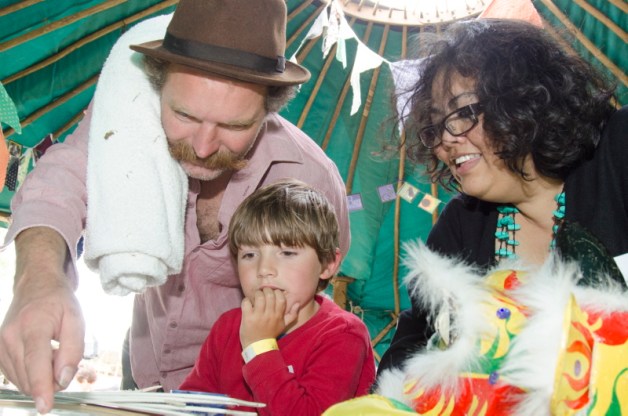
Ah, the rough-smooth joy of snakeskin. Who could resist a little stroke? Well, a few people definitely can it seems (ophidiophobics), but certainly not this young chap. Along with hundreds of other visitors, this family stopped by at the Oxford University Museums yurt at this year’s Wilderness Festival where we spent four great days showing off objects from the collections and indulging in a bit of festival craft.

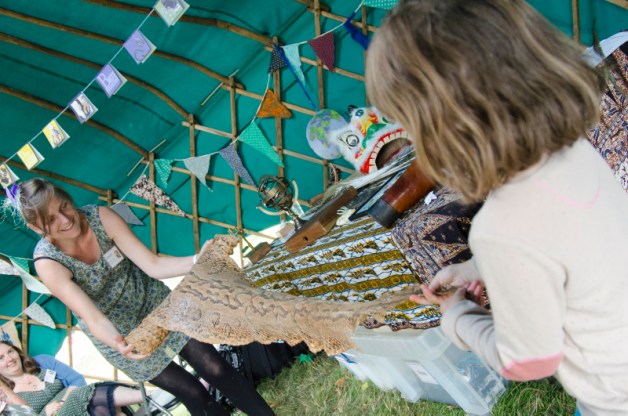
Wilderness signThe weather was kind, and armed with a brilliant team of volunteers and festival-hardy staff we welcomed costumed, painted and be-masked revelers to our tent to learn about the museums and get up close to some great objects. Outside in the sunshine, people whiled away the day making Pitt Rivers Museum-inspired hats, Museum of the History of Science planispheres and our own peacock headdresses.
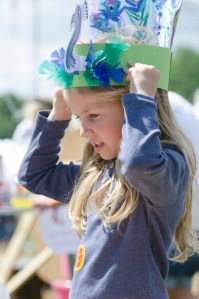
Peacock headdress
Peacock headdress

We had a really positive response to everyone who came along and joined in with the activities, and although I shouldn’t brag, this is a nice comment from one parent which I will share:

We had a really fantastic time at the Oxford University Museum area. They love making Napoelon style hats which kept them occupied for ages. They also really enjoyed looking at the bugs and inspecting the snake skin. The staff couldn’t have been more helpful – they had a great rapport with the kids and were a friendly team. Please come again next year!” – Mother and two daughters, aged 8 and 6.

As for Wilderness itself, things took a rather stranger and more adult turn after nightfall as the Bacchanalian Masked Ball got into full swing in a hitherto hidden vale amongst the lantern-lit trees. No record exists of that portion of the evening but suffice to say that visions were beheld and morning heads were a little sore.

Yurt
The camp
Family
Investigating the collections
Insect drawer
The pinned insect drawer
Rock python
The ever-popular rock python skin (so long it didn’t fit in the tent!)

Thanks to everyone who came to help out, and to everyone who visited on the day. And thanks to the Wilderness Festival team for setting us up with a lovely green yurt as our base-camp.

More next year, perhaps…

Scott Billings, Communications coordinator

Thanks to Chris Wood for the photos.

Dodo Loco

Michael Rosen enters the 'Alice Door', Christ Church Oxford
Michael Rosen enters the ‘Alice Door’, Christ Church Oxford

I had a magical day of wonderland adventures recently. Each year Oxford celebrates one of its favourite literary daughters with Alice’s Day, a festival of theatre, art, stories and general silliness that takes place throughout the city. As we’re closed this year, we couldn’t join in on the day, so we decided to do something special in the run up.

_DSC2739Along with the Story Museum, Christ Church cathedral and Blackwell’s, the Museum has created the Alice Team… or A Team! Our mission is to show Oxford’s children what an inspiring city they live in, tell them tales of Alice in Wonderland and help them create something fit for an imaginary world. With this year’s Alice’s Day theme set as nonsense, we created a project called Dodo Loco.

Dodos may be extinct, but we certainly tracked a few down on our hunt around Christ Church. _DSC2694Children from Larkrise, East Oxford and St Ebbe’s Primary Schools joined us for an exciting behind-the-scenes trail, visiting special spots like the rooms where Lewis Carroll (aka Charles Dodgson, or Dodo Dodgson) lived, and the lawn where the real Alice (Alice Liddell) played croquet. 

Along the way, they tracked down nonsense words dotted around the college and cathedral. Once we were fired up and had soaked up the atmosphere of Alice in Wonderland, we all marched over to the Story Museum for the next stage of our Alice adventure. _DSC2802

_DSC2815The 120 children (and the A Team members) were treated to a spectacular nonsense poetry workshop by the fabulous Michael Rosen. He got everyone laughing and moving as he performed some of his own poems; my favourite was Hand on the Bridge and I really recommend watching this video for a glimpse of his style. Then, using the words gathered around Christ Church and lots of ideas from the children, he created some more hilarious nonsense poetry, before handing over to the children themselves.

_DSC2776

I must admit to being enormously in awe of Michael, so it was great to see how patient and warm he was towards the children and even the adults! He joined my group for the tour around Christ Church, which was both exciting and quite nerve-wracking! He was great, though, joining in with the activities and even telling me a few extra stories about the Alice in Wonderland characters. Here I am with Michael, enjoying another inspiring story.

More Dodo Loco updates coming soon!

Rachel Parle, Education Officer

Chris Packham Goes to Town

Chris Packham

We have had the pleasure of hosting the brilliant Chris Packham at the Museum recently. He has been filming with the collections for a forthcoming series for the BBC. Keep an eye out for that.

In the meantime, we chatted to Chris about our Goes to Town trail of specimens around Oxford city centre. He was very enthused about the idea and volunteered for this snap in front of our banner outside the front of the Museum.

Chris said: “I think this is a really good idea. If it encourages people who otherwise wouldn’t visit the Museum to come along and have a look at things then that is really worthwhile.”

It is almost a couple of weeks since the release of the specimens and we are now looking forward to receiving entries to our competition. To enter, you’ll need to visit all twelve specimens on the trail and tell us, via the website, which has the highest Danger rating and which has the highest Rarity rating. Prizes will be given to people whose names are drawn out of the hat when the Museum reopens in February next year.

But for you blog readers, here’s a sneaky taster:

Here's an escapee in situ. You'll have to get up close to read the all-important ratings...
Here’s an escapee in situ. You’ll have to get up close to read the all-important ratings…
Photo: Mike Peckett