Cornbury and Cockroaches

Cornbury 5

A year of closure in the Museum is a great excuse to get out and about in our van. A glorious sunny spell is even more of an incentive!

Summertown

What better way to start the bank holiday weekend than standing in a busy street dressed as a cockroach? Here I am (on the right) with Education Trainee Liz, as a butterfly, and Education Officer Chris, in his fantastic dung beetle outfit. This was all in aid of the Oxfordshire Art Weeks event – the Summertown Street Parade. Our live cockroach handling and pinned insect displays fitted perfectly with this year’s minibeast theme and the costumes grabbed plenty of attention. I learnt a lot about life with enormous antennae – it certainly makes getting in and out of a gazebo pretty hard work!

Other attractions at the popular event included felt making, decorating tea towels and a minibeast costume parade, which was judged by our very own dung beetle!

Cornbury 4On Tuesday, we took a few of our most dramatic specimens out to Cornbury Park for a warm up event for the Wilderness Festival. We’re excited to be taking part in the festival this August, so it was great to be able to visit the beautiful site and meet some of the people involved. 

Here our famous cheetah, who usually greets museum visitors with a ‘Please Touch’ sign, is being unpacked for an afternoon in the sunshine. As you can see from the photo below, he looks quite at home in this stately setting!Cornbury 3

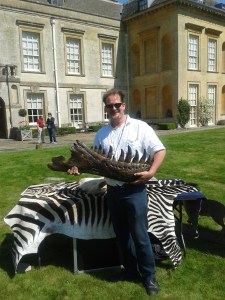
Cornbury 2Other specimens we took with us included this impressive cast of a T rex jaw. Chris is clearly very pleased to have an excuse to show it off!

Look out for us back at Cornbury Park for Wilderness 8th – 11th August. Of course, we’ll have plenty of stunning specimens to handle, along with family crafts to make… and wear!

Rachel Parle, Education Officer

Lightning strikes!

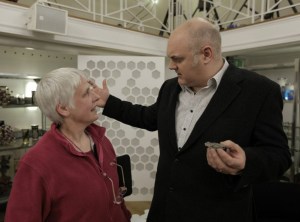
Science Club presenters Mark Miodownik, left, and Dara Ó Briain, right, talk fulgurites with Monica Price, assistant curator of Mineralogy Collections  at the Museum

I’ve just been getting our fulgurites out of their drawer for their second outing to London. ‘What’s that?’ I hear you ask. Well, the clue’s in the name, for ‘fulgur’ is Latin for lightning. Fulgurites form when lightning strikes the ground; and if the ground happens to be made of sand, the intense heat of the lightning melts the grains of sand to form a tube of natural glass. The longest known fulgurite is nearly five metres long, but they are always very fragile things.

A bit of discussion about fulgurites at the end of filming the pilot programme
A bit of discussion about fulgurites at the end of filming the pilot programme. Presenter Dara Ó Briain is holding the Drigg fulgurite. Photo: Alastair Duncan

So why is a fulgurite going to London? We get all sorts of requests to see specimens, from researchers, amateur enthusiasts, students and artists, and even people who are just curious. Our collections are there to be used and enjoyed after all. But in this particular case the producers of the BBC4 programme Science Club were making a pilot for their new series and were looking for a fulgurite to star in the show.

I took two different fulgurites to the recordings, both found in the early 19th century. One is a piece labelled as coming from Drigg in Cumberland. This was a famous discovery; even Charles Darwin knew about them, for he wrote that the fulgurites he discovered in South America were very like those of Drigg in appearance. The second was found in Westphalia, Germany, and it shows a glassy trace of the lightning’s path as it passed through the sand.

Mark was determined to have his photograph taken holding a fulgurite.
Mark was determined to have his photograph taken holding a fulgurite! Photo: Alastair Duncan

For this pilot programme Science Club was investigating natural disasters. Presenter Dara Ó Briain was joined by expert demonstrator Professor Mark Miodownik who had quite a shocking experience with a lightning machine! We were also shown why it is dangerous to stand under a tree during a thunder storm, and we heard about the lucky escapes some people have when struck by lightning.

Fulgurites are rather rare and special, and as the pictures show, both presenters enjoyed a chance to get a close look at these natural curiosities.

The pilot programme was successful, and one of our new Education trainees, Liz Danner, will be taking the fulgurites back for the final filming of Science Club this week. If you would like to see them too, they will feature in our next ‘Presenting…‘ display soon. Follow the blog and we’ll let you know when

Watch out for more Science Club on BBC4 – it’s fascinating and fun.

Monica Price, Assistant curator, Mineral Collections

Oxfordshire Goes Wild!

DSC_1774

DSC_1780The Education team had a fantastic sunny day out on Saturday at Oxfordshire Goes Wild. This annual ecology extravaganza sees many of the county’s nature and wildlife groups gather to bring us all a bit closer to the natural world.

In previous years the event has been held at the Museum of Natural History, but as we’re closed at the moment, we stepped out into the countryside… and we couldn’t have picked a better day for it! We arrived at the Earth Trust Centre in Little Wittenham in full sun and were given a beautiful spot to set up our activities, overlooking the Oxfordshire countryside.

20130420_102455
Set up and waiting for the crowds
DSC_1786
Nice and busy later on!

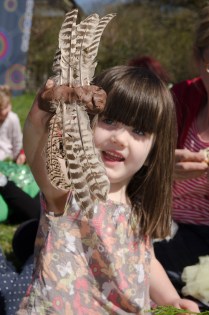
Several hundred children took the opportunity to dissect owl pellets and identify their prey in the sun, or learn about our collections through our Museum Mix-Up activities. Toddlers and grandparents alike were seen picking through the pellets to discover skulls, bones and claws; these owls clearly lived in very rich hunting ground!

We all managed to sneak a short break during the day to investigate the many other things that were going on. There were live animals galore in the shape of bats, reptiles, owls and a bounty of bugs. Also on offer was red kite nest building, pond dipping and crafts a-plenty.

We all left feeling tired but enthused and impressed. Well done to all involved for a fantastic event celebrating our diverse and fascinating wildlife. Even our stuffed owls enjoyed the day out!

Clay creatures with Going Wild
Dissecting owl pellets with us.
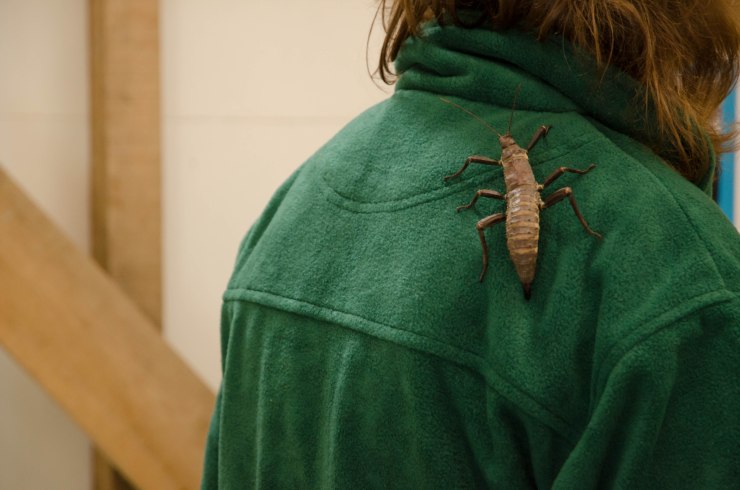
Creepy crawlies get everywhere. A stick insect roams at the Minibeast Mayhem stall.
Creepy crawlies get everywhere. A stick insect roams at the Amateur Entomologists’ Society stall
20130420_161353
Our expert navigators confer over the best route to Wittenham.

Rachel Parle, Education officer

Presenting… Bruno’s fossil find

Presenting Bruno's fossil find

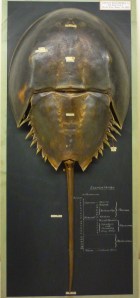
Limulus polyphemisYou’ve read about it in the press (probably), but now you can see Bruno Debattista’s rare trace fossil find for yourself in our Presenting… display, just inside the entrance of the Museum. Although we are closed, this changing exhibit can be seen by visitors coming through the building to the Pitt Rivers Museum.

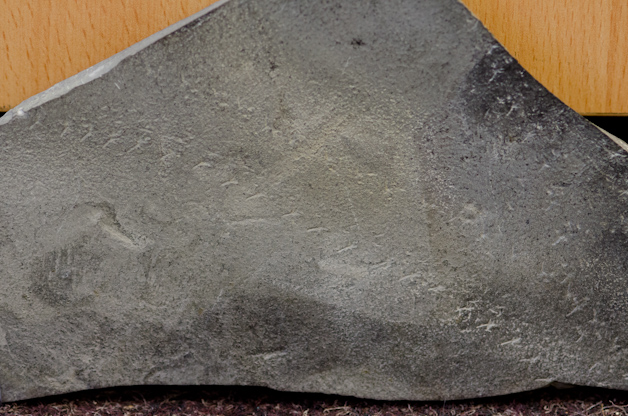
On display we have Bruno’s shale rock, found in Bude, Cornwall last year, which shows faint tracks left by a pair of horseshoe crabs as they crawled up an ancient, muddy shore more than 300 million years ago. Although the species of horseshoe crab which made these tracks is long extinct, we are displaying two modern specimens for comparison. One is around the size of the animal which left the original trackway; the other is a full size horseshoe crab which lives in the Atlantic Ocean – Limulus polyphemus.

We should also point out that horseshoe crabs aren’t really crabs at all. Crabs are crustaceans, but horseshoe crabs are more closely related to the arachnids, such as spiders and scorpions.Fossil and horseshoe crab

Scott Billings – Communications coordinator

Combe Mill in the snow

Combe Mill in the snow

The unexpected March snow has done nothing to deter the Museum team getting out on the road. Early on Sunday morning, as the snow started to swirl, Education and Geology staff packed up the van and set off to Combe Mill.

Van in the snow

The Mill is the original sawmill and workshop of the old Blenheim Palace Estate and features an enormous water wheel and several steam engines. Their monthly Combe Mill in Steam is an exciting day out where visitors can see a working blacksmith’s forge and lots of traditional machines and crafts.

When we arrived, it was far too cold to pitch up our tent, so the mill staff took pity on us and let us set up in their lovely Pattern Room. The workshop was filled with welcoming aromas of sawdust, oil and smoke from the smithy. The perfect place to spend a snowy day. Here’s Janet making herself at home.Setting up at Combe

Volunteers at CombeBecause Oxfordshire is a brilliant place to look for fossils, we took along some fascinating local fossils for visitors to see and touch. Here’s Carolyn from Geology showing these volunteers some gems from the collection, including a pterosaur wing bone, an enormous cetiosaurus vertebra and an ancient shark’s tooth. Visitors were amazed that these discoveries were made right on their doorstep!
Alongside that, families made their own museum-quality casts of similar fossils. The footprint of Oxfordshire’s famous Megalosaurus, a dinosaur first found just up the road in Stonesfield, was as popular as ever.

Sam making poker

Though the impressive Combe Mill team seemed completely undaunted by the freezing temperatures and heavy snow, sadly the event didn’t receive its usual crowds of visitors. However, those who battled the ‘spring’ weather were rewarded with warmth, a hearty welcome and some fascinating experiences. Here’s Sammy, from Woodstock, in the blacksmith’s forge with volunteer Amy. He made his own poker to take home.

We all really enjoyed the opportunity to meet such enthusiastic, interesting and interested visitors and volunteers.To finish off, here’s our view from the Pattern Room window. Can you believe this is March?!

Can you spot the van in the snow?

Rachel Parle, Education Officer

Incredible fossil find

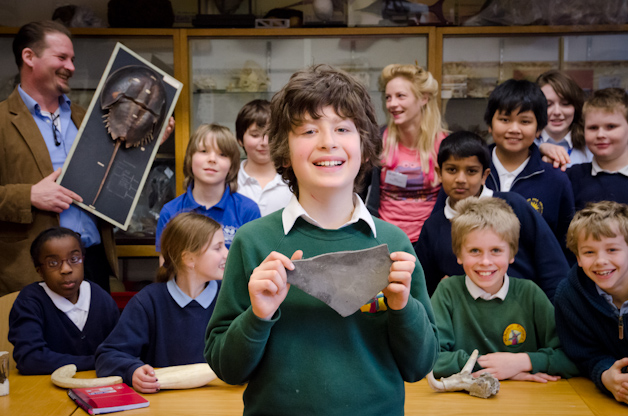
At the Natural History After-School ClubWe’ve been looking forward to sharing this story with everyone for a while and following a big splash in the national media here this morning we can now post it on the blog too. The picture above is of our Education team’s Natural History After-School Club and in the front is Bruno Debattista, a 10-year-old pupil from Windmill Primary School in Oxford.

Bruno with horseshoe crabs

What’s exciting is what Bruno is holding in his hand: a piece of shale that he collected while on holiday in Cornwall and correctly identified as containing a faint fossilised imprint. Members of the After-School Club are encouraged to collect specimens and bring them in each week to identify and talk about them. When Bruno brought his rock along we were somewhat stunned by what appeared to be a very rare trace fossil – a fossilised mark or imprint, rather than the more common fossilised body parts.

There was some discussion and microscope-peering amongst our expert geologists before the fossil find was finally confirmed by the Museum as being the foot and tail prints left by a pair of mating horseshoe crabs, crawling up a muddy shore around 320 million years ago. You can see in the picture here what a fully grown horseshoe crab looks like; a specimen of the size that made the trackways is perched on top of Bruno’s fossil.

The footprints left by the horseshoe crab can be seen in a trail running from the top left to the bottom right of the shale slab.

It takes a very keen eye to spot such faint tracks and plenty of enthusiasm to go hunting for them. It’s exactly this kind of enthusiasm that the Natural History Club is trying to nurture, so we’re delighted to be able to report Bruno’s incredible find and we are especially pleased that Bruno and his family have decided to donate the fossil specimen to the Museum’s collection.

Scott Billings, Communications coordinator