The Museum is really pleased to be a partner in Oxford Swift City, a major new initiative to protect and nurture the city’s populations of swifts. Here Keo Baxendine at RSPB Midlands tells us more about the project…
Swift expert George Candelin shares his experience of researching the swifts at the Museum. Image: Colin Wilkinson.
The swifts have just returned to the UK after their long migration from Africa. At the Museum they have begun circling the tower where they nest each year.
These charismatic birds, Apus apus, are commonly recognised throughout the UK as a sign of summer. They also have a long cultural association with Oxford as a symbol of knowledge and dexterity. Yet sadly, the national swift population has fallen by 42 per cent since 1994, due to a lack of nesting sites and food.
The Oxford Swift City project hopes to turn the birds’ fortunes around by protecting existing swift nesting sites as well as encouraging the creation of new ones. Last night, project partners and guests gathered at the Museum to kick off the project.
The swift is an iconic species whose appearance announces the start of summer. Sadly the swift is in trouble. Numbers have dropped dramatically, putting the birds at risk of disappearing completely from the UK. The Oxford Swift City community project provides local people with a great opportunity to learn about this important bird and discover how to take action to help give swifts a home in Oxford. – Lucy Hyde, Oxford Swift City Project Officer
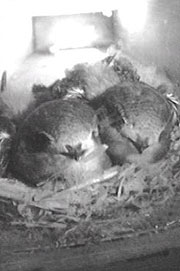
Swift chicks in a nestbox in the Museum tower, shown on the webcam feed
There are lots of ways to get involved: take part as a swift survey volunteer; help out at a community event; or just put up a nestbox or plant wildflowers in the garden. You can also join a local swift expert on a number of ‘swift walks’ through Oxford over the summer.
The colony of swifts which nests in the Museum has been the subject of a research study since 1948, and is one of the longest continuous studies of a single bird species in the world. This work has contributed much to our knowledge of the swift.
Fittingly, Oxford Swift City is running a ‘Swift Tower’ design competition. Subject to approval, the winning design will be constructed in Oxford next year, providing ideal nesting spaces for swifts – so get scribbling!
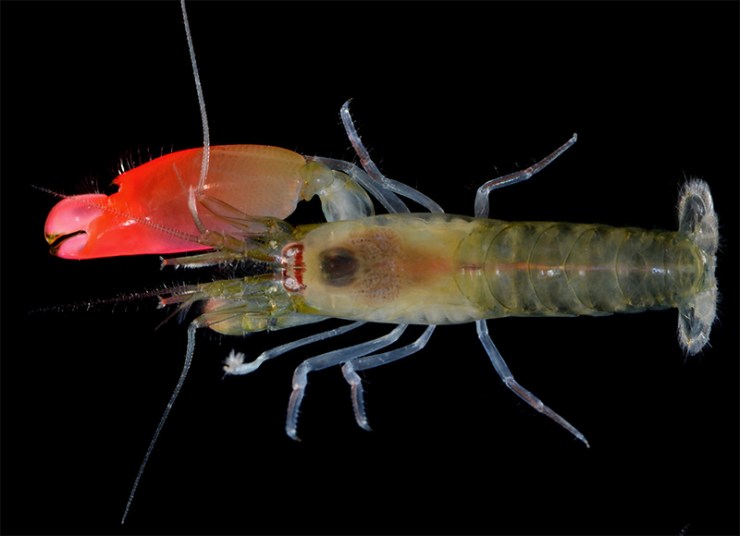
Image: Arthur AnkerIn 1975, on Have a Cigar, Pink Floyd wryly sang “The band is just fantastic / That is really what I think / Oh, by the way, which one’s Pink?”
Well, in the rather different world of snapping shrimps there really is no question which one’s pink; and, unlikely as it seems, these two worlds have now overlapped…
The strikingly bright pink-clawed species of pistol shrimp pictured above, and discovered on the Pacific coast of Panama, has been given the ultimate rock and roll name in recognition of the discoverers’ favourite rock band – Pink Floyd. In a paper published today, and co-authored by our head of research Sammy De Grave, it has been named as Synalpheus pinkfloydi.
Just like all good rock bands, pistol shrimps, or snapping shrimps, have an ability to generate substantial amounts of sonic energy. By closing its enlarged claw at rapid speed the shrimp creates a high-pressure cavitation bubble, the implosion of which results in one of the loudest sounds in the ocean – strong enough to stun or even kill a small fish.
Combined with its distinct, almost glowing-pink snapping claw, Synalpheus pinkfloydi is aptly named by the report’s authors: lead author Arthur Anker of the Universidade Federal de Goiás in Brazil, Kristin Hultgren of Seattle University in the USA, and Sammy De Grave here at the Museum.
If Synalpheus pinkfloydi had adorned the cover of Pink Floyd’s 1977 album Animals, rather than the famous dirigible pig. Image: Chris JarvisSammy has been a lifelong Pink Floyd fan and has been waiting for the opportunity to name the right new species after the band.
I have been listening to Floyd since The Wall was released in 1979, when I was 14 years old. I’ve seen them play live several times since, including the Hyde Park reunion gig for Live8 in 2005. The description of this new species of pistol shrimp was the perfect opportunity to finally give a nod to my favourite band.
Synalpheus pinkfloydi is not the only pistol shrimp with such a lurid claw. Its closely-related and similar-looking sister species, Synalpheus antillensis, scientifically described in 1909, is found in the western Atlantic, including the Caribbean side of Panama. But the authors of the new paper found that the two species show considerable genetic divergence, granting S. pinkfloydi a new species status and its very own rock and roll name.
Arthur Anker, the report’s lead author, says:
I often play Pink Floyd as background music while I’m working, but now the band and my work have been happily combined in the scientific literature.
Another Shrimp in the Wall featuring Synalpheus pinkfloydi, the Oxford University Museum of Natural History building, and other Pink Floyd references. Artwork by Kate Pocklington.Animals feature frequently in the Floyd back-catalogue. Indeed, the 1977 album Animals includes tracks titled Dogs, Sheep, and a suite of music dedicated to pigs. Then there’s Several Species of Small Furry Animals Gathered Together in a Cave and Grooving with a Pict from 1969’s Ummagumma. In fact, other biologists have already named a damselfly after that album: Umma gumma, in the family Calopterygidae.
However, until today there have been no crustacean names known to honour the band.
The full paper, Synalpheus pinkfloydi sp. nov., a new pistol shrimp from the tropical eastern Pacific (Decapoda: Alpheidae), by Arthur Anker, Kristin M. Hultgren, and Sammy De Grave is published by Zootaxa.
Our next exhibition – Brain Diaries: Modern Neuroscience in Action – opens on 10 March and in preparation we have indulged in a little bit of brain-washing… This article contains an image of a preserved human brain.
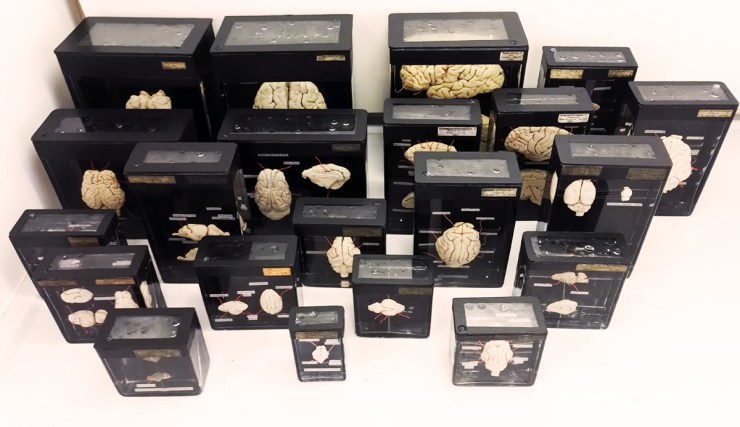
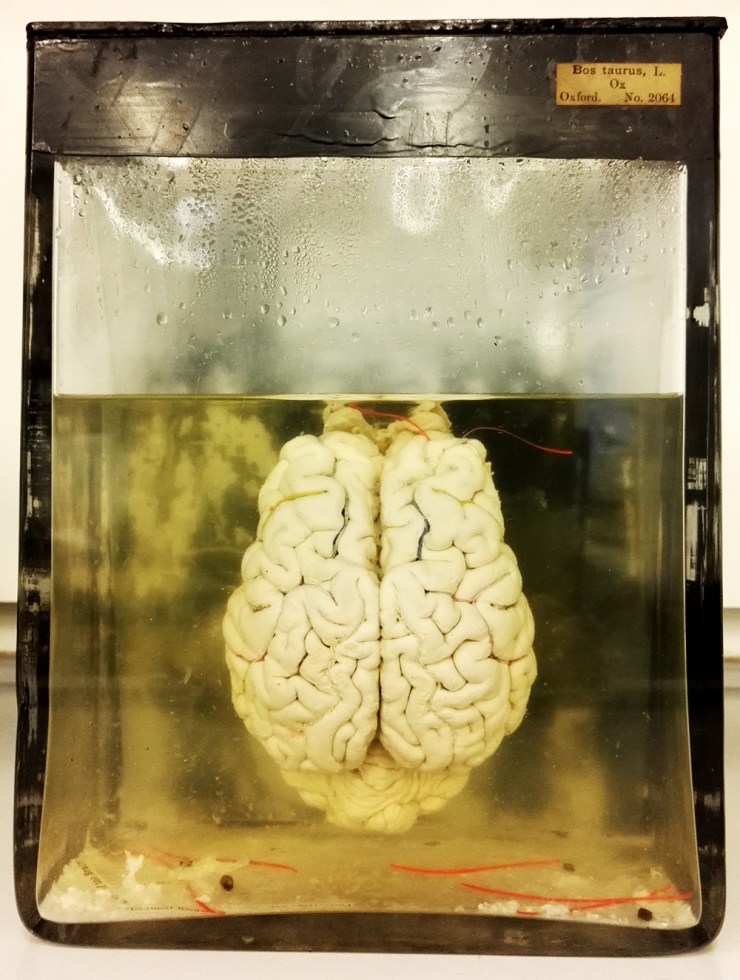
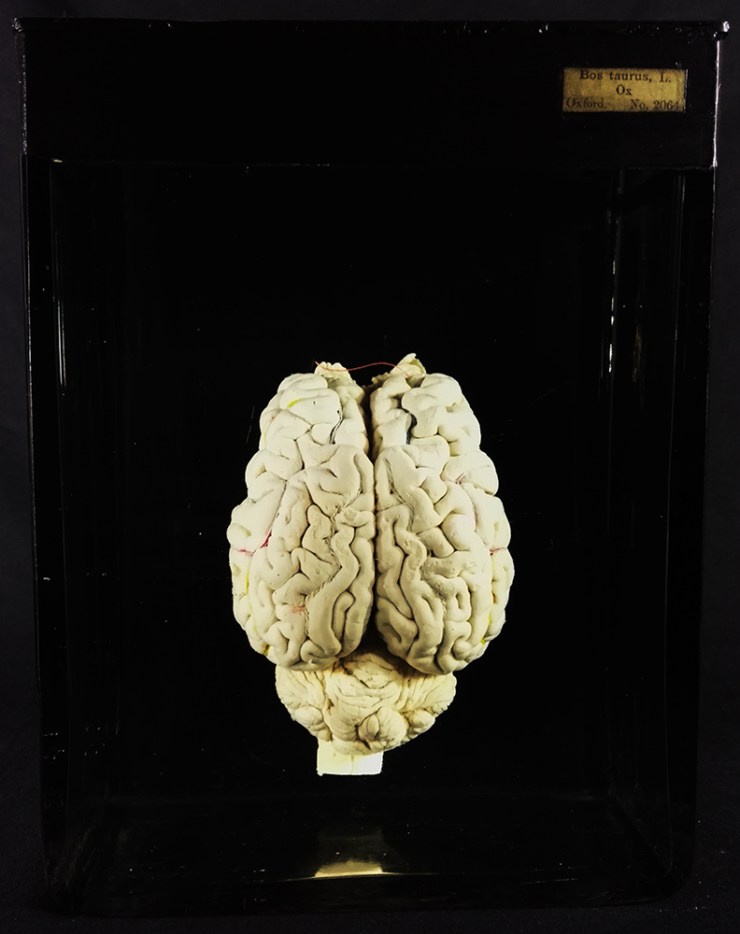
One of the first displays visitors will encounter is a ‘wall’ of 23 fluid-preserved mammal brains – from a Short-nosed Bandicoot to cow. The style of jar, with its black bitumen and paint backing, tells us that these were once used for display so it is exciting to put them in the public galleries again. Museum conservator, Jacqueline Chapman-Gray, runs us through the meticulous process she undertook to ensure these brains will look their best for their return to the limelight.
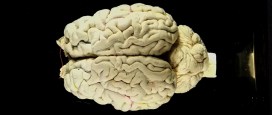
Cow brain before conservation treatmentA number of the brains had become dehydrated over time as the level of fluid – alcohol – had dropped. These needed to go through a rehydration programme to ensure their long-term preservation. This is more complex than simply adding more fluid to the jar. Instead the alcohol level needs to be increased gradually to avoid damaging the tissues.
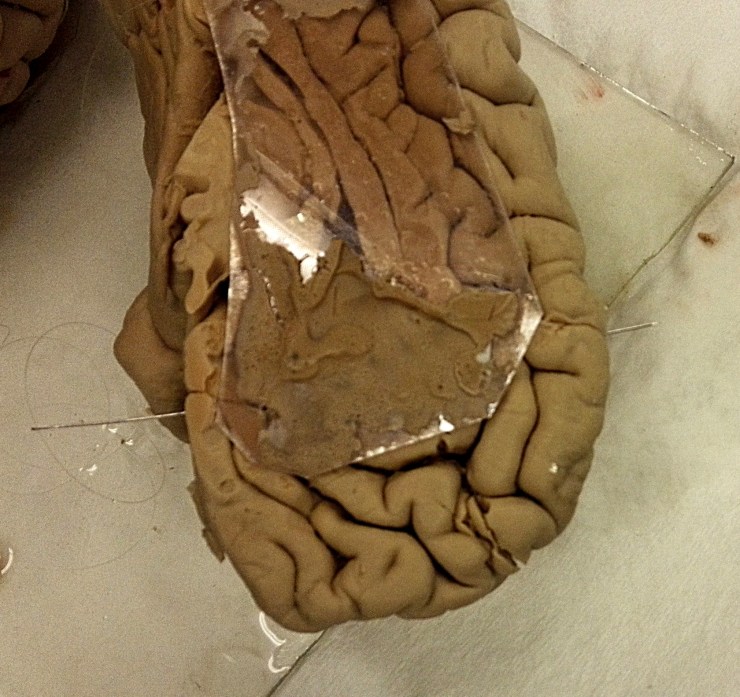
Brains soaking in alcoholOthers had started to detach from their glass mounts, or anatomy labels that marked each of the different areas or sections of the brain had come loose. These were carefully remounted using specialist conservation-grade materials and a steady hand! Three brains had become completely detached and were repaired using a polyester monofilament thread, otherwise known as fishing line.
Repairing a human brain with a beading needle Labels found detached at the bottom of the jarFor the smallest of the brains a normal sewing needle was enough to pass through the tissues but for the larger two either a flexible 10cm beading needle or large 25cm mattress needle was needed. The original threading points were reused wherever possible though in one case this proved to be too difficult, as the tissue was soft and susceptible to breaking. With precision and patience I was able to gently stitch them back into place on the backing plate so they look as good as new.
All of the jars were given a thorough clean to ensure that seals were tight fitting and that the contents were shown off to their best. They were then filled with fluid to 4/5ths from the rim and the brains gently placed back inside.
Lids were sealed with clear silicone and each jar was topped up with a syringe through a small hole in the lid that is there for this very purpose – once full, this hole is also sealed.
Lastly, after the seals had dried, for the final finishing flourish black paint was reapplied to the backs and tops of the jars to provide a contrasting backdrop.
Ta-dah… the cow brain after conservation treatmentBrain Diaries opens on Friday 10 March and runs until Monday 1 January 2018. Take a look at the website to find out more about the exhibition and accompanying programme of events at braindiaries.org
For the past nine months there has been a lot of moving going on around here. Imagine moving house endlessly for weeks on end, but where your house is full of bones, insects, fossils, rocks, and weird and wonderful taxidermy. And the location of everything has to be precisely recorded. The museum move project was a bit like that.
Project assistant Hannah Allum explains…
The museums are migrating, we declared in May 2016. And so they have. The first major stage of the stores project has been completed. After we had created inventories for the largely unknown collections held in two offsite stores, the next stage was to pack them safely and transport them to a new home nearer the museum, a job which demanded almost 70 individual van trips! We now have over 15,000 specimens sitting in vastly improved storage conditions in a new facility.
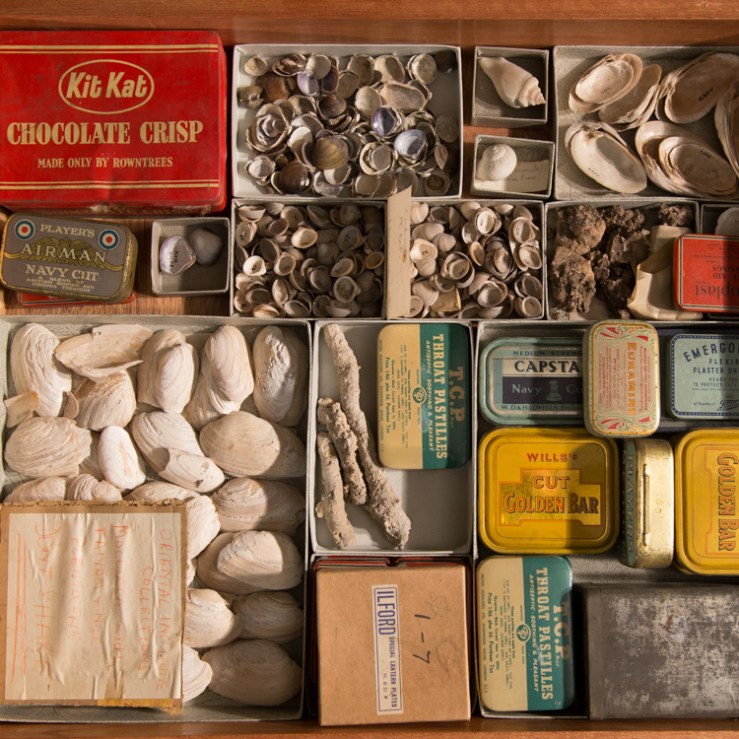
A miscellany of boxes for a collection of shells
Let’s revel in some numbers. All in all there were over 1,000 boxes of archive material, mostly reprints of earth sciences and entomological research papers; over 1,300 specimens of mammal osteology (bones); and more than 1,000 boxes and 650 drawers of petrological and palaeontological material (rocks and fossils).
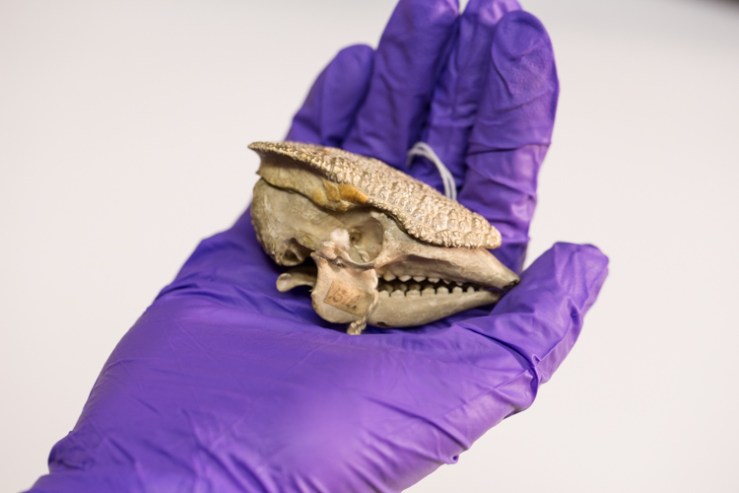
Some of the more memorable specimens include old tobacco tins and chocolate boxes filled with fossils and shells; a beautifully illustrated copy of the ‘Report on the Deep-Sea Keratosa’ from the HMS Challenger by German naturalist Ernst Haeckel; and the skull of a Brazilian Three-banded Armadillo (Tolypeutes tricinctus), complete with armour-plated scute carapace.
The skull and carapace of a Brazilian Three-banded Armadillo (Tolypeutes tricinctus)
There were also a few objects that have moved on to more unusual homes. A 4.5 m long cast of Attenborosaurus conybeari (yep, named after Sir David) was too large to fit in our new store and so made its way to another facility along with a cornucopia of old museum furniture. A set of dinosaur footprint casts, identical to those on the Museum’s lawn, have been gifted to the Botanical Gardens for use at the Harcourt Arboretum in Oxford.
And last but not least, a model of a Utahraptor received a whopping 200 applications from prospective owners in our bid to find it a suitable home. After a difficult shortlisting process it was offered to the John Radcliffe Children’s Hospital and following a quarantine period should soon be on display in their West Wing.
Casts of footprints by made Megalosaurus, queuing for a lift to Harcourt Arboretum. Image: Hannah Allum
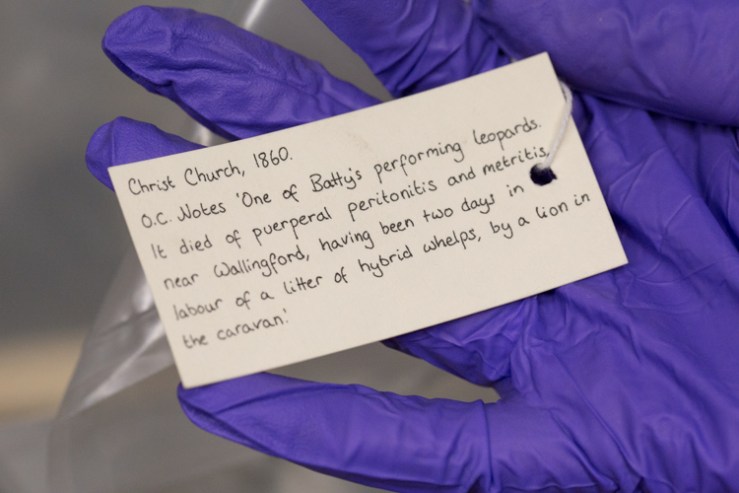
Fittingly, the final specimen I placed on the shelf in the new store was the very same one that had been part of my interview for this job: The skeleton of a female leopard with a sad story. It apparently belonged to William Batty’s circus and died of birthing complications whilst in labour to a litter of lion-leopard hybrids before ending up in the Museum’s collections in 1860.
The sad story of a performing leopard
Though the moving part of this project is now complete there is still plenty of work to do. We are now updating and improving a lot of the documentation held in our databases, and conservation work is ongoing. The new store will also become a shared space – the first joint collections store for the University Museums, complete by April 2018.
The Utahraptor model in the old store awaiting collection by its new owners.
Illustrated plate from the Report on the Deep-Sea Keratosa from the HMS Challenger by Ernst Haeckel
The title page of the Report on the Deep-Sea Keratosa from the HMS Challenger by Ernst Haeckel
On the van, off the van; on the van…
Boxes of Earth collections material stored safely and in sequence in the new store
Boxes, glorious boxes…
Rack ‘n’ Roll: Hannah deftly working the racking
Lily Wilks, an intern assisting with the inventory of bound reprints. Image: Hannah Allum
Hannah Allum working in the old store. Image: Edward Adcock
Life Collections Manager Mark Carnall and Project Assistant Hannah Allum carrying one of the final specimens, a Mirounga leonina (Southern elephant seal) skeleton, into the new store. Image: Edward Adcock
The Attenborosaurus fossil cast, in its unusually shaped case, en route to a new custom built support frame. Image: Hannah Allum
Under the sea, Curaçao, Caribbean. Image: Sancia van der Meij
By Sancia van der Meij, Research Fellow
Biologists often refer to the word “species” when they are talking about the animals or plants that they study, but just what exactly is a species? Defining ‘species’ is actually quite tricky…
A basic definition is based on the work of a German biologist called Ernst Mayr, whose simplified description is “a group of interbreeding populations that are reproductively isolated from other groups”. This is a great starting point, but it is difficult to use when studying animals in the field. Biologists therefore use breeding experiments in laboratories and, increasingly, genetics to help determine what a species is.
How and under which circumstances new species evolve remains an important topic in biology. Quite a lot is known about geographical barriers causing the formation of new and distinct species through evolution – a process known as speciation. Mountains, rivers and ocean currents, for example, can divide populations of single species and in the long run – thousands or millions of years – this isolation can cause different populations to evolve in separate, new species.
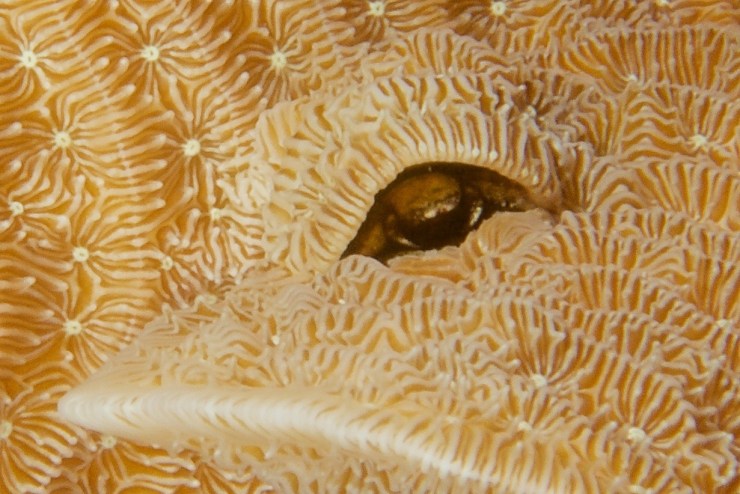
Gall Crab inhabiting a small tunnel in an Agaricia coral. Image: G van Moorsel
But a more difficult concept in speciation is how species can evolve in the same geographical area. Together with a colleague, I studied the genetic composition of Opecarcinus hypostegus, a tiny crab species, around 5 mm in size, that only occurs in the Atlantic Ocean. These Gall Crabs are adapted to living in stony corals and often show a clear preference for inhabiting closely related coral species.
Overhang in a Agaricia coral where a gall crab dwells. Image: Sancia van der Meij
We studied over 200 specimens from five different coral species, all collected from the Caribbean island of Curaçao. The results showed that O. hypostegus should be considered a single, valid species. But to our surprise, when we zoomed into the details of the genetic composition of the crab, we noticed small differences in the DNA of the crabs inhabiting the various coral species. With statistical tests we could prove that the variation in DNA was significantly different between the crabs inhabiting these five different Agaricia corals.
Gall crab dwelling in Agaricia coral. Image: Sancia van der Meij
Despite the fact that all the crabs live around the same small Caribbean island, it does appear that we see the very first signs of future speciation in the crab’s DNA. Unfortunately we will not be around to witness the new species as it will likely take several hundreds of thousands of years before the making of these new crab species has neared completion. But how exciting to witness its new beginnings?
The museum holds the only remaining soft tissue of the extinct dodo known anywhere in the world. The partially dissected skin of the head and scales from the feet of a single dodo represent one of natural history’s most iconic specimens. In fact, it is so tied to the museum’s identity and history that we use the dodo as our logo and it is even incorporated in the name of this blog.
Although the dodo head had been at Oxford University since the formation of the original Ashmolean Museum in the 17th century, it wasn’t really until the 19th century that the specimen really became celebrated.
Around this time, publications confirmed the extinction of the dodo from the island of Mauritius, where it was endemic. To capitalise on the rising interest in the animal, Ashmolean Museum Keeper John Duncan commissioned a number of casts of the Oxford Dodo head to give to, and exchange with, other museums.
One of the earliest of these casts was presented to the British Museum in 1828; later casts are recorded as being sent or exchanged with leading scientists of the time, as well as with Leiden Museum and the Royal College of Surgeons.
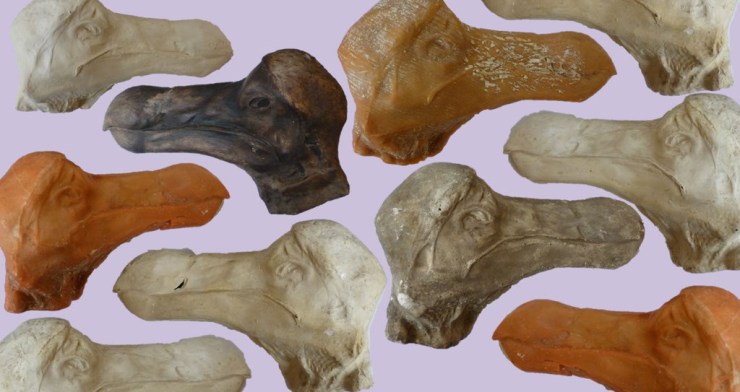
From these original and later casts further casts and models were presumably made, and eventually, dodo specimens spread to virtually every major natural history museum in the world. Today, many museums display casts of this head, all stemming from the single specimen held here in Oxford.
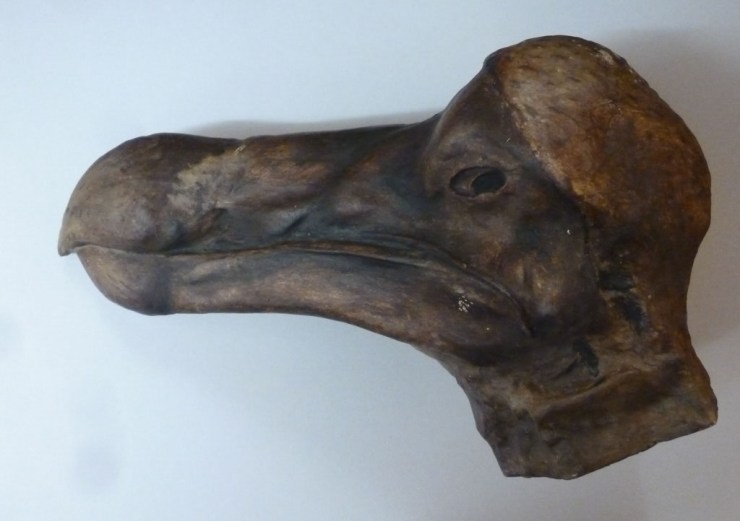
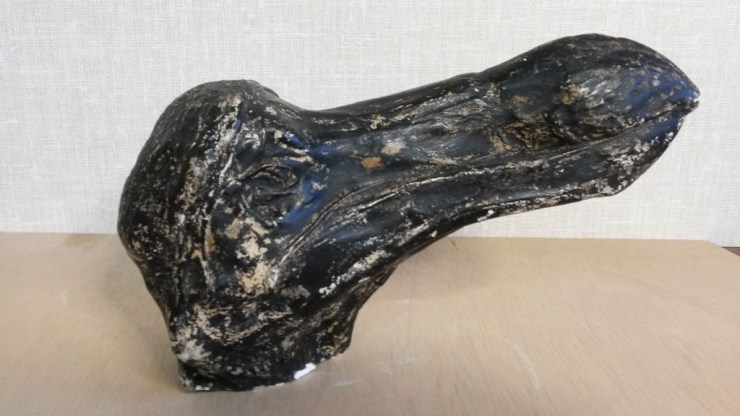
One of the many casts in the Oxford University Museum of Natural History, this one has been painted to match the original specimen
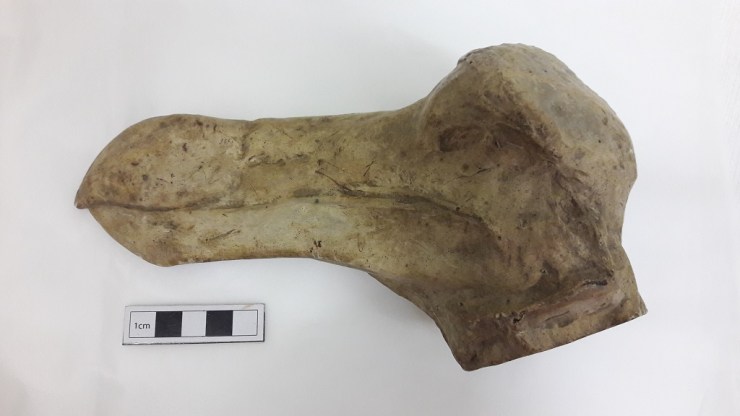
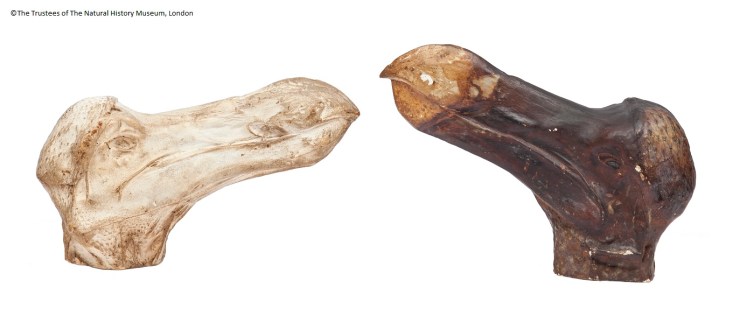
The Museum contains a number of models and casts of the head too; some are made from plaster and resin, some are painted to resemble the original specimen. The head of the dodo was actually dissected in 1847, by Henry Acland. He removed the skin from one side of the face so the early casts are a record of how the specimen would have looked originally.
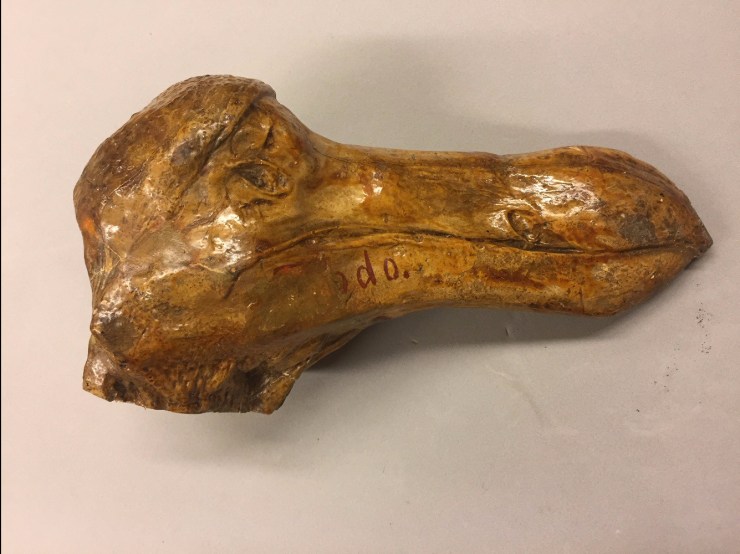
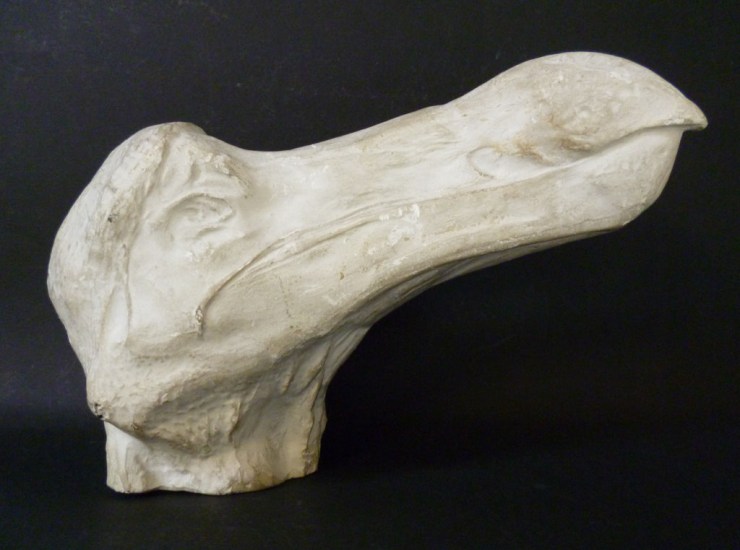
In preparation for the Presenting display in the Museum I contacted natural history museums through the Natural Sciences Collections Association asking people to share information and photos about their casts and models of the dodo head. I wanted to try and construct a picture of how the dodo head was disseminated, as well as capture the diversity of quality and colours of representations of the original specimen. Here’s how far some of the dodos have flown:
Cast of the head labelled as coming from Cartwright Hall. Curator Gerry McGowan suspects this may have come via the Bradford Philosophical Society collections. The first curator of the society, Louis Compton Miall was friends with Thomas Henry Huxley and through him had contacts with many other geologists who may have gifted or exchanged this cast.
Bristol Museum & Art Gallery Bristol received a cast of the head directly from Oxford from Philip Duncan in 1834, keeper of the Ashmolean Museum between 1826 and 1855. Unfortunately, the head was likely destroyed in bombings of Bristol in 1940.
Canterbury Museum, New Zealand
Received a cast of a head from Professor Rolleston on 21 July 1871 in exchange for two kiwi skeletons which are still in the museum collections today.
Cast of head and foot presented to the museum by E.Ray Lankester in 1891/1892 just after leaving UCL and being appointed the Linacre Professor of Comparative Anatomy at Oxford.
The Great North Museum Hancock’s cast was presented by George Townsend Fox. This specimen had been presented to the Natural History Society of Newcastle in 1841 by Fox and had originally been presented by Philip Duncan.
Cast of the head that had quite a circuitous route to the Horniman Museum. The Horniman received the cast from the geology department of Queen Mary’s University of London in 1964 which received the cast from the Saffron Walden Museum in 1962.
Manchester Museum Cast of a head, presumed to have been presented by William Boyd Dawkins. The cast is currently on display in the Living Worlds gallery in Manchester Museum.
The National Geological Repository British Geological Survey
The Natural History Museum’s collections contain three casts of the Oxford Dodo head – two in the ornithology collections (pictured) and one in the palaeontology collections. The unpainted cast in the ornithology collections has the name ‘Johnson’ inscribed into the base.
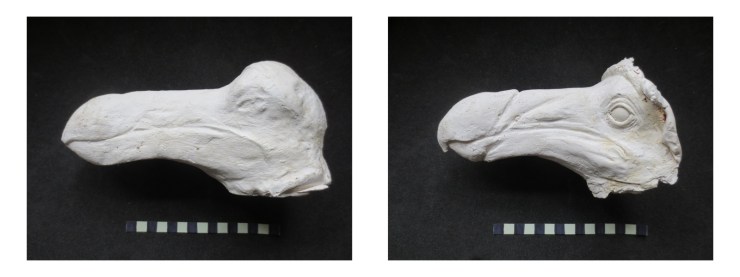
Colleague Adam Smith got in touch with some interesting specimens from Wollaton Hall. The first one looks like another cast in this series but the second cast is unlike any of the others gathered here. The cast shows an open eye, detail on the beak as well as a more defined hook to the end of the bill.
Unfortunately, there’s not much information about the origins of these two casts so it’s probable that the ‘open eye’ cast may be a cast of a model reconstruction or an in progress sculpt. There’s an extremely slight chance it’s a cast of an otherwise unknown dodo head… If you recognise this dodo head do get in touch so we can solve this mystery for colleagues in Nottingham (it’s not the model dodo that we have on display here!).
Cast of a head at Warwickshire Museum with damage to the beak. Donated to the museum by clergyman and naturalist Reverand Andrew Bloxham in the 19th century. As the museum is currently moving stores, further information about when this cast was acquired is inaccessible.
**
If you work at a museum and have a dodo head cast to share, please do get in touch and we’ll update this blog accordingly.
Last updated: 10/11/17
‘Presenting… The Flight of the Dodo’ was on display at the Museum of Natural History from the 25 January to 22 March 2017.
Acknowledgements
With many thanks to colleagues across the sector who helped with information and images about dodo specimens: Adam Smith, Alice Adams, Jack Ashby, Carol Davies, Bonnie Griffin, Dan Gordon, Yvette Harvey, Mike Howe, Emma-Lousie Nicholls, Laura McCoy, Gerry McGowan, Nigel Monaghan, Henry McGhie, Pat Morris, Paul Scofield, Paul Shepherd, and Paul Sweet.



















 More Than A Dodo