Cicada serenade

A Spotlight Specimens special for Oxford Festival of Nature

by Leonidas-Romanos Davranoglou, DPhil student, Animal Flight Group, Department of Zoology, University of Oxford

Anyone walking on a summer day in hot places such as the Mediterranean or the tropics will have heard cicadas singing. Cicadas actually are among the loudest of all animals, singing at up to 120 dB – as loud as a passing freight train. In fact, you can damage your ear if a particularly loud species starts singing next to your head.

Some countries even have health and safety policies which prevent people from working outdoors when cicadas are singing. If a single cicada can sing that loud, you can imagine what a forest filled with them sounds like!
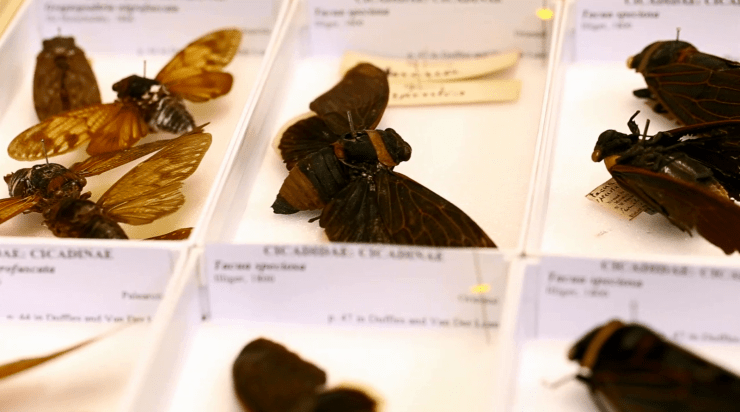
Tropical cicadas from the Museums' collections
Tropical cicadas from the Museums’ collections

Only male cicadas sing, primarily to attract females, much like a Romeo singing to his Juliet. Females are mute, but they respond to males of their liking by flicking their wings, generating a loud click. Entomologists often mimic the female response by snapping their fingers under a tree containing cicadas. In this way, they can collect males eager to mate, which would otherwise be too high in the tree to reach.

An unpleasant parasitic fungus capitalises on this arrangement: The fungus basically consumes the innards of the male cicadas, causing their private parts to fall off – in effect castrating them. A castrated male may stop singing and as a result, other males try to mate with it, and in this way the fungus is transmitted from male to male.

But how do these famous (or notorious, if you find them annoying) cicadas produce these incredible sounds? This has remained a mystery since the time of the ancient Greeks, who admired these animals. But the matter was settled through a collaboration between Oxford University and Australian scientists. The physical process is not too complex and you can get a good idea how it works by using an empty plastic bottle.

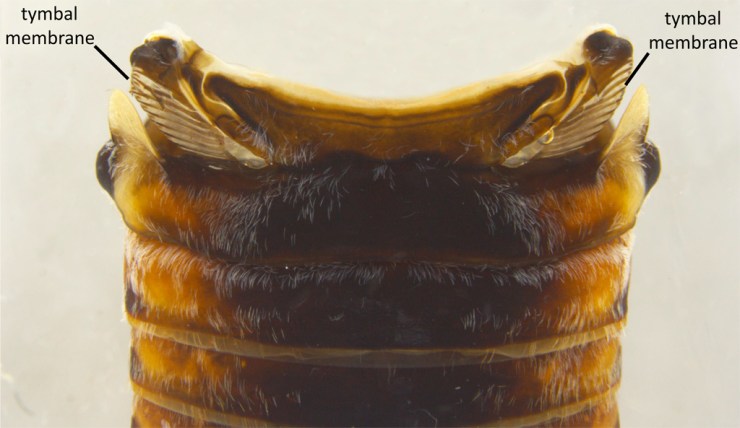
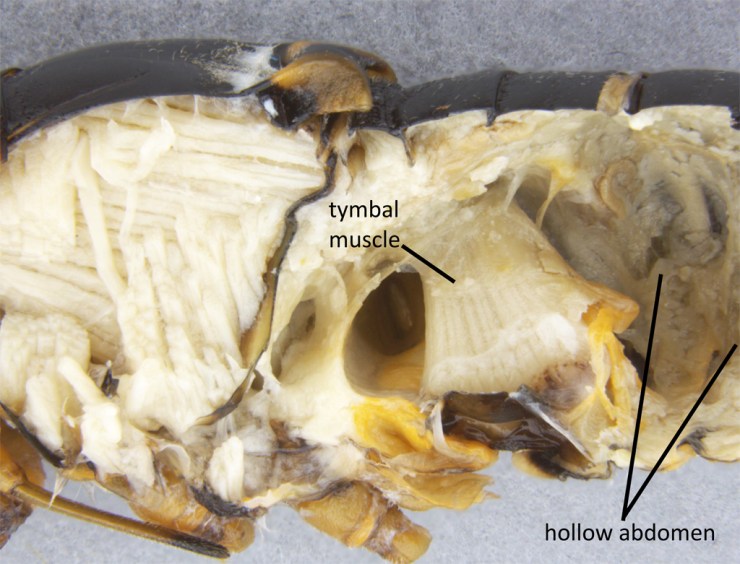
Cicadas have a unique membrane on the sides of their abdomen called the tymbal membrane, which is strong but flexible. Internally, two huge muscles attach to this membrane. When the muscles contract, they pull and buckle the membrane inwards to produce a strong popping sound. You can imitate this by squeezing an empty plastic bottle in and out. Speed up this process by a few hundred buckles per second and you get a cicada’s song.
PowerPoint Presentation
Dorsal view of the abdomen of the cicada Cicadetta flaveola, showing the two membranes on the sides of the abdomen (tymbal membrane).
Lateral view of a dissected cicada, Tibicen plebejus. The huge muscle attaches to the tymbal memembrane, and pulls it inwards to generate a loud click. Note that after the large muscle, the abdomen is largely hollow.
Lateral view of a dissected cicada, Lyristes plebejus. The huge muscle attaches to the tymbal memembrane, and pulls it inwards to generate a loud click. After the large muscle, the abdomen is largely hollow.

Producing sound however, is not enough. Just like we have to talk with a particular loudness so people can hear us, cicadas must find ways of amplifying their sound, so females can hear them from very far away. The way cicadas achieve this is via something called Helmholtz resonance. You can create this phenomenon by blowing air across the top of the empty bottle you just used to create the pop.

Blowing across a bottle produces sound due to the behaviour of air when it is confined in a container with an open hole. The abdomen of cicadas forms a Helmholtz resonator as well: it is completely hollow, and two openings on the underside, called tympana, act as the top of a bottle and radiate sound in the same way.
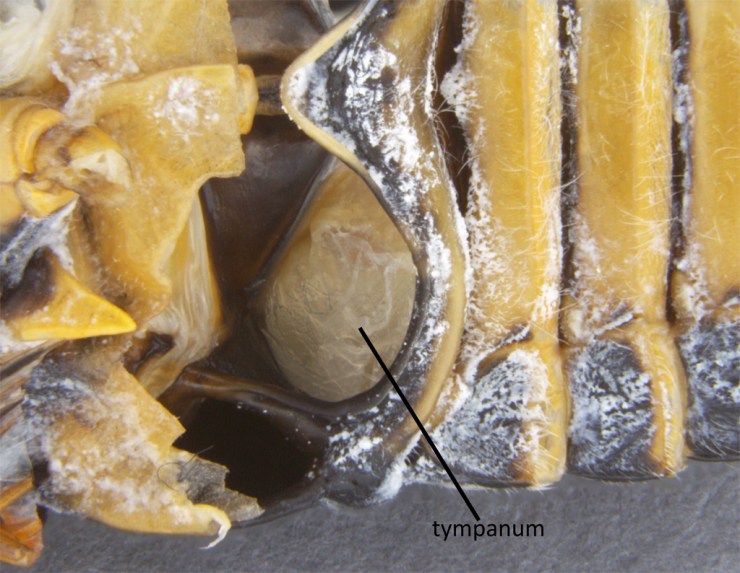
Ventral view of a dissected cicada, Tibicen plebejus. The large aperture is the tympanum, which acts as the amplifier for the cicadas' song. The hole of an empty bottle behaves in the same way when you blow air over it.
Ventral (underside) view of a dissected cicada, Lyristes plebejus. The large opening is the tympanum, which acts as the amplifier for the cicada’s song. The hole of an empty bottle behaves in the same way when you blow air over it.

The singing habits and unique anatomy of the cicadas are perhaps best summarized in a quote by 19th-century entomologist Jean Henri Fabre, who, poetically as always, said:

Assuredly one must be passionately devoted to music thus to clear one’s internal organs in order to make room for a musical box!

OFoN_logo_green block_small

Invasive crayfish

A Spotlight Specimens special for Oxford Festival of Nature

By Sancia van der Meij, Research Fellow

The White-Clawed Crayfish (Austropotamobius pallipes) is often assumed to be native in the UK, but was in fact brought across by monks in the Middle Ages from northern France

In the 1970s this was joined by a further seven invasive crayfish species from other parts of the world, but mainly from North America. Some of these species have a very restricted distribution in the UK, such as Procambarus acutus which is only known from a single pond in Windsor.

The most widespread of these is the Signal Crayfish, Pacifastacus leniusculus, which was introduced to Europe in the 1960s and reached the UK by 1975. It is now widespread in waterways around England, Wales and parts of Scotland. There are records of Signal Crayfish from all over Oxfordshire, in the River Thames, River Cherwell, canals and ponds, and they are fished for by many people as sport or food.

The Signal Crayfish is so named because of the blue-white patches on the underside of its claws, next to the finger joint. It is the easiest invasive species to identify given its large size, smooth carapace and signal spots.

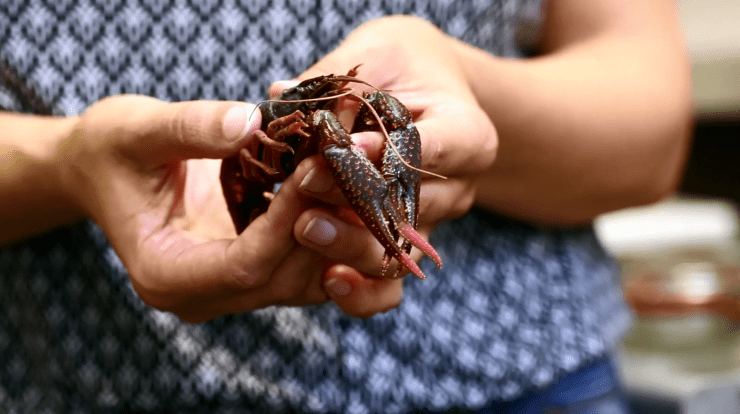
The Red Swamp Crayfish (Procambarus clarkii), from North America, is an invasive species in the UK

There are a number of information sites to help with identification such as the UK Crayfish Hub run by Buglife. The Non-Native species website runs a recording scheme for sightings of all invasive species too. Don’t worry though, the huge Tasmanian Giant Crayfish (Astacopsis gouldi) shown in the video clip has not made it to our waterways!

Whilst increased levels of water pollution and habitat degradation, fragmentation and loss have played their part in the decline of many crayfish populations, several species are also significantly impacted by the introduction and spread of a disease known as ‘crayfish plague’, a fungal disease is carried by some  North American species.

OFoN_logo_green block_small

Spiky spiders

A Spotlight Specimens special for Oxford Festival of Nature

by Steven Williams, research student at Oxford Brookes University

I have been interested in Thorn Spiders since I was 12 years old. People are often afraid of spiders but the ones I study are not harmful to humans and I think they’re quite beautiful when you get up close and see them under a microscope.

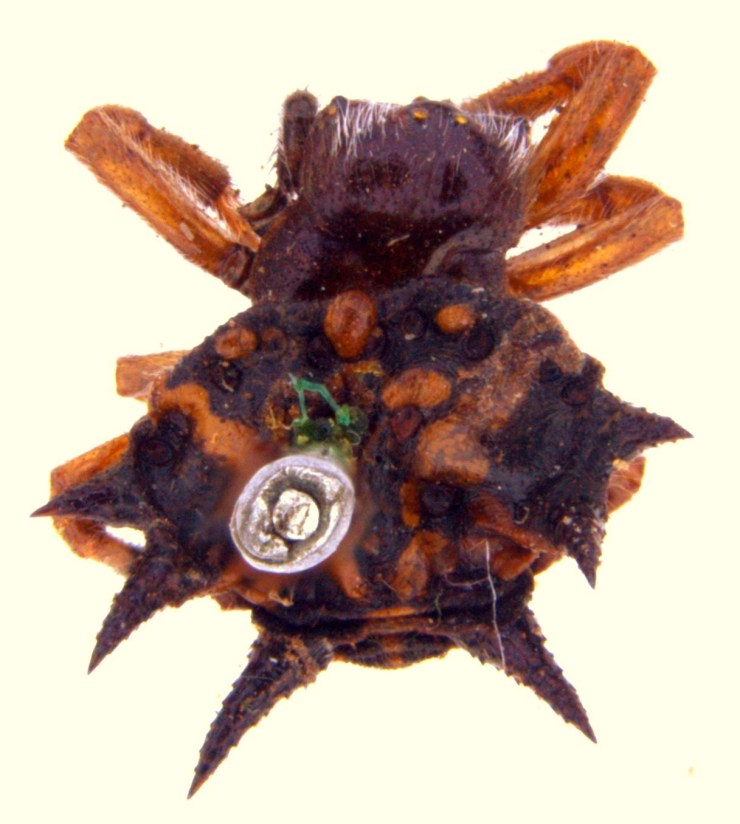
They get the name ‘Thorn Spiders’ from the spines that protrude from their abdomen. These are assumed to be a defence mechanism but this has not been confirmed. The female Thorn Spiders are the ones with the larger spines – some reaching several centimetres in length; the males do not possess such striking features.

IMG_9143
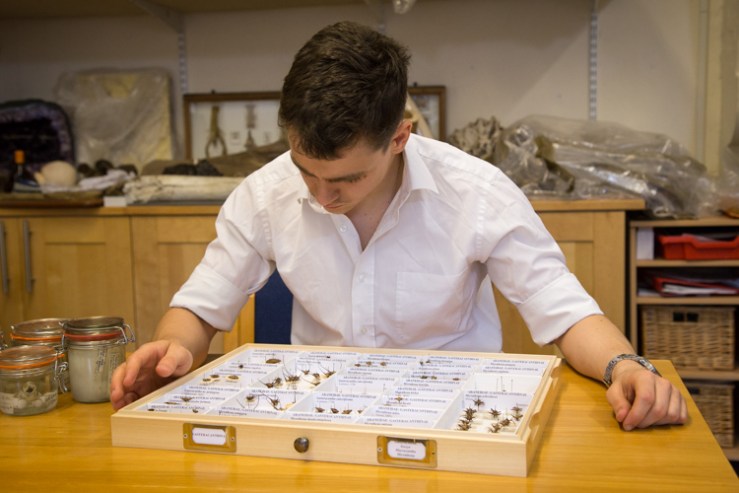
Steven Williams uses the Museum’s collections as part of his PhD research

My research revolves around how the different species of Thorn Spiders are related to each other and my aim is to create a kind of ‘family tree’ for the various species. I am also looking into the evolution of the spines and their habitats and distribution. They are commonly found across the Pan-Tropical region, with a few in the Americas and some in Australia. They are not found in Britain though unfortunately!

The handwriting on the specimen's label confirms that it was collected by Charles Darwin
The handwriting on the specimen’s label confirms that it was collected by Charles Darwin

Here are my three favourite specimens of these spiders from the Museum’s collection. The Australian Jewel Spider/Christmas Spider  (Austracantha minax), below, was collected by Charles Darwin on the Voyage of the Beagle when he stopped in Sydney, Australia.

I found this specimen when I was looking through the Museum’s dried spider collection; staff were not aware of its existence, and it is now stored with all the other Darwin specimens. We can confirm that it was collected by Darwin because the handwriting on the label is the same as in Darwin’s letters of correspondence.

sdfgf
An Australian Jewel Spider (Austracantha minax), collected by Charles Darwin during the Voyage of the Beagle

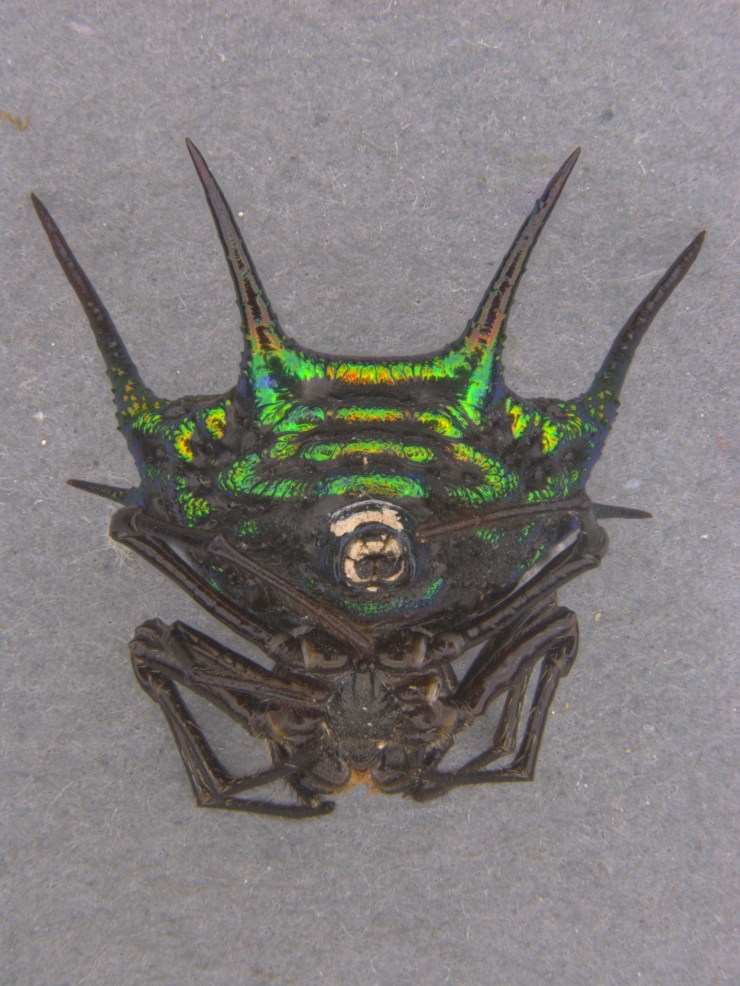
The metallic Thorn Spider (Gasteracantha scintillans), below, has a beautiful deep green metallic abdomen. It reminds me of a Ground Beetle’s wing cases and the rich metallic colour is something you wouldn’t normally see in spiders. They are only found in the Solomon Islands and this is a species I am working on currently for another area of my research, separate from my PhD.

Metallic Thorn Spider (Gasteracantha scintillans)
Gasteracantha scintillans has an unusual metallic green abdomen

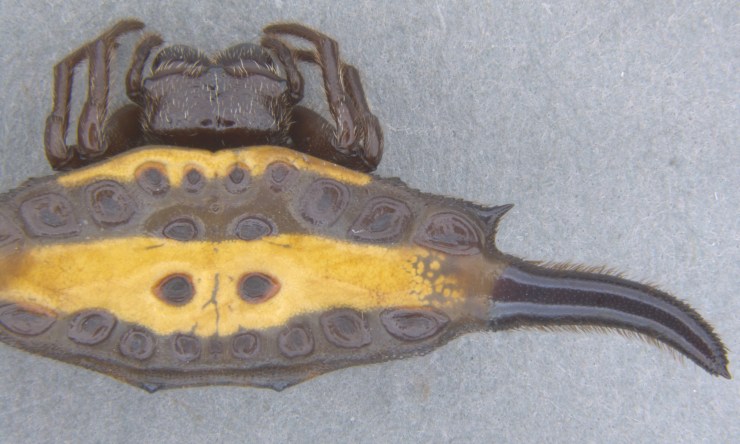
And this last one, Gasteracantha thorelli, I think is one of the coolest species of thorn spiders. I just love the large spines on this spider! The way the final pair of spines curve round reminds me of a bull’s horns.

Gasteracantha thorelli has some impressive 'horns'
Gasteracantha thorelli has some impressive spines that look like a bull’s ‘horns’

OFoN_logo_green block_small


A family of Clown Beetles

A Spotlight Specimens special for Oxford Festival of Nature

By Amoret Spooner, Life Collections

Within the order of insects Coleoptera – the beetles – is a family called Histeridae, also known as the Clown Beetles. This family is found worldwide and so far around 3,900 species have been discovered. Of these, 52 species are found in the UK and it’s these that I’m currently working on.

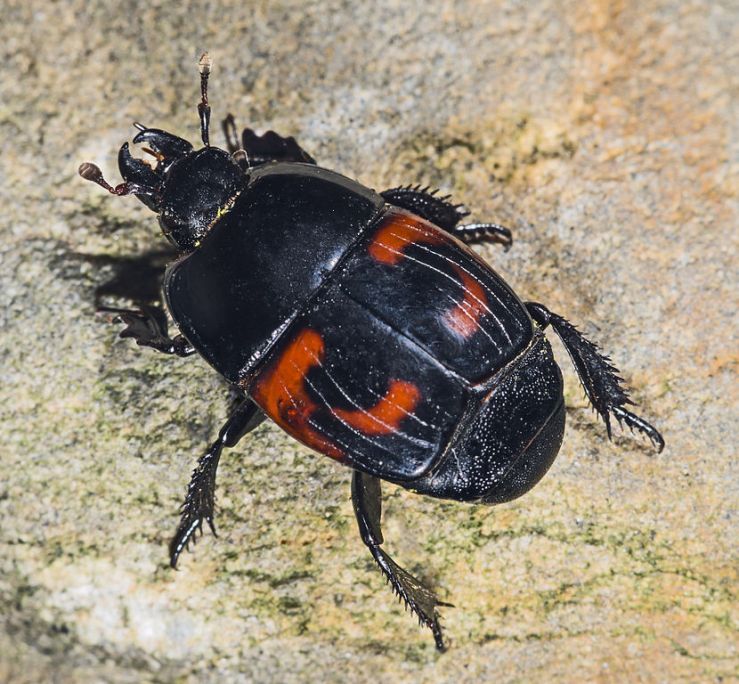
Histeridae aren’t the most appealing beetles to look at. They’re not very big, or round, and they don’t come in pretty colours. Basically they lack the wow factor… until you look at bit closer!  Hister quadrimaculatus is probably the biggest and most colourful of the British species; it is black with four red dots (it’s all in the name).

https://commons.wikimedia.org/wiki/User:Archaeodontosaurus
Hister quadrimaculatus. Image: Didier Descouens

Histeridae live in a variety of habitats, but are most commonly found in dung and carrion. Surprisingly though, they are not eating the dung or the dead animal; they are there for the fly larvae. Flies are attracted to decomposition, and the Clown Beetles take advantage of this. The adult female Histerid lays her eggs within these environments and three days later the larvae emerge to feast on the fly eggs and pupa.

Some of the more obscure species, such as the rare Haeterius ferrugineus live in ants nests, particularly those of the Slave-maker Ant (Formica sanguinea) and the Black Ant (Formica fusca). These types of Histerids vary in colour and modifications compared to the dung- and carrion-dwelling Histerids because they have evolved to live successfully with ants.

sdfsd
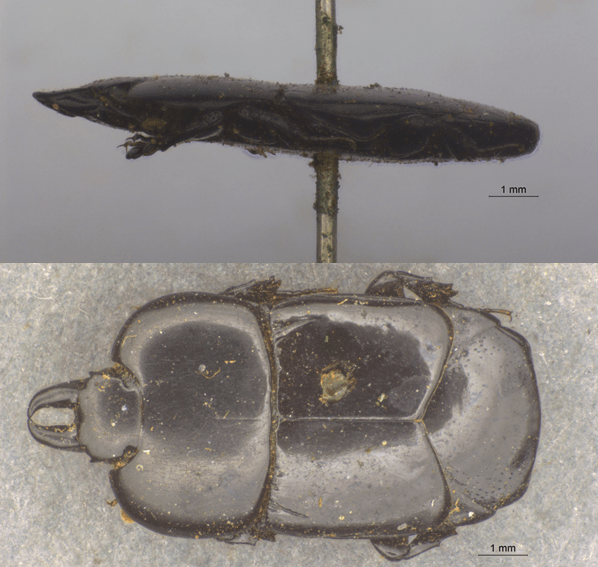
Hololepta plana is little more than 1mm thick, perfectly adapted for living under bark

Another species that differs from the norm is Hololepta plana; as an adult it is completely flat, adapted to live under bark and feed on the larvae of other invertebrates.

The Histeridae are a wonderfully diverse family, and we’ve got some pretty amazing examples of them in the UK. They may not be beautiful to everyone, but they are fascinating creatures that play a vital role within our environment and we’ve got a lot more to learn about them.

OFoN_logo_green block_small

From worms to stars

A Spotlight Specimens special for Oxford Festival of Nature

by Imran Rahman, Research Fellow

Starfish are among the most distinctive animals found along the seashore today. Together with other well-known forms such as sea urchins, sea cucumbers and brittle stars, they belong to a major group called the echinoderms, which is characterized by a unique type of symmetry — called fivefold symmetry. This means they can be divided into five roughly equal parts.

IMG_9013

In contrast, the closest living relatives of echinoderms are worm-like animals that have bilateral or mirror-plane symmetry, where they are divisible into mirror-image halves. It’s widely-thought that the common ancestor shared by echinoderms and other animals also had bilateral symmetry. Because they are so different to all other living animals, deciphering the evolutionary history of echinoderms, and their path from worms to stars, has proven a major challenge for scientists.

IMG_9006
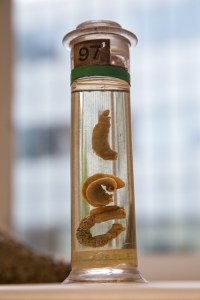
The closest living relatives of echinoderms are worm-like animals like these acorn worms Balanoglossus sp.) from Naples

Fortunately, fossils can shed light on echinoderm evolution. Echinoderms have an excellent fossil record because they possess a hard, mineralized skeleton, which greatly enhances their chances of being preserved as fossils compared to soft-bodied organisms. The first fossil echinoderms are over half a billion years old, and include extinct groups that show both bilateral and five-fold symmetry.

In addition, fossils are known that exhibit three-fold symmetry, as well as others that lack a clear plane of symmetry – they are asymmetrical. These fossils document the earliest history of echinoderms, and so could help us to better understand their evolution.

The fivefold symmetry of the starfish
The fivefold symmetry of the starfish (Randasia granulata from Madagascar)

Based on our understanding of living animals, and using modern methods for reconstructing the relationships of different species, it’s possible to infer that the early fossil echinoderms with bilateral symmetry belong at the base of the echinoderm evolutionary tree.

Print

The next branches in the tree lead to the asymmetrical fossil groups, and these are followed by those forms that show three-fold symmetry. Lastly, we see the diversification of forms with fivefold symmetry, including species belonging to the groups that still exist today, such as the starfish.

Using the fossil record, we can therefore see a clear picture of how echinoderms evolved from worm-like organisms into star-shaped creatures.

OFoN_logo_green block_small


Nature’s Waste Management Team

A Spotlight Specimens special for Oxford Festival of Nature

By Darren Mann, Head of Life Collections

One cow can produce over nine tonnes of dung per year. With a population of about 3.4 million cows in the UK alone, that’s a heck of a lot of dung deposited on our grasslands. Just imagine how much dung is produced every year if we include the output of horses, sheep, pigs, and all the wild animals out there.

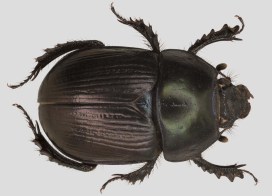
Dor Beetle – Geotrupes mutator

All of this dung is broken down by a multitude of invertebrates, including flies, worms, and beetles, as well as bacteria, fungi, and weathering. One of the key groups involved in the removal and degradation process is the aptly named ‘dung beetles’.

In the UK there are 61 species of dung beetle, though sadly just over half of these are now in decline and some have already become regionally extinct. UK dung beetles vary in size from just 3 mm to over 25 mm and occur wherever dung is found, though some prefer sandy soils and others like to live in woodlands.

Larvae in dung pile
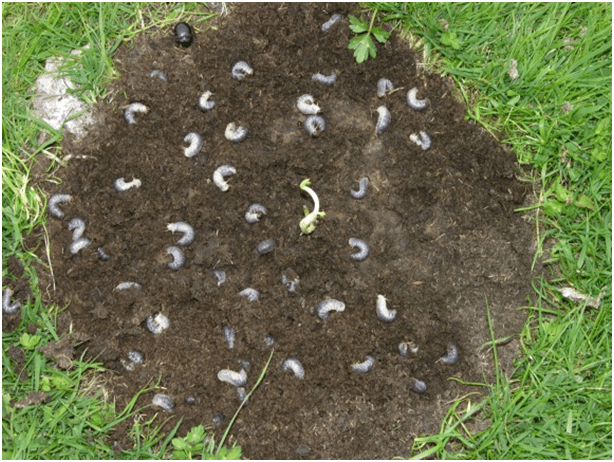
Dung beetle larvae (Aphodius fossor)

As adults, dung beetles feed on the liquid part of dung. The larvae of most of our species live inside the dung pile and are called the dwellers. These munch their way through the solid matter of the dung pile, gradually breaking it down over a few months. Other species such as Geotrupes mutator, pictured above, excavate a tunnel and bury the dung below ground. These tunnellers construct a brood chamber in which their young develop.

Aphodius fossor
Aphodius fossor

Through their actions, dung beetles perform a number of valuable ecosystem services. The most obvious is dung removal and degradation which leads to improved soil health by nutrient cycling and soil movement. By burying the dung they reduce the amount of available breeding habitat for pest flies and livestock parasites too.

All of these important services have been estimated to save the UK cattle industry £367 million per year. The value of dung beetles doesn’t end there as they also provide an important source of food for farmland mammals and birds. So next time you see a pile of dung in a field, just think of all the hard working beetles within…

Staff and associates of the Museum also run the Dung beetle UK Mapping Project – affectionately abbreviated to DUMP!

OFoN_logo_green block_small