The calm before the swarm

IMG_7427
Juliet and Pete painting wooden panels ready to hang Kurt’s work

In just 24 hours, our brand new exhibition will be open to the public. Bees (and the odd wasp) in my bonnet has been over a year in the making, but it’s all finally falling into place and an unexpected calm has set in.

The exhibition is an arts/science collaboration, with vibrant artwork by Kurt Jackson alongside bee specimens from the Museum’s collection and the latest scientific research on threats to British bee populations. Pop in and see it between 18 March and 29 September.

But let’s lift the gallery barrier and take a peek at some of the hard work that goes into putting an exhibition like this together.

IMG_7586
One of Kurt Jackson’s paintings is unwrapped

Back in November 2014, we first met with Kurt Jackson to discuss a new direction in his work. Famous for dramatic, dynamic landscape paintings, he had recently become particularly fascinated by bees.

He thought the Museum would be the perfect place to exhibit his new paintings and sculptures and, of course, we agreed.
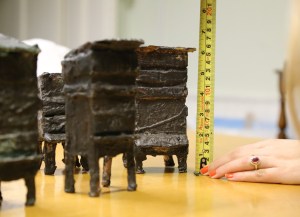
Measuring 'Hives' bronze sculptures
Measuring ‘Hives’ bronze sculptures

Fast forward 15 months and these works arrived at the Museum, couriered all the way from Kurt’s home and studio in Cornwall. We then spent several days unpacking, measuring, examining and photographing each of the pieces.

When the Museum takes on loan items, we need to fill in object condition reports so we can be sure how they come into the building… and how they leave at the end of the show! With 57 pieces to work through, it was a painstaking process, but we all relished the opportunity to get up close to the beautiful artworks. Holding them in our hands and visualising them on display was a special experience.

Examining the back of one of the largest paintings in the exhibition, "Vespa".
Examining the back of one of the largest paintings in the exhibition, “Vespa”.

While Kurt was painting, drawing and sculpting to create these works, we were also working hard preparing the exhibition space to show them off. Pete Johnson and Adam Fisk, from the Museum’s workshop, created large wooden panels to hang paintings, installed all sorts of intriguing 3D works and suspended fabric banners, to name but a few challenges. They’ve done a great job in creating a contemporary art gallery space in a Victorian museum.

IMG_7842
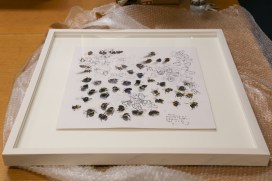
One specimen for each of the 270 British bee species

Bees are fascinating for artists and scientists alike. The scientific specimens and text panels interspersed among the artworks draw attention to the amazing diversity of British bees (almost 270 species in total) and explore the causes of population decline.

This was put together by James Hogan, in our Life Collections, but included further expert advice from Professor Dave Goulson of the University of Sussex and Professor Charles Godfray of Oxford University, to ensure all of the research was accurate and right up to date.

As we tick off the last tasks on our to do list, I can’t wait to see the exhibition buzzing with visitors from tomorrow morning.

Rachel Parle, Interpretation and Education Officer
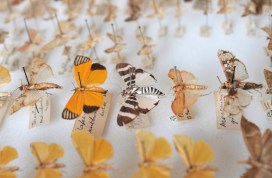
Ferocious, tree-like and beautiful…

Draws in Shelford room

Katherine Child has spent a lot of time photographing the Hope Entomological collections at the Museum; you may remember her beautiful work from the Light Touch exhibition in 2014. But with somewhere between 5 and 6 million insects in the collection, there is still plenty to explore.

Since September she’s been working on a project to photograph African moths and their labels for www.africanmoths.com, which aims to provide as much information as possible for the identification and recording of moths throughout the African continent. The site already displays thousands of images of stunning specimens, some taken in their natural environment and others from collections such as the one here in Oxford.

Katherine reveals some of the challenges and delights of her work:

**

Trying to track down moth specimens is a great excuse to browse some of the beautiful moths in the Lepidoptera collections.

One of the best things about this project for me is probably the fact that it involves exploring the collections to find all the moths that I need to document. The cabinets in the Shelford room, where some of the Lepidoptera are kept, contain drawer after drawer of beautiful and fascinating specimens, and trying to track down a particular moth is a good excuse to browse through the hundreds that are up there.

The photos below show some of my favourite specimens from those I’ve photographed so far.  Some I like just for aesthetic reasons, others have interesting historic labels, are cleverly camouflaged or have appealing names.

Paralacydes arborifera, for instance, is named because of the pattern on its wings; arbori is Latin for tree and fera refers to a beast or creature.  It is easy to see why this moth was named “tree-beast”.

Paralacydes arborifera and its labels: one of several thousand moths which will eventually go on to the African Moths website. Arborifera translates from Latin as tree-beast or tree-creature.
Paralacydes arborifera and its labels: one of several thousand moths which will appear on the African Moths website.

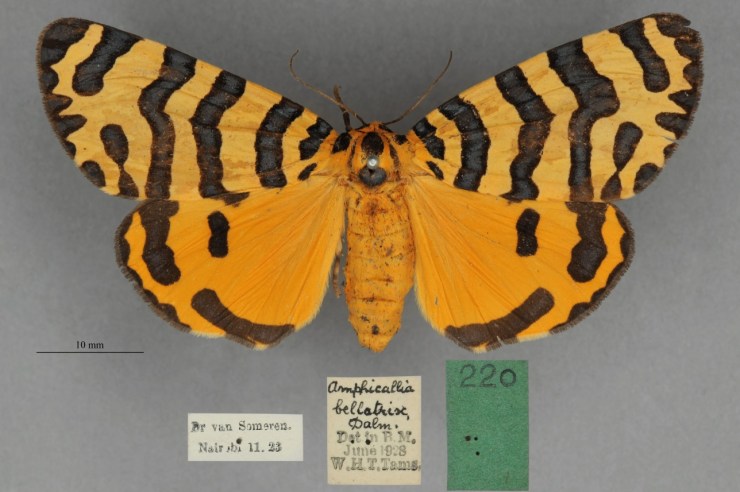
Amphicallia bellatrix was presumably given the name Bellatrix (meaning warrioress, war-like or ferocious) because of its striking warning colours.  As with the stripes on a bee or wasp, yellow and black tends to mean danger in the natural world.

Amphicallia bellatrix displaying the striking warning colours which give it the name bellatrix meaning warlike, ferocious or warrioress.
Eutomis minceus, found in South Africa, displaying beautiful iridescence.

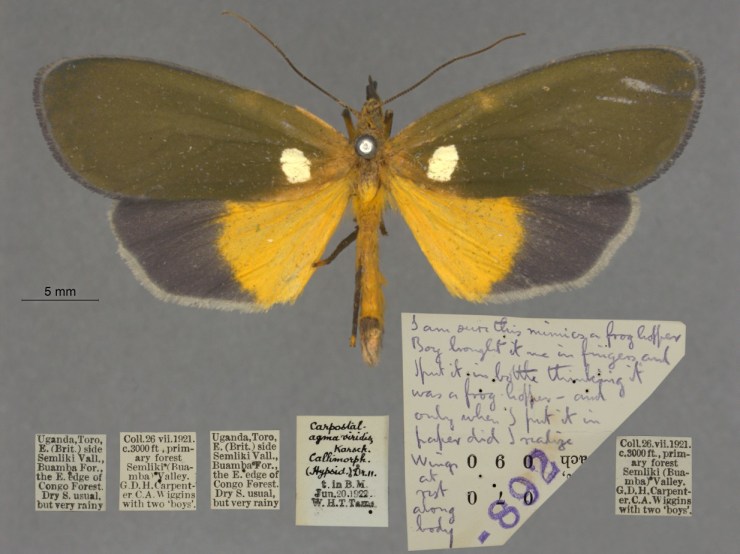
It is always interesting to see a little more information about how the specimens were found or caught. The description on the label below records how the moth was initially mistaken for a froghopper when caught by ‘boy’, and was only later identified to be a moth.

Photo of Carpostalagma viridis and its labels. The large label second from right reads: ‘I am sure this mimics a frog hopper. Boy brought it me in fingers and I put it in bottle thinking it was a frog hopper – and only when I put it in paper did I realise. Wings at rest along body.’

I look forward to photographing many more moths over the months to come!

Katherine Child, Image Technician, Life Collections

Visions of 2016

Bee 1

This year promises to be a little bit different. We’re looking at the Museum and its collections from a new point of view – through the eyes of artists, photographers and writers. We’re presenting different ‘visions’ of the natural world in a series we’ve called Visions of Nature. With a title borrowed from John Ruskin, there’s a definite nod to our Pre-Raphaelite roots, but there will be plenty of opportunities for an up-to the minute look at natural history, too. Here’s a few more details about what we’re planning…
Bee 2_crop

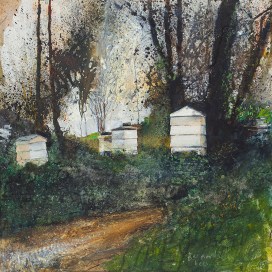
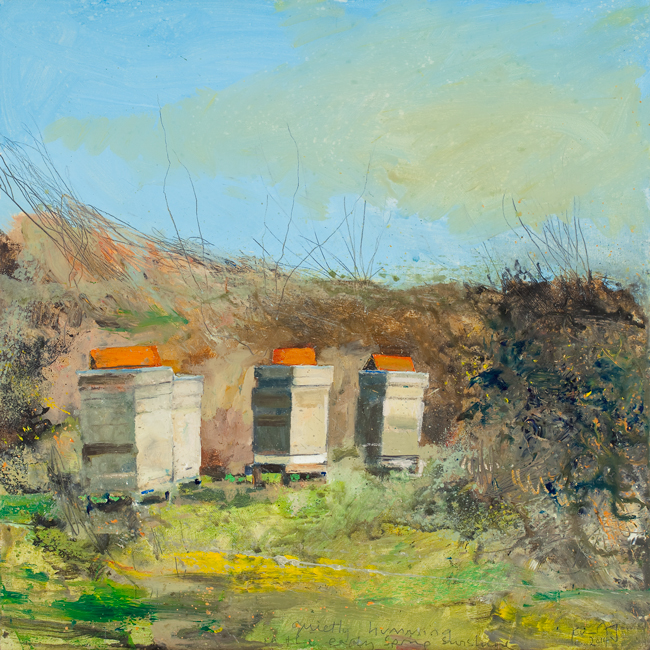
Kicking off this year’s exhibition programme will be a brand new show from artist Kurt Jackson. You may know his dramatic landscapes or even his work as artist in residence at Glastonbury, but this time, insects are the focus for his brush, pencil and chisel.

In Bees (and the odd wasp) in my bonnetwe’re bringing together Jackson’s beautiful paintings, sculptures and sketches with specimens from the Museum’s enormous bee collection and the latest contemporary research into bee population decline.

Bee 7

At the moment we’re choosing which specimens to include and are eagerly looking forward to a trip down to Kurt Jackson’s home in Cornwall to collect the artworks. With each bee pinned in place and every last painting hung perfectly, we’ll be opening the exhibition on Friday 18th March. There are lots of exciting events focussed around bees, too – including a special tour and talk by Jackson himself and a workshop run by a local beekeeper that describes how a bee colony changes over the course of a year. You can book a place on these and more here.

Exaerete Frontalis_Side View_v20

Next up will be Microsculpture; The insect photography of Levon BissThis really will make you see insects in a different light, with 10mm specimens blown up to 3m prints, all on display in the Museum court. Over the last couple of years, Levon, who is famous for dramatic photographic portraits of sports, music and film stars, has been working with James in our Life Collections team to select bizarre and beautiful insects. The result is a collection of beautifully-lit, high magnification portraiture that celebrates the amazing diversity of the insects and their morphology.

Visions of Nature logo_Single logoThe final third of the year will be centred around a literary vision of nature. We’ll be collaborating with some of our favourite natural history writers from the worlds of fact and fiction to offer an exciting programme of talks, debates and workshops. Key to this part of the year will be our poets in residence. Throughout 2016, three poets, John Barnie, Steven Matthews, and Kelley Swain, will be working alongside staff in our collections and out in the Museum itself to gain inspiration for their writing.
In the autumn, they will take part in a number of events and activities to present their work, and will be publishing a small anthology at the end of the year.

With plenty of other ideas in the mix, including exhibitions by Oxfordshire artists and photographers exploring the natural world and even a possible comedic vision of nature, there’s far too much to include here. So, there’s a dedicated Visions of Nature site, where you can find out about the poets’ latest inspiration, which exhibitions are opening soon, and what events you can sign up for. An exciting year ahead!

Secretarial work

After Treatment 2

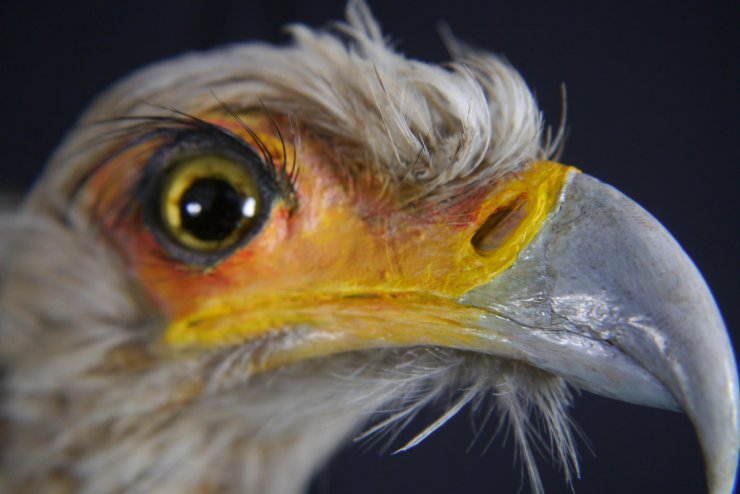
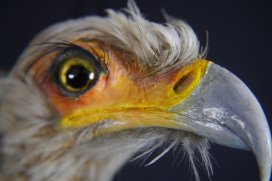
Our striking Secretary Bird stands at over 1 metre tall and should be one of the most impressive specimens in the Museum, but it hasn’t been looking its best for a while. This African bird of prey was looking rather sorry for itself, with scruffy feathers and moth damage. Conservation intern Ruth Murgatroyd stepped in to bring it back to its former glory.

**

Wrapped and ready for the freezer

The first step for any specimen undergoing conservation treatment is a 72 hour spell in the freezer at -30⁰C. This kills off any inhabiting webbing clothes moths, which can be very destructive to taxidermy specimens. Getting ready for the freezer required some creative packaging to protect the characteristic quill shaped plumage and tail feathers, before wrapping in plastic.

The feathers would need a good groom, which is a lot easier once they’re clean. I used dry methods first, including a brush dust with a vacuum cleaner and the very effective use of cosmetic sponges. The feathers were further cleaned with a gentle non ionic detergent in water and rinsed with a water/ethanol mix. I used a paint brush to dab the solution onto each feather individually.

Ruth cleaning tail feathers

When the feathers were clean and dry they were groomed to realign the filaments of the feathers, known as barbules. Parts of the bird’s tail and right wing were missing, so as this is a display specimen, we decided it was appropriate to recreate these areas to more accurately represent what the bird looks like in the wild. Any additions had to be easily identifiable and reversible. Goose feathers were sourced and colour-matched with Orasol dyes. They are now held in place by adjacent feathers and give a much more natural appearance.

Before treatment, with missing wing and tail feathers

The face of the Secretary Bird had been previously painted but this was quite faded in colour compared to the buoyant oranges and yellows of the animal in the wild. We decided to reflect this with a touch up. The new layer was painted in with acrylics, but a base layer of water soluble adhesive now protects the original paint, so layers of paint could be taken back at any time.

The finishing touch to the conservation of a taxidermy specimen is often to make sure the eyes are clean and gleaming. Saliva on a swab is really effective for this.

The Secretary Bird was then ready to go back in its newly-polished case. This had also been lined with UV film to protect the specimen from light damage. Just before it went back on display, the bird made an appearance at the Museum’s daily ‘Spotlight Specimens’ session where it met visitors keen to hear about its recent conservation.

Secretary Bird  back on display
Secretary Bird back on display

Pop in to the Museum to see the finished Secretary Bird on display and standing tall .

Ruth Murgatroyd, Conservation Intern

So long, 2015…

IMG_6901-Edit

As you can tell from the adornment of our Red Deer, Christmas is upon us, so it’s nearly time to bid farewell to another year. It’s been another remarkable twelve months here at the Museum so here’s a little round up a few highlights from 2015…

As winter gave forth to spring
News emerged of a heartwarming thing
The Art Fund whispered in our ear
We were nominees for Museum of the Year!

Although eventual winners we were not
It mattered really not one jot
For in celebration we embarked
On the Dodo Roadshow – a tremendous lark

Back in April we’re pleased to say
Another award came our way
Goes to Town gave creatures free reign
And grabbed a gong for Marketing Campaign

But we weren’t always on the road
In our exhibitions many stories were told
Of evolution, geology and sensory powers
Science and research passed the visitors’ hours

Our doors were open without interruption
While out on the lawn was a volcanic eruption
University scientists had plenty to say
On a really Super Science Saturday

So to our schools, and families, and adults and more
Thank you, cheers, and thank you some more

Here’s our programme for January to April. See you in 2016…

Out of order

Amphionides small

Our head of research, Sammy De Grave, is the lead author of a paper published in Scientific Reports last week. In this paper he and his co-authors propose to remove an entire ‘order’ of crustaceans. But just what is an order, and why would we want to get rid of one?

Biologists organise all life into ranked groups. The most familiar, and at the bottom level, are genus and species. These are recognisable in the format Homo sapiens, where Homo is the genus and sapiens is the species.

One of the higher groupings is called an order. For crustaceans, there are around 70,000 known species grouped into approximately 50 different orders. One of these orders is the subject of the paper mentioned above – it’s called Amphionidacea – and the odd thing about it is that it was created in 1973 for just one species, an enigmatic open-sea creature called Amphionides reynaudii.

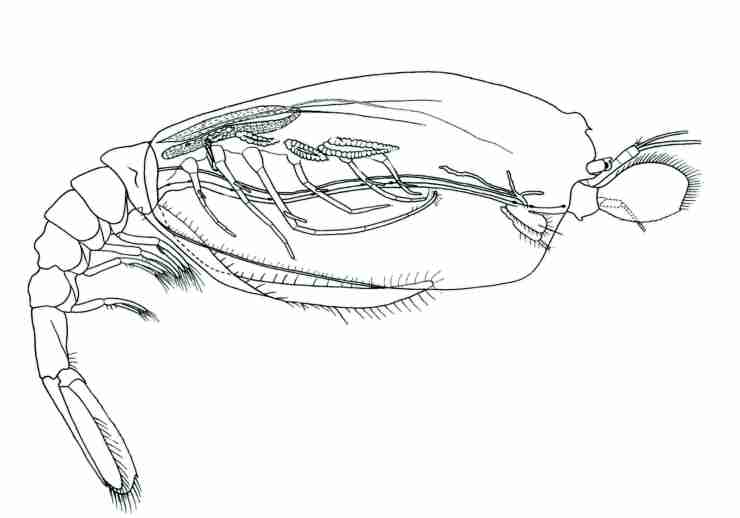
Presumed adult female of Amphionides reynaudii (after Williamson, 1973)

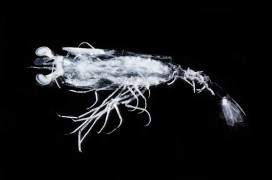
Although the species has been known since 1833, relatively few specimens have been collected and almost none since 1973. Some larval stages have but recognised, but only three adult males have ever been found and no intact adult females have been collected. The reference illustration above is a composite of 43 damaged specimens.

Lacking good research specimens, the status of this creature has long been debated. Luckily, in 2011 Jose Landeira, a biologist on Gran Canaria, collected six specimens. As usual they were extensively damaged (you can see this in the photograph at the top), but a specialist genetic lab at National Taiwan Ocean University was able to extract some small fragments of DNA.

Building on earlier work by a US group, the sequences were analysed and the results show that Amphionides is not a separate order after all, but merely a shrimp. You can see where it fits in the taxonomic scheme of things by clicking the chart below.

Out of Order Fig3
Phylogram of the Decapoda order of crustaceans, which includes crayfish, crabs, lobsters, prawns and shrimp. The position of Amphionides indicated in red (click to enlarge)

In keeping with its oddball status, however, many questions remain unanswered. Amphionides larvae have been recorded across all oceans from the tropics to subtropics, but almost no known shrimp species have such a distribution as adults. And although the genetic analysis reveals a strong affinity to a single family of shrimp (Pandalidae), it remains unclear which genus or even species it could be the larvae for.

So Amphionides may be removed from its order, but the mystery of the little shrimp lingers yet…