It’s offishal!

Tuna 1

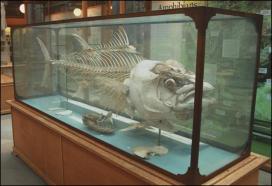
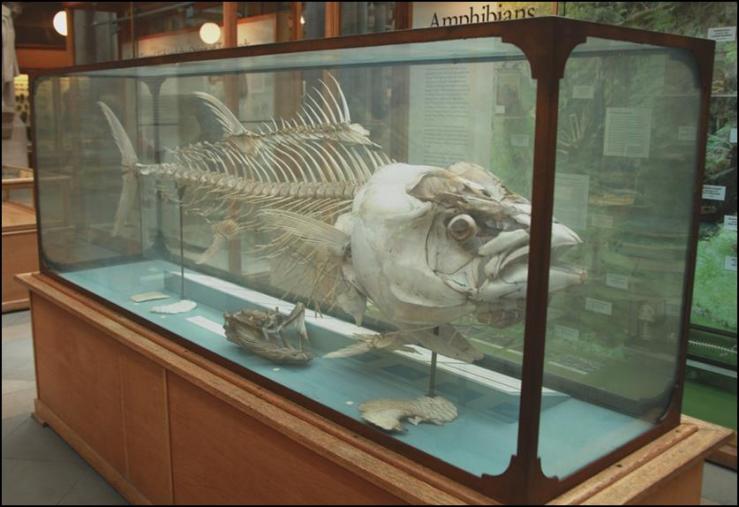
This skeleton has been on Bethany Palumbo’s conservation hit list for some time. As the Conservator for our Life Collections, she keeps a close eye on specimens that need a bit of TLC, or indeed a full make-over. Bethany and team have now been given the go-ahead to dedicate their attention to the Atlantic Bluefin tuna (Thunnus thynnus), located in the Museum court. The project will kick off on November 9th and should take around 4 weeks to complete.

This specimen has a long and interesting history. It’s been on display in the Museum since it opened in 1860, but records show that it was previously displayed in the Anatomy Museum at Christ Church College, Oxford. The fish was collected by Dr. Henry Acland, a leading figure in the establishment of the Museum. He obtained it through the Consul of Maderia in 1847 and its remarkable story was recorded in a historical review of the Museum Zoological collections (1976).

‘…the fish had been packed in salt and placed in an eight foot-long box addressed to ‘Dr Acland, Oxford’. During the voyage, the crew and passengers had become convinced that the box contained the corpse of a patient which in their superstitious minds was sufficient to account for the storm in the Bay of Biscay. The crew and passengers could not be convinced otherwise and Acland submitted to the opening of the ‘coffin’ by the ship’s carpenter, who unscrewed the lid before the assembled company, to reveal the tunny for all to see. It was eventually delivered to the Museum at Christ Church in perfect condition, the skeleton being later carefully articulated by Charles Robertson’.
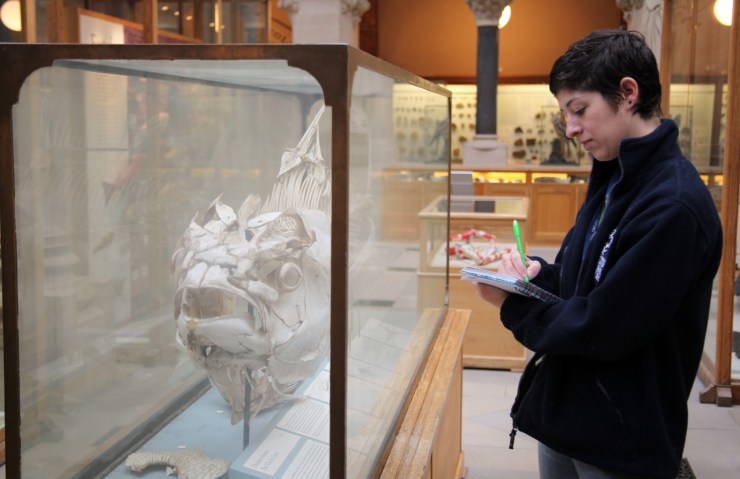
Conservation intern Abby assesses the condition of the Bluefin Tuna in order to develop a plan for treatment.

Now classified as an endangered species, this Bluefin Tuna also has significant scientific, as well as historical importance. Our conservators will take this into account, ensuring that any treatment is carried out sensitively. To allow Museum visitors to watch conservation in action, the work will be carried out right in the Museum court. Bethany is looking forward to lots of conversations with the public about all things fishy!

Rachel Parle, Interpretation and Education Officer
5 fantastic earwig facts

P1110897

Nigel Cook is one the last of our summer interns to fly the nest. He’s just come to the end of an eight-week placement as part of his MA in Museum Studies at Leicester University, and has been based in our Life Collections. Over this time with us, he’s developed an affection for an unlikely insect.

**

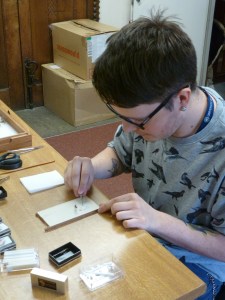
Nigel working on an earwig specimen

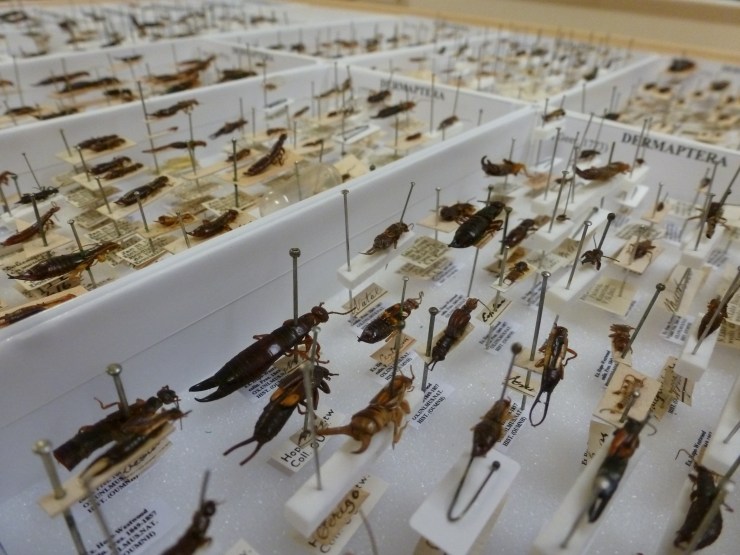
I have been working with a historic collection of earwig specimens (some over 100 years old!), ensuring that they are safely moved into new storage and given some care and attention on the way. There was a time when the word ‘earwig’ would send a shiver down my spine, as I recalled childhood tales of eggs being laid in my ear as I slept. But now I know better; earwigs don’t make their homes in ear canals, you are much more likely to discover them under stones, or the bark of a tree.

Like me before the start of my project, few people know anything about this fascinating order of insects, so here are 5 amazing facts I have learned during my internship that might change the way you think about them.

  1. Mum’s the word

Unusually for non-social insects, earwigs make great mums! In several species, earwig mothers will stay and care for their eggs in a makeshift nest. They provide the eggs with warmth, fend off predators, and even clean the eggs regularly in order to prevent fungus growth.

  1. “Skin wings”
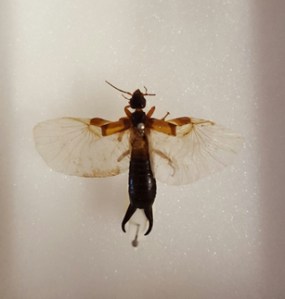
An earwig with wings unfolded

Earwigs belong to the order ‘Dermaptera’, a Greek name which is derived from the roots “derma”, meaning skin, and “ptera”, meaning wings. This is because most species have a pair of thin hind wings which fold neatly under a shorter pair of forewings, called tegmina, which act like a protective casing.

Yes, earwigs can fly! Although they rarely use this ability, it has helped them to spread worldwide.

  1. A strong grip

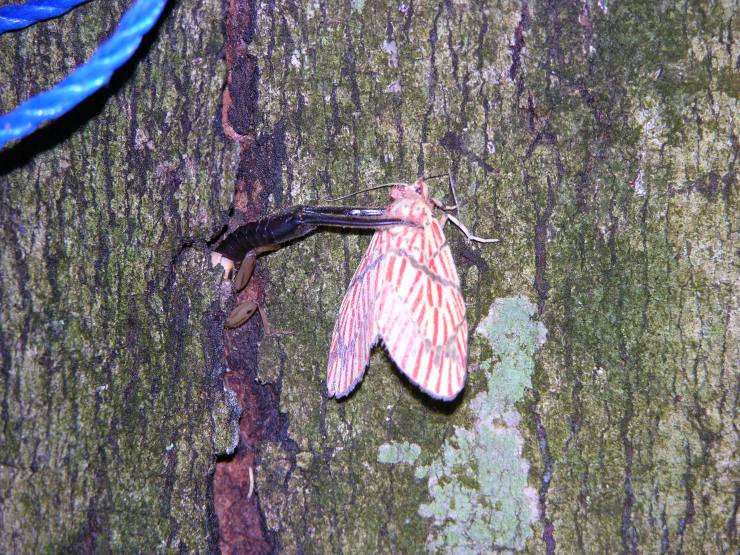
Moth earwig large

Many earwig species feed on decaying plant and animal matter, some eat living plants and others are predators. These carnivores usually prey on smaller insects, but with the use of the pincers (or ‘cerci’) on their abdomens, some earwigs are capable of snaring much larger insects. These pincers can vary in shape and size from species to species, and even between males and females.

  1. That itching feeling…

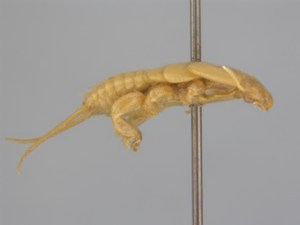
Earwig pinIn the jungles of Africa, there are giant pouched rats far larger than the rats we might see scurrying around our cities. Within the fur of some of these rats lives a very odd earwig; those of the family ‘Hemimeridae’.
These tiny insects are ‘ectoparasites’, spending their entire lives on the rats. Wingless and blind, they barely resemble earwigs at all.

  1. Darwin’s collection

During his great expeditions around the globe, Charles Darwin personally collected many specimens to support his theories. Amongst these specimens were earwigs, some of which survive in museum collections to this day, including several here at the Museum of Natural History.

P1110899Although earwigs have carried a bad reputation for many years, it’s important to realise that they pose no risk to humans.

They are a diverse, widespread and very successful order of insects that have been wrongly labelled as ear-invaders. So the next time you find an earwig, see it the way I do now: as a fascinating insect that’s just a little misunderstood.

Nigel Cook, Entomology Intern

Getting a grip on Life

Frogs

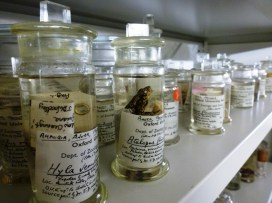
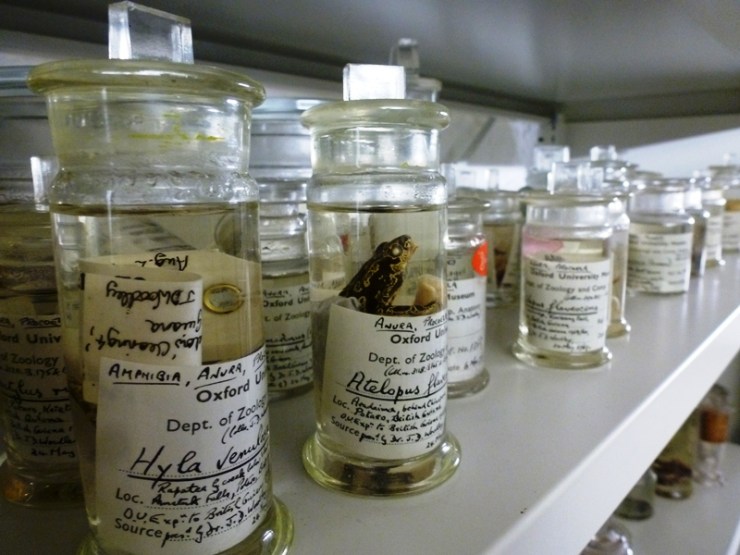
Hello. My name is Mark Carnall and this is my first post for More than a Dodo. It’s my third week as the new collections manager for Life Collections here at the Museum, which means I now have responsibility for all of the life-related material that isn’t entomological (so no insects, spiders, millipedes and other creatures which loosely fall under the term ‘minibeasts’).

Mark CarnallWhile I’m thankful that my job is made a little easier for not including roughly two thirds of animal life, it’s challenging enough: microscopic snail shells up to entire whale skeletons – and everything in between – fall under my purview.
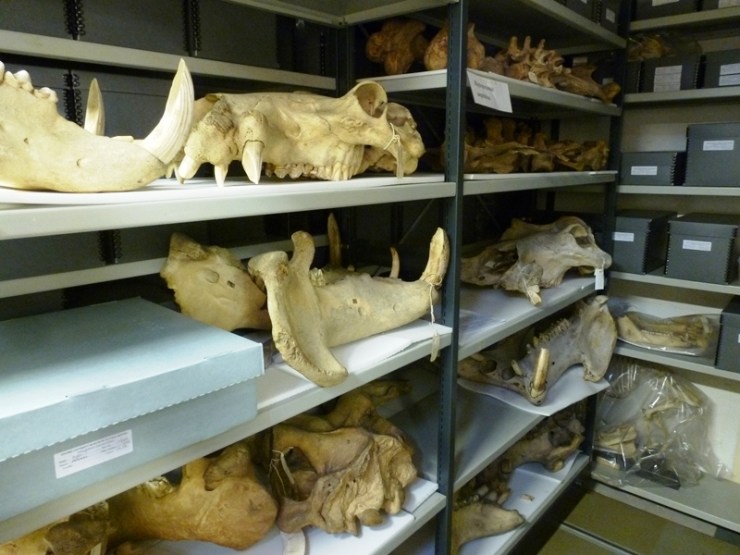

There are approximately half a million specimens in my care: mammals (including humans), birds, fish, reptiles, amphibians, sponges, corals, jellyfish, molluscs, echinoderms (starfish, sea urchins and their allies), and a whole host of more obscure but equally interesting animals.

Hippopotamii, hippopotamuses Skulls of hippos in the mammal osteological store

How does one go about getting to grips which such a large and varied collection? Well, rather than starting at aardvarks and working through to zebras, perhaps the best way to learn about the collection is by facilitating the use of it.

Already, enquiries have been coming in from researchers, other museum professionals and members of the public. So far, I’ve had questions about preserving giant squid; the number of gorilla specimens we hold; the sexy parts of crabs; the history of the whale specimens on display; the identity of a bird-footed cup; and a number of queries about our human remains material.

I’ve also been taking the time to geek out over explore the collections, and there’s barely a drawer or cabinet that doesn’t have a first, largest or oldest. It’s not all treasures though: there’s material that scientists might regard as barely interesting as a data point, but is perfect for engaging and enthusing visitors in displays, events and workshops.

Molluscs- Sun dappled mollusc cabinets. I love the smell of molluscs in the morning.
Sun-dappled mollusc cabinets. I love the smell of molluscs in the morning.

This was highlighted in my first week here when a visitor brought a specimen in for identification. Although it was ‘just a cow tooth’, its owners were so happy to solve their mystery that they wanted to print and frame the identification (hopefully this sparked a lifelong interest in natural history too).

So I’ll be spending the next weeks finding my way around the collections and you’ll be discovering it all at the same time through blog posts here, my Spotlight Specimen slots in the Museum and no doubt through our jam-packed public events programme.

Next time, I’ve got a whale of a tale for you. Or perhaps that should be tales of a whale for you…

Mark Carnall, Collections Manager, Life Collections

Delving into dung

25

Each summer we host a variety of interns, working both in the collections and with the public. Oxford University student Maria Dance has now come to the end of her placement and reflects on the delights of dung beetles and what they can teach us about ecosystems.

**

Over the past six weeks I have been working in the Hope Entomological collections, home to an estimated 5 million insect specimens. Coming fresh from my second year studying biology at Oxford University, I have been working on a project to sample-sort and identify dung beetles from the SAFE project in Sabah, Malaysian Borneo.

A very short introduction to dung beetles
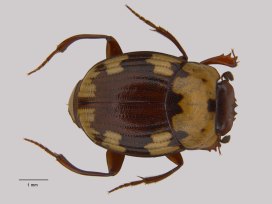
From the order Coleoptera, sub-family Scarabaeinae, most true dung beetles feed exclusively on dung. Some roll dung away from the main pile and bury it for food or as a brood site, some tunnel below the dung  and bury it that way, and others are “dwellers” and simply live in it. All are essential groups for ecosystem functioning and provide indispensable services from which humans benefit; dung beetles recycle nutrients, rework soils, and act as secondary seed dispersers.

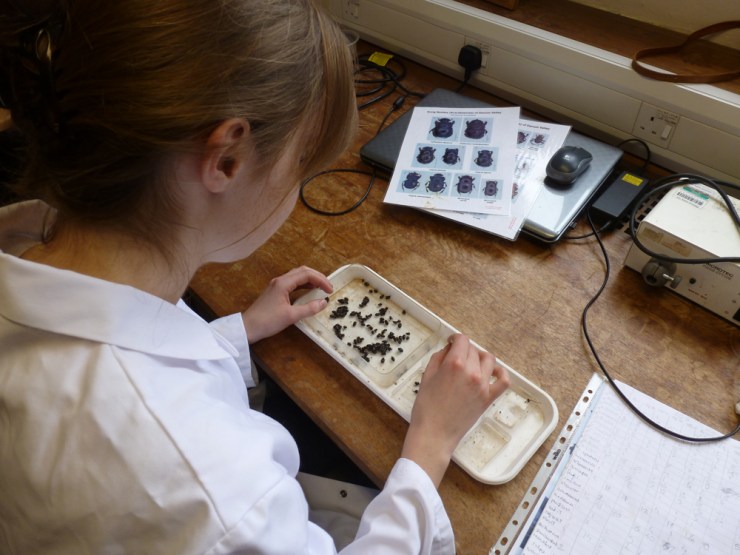
Maria sorting through a dung beetle sample

Dung beetle research at Oxford

Researchers at Oxford are studying the link between dung beetle biodiversity and ecosystem functioning to predict the true environmental consequences of human-driven habitat loss and fragmentation in the tropics. So I have been identifying beetles to calculate diversity, which is then compared across sites with very different human disturbance levels. Dung beetle diversity and community composition are good proxies for ecosystem functions as we know the roles that different groups of dung beetles play.

More than an intern

P1110406
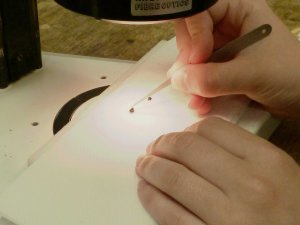
Working on tiny dung beetle specimens

The starting point is for me is material collected from (human) dung-baited pitfall traps, which I search through and extract all dung beetles from; it’s a smelly, tricky job that needs a sharp eye as some beetles can be as small as 2mm in length!

Next comes the hard part: identification. Darren Mann, Head of Life Collections at the Museum and dung beetle taxonomist extraordinaire has guided me through the process. It was particularly difficult to identify the Bornean species due to the lack of good primary literature. A microscope is essential, as many characters used to identify species are not visible with the naked eye.

P1040924
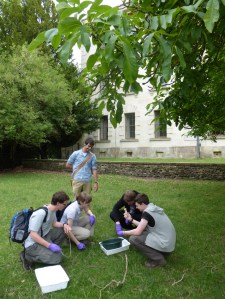
Students sampling for dung beetles at Magdalen College deer park

As my internship draws to a close, I have identified 6851beetle specimens to 56 species. I have also carried out some initial analyses: comparing diversity between habitats, and between data from 2015 and 2011.  I want to find out whether differences over time are more significant than differences between habitats.

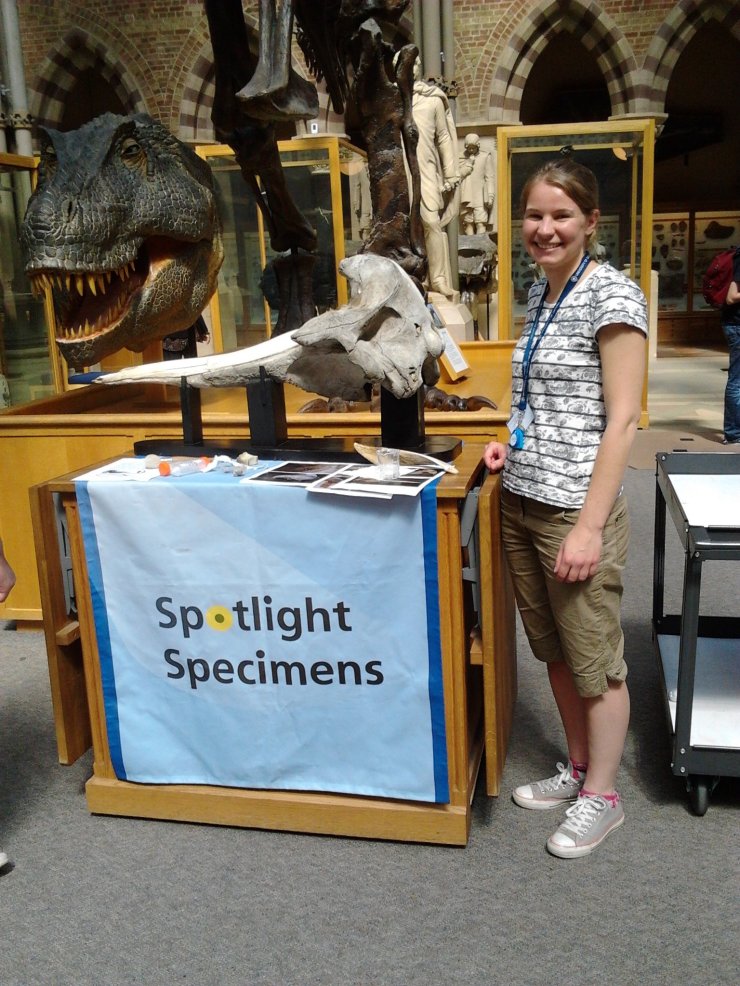
In my last week I was fortunate enough help run a “Spotlight Specimens” session about silk worms and their fascinating, human-dependent existence. In the sessions, experts from the Museum collections show intriguing objects and specimens that are not usually on display. Visitors were able to interact with live silk worms and see them cocoon-building, while we answered questions.

In September I travel to Borneo for a field course, where I hope to put my newly-learnt identification skills to practice. Over the past six weeks I have become more enthused by taxonomy, tropical rainforest ecology but, most importantly of all, dung beetles!

Maria Dance, Intern in Life Collections

The legend of the Layardi Whale

After - seperate proper right

The Museum gains a new buzz over the summer as we’re joined by a host of interns. Many are students who require a placement as part of their university degree. Ruth Murgatroyd, who is in her first year of the MSc Conservation Practice programme at Cardiff University, is spending her summer putting a variety of conservation skills into practice in our Life Collections.

During our 2013 year of closure, five large whale skeletons received extensive conservation treatment, which was described and documented on the Once in a Whale blog. Here, Ruth explains that there is more to be done conserving other whale specimens in our collection, and describes the careful work that it takes to bring them back to their best.

**

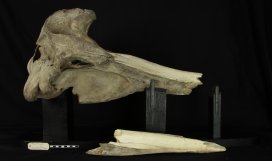
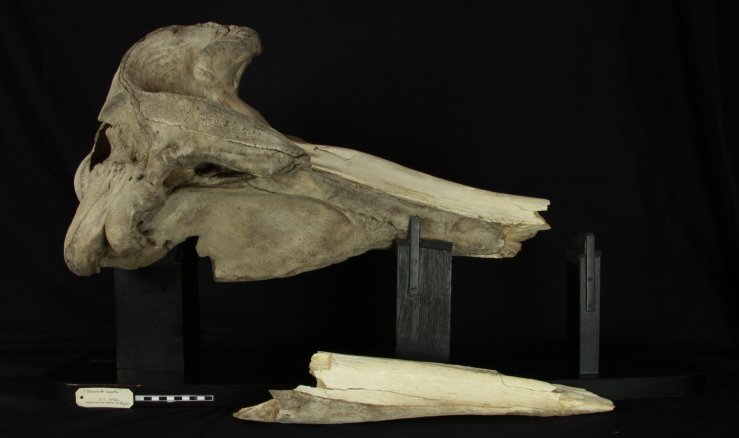
One of the specimens I’ve been working on in the lab is the skull of a Layard’s Beaked Whale (Mesoplodon layardi). As with many historic specimens, past repairs had become damaged or discoloured. The porous bone that allows whales to be buoyant under water had darkened and acquired staining and tide marks. It needed some attention.

Before PL Break
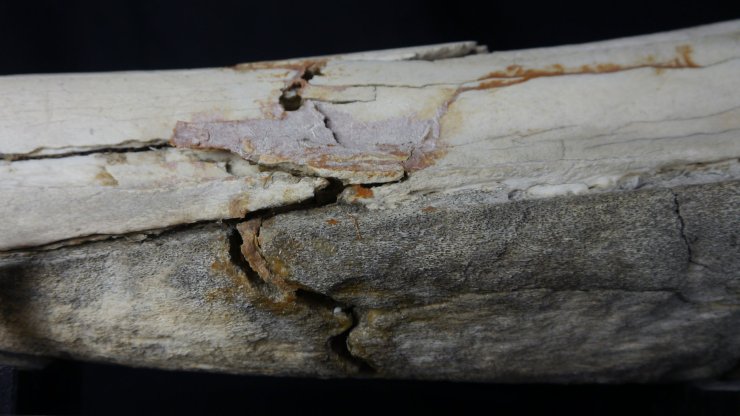
The brown material is animal glue, used in a previous conservation

It’s important to research specimens, to gain a full picture of the animal and its origin. This one turned out to have a particularly interesting story. I knew that the whale’s skull entered the collection in 1874, coming from Cape Point, South Africa, and attributed to J. Mackellar. Over tea time conversations with a colleague in the Museum it came to light that it might be the same whale mentioned by Henry Moseley (1844-1891), a naturalist on board the HMS Challenger voyage. In Moseley’s Notes by a Naturalist he mentions finding a Layardi cranium on a beach “near Mr Mckellar’s” in Cape Point in 1874. He described how it had its beak pushed into the sand and was being used as a target for rifle practice.

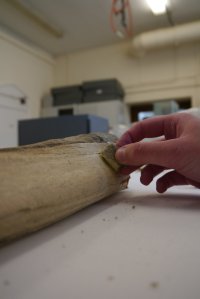
Cleaning with the rubber smoke sponge

After assessing the condition and taking pre-treatment photographs, I decided that the main objectives of the conservation were to remove past unsympathetic repairs; consolidate the bone around a break; clean the staining; and provide padding to the wooden support.

Cleaning needed different techniques depending on the location and the problem. Brush dusting with a vacuum cleaner and dry cleaning with a rubber smoke sponge was the first stage, followed by more specific treatments for ingrained stains. They were treated with poultices, which slowly release water into the pores of the bone and draw out soluble impurities as they evaporate.

I removed the brown adhesive using water on a swab. A pungent smell was given off that tells me the last conservator had used animal glue. I replaced this with an easily reversible acrylic resin.

The beak had been severely damaged (perhaps from the rifle practice!?), but its weight poses a conservation problem. An adhesive strong enough to support the weight of the repair is likely to be stronger than the bone and any stresses on the repair may result in further damage to the bone rather than to the adhesive. As the whale is going back into store for now, we decided that the two fragments will be left separate. The two fragments can be seen here in the wooden support.

After PR
Both fragments together in a wooden support

Although we can’t be sure that this is the Challenger whale specimen, the possibility certainly added an extra level of intrigue to this fascinating project.

Ruth presenting the whale to visitors as part of our Spotlight Specimens strand
Ruth presents the whale conservation work to visitors as part of our Spotlight Specimens strand

Ruth Murgatroyd, Intern, Life Collections

Mad about minibeasts


Bark_beetles1

Minibeasts are everywhere, and there are millions of them! These little invertebrates can be found in every environment on the planet.

Woodlands are great places to look for minibeasts as they are home to a large number of specialist species. This is because a wood contains a diverse range of habitats including dead wood, open areas such as grassy glades, the tree canopy and understorey layers where the smaller woodland plants can be found, as well as leaf litter and rich soils.

If you fancy going on a hunt for some minibeasts yourself, here are a few things you could look for in different kinds of habitats.

Dorcus parallelipipedus
Lesser Stag Beetle (Dorcus parallelipipedus)
Lesser Stag Beetles, like their larger relatives the Greater Stag Beetles, are dependent on decaying wood. The larvae can take two or more years to develop in the old wood and the adult lives for about two years. They are mainly active at night but can sometimes be seen by day or tempted out in the early evening by a sweet treat such as maple syrup.

Beautiful butterflies such as the Speckled Wood, Brimstone and Hairstreaks can be found flitting around in woodland glades, visiting flowers and looking for mates.

Speckled Wood
Speckled Wood Butterfly (Pararge aegeria)
Bumblebees are also frequent visitors. There are 24 species of bumblebee in the UK but there are only about eight that are commonly seen. When a bumblebee has visited a flower it leaves a chemical message to tell the other bumblebees that it has been there and not to bother investigating as the nectar has already been plundered.

There’s plenty more to discover too, from pseudoscorpions to the importance of aphids in the food chain of many ecosystems…

If you’d like to learn more then come along to Wytham Woods in Oxford at 10am on 22 July or 26 August and help us see what we can find in a 90-minute guided walk around the woods. The event is free, family friendly (ideal for children 7+) and an expert will be on hand to help with minibeast identification too. For more information and to book email ceri.watkins@oum.ox.ac.uk.

Ceri Watkins – TCV Natural Talent Trainee