Get on your soapbox


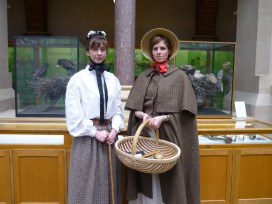
Mary Kingsley (l) and Mary Anning (r) prepare for their appearance in Soapbox City
Mary Kingsley and Mary Anning prepare for their appearance in Soapbox City

As April draws to a close, Oxford prepares for the traditional May Morning celebrations. Alongside the choir singing on Magdalen Tower, the reckless students leaping from the bridge and morris dancing in the medieval streets, you will find staff from Oxford University Museums joining in with the revelries.

An early-morning dung beetle will be taking to the soapbox

The Museums have taken charge of a one hour slot, from 8-9am, with staff from the Museum of the History of Science, Pitt Rivers Museum and, of course, the Museum of Natural History taking to the stage during the hour. If you’re willing to get up bright and early, you’ll be able to see a giant dung beetle arguing the value of his species, a T rex in a rap battle with a dodo, and two dignified ladies visiting from the past to remind everyone just how significant they really were.

Ellena Smith, ASPIRE Assistant across the Museums, is co-ordinating the Museums’ slot. She says;

Soapbox City is a fantastic opportunity to share knowledge and insight from Oxford University Museum staff in a fun and exciting way, and a great chance for the Oxford University Museums to reach out to a new audience.

Here’s the full timetable for the Museums’ shift:

08:00 Shooting Holes in Pitt Rivers Myths, Helen Adams (Pitt Rivers Museum)

08:05 Music in the Museum, Kelly Smith (HLF Trainee)

08:10 Conservation Station, Bethany Palumbo (Museum of Natural History)

08:15 Cockroaches: Pets or Pests, Darren Mann (Museum of Natural History)

08:20 Why the World needs Dung Beetles, Chris Jarvis (Museum of Natural History)

08:25 Natural History Stand-up, David Legg (Museum of Natural History)

08:30 T rex Vs the Dodo Rap Battle, Steven Williams (Museum of Natural History)

08:35 A Tale of Two Marys, Caroline Cheeseman and Rachel Parle (Museum of Natural History and Joint Museums Volunteer Service)

08:40 Why older people are radical, Helen Fountain (Museum of Oxford)

08:45 Geek is Good, Scott Billings (Museum of the History of Science)

08:50 When History Goes Wrong, Stephen Johnston (Museum of the History of Science)

08:55 You think you are smart?! Silke Ackermann (Museum of the History of Science)

If you’re up early for the festivities (or still awake from the night before!), do join us on Broad Street for a little May Morning museum madness.

Rachel Parle, Interpretation and Education Officer
 

A fly-ing visit

FliesThe Museum lawn has been buzzing for the last few days. Mostly it’s families enjoying a picnic in the warm sunshine before coming into the Museum for our Easter holiday activities, but there have also been a few insects adding to the hum. Darren Mann, Head of Life Collections explains;

In autumn and spring you may notice large swarms of flies on walls, fenceposts and especially on cars. Most often these aggregations are of the autumn house fly (Musca autumnalis), a beautiful fly which sadly can also be a pest.

The fly occurs across the temperate latitudes of Europe, northern Africa, and central Asia, but was introduced to North America perhaps through military transport or domestic commerce, in the 1940s.

Musca autumnalis
Musca autumnalis


Although Darren says they are one of his favourite flies, he does admit that the autumn house fly has some rather unappealing habits;

They overwinter as unmated adults and emerge in spring, often clustering in large swarms to sun themselves. The breeding seasons begins in spring and after mating females disperse into the surrounding environment to find suitable dung in which to lay their eggs. The yellow maggots (larvae) live exclusively in the dung of cattle, and help the process of nutrient recycling.

Unlike many flies, there is strong sexual dimorphism; the males are marked with orange on their abdomen, while the females tend to be all grey.

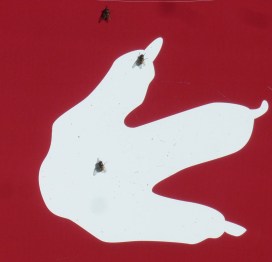
Musca autumnalis gather in the sunshine on a Museum sign
The flies enjoying a sun-baked Museum sign

While you’re soaking up the warmth and feeling energised for the summer ahead, remember that these little flies will be doing the same!

Rachel Parle, Interpretation and Education Officer

A Sad Tail

IMG_5790crop

Last week we celebrated the return of our beloved Nile crocodile skeleton. It’s been out on loan to the Oxford University Zoology Department during our closure year, but is now back in position in the Museum gallery for all to see.

Nicola working on the crocodile
Nicola working on the crocodile in the Museum

To mark the occasion, the conservation team decided to give the crocodile some much needed care. Originally this piece was displayed on carpet tiles, which can be potentially harmful to the specimen as they deteriorate… as well as looking pretty ugly! My first step was to remove these from the base of the specimen. I was then able to assess the skeleton for priority areas.

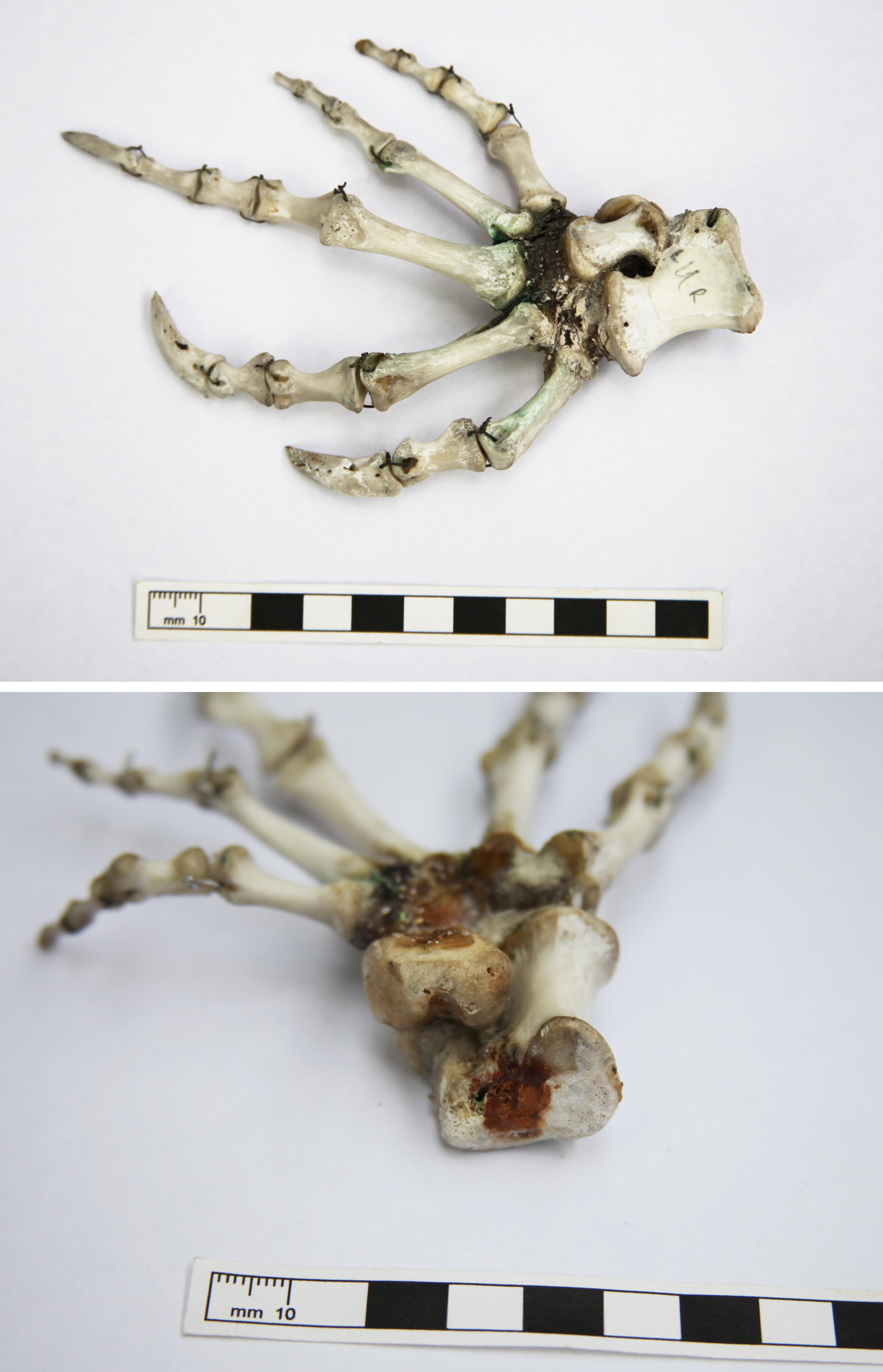
The crocodile's foot showing signs of damage from corroded wire
The crocodile’s foot showing signs of damage from corroded wire

Originally the specimen was articulated (held together) using a combination of iron and copper wire. This skeleton is over 150 years old and, during its time on display, these wires have corroded and stained the bone; this was particularly prominent in areas of existing cartilage, such as around its ribs. So I removed the old wire and replaced it with stainless steel, which has a longer life span.

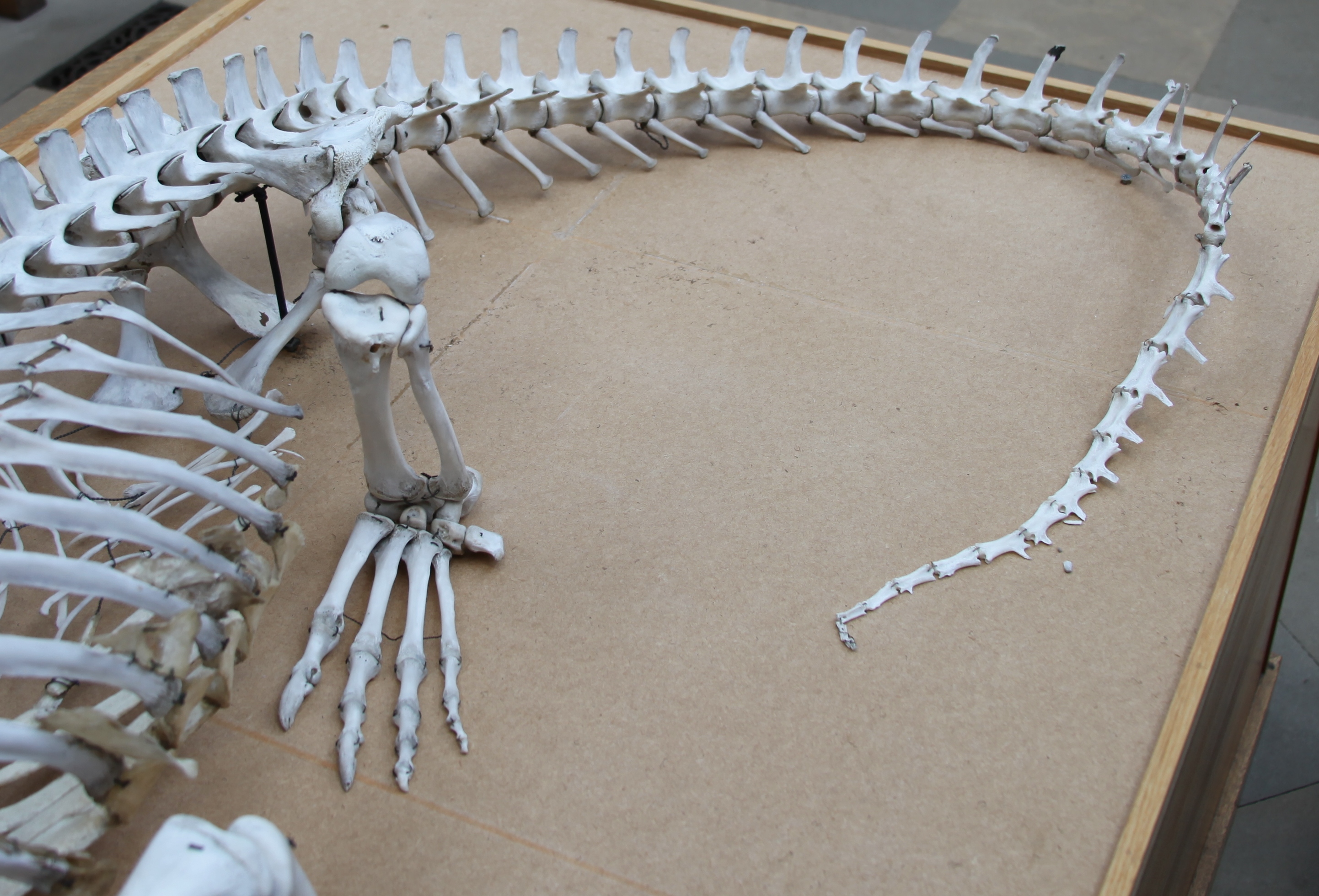
The existing articulation had also failed in some areas; this was most obvious on the tail, which had lost its natural curve and gained a limp collapse – lovingly referred to by visitors as a ‘sad tail’. A ‘happier tail’ was obtained by threading a stainless steel wire through the vertebral column, meaning no new holes would need to be drilled.

The crocodile's tail before Nicola worked her magic
The crocodile’s tail before Nicola worked her magic

The alignment of the rear of the skull and the atlas and axis bones at the top of the spine were not correct. To treat this, I removed the skull, allowing access for wire replacement. The skull was returned to its original supporting armature, now with conservation grade cushioning to relieve any unnecessary pressure on the bone. I guided the skull into its new position and fastened it in place.

The crocodile skeleton complete with 'happier tail'
The crocodile skeleton complete with ‘happier tail’

IMG_5785Once complete, I coated the base of the specimen with sand (a more natural environment for a crocodile than carpet!) and called in some strong helpers to replace the heavy glass lid.

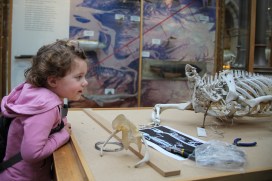
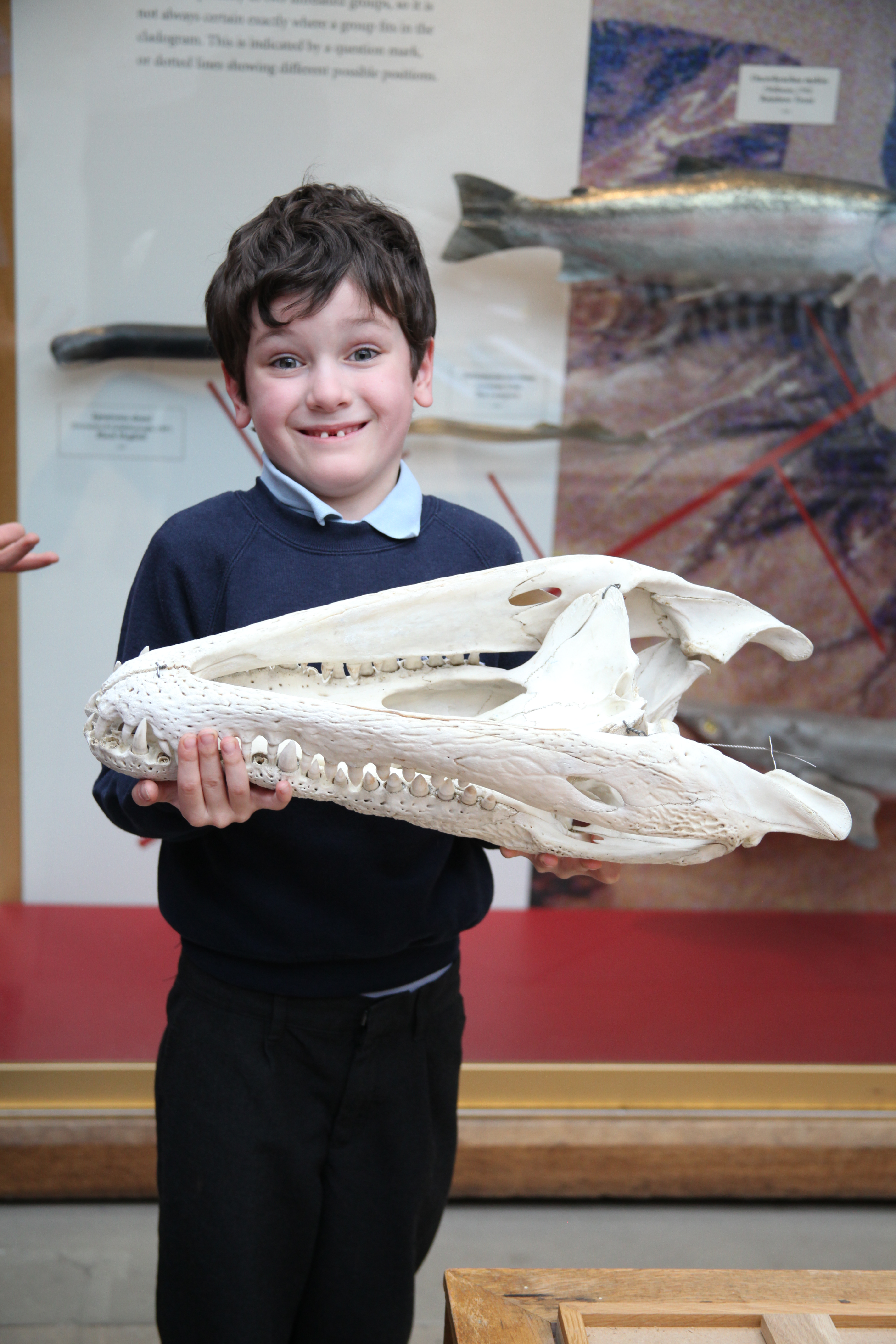
This project was particularly exciting to work on as it offered an opportunity to discuss the work of the conservation department with the passing museum visitors. I was able to make a few school trips a little more exciting with the phrase “Would you like to hold a croc skull?”.

Nicola Crompton, Conservation Intern

Oh the ‘Capy-drama’

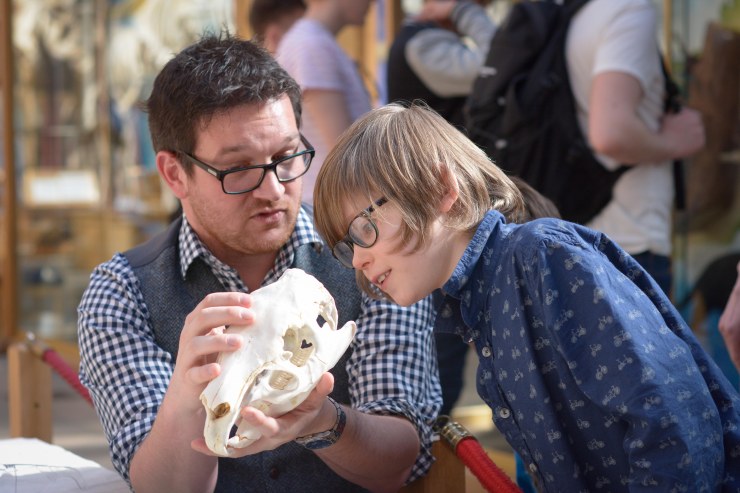
Here’s a little taster of the Capybara Construction event that we held in the Museum last Sunday. Evolutionary biologist and presenter of BBC4’s Secrets of Bones, Ben Garrod, joined our Life Collections conservator Bethany Palumbo and conservation intern Nicola Crompton to attempt the live reconstruction of a capybara skeleton.

This event was part of the week-long Reactions festival – an exploration of science and the arts at the University of Oxford Museums.

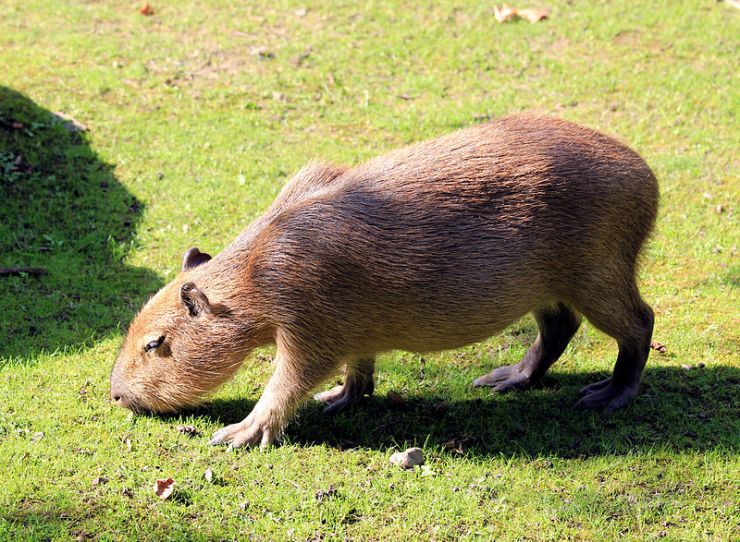
Just in case you don't know what a capybara is - here's one. It's the world's largest rodent and lives in South America.
Just in case you don’t know what a capybara is – here’s one. It’s the world’s largest rodent and lives in South America.

We should confess that Ben and Beth did not manage to completely recreate the skeleton, but they had plenty of interesting conversations with visitors about bones, anatomy, capybaras and conservation, so a very successful day nonetheless. Thanks again to Ben for coming along.

Examining the skull and explaining the capybara jaw movements.

A slice of science with your cuppa

IMG_1084

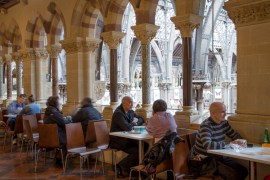
The view from the Museum’s upper gallery has always been spectacular; it’s the best place to admire the roof’s decorative iron work or to spot the dinosaurs lurking below. But add a great cup of coffee and a slice of cake to the experience and it steps up to a new level of pleasure. So it’s been fantastic to see so many happy visitors enjoying a break in our brand new café, Mortons at the Museum.

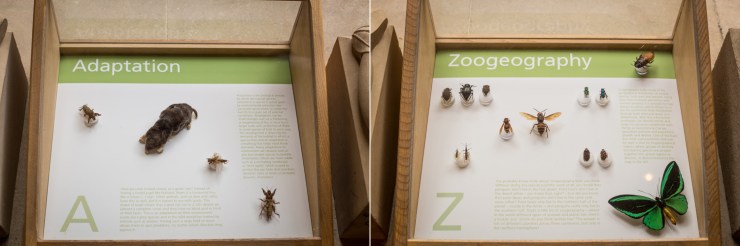
IMG_1127But we know that our visitors are a discerning bunch and are keen to learn, even when they’re enjoying elevenses, so we’ve installed a new display that runs the length of the upper gallery. A-Z is a taster of 26 natural history topics for you to get your teeth into.

From A for Adaptation to Z for Zoogeography, the alphabetical adventure whizzes past terms as diverse as Nocturnal and Living FossilIt’s designed so that you can take a pick and mix approach to whet your appetite, before devouring the large-scale displays around the Museum.

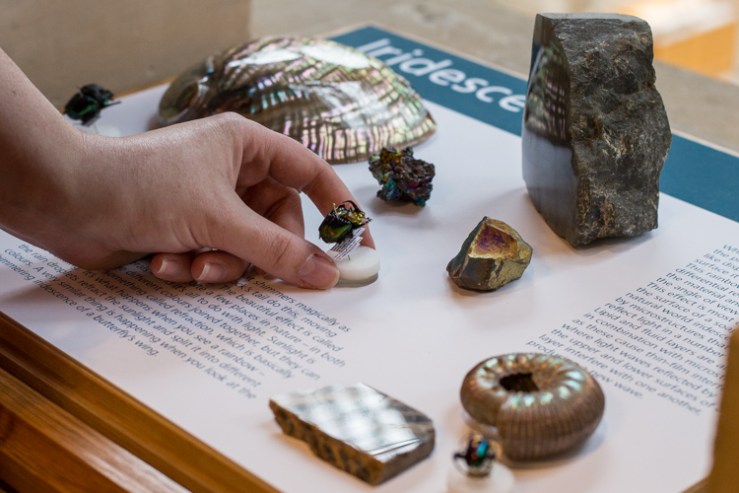
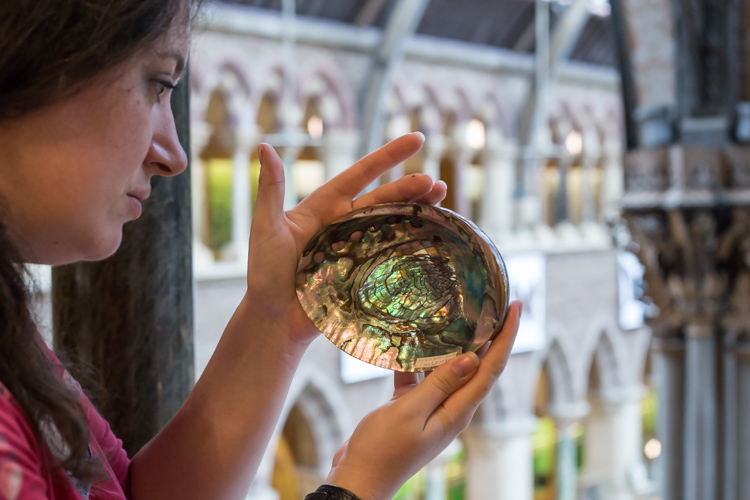
Zoë Simmons examining an abalone shell ready for the Iridescence case.
Zoë Simmons examines a Haliotid shell for the Iridescence case.

Zoë Simmons, of the Museum’s Life Collections, curated A-Z. She says that “One of the greatest challenges of the project was working on a display that encompasses such a wide range of subjects and crosses all disciplines of the Museum’s collections. I learnt a lot whilst researching and writing up the text for these displays.

“My favourite case is Iridescence. Not only is it full of beautiful rainbow-hued objects, but it has examples from all areas of the collections. There’s a fossilised ammonite, peacock ore, a Nectarinia bird, a jewel scarab and a Haliotid shell. It’s wonderful to be able to put a truly multi-disciplinary case together, as the opportunity is rare.”

A to Z

Each case has two levels of interpretation; a shorter, more light-hearted piece of text pitched at an average 10 year old visitor (though enjoyed by big kids too!), plus a more in-depth explanation for those who prefer a bit more science with their snacks.

IMG_1122
Lovely cakes in the new Café.

Tea and Typescake and Camouflage and sandwiches and Stromatolite seem to sit well together. Next time you’re experiencing museum fatigue, join us for a little nibble of natural history up in our brand new café.

Bon appétit.

Rachel Parle, Interpretation and Education Officer

What’s on the van? – Wallace’s giant bee

Wallace_photo

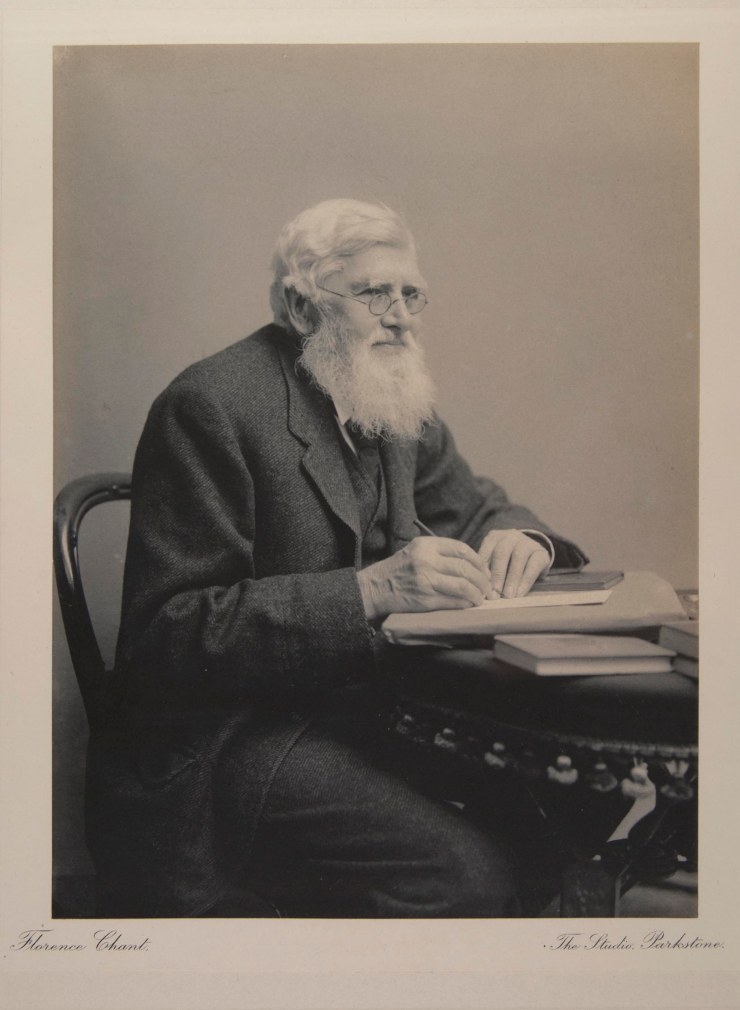
This Thursday, 7th November, marks 100 years since the death of the famous Victorian naturalist Alfred Russel Wallace. Wallace was an intrepid explorer and prolific collector and is hugely important in our understanding of the natural world. He co-discovered evolution by natural selection with Charles Darwin and we are fortunate to have several hundred of his specimens and letters in our collections here at the Museum of Natural History. 

To celebrate the life of such an important scientific figure, we’re dedicating this week on the blog to all things Wallace. We’ll be sharing some hidden gems, little known facts about the great man and stories of Museum staff walking in the footsteps of Wallace.
So here begins Wallace Week, with a description of one of his fantastic specimens…

_Megachile

This week’s What’s on the van? comes from Sally-Ann Spence of Minibeast Mayhem and the Bug Club.

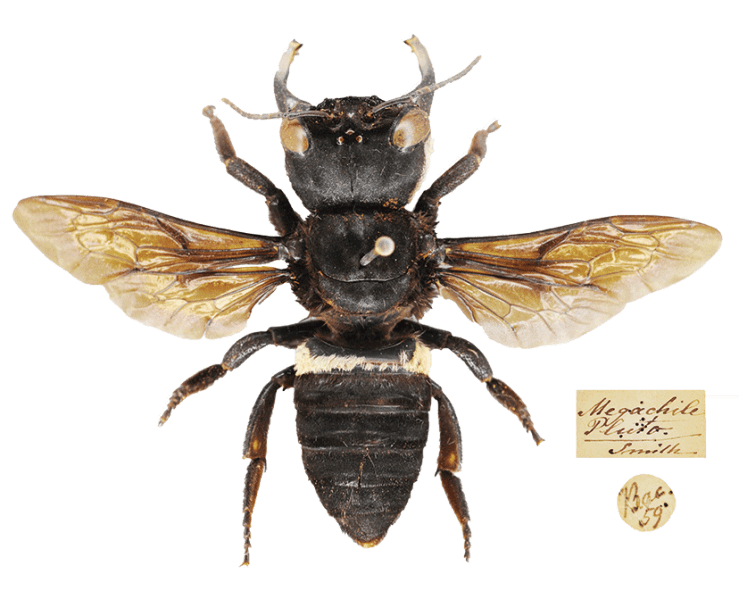
A single female bee stands out dramatically from all the bees in Oxford University Museum of Natural History’s bee collection and not for one reason, but three.

Firstly and quite simply is her impressive size. With a 63mm (2.5”) wingspan she completely dwarfs all her companions. Secondly, she has the most enormous and impressive mouthparts: jaws longer than her actual head held agape in the same fashion as a stag beetle’s mandibles.

The third reason and perhaps the most special, is not associated directly with her body, but the little unobtrusive label impaled with her on the pin. Alfred Russel Wallace was inordinately fond of using tiny round paper discs to store information on when mounting his specimens and this bee is in fact called Wallace’s Giant Bee, Megachile [Chalicodoma] pluto, the world’s biggest bee. It was first discovered by Wallace in Indonesia in 1858 and then thought to be extinct until 1981, when it was rediscovered by the American entomologist Adam C. Messer.

It really is the most interesting and unusual bee. The females are not only larger than the males in general size but also have the markedly more impressive mouthparts. They appear to use these jaws to collect resin from trees by rolling it up into neat balls for transport in flight. Then they mix it with wood and dried fibres to make a waterproof nesting material.

The next amazing thing is where they actually build their communal nests. Not underground or in cavities, but inside the already existing nests of tree-dwelling termites. Surprisingly, very little is known about the world’s biggest bee. It may be nesting within the termite colony to ensure a microclimate for its own young. It may be gaining protection from predators and parasites by being there. Perhaps it is a combination of these reasons.

It is possible that when Wallace collected this specimen in 1858 he was completely unaware of its nesting behaviour, so it then remained hidden for so long within its termite cloak. Even the local people were unaware of its very existence, although local folklore was based upon it.

This lone female bee and her famous collector are a constant reminder to us all today why research is so vital and of the huge importance of museum collections.

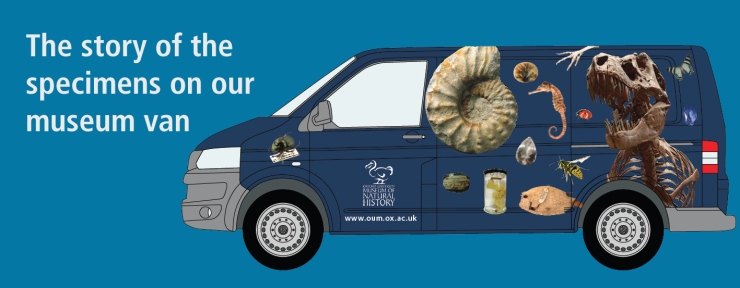
What's on the van?