Museum expert uncovers ‘hopping’ dinosaur!
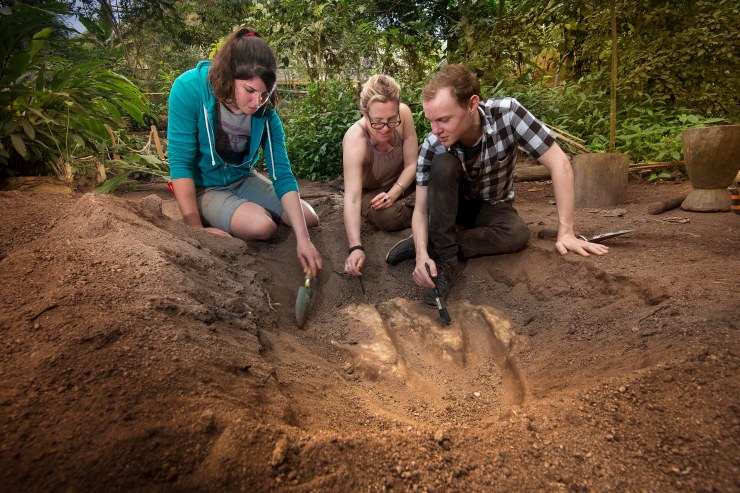
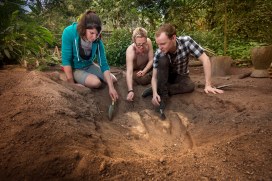
L-R Lucy Wenger (Skilled horticulturist), Dr Gabriella Gilkes (Eden Scientific Project Manager) and Dr David Legg (Museum Research Fellow) Credit: Emily Whitfield-Wicks
L-R Lucy Wenger (Skilled horticulturist), Dr Gabriella Gilkes (Eden Scientific Project Manager) and Dr David Legg (Museum Research Fellow)
Credit: Emily Whitfield-Wicks

This was our joint April Fool story with the Eden Project!

Experts from the Museum have been called in to help with an exceptional discovery, found lurking in a rainforest… in Cornwall!

eden-logo horiz 2Staff at the Eden Project were installing a new display in the Rainforest Biome, when they noticed that the ground was surprisingly uneven. Digging deeper, skilled horticulturist Lucy Wenger uncovered what seemed to be a pair of three-toed footprints. Wondering what could possibly be responsible for these marks, the team decided to approach the palaeontologists here at the Museum of Natural History.

We often get emails and calls from people who believe they’ve found something extra-special, so at first the experts were a little sceptical, but when the Eden Project sent through measurements and photographs of their finds, their discovery started to look rather familiar.
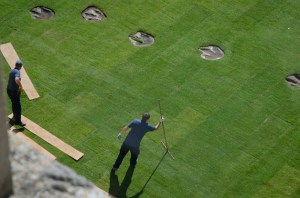
Megalosaurus prints on the Museum lawn

Regular visitors to the Museum will know that we have a trackway of dinosaur footprints marching across our lawn. These casts were taken from the famous fossils discovered just up the road from Oxford, at Ardley Quarry, in 1997. It was staff from the Museum who identified the Jurassic dinosaur Megalosaurus as the likely culprit for the Ardley prints. Could this new pair of prints have been made by something similar? The Museum’s Palaeontologist Research Fellow Dr David Legg decided to jump on a train heading south west.
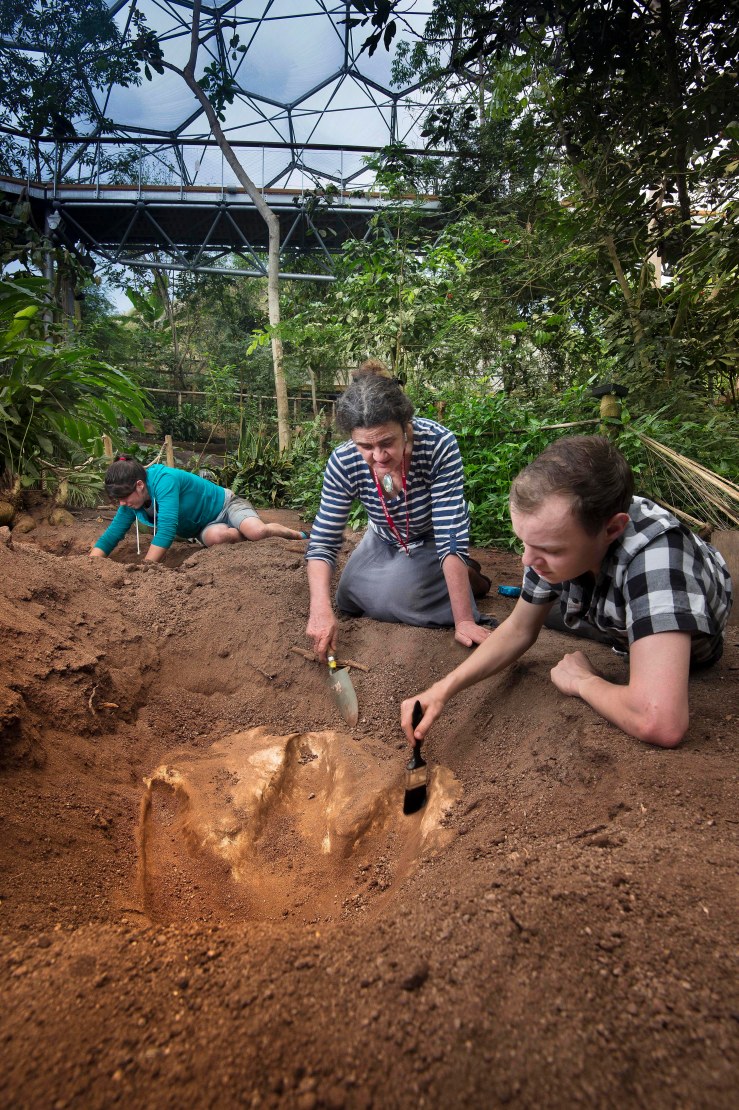
Dr David Legg carefully reveals the footprints with Dr Jo Elworthy (Eden Scientist)  Credit: Emily Whitfield-Wicks
Dr David Legg carefully reveals the footprints with Dr Jo Elworthy (Eden Scientist)
Credit: Emily Whitfield-Wicks

Today we’re excited to reveal that David has confirmed that the footprints were indeed created by Megalosaurus, a carnivorous dinosaur native to Southern England during the Middle Jurassic period. But there’s something a little unusual about this pair of prints…

Dr Legg said: “This is a truly remarkable find. Not only is there no doubt in our minds that the prints are those of a Megalosaurus, but they almost certainly represent a new species altogether.
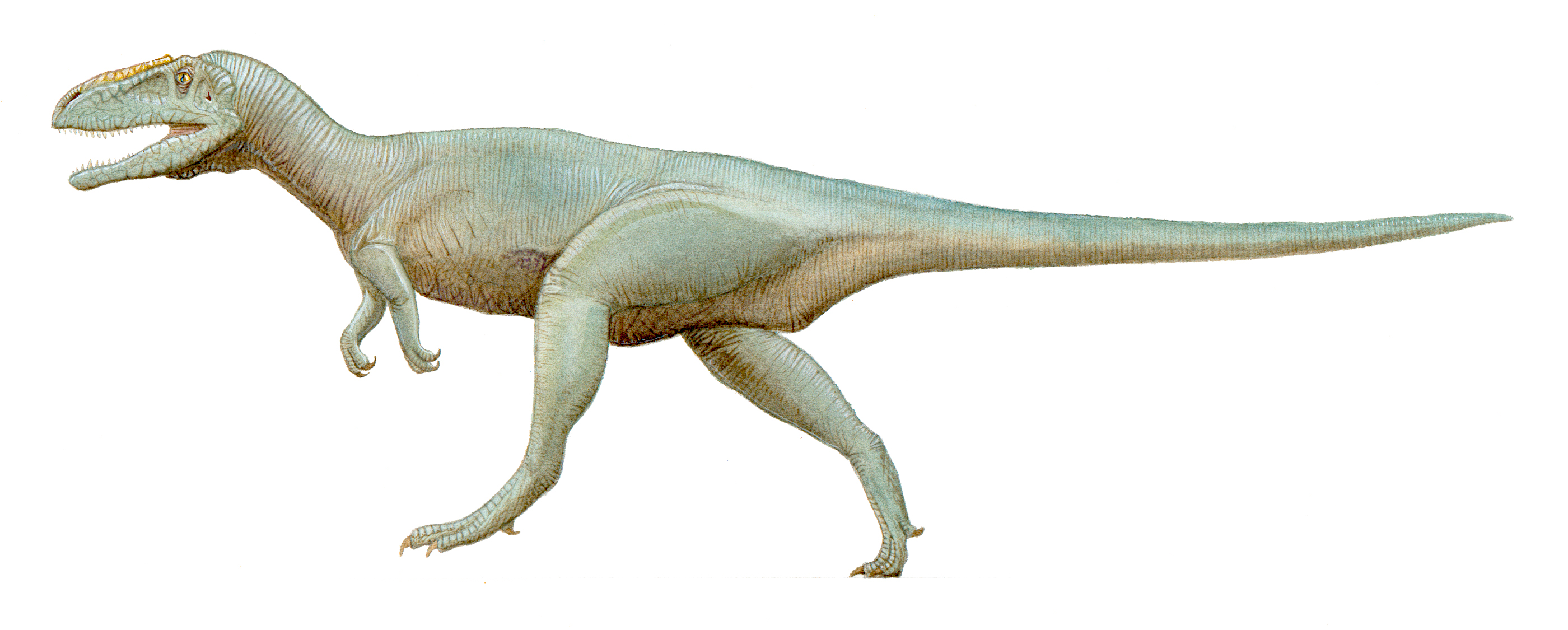
Artist's impression of Megalosaurus
Artist’s impression of Megalosaurus

“With track marks like these you would normally expect to see variation between the right and left prints but these two are very similar, if not identical. This suggests to me that this particular specimen preferred to hop everywhere or maybe even had just one leg.”

This is a revolutionary discovery and will alter the understanding of dinosaur movement for palaeontologists across the world. Dr Legg adds, “This is the first time we have found evidence of Megalosaurus this far to the west, and we are proposing that the creature be named Megalosaurus cornwallis-prilaeno.”

To find out more about this truly incredible discovery, watch this short report put together by the Eden Project.

Today, the Biome team are setting up a cordon around the 74 cm x 57cm prints in the West Africa section to protect them from possible accidental damage by the thousands of visitors who come to the Project every week. They are also checking the surrounding area for more prints or possibly even bones from the Megalosaurus. Of course, we’ll keep you fully up to date with the story, as it emerges.

Rachel Parle, Interpretation and Education Officer

Breakout!

8.Ident

I bring you breaking news from the Museum of Natural History. As you all know, the Museum has been closed for over a year and, during that time, a number of our specimens have been popping up in unlikely places around Oxford city centre.

The Goes to Town project has seen a penguin in the fish mongers, a bank vole in the bank and a book worm in a book shop. All was going swimmingly until today.

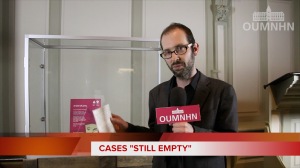
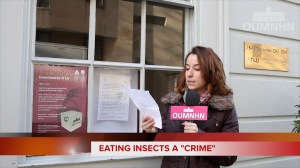
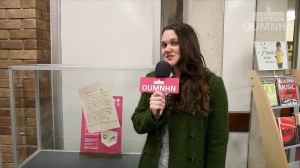
3.RachelSeriousWe’ve been receiving reports from several of our Goes to Town venues that there’s been a breakout. The snowy owl has vanished from the University Church, the edible insects have escaped from the Turl St Kitchen and a white rabbit is on the loose from the Central Library. There’s trouble afoot.

We’ve put together a special bulletin of Oxford University Museum of Natural History News.

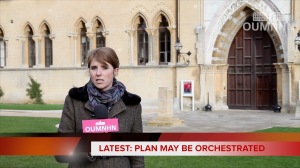
Scott Billings at St Mary the Virgin Church
Scott Billings at the University Church

Reporters Bethany Palumbo, Jess Suess and Scott Billings joined me to bring you the latest story direct from the scene.

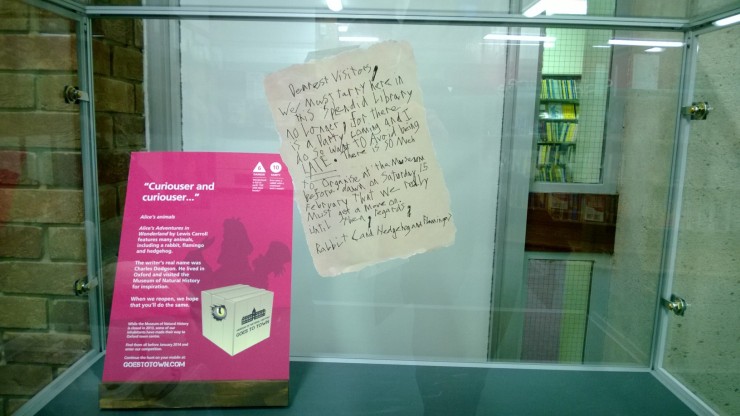
The mystery has been give an even more intriguing twist by the appearance of letters left behind by the escaped specimens. Each creature has its own motive for abandoning its case, but there is a definite theme throughout; they’re all coming home!

A note left behind by the white rabbit, Oxford Central Library
Bethany Palumbo at Turl St Kitchen

As each report unfolds, it’s clear that the specimens have escaped in order to return to the Museum, ready for our re-opening on Saturday 15th February.

So, who is behind this mass escape? Watch the report video to find out.

Jessica Suess at Oxford Central Library

The Museum of Natural History will be the place to be on Saturday 15th February. Even the Goes to Town specimens don’t want to miss out on the action! Join us then, dawn till dusk.

Rachel Parle, Interpretation and Education Officer

Good news travels fast

BBC Oxford's Martin Eastaugh talks to architect Nicholas Bradley
BBC Oxford’s Martin Eastaugh (R) talks to architect Nicholas Bradley (L)

The Museum’s been at the centre of a media whirlwind over the past week. After a rather dormant year, things are coming back to life and the TV cameras, microphones and journalists are keen to capture it all.

Wednesday 15th January marked one month until the day when our doors will swing open again, so it was great to hear us popping up on BBC Oxford… both TV and radio in one day!

IMG_0718Radio journalist Martin Eastaugh seemed to thoroughly enjoy his time with us and put together a really enthusiastic report, which features some names you may recognise. Listen from 01:55 to hear the latest on the Museum’s re-opening. Then at 02:50, make sure you listen to Martin talking to Purcell architect Nicholas Bradley high up on the roof. You have just 5 days left to hear the report, so don’t dawdle!

The BBC TV cameras arrived just in time to capture the unwrapping of one of our very largest specimens, the Iguanodon skeleton. Take a look at Stuart Tinworth’s piece for BBC Oxford news that shows just how beautiful and light the Museum is looking lately.

Museum staff unwrapping the Iguanodon
Museum staff unwrapping the Iguanodon skeleton

Then, to top it off, we’re only on the front page of the Oxford Times!

Of course, the attention’s very nice, but the most positive thing that’s come out of the media coverage is the public’s reaction. We’ve had many people telling us how excited they were to see their “favourite museum” on TV and to hear that they’ll soon be able to come back and enjoy it once more. The good news is, there’s just 29 days to go!

Rachel Parle, Interpretation and Education Officer
The One Show

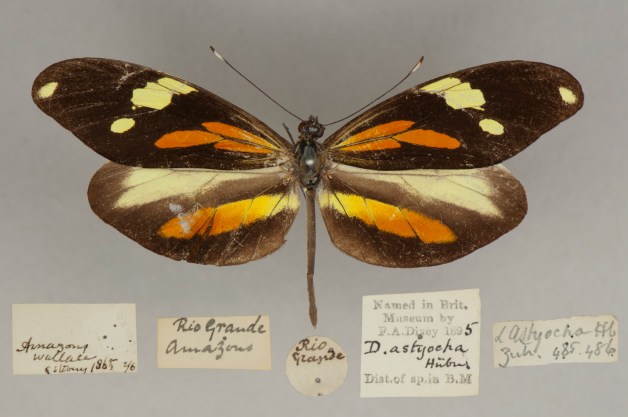
Amazon Dismorphia Wallace

Last week, members of our conservation team were presented with a wonderful opportunity to get out of the ‘Whale Tank’ and make their way to London to escort some very special specimens to the BBC.

The precious cargo consisted of newly-discovered Alfred Russel Wallace butterfly specimens that were uncovered in the Museum’s Life Collection by 17-year-old Athena Martin, a Nuffield Research Placements work experience student. This story featured on Thursday night’s edition of The One Show, where presenter Mike Dilger spoke about Athena’s project with the Museum and was able to show, on national television, the fruit of her hard work.

Papilio
Papilio ulysses. Examples collected by Wallace are marked with a red dot.

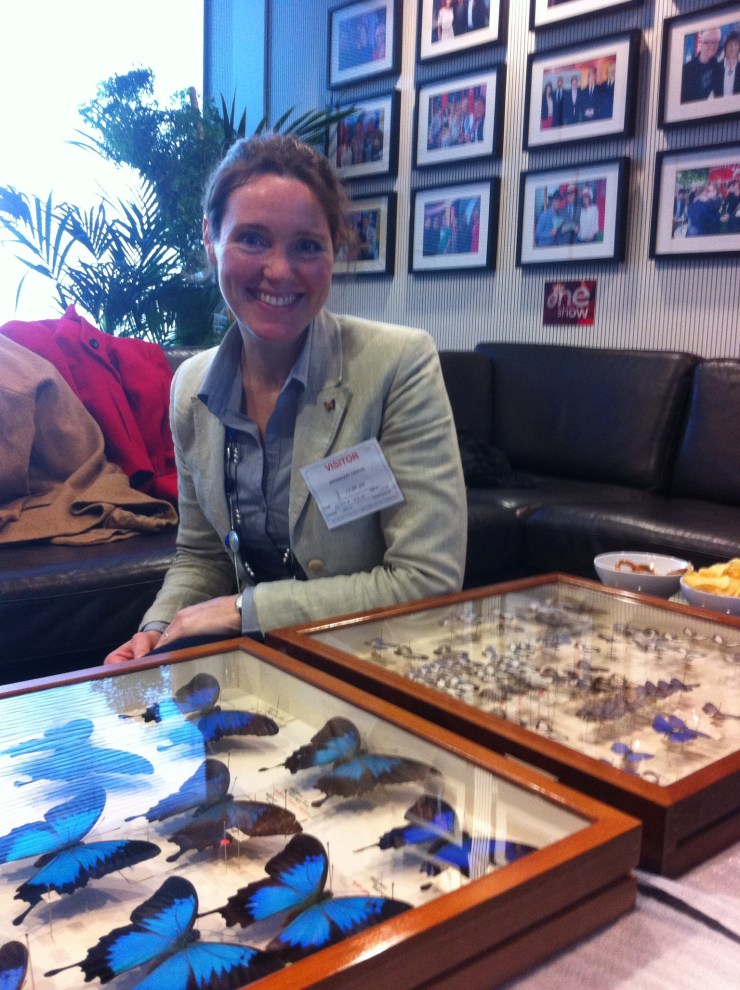
Two cases of butterflies were used on the programme and contained specimens collected by Wallace during his exploration of the Malay Archipelago. The show focused in particular on Papilio ulysses, and it was a joy to witness Mike Dilger’s excitement at discovering Wallace’s handwritten collection labels.

Our specimens, which were shown alongside some wonderful footage of CT scans of a developing chrysalis, made for excellent viewing for anyone with an interest in Lepidoptera.

If you missed it the first time around please do have a look on the BBC iPlayer. The butterfly feature begins at about 15’40”.

Gemma Aboe with the drawers of Wallace specimens.

We are very grateful for coverage on The One Show as it was an excellent opportunity to demonstrate, outside the Museum environment, the significance of natural history specimens, as well as highlight the important work of our conservators. It was also a thrill to be on set and watch the live show, so thanks a lot to the BBC for asking us along.

Nicola Crompton, Conservation intern
Gemma Aboe, Assistant conservator

Chris Packham Goes to Town

Chris Packham

We have had the pleasure of hosting the brilliant Chris Packham at the Museum recently. He has been filming with the collections for a forthcoming series for the BBC. Keep an eye out for that.

In the meantime, we chatted to Chris about our Goes to Town trail of specimens around Oxford city centre. He was very enthused about the idea and volunteered for this snap in front of our banner outside the front of the Museum.

Chris said: “I think this is a really good idea. If it encourages people who otherwise wouldn’t visit the Museum to come along and have a look at things then that is really worthwhile.”

It is almost a couple of weeks since the release of the specimens and we are now looking forward to receiving entries to our competition. To enter, you’ll need to visit all twelve specimens on the trail and tell us, via the website, which has the highest Danger rating and which has the highest Rarity rating. Prizes will be given to people whose names are drawn out of the hat when the Museum reopens in February next year.

But for you blog readers, here’s a sneaky taster:

Here's an escapee in situ. You'll have to get up close to read the all-important ratings...
Here’s an escapee in situ. You’ll have to get up close to read the all-important ratings…
Photo: Mike Peckett

Ode to a Dodo

Professor Dodo

Now here’s a sad story
That you all should hear
About a funny old bird
Who had never known fear

Till explorers landed
Upon the isle of Mauritius
And the creatures they brought
Found this Dodo delicious

Too docile to fight
Too flightless to flee
Now a head and a foot
Are all you can see

There’s a rather nice article on the Guardian website today all about our famous Dodo remains. Journalist Henry Nicholls interviewed our zoological collections manager Malgosia Novak-Kemp, who showed Henry the only known surviving soft tissue remains from the extinct Dodo.

The article includes a reference to Hilaire Belloc’s poem, so it seemed appropriate to share this little Ode to a Dodo with you. We wrote it as part of our Goes to Town trail, which is launching in Oxford next week.

You can watch a short trailer about this at goestotown.com, but suffice to say that the Dodo will feature, along with his Ode, in one of our partner venues. See if you can find him and all the other exhibits from Tuesday next week.

Scott Billings, Communications coordinator