The Big Brain Competition

What happens in your brain when you receive compliments? And what’s going on in your mind when you watch your football team win a match? Does the brain respond differently when recalling music, compared to listening to it? All these questions, and more, have been posed in our Big Brain Competition

Coinciding with the Museum’s Brain Diaries exhibition, the Wellcome Centre for Integrative Neuroimaging is inviting you to ask your own question about the brain to be in with a chance to have it tested by neuroscientists using Oxford’s state-of-the art Magnetic Resonance Imaging (MRI) scanner.

The advanced MRI scanner at the John Radcliffe Hospital in Oxford is one of the strongest in the world. It allows scientists to carry out functional MRI (fMRI) scans to see the brain in action. This mind-blowing procedure can reveal how the brain changes when learning a new skill or how it compensates when someone recovers from brain damage. It can also reveal which areas are used when people speak, move or laugh, to give just a few examples.

This fMRI scan shows how blood flows to the visual cortex region at the back of the brain when viewing a visually-stimulating checkerboard pattern
layouttile
Dr Stuart Clare of the Nuffield Department of Clinical Neurosciences is asking you for questions about the brain

Functional MRI shows when a brain area is more active by detecting the changes in blood oxygen levels and blood flow that happen in response to neural activity. The technique can be used to produce activation maps showing which parts of the brain are involved in a particular mental process.

The scientist behind the Big Brain Competition is Dr Stuart Clare, whose research involves pushing the technological boundaries of the fMRI technique to reveal new insights about how the brain functions normally and how it is affected by disease. There is still so much that the fMRI scans can bring to light, so Stuart is asking you for ideas!

Over several years of inviting people in to see the beautiful pictures that our MRI scanner can produce, I’ve been fascinated by the questions they have about the brain and whether you can see this thing or that thing in our fMRI scans.  With this competition we want to give people the unique access to our scanner and the chance to try an idea out for themselves.

When coming up with an idea for investigation there are a few practical things to bear in mind. Any activity has to be something people can do when lying down in the scanner and it has to be clear when they start and stop doing the activity. But Stuart is very open to ideas for experiments that they haven’t come across before – something that scientists really don’t already know the answer to.

The animation below explains how fMRI works and what it can do. So take a look, think up an experiment of your own and enter your idea via this form. The best one will be put into action by the research team and you will be able to watch the scans take place at the John Radcliffe Hospital yourself!
Skeletons in the closet

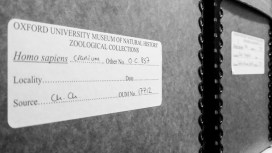
Once found in almost every museum and university in the western world, human anatomy collections have slowly disappeared over time, as medical practices have changed. These collections are historically important and medically relevant, providing direct evidence of patients’ lives and illustrating a pivotal period in the history of medicine.

Over the past seven months, Dr Kathryn Krakowka has been going through the Museum’s human remains specimens to create a new detailed database of the contents. Here, Kathryn talks about the fascinating material she is working on…

The Museum holds many specimens that are not on public display, and perhaps one of the largest collections hidden from view is the human remains. This collection was started in the first half of the 18th century by Dr Matthew Lee, and eventually passed to Dr Henry Acland, founder of the Museum. Acland added a lot to the collection, acquiring his own samples as well as purchasing specimens and collections from other physicians.

When Acland gathered material for the new museum building in 1860, he brought this anatomical and physiological material with him, including the human remains. The collection continued to develop throughout the 19th century and grew to contain over 1,400 specimens. It is now one of the few collections from this period still in existence in Britain.

As a specialist in human osteology, I am trained to assess human skeletonised remains for such characteristics as sex, age-at-death, and any pathologies or trauma that the individual was affected by in life.

The Museum’s collection revealed specimens that tell a tale of health and medicine at Oxford in the 18th and 19th centuries. Many of the specimens were used to teach medicine, so many different skeletal pathologies are represented, including bacterial infections, genetic deformities, nutritional deficiencies, and traumatic injuries.

A skull fragment showing a large growth. The four round marks are thought to have been made by a tool during investigations after death.

One example is the frontal bone of a possible child, pictured above. This presents a large porous growth affecting both the outer and inner table of the bone. The characteristics of the lesion suggest osteosarcoma (bone cancer). There are then what appear to be four tool markings on the outer table of bone that indicate some sort of drill may have been used to take samples of the bone after death, possibly in an attempt to determine what was ailing the individual during life.

As this growth is quite large and just above the forehead, it would have been very noticeable while the individual was alive. This specimen provides an interesting example of how medical practices were often developed through exploratory postmortem analysis.

Now that the collection has been fully catalogued and digitised, it is hoped that further research into specimens like this one can help shed light on historical pathologies and the development of medicine as a discipline.

The database and digital images of the specimens will soon be available on the Museum’s website, thanks to funding by the John Fell Fund.

Oxford Swift City takes flight

The Museum is really pleased to be a partner in Oxford Swift City, a major new initiative to protect and nurture the city’s populations of swifts. Here Keo Baxendine at RSPB Midlands tells us more about the project…

Swift expert George Candelin shares his experience of researching the swifts at the Museum. Image: Colin Wilkinson.

The swifts have just returned to the UK after their long migration from Africa. At the Museum they have begun circling the tower where they nest each year.

These charismatic birds, Apus apus, are commonly recognised throughout the UK as a sign of summer. They also have a long cultural association with Oxford as a symbol of knowledge and dexterity. Yet sadly, the national swift population has fallen by 42 per cent since 1994, due to a lack of nesting sites and food.

The Oxford Swift City project hopes to turn the birds’ fortunes around by protecting existing swift nesting sites as well as encouraging the creation of new ones. Last night, project partners and guests gathered at the Museum to kick off the project.

The swift is an iconic species whose appearance announces the start of summer. Sadly the swift is in trouble. Numbers have dropped dramatically, putting the birds at risk of disappearing completely from the UK. The Oxford Swift City community project provides local people with a great opportunity to learn about this important bird and discover how to take action to help give swifts a home in Oxford.
– Lucy Hyde, Oxford Swift City Project Officer

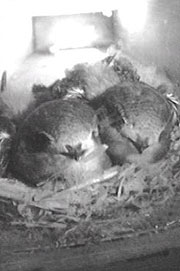
Swift chicks in a nestbox in the Museum tower, shown on the webcam feed

There are lots of ways to get involved: take part as a swift survey volunteer; help out at a community event; or just put up a nestbox or plant wildflowers in the garden. You can also join a local swift expert on a number of ‘swift walks’ through Oxford over the summer.

The colony of swifts which nests in the Museum has been the subject of a research study since 1948, and is one of the longest continuous studies of a single bird species in the world. This work has contributed much to our knowledge of the swift.

Fittingly, Oxford Swift City is running a ‘Swift Tower’ design competition. Subject to approval, the winning design will be constructed in Oxford next year, providing ideal nesting spaces for swifts – so get scribbling!

Funded by the Heritage Lottery Fund, the RSPB-led Oxford Swift City project is supported by many local partners, including Oxford University, Oxford University Museum of Natural History, Oxford City Council, Thames Valley Environmental Records Centre, Environment Resources Management and the local Wildlife Trust.

For more information please email oxfordswiftcity@rspb.org.uk.

Fossil-finding

By Jack J Matthews, research fellow

On the southern shores of Newfoundland in Canada lie rocks containing the oldest known evidence of large, architecturally-complex life. Deposited within the Ediacaran Period, some 565 million years ago, these deep marine deposits have been the focus of palaeontological research since the first discovery of fossils there in 1967, and the locality – Mistaken Point Ecological Reserve – now sits in the UNESCO World Heritage list.

As part of my research on these rocks, alongside colleagues from Memorial University of Newfoundland, and the University of Cambridge, I created a new geological map of the area, covering 35 km of coastline in and around the Reserve. As well as providing new insights into the rocks themselves, and what environments they were deposited in, this mapping had an unexpected outcome – the discovery of some totally new fossil sites.

Overview of the Mistaken Point outcrop of the famous ‘E’ Surface

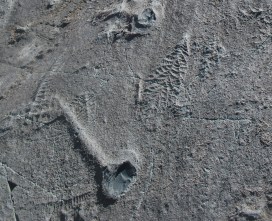
One site in particular, dubbed the ‘E’ surface, is the focus for Ediacaran fossils in Newfoundland. It is an area about the size of three Olympic boxing rings, containing more than 3,000 fossil organisms. Through the mapping we found a number of other outcrops of this same surface, but each shows slightly different types of fossils.

This is a mystery: if all the outcrops are from the same geological surface, why do they show different fossil assemblages?

The clue to the answer came while photographing the fossils and overlying volcanic ash at Mistaken Point, when I heard a loud, deep boom: a freak wave had struck the bottom of the cliff below the outcrop, sending a large splash of salty spray over much of the surface.

This got me thinking – how are processes such as weathering and erosion affecting the fossil surfaces now? Closer observation revealed those outcrops of ‘E’ with pristine beautiful fossils tended to be further from the sea, have a shallower dip, and the overlying ash tended to fall away in little flakes revealing beautiful, crisp, fossils. Other outcrops with scruffy fossils were usually close to the sea, battered by waves and rocks, steeply dipping, and the overlying ash, and often the fossils below it, would gradually abrade away as they are attacked by the sea.

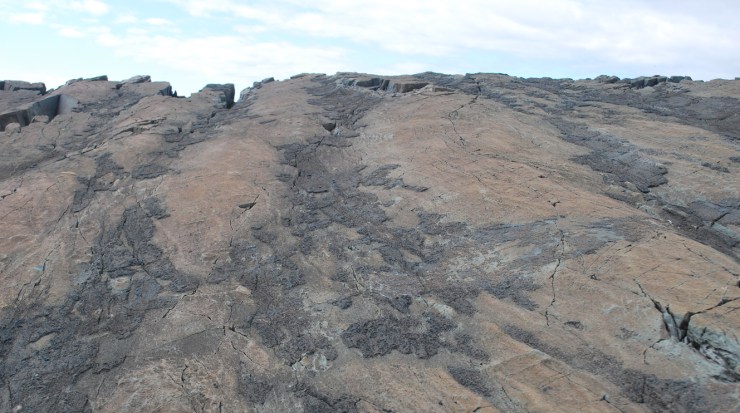
Looking along the ‘E’ surface showing areas still covered in ash (black) and revealed fossil surface (red and grey)

Palaeontologists often discuss how changes during the fossil preservation of an organism can affect what we discover today, but they rarely discuss how processes occurring after preservation – metamorphism, exhumation, weathering, erosion, and even the time, manner, and conditions in which the fossil is recorded – might all affect how we analyse and interpret the original community of life which became fossilised.

Our new paper, published by the Geological Society of London, talks about these Post-Fossilization Processes, and recommends that when researchers are collecting fossil data they consider how their measurements might have been biased by such factors.

For 50 years now, the coastline of Newfoundland has yielded some of the most important finds in understanding the rise of the early life of the Ediacara, and through that the first evidence of animal life. Discoveries over the past few years show there is still much more to be found, and we’ll just have to hope that the post-fossilization processes fall in our favour to allow for many more significant discoveries.

Which one’s Pink?

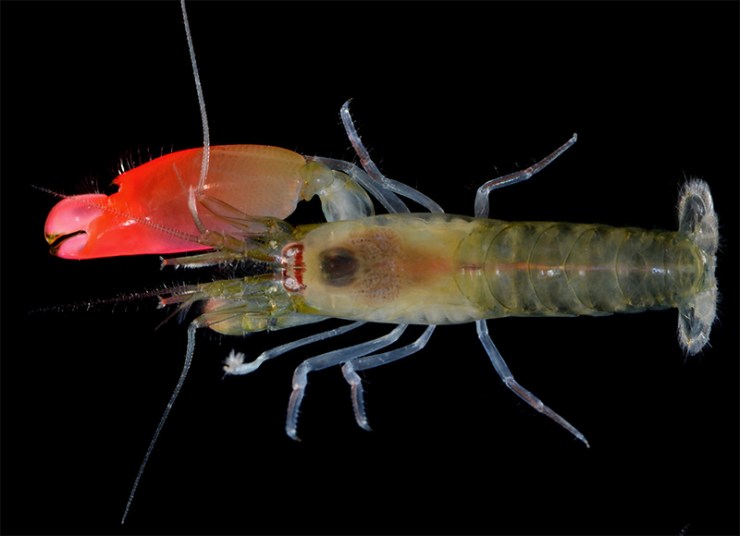
Image: Arthur Anker
In 1975, on Have a Cigar, Pink Floyd wryly sang “The band is just fantastic / That is really what I think / Oh, by the way, which one’s Pink?”

Well, in the rather different world of snapping shrimps there really is no question which one’s pink; and, unlikely as it seems, these two worlds have now overlapped…

The strikingly bright pink-clawed species of pistol shrimp pictured above, and discovered on the Pacific coast of Panama, has been given the ultimate rock and roll name in recognition of the discoverers’ favourite rock band – Pink Floyd. In a paper published today, and co-authored by our head of research Sammy De Grave, it has been named as Synalpheus pinkfloydi.

Just like all good rock bands, pistol shrimps, or snapping shrimps, have an ability to generate substantial amounts of sonic energy. By closing its enlarged claw at rapid speed the shrimp creates a high-pressure cavitation bubble, the implosion of which results in one of the loudest sounds in the ocean – strong enough to stun or even kill a small fish.

Combined with its distinct, almost glowing-pink snapping claw, Synalpheus pinkfloydi is aptly named by the report’s authors: lead author Arthur Anker of the Universidade Federal de Goiás in Brazil, Kristin Hultgren of Seattle University in the USA, and Sammy De Grave here at the Museum.

If Synalpheus pinkfloydi had adorned the cover of Pink Floyd’s 1977 album Animals, rather than the famous dirigible pig. Image: Chris Jarvis
Sammy has been a lifelong Pink Floyd fan and has been waiting for the opportunity to name the right new species after the band.

I have been listening to Floyd since The Wall was released in 1979, when I was 14 years old. I’ve seen them play live several times since, including the Hyde Park reunion gig for Live8 in 2005. The description of this new species of pistol shrimp was the perfect opportunity to finally give a nod to my favourite band.

Synalpheus pinkfloydi is not the only pistol shrimp with such a lurid claw. Its closely-related and similar-looking sister species, Synalpheus antillensis, scientifically described in 1909, is found in the western Atlantic, including the Caribbean side of Panama. But the authors of the new paper found that the two species show considerable genetic divergence, granting S. pinkfloydi a new species status and its very own rock and roll name.

Arthur Anker, the report’s lead author, says:

I often play Pink Floyd as background music while I’m working, but now the band and my work have been happily combined in the scientific literature.

Another Shrimp in the Wall featuring Synalpheus pinkfloydi, the Oxford University Museum of Natural History building, and other Pink Floyd references. Artwork by Kate Pocklington.
Animals feature frequently in the Floyd back-catalogue. Indeed, the 1977 album Animals includes tracks titled Dogs, Sheep, and a suite of music dedicated to pigs. Then there’s Several Species of Small Furry Animals Gathered Together in a Cave and Grooving with a Pict from 1969’s Ummagumma. In fact, other biologists have already named a damselfly after that album: Umma gumma, in the family Calopterygidae.

However, until today there have been no crustacean names known to honour the band.

The full paper, Synalpheus pinkfloydi sp. nov., a new pistol shrimp from the tropical eastern Pacific (Decapoda: Alpheidae), by Arthur Anker, Kristin M. Hultgren, and Sammy De Grave is published by Zootaxa.

Ask a neuroscientist

Can your brain rewire itself? How is the brain built and what can go wrong? And should the secondary school day start later to compensate for teenage sleep patterns?

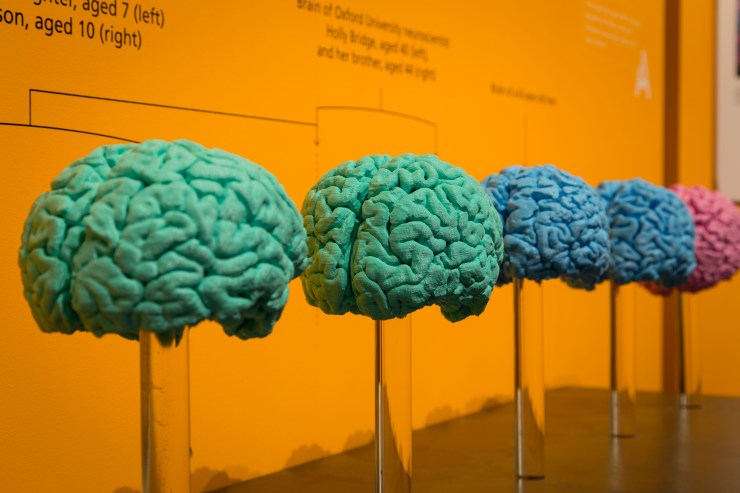
Neuroscientists from the University of Oxford address all these questions in our new exhibition – Brain Diaries – Modern Neuroscience in Action. Created in partnership with Oxford Neuroscience, the exhibition and event programme kicked off last week to coincide with international Brain Awareness Week, which runs from 13-19 March.

Here we present a selection of videos from the exhibition. The full set is available on our YouTube channel now. And if you’re not able to visit the exhibition itself, we’ve built a special Brain Diaries website which contains all that neuroscience goodness.

Is brain-building a tricky business?
Professor Zoltán Molnár of the University of Oxford specialises in the development of the brain. In this video he talks about the complex processes at play during the brain’s early development, including how things can sometimes go wrong.

Can my brain rewire itself?
Associate Professor Holly Bridge works in the Nuffield Department of Clinical Neurosciences in the John Radcliffe Hospital in Oxford. Her research focuses on using MRI scans of the human brain to understand the organisation of the visual system in people with normal vision and in those with abnormal visual function. Here she talks about how the brain can rewire itself to compensate for damage to certain sensory areas.

School’s out – should the school day start later?
Dr Christopher-James Harvey works at the Sleep and Circadian Neuroscience Institute at the University of Oxford. As part of the Teensleep research project, he is investigating how changes in the natural rhythm of sleep in adolescents, and the effects of sleep education, might impact on academic, health and sleep outcomes. Here he talks about initiatives to trial a later starting time for the secondary school day.

To read more about Brain Diaries and see the full programme of public events see braindiaries.org.