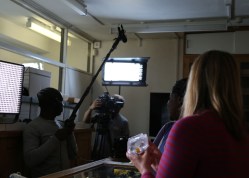
Our lunar visitor with presenter, Maggie (l), and guest, Sarah (r)
We’ve had a visitor all the way from the Moon! Dr Sarah Russell from the Natural History Museum brought a slice of lunar meteorite with her when she came to be a guest on the BBC’s The Sky at Night television programme. A whole episode was filmed here in the Museum last week.
Meteorites are rocks from space that have fallen to Earth and, in fact, it was a meteorite hitting the Earth that created the Moon!
Chris holds a piece of the Chandakapur; Maggie holds a slice of the Gibeon meteorite
In the programme, presenters Dr Maggie Aderin-Pocock and Dr Chris Lintott will be showing some of the meteorites in our collection.
One of these arrived at Amalia Farm in Gibeon, Namibia, in 1836, and the other landed at Chandakapur, India, in 1838. Both had travelled from the asteroid belt, a band of planetary debris orbiting between Mars and Jupiter.
We now believe that the dinosaurs became extinct after a massive meteorite collided with the Earth. It brought with it a lot more of the element iridium than would naturally occur on Earth. You’ll be able to see our sample of the iridium-rich clay rock that formed at the bottom of the sea, hundreds of miles away from the giant impact crater.
Chris holds a piece of the special iridium-rich clay that gave scientists an important clue to the extinction of the dinosaursFilming behind the scenes in the Museum
This episode of The Sky at Night has a lot about impacts – not just meteorite landings. It will be screened on BBC4 at 10pm on Sunday 8 June, and repeated on Thursday 12 June at 7.30pm. Don’t miss it!
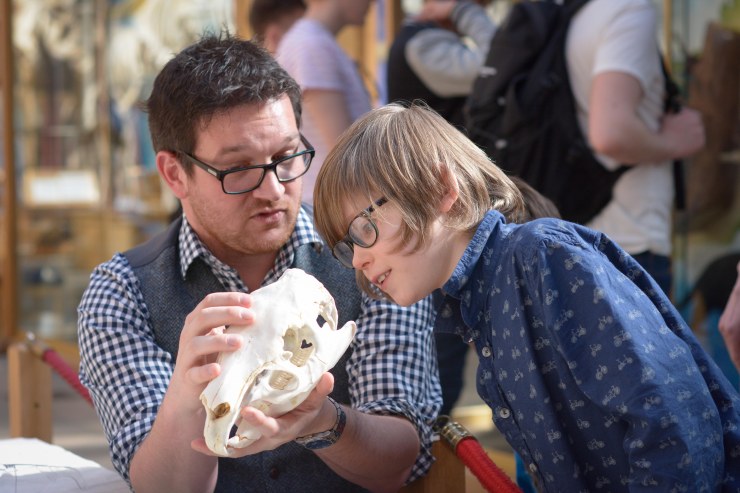
Here’s a little taster of the Capybara Construction event that we held in the Museum last Sunday. Evolutionary biologist and presenter of BBC4’s Secrets of Bones, Ben Garrod, joined our Life Collections conservator Bethany Palumbo and conservation intern Nicola Crompton to attempt the live reconstruction of a capybara skeleton.
This event was part of the week-long Reactions festival – an exploration of science and the arts at the University of Oxford Museums.
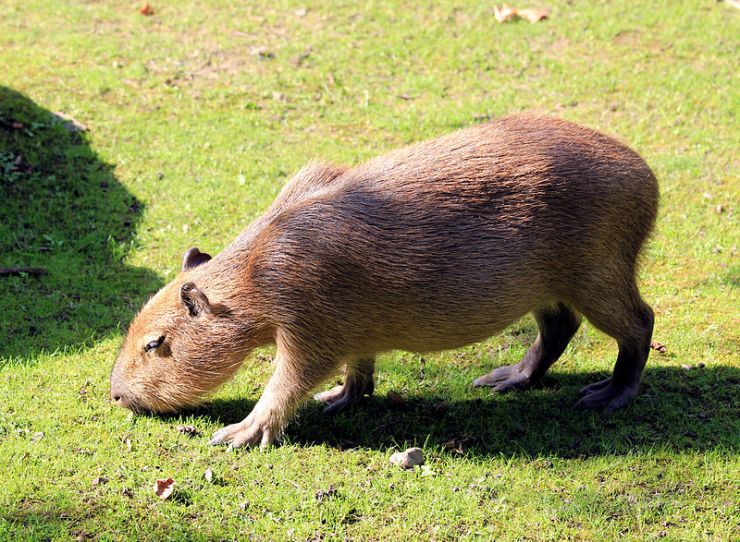
Just in case you don’t know what a capybara is – here’s one. It’s the world’s largest rodent and lives in South America.
We should confess that Ben and Beth did not manage to completely recreate the skeleton, but they had plenty of interesting conversations with visitors about bones, anatomy, capybaras and conservation, so a very successful day nonetheless. Thanks again to Ben for coming along.
Examining the skull and explaining the capybara jaw movements.
What a week indeed. As the dust settles on our reopening celebrations, it’s a chance to step back and regard the blur of activity that has whipped through the Museum since 7am on Saturday 15 February.
As dawn broke on that stormy, flooded, grey and windy morning people were already standing outside in the cold waiting to tuck in to their breakfast bacon bap in the new Museum Café. At first it was a trickle of visitors, but then it was a deluge… People swarmed to the Museum in droves, with more than 5,300 visitors by the end of the first day alone.
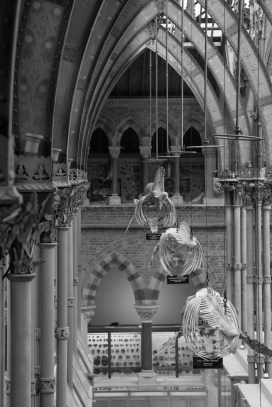
One of our more knowledgeable visitors explains the anatomy of a whale to Nicola
The buzz made for a fantastic event, with live music provided by The Alternotives (in full flow in the picture above) and The Knights of Mentis. Staff were on-hand in bright green T-shirts to welcome people and to carry around some intriguing specimens from the collections. There was the ever-popular live bug-handling and generally much merriment occurred.
The frenetic pace continued through the week, with the half-term rush hot on the heels of the reopening day. By the end of the first week more than 30,000 people had been through the doors, which is without a doubt a record for us and way more than we anticipated.
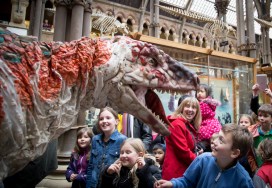
The kids dig Dinosaur Zoo’s Australovenator.
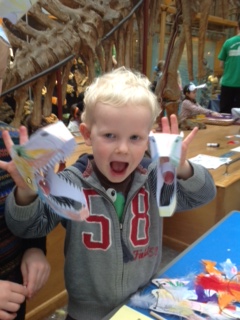
During half term, hundreds of children (and quite possibly a few parents) made Dodo masks and T. rex finger puppets at our Family Friendly activity; then later in the week there was the rather terrifying surprise appearance of creatures from the Dinosaur Zoo stage show. A five metre Australovenator ‘puppet’ marauded through the court, scattering children as it went and earning us a nice spot on the local TV news. The Dinosaur Zoo was visiting the Museum ahead of shows at Oxford’s New Theatre in April, so check that out if you missed the action here.
With around 4,000 visitors a day during the week we have been somewhat taken aback by the enthusiasm that greeted the reopening of the Museum, and at times it has been a struggle to accommodate everyone, especially in the predictably popular café.
T. rex finger puppets!
And with a faulty lift and some plumbing difficulties in the toilets there have been challenges along the way. If you visited and some things weren’t quite working properly, apologies. We have been busily sorting everything out all week, so hopefully the teething troubles have now passed.
Now it’s back to business – no more scaffolding, no more stories from the roof rafters and no more Darkened not dormant, our closure blog. Instead we’ll be telling you about what’s going on at the Museum here, on our new permanent blog. There are lots of events coming up which you might want to come to, but more than that we want this blog to reveal interesting things about the workings of the Museum, from behind-the-scenes and on the periphery of the more visible public events. So stay tuned for that. And if you don’t already, follow our squawks and drop us a line on Twitter @morethanadodo too.
Last summer Robert Rapoport, film maker and DPhil student at the Ruskin School of Art, recorded some footage of the whale conservation project that took place in the Museum during the closure. Here’s Robert’s finished film for your enjoyment. The film is also showing next to the Welcome Desk at the front of the Museum, so check it out if you’re visiting.
And if you haven’t seen it already, you can read all about the whale conservation project on the Once in a Whale blog.
We recently brought you the breaking news that the animals on our Goes to Town trail had escaped from their cases and were planning to return here to reopen the Museum on Saturday 15 February.
We can now reveal that these creatures have been sighted, skulking by the light of the Moon, and making their final preparations for this reopening party. It seems that the Museum will be Darkened no longer, and most certainly not Dormant.
I bring you breaking news from the Museum of Natural History. As you all know, the Museum has been closed for over a year and, during that time, a number of our specimens have been popping up in unlikely places around Oxford city centre.
The Goes to Town project has seen a penguin in the fish mongers, a bank vole in the bank and a book worm in a book shop. All was going swimmingly until today.
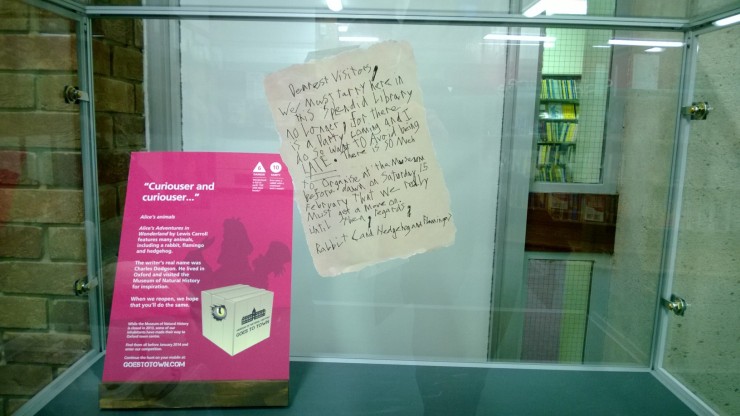
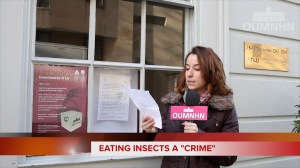
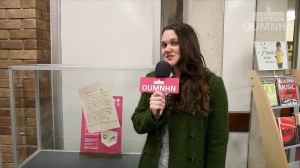
We’ve been receiving reports from several of our Goes to Town venues that there’s been a breakout. The snowy owl has vanished from the University Church, the edible insects have escaped from the Turl St Kitchen and a white rabbit is on the loose from the Central Library. There’s trouble afoot.
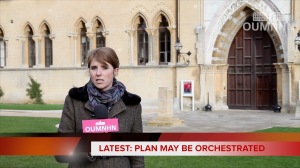
Reporters Bethany Palumbo, Jess Suess and Scott Billings joined me to bring you the latest story direct from the scene.
The mystery has been give an even more intriguing twist by the appearance of letters left behind by the escaped specimens. Each creature has its own motive for abandoning its case, but there is a definite theme throughout; they’re all coming home!
A note left behind by the white rabbit, Oxford Central LibraryBethany Palumbo at Turl St Kitchen
As each report unfolds, it’s clear that the specimens have escaped in order to return to the Museum, ready for our re-opening on Saturday 15th February.
So, who is behind this mass escape? Watch the report video to find out.
Jessica Suess at Oxford Central Library
The Museum of Natural History will be the place to be on Saturday 15th February. Even the Goes to Town specimens don’t want to miss out on the action! Join us then, dawn till dusk.
Rachel Parle, Interpretation and Education Officer







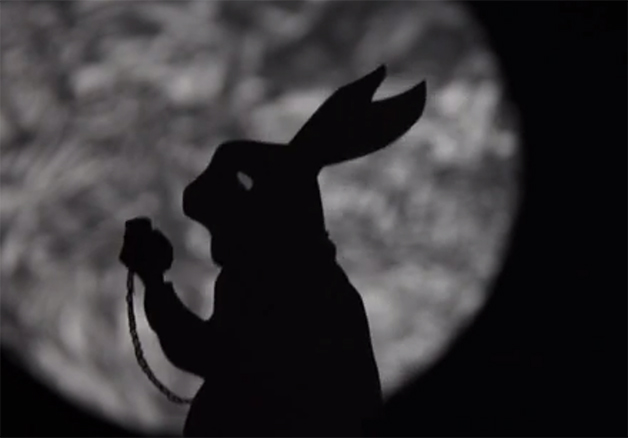


 We’ve been receiving reports from several of our Goes to Town venues that there’s been a breakout. The snowy owl has vanished from the University Church, the edible insects have escaped from the Turl St Kitchen and a white rabbit is on the loose from the Central Library. There’s trouble afoot.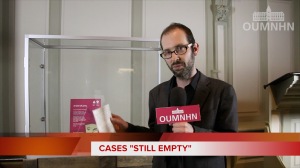
 More Than A Dodo