What’s on the van? – Black-capped kingfisher

_kingfisher

This week’s What’s on the van? comes from Malgosia Nowak-Kemp, Collections Manager in the Museum’s Life Collections.

Kingfishers belong to a family Alcenidae where they are organised into 14 genera with 86 species. Most of them live in the tropics and only a small number of species venture into temperate zones as migrant breeders. Some species feed on forest-floor or air-borne insects, some prey on birds and reptiles and some, similar to our native species, on fish. Kingfishers living away from water, called the tree kingfishers, adopt a sit-and-wait strategy to catch their prey on the ground, whereas kingfishers living near lakes, rivers or streams, the so-called river kingfishers, deep-dive either from a perch or from hovering flight.

The kingfisher you see painted on the van is called the black-capped kingfisher, Latin name Halcyon pileata. It lives in tropical Asia, from India to China, Korea and Southeast Asia. This is a relatively big kingfisher whose length reaches about 28cm.

The black-capped kingfisher is a river kingfisher, found near coastal waters, especially in mangroves. It surveys the area from a high perch and hunts not only for insects but also for frogs and fish. As in other kingfishers, it has very good eyesight, enabling it to cope with reflections on the rippling surface and light refraction of the water, which makes the prey appear to be nearer the surface than it really is.

It makes its nest on the banks near water, with both sexes excavating the nest tunnel. A single clutch of 4-5 round white eggs is typical, with the female being mostly responsible for the incubation. The eggs hatch at daily intervals, resulting in a marked size difference between the chicks. Both parents are equally involved with feeding the brood.

This particular specimen of the black-capped kingfisher was collected in Bangladesh and, after being prepared by a taxidermist, was displayed in a glazed case for a number of years. It came to the Museum in 1963 as part of a large donation of bird skins presented by B.B. Osmaston.

What's on the van?

What’s on the van? – 7 spot ladybird

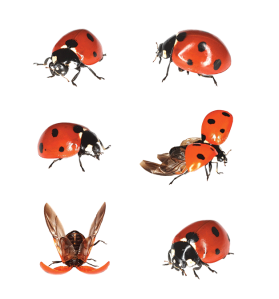
_5450712_xl_ladybird2

This week’s What’s on the van? comes from Richard Comont of the Centre for Ecology and Hydrology.

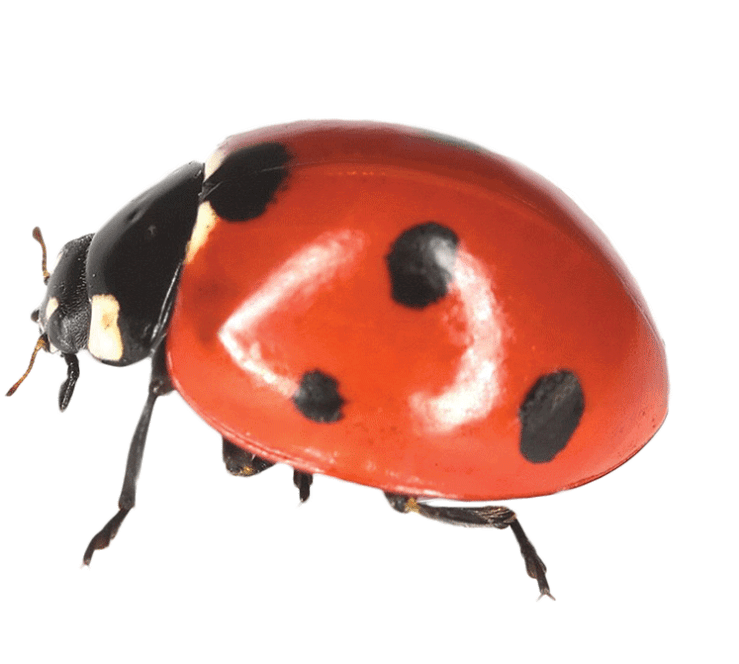
The 7-spot ladybird, Coccinella septempunctata, is one of the most iconic examples of British wildlife. Probably our best-known beetle, its image has been used as the logo for books, clothes, and much more.

It’s one of our largest ladybirds, up to 8mm long, and it can be found almost anywhere – it’s not fussy about habitat and usually arrives shortly after an aphid colony has established. Gardens and rough ground are good areas for the species – they especially love nettle patches!  Their bright red colouration makes them easy to spot, but is actually a warning to predators – ladybirds practice chemical warfare by producing a foul-tasting yellow liquid from their knee joints when disturbed.

_5450712_xlThe 7-spot has been familiar to farmers and gardeners throughout history as a brightly-coloured guardian against greenfly, and it’s from this that ladybirds get their slightly odd name. Bright red in colour (matching the cloak of the virgin Mary in early biblical illustrations) and with seven black spots recalling the seven sorrows of Mary, these tiny predators were clearly a gift from the gods to farmers suffering from aphids on their crops, and so they became known as ‘Our Lady’s birds’, which became shortened to ‘ladybirds’.
Most people recognise the 7-spot, but are surprised to hear that there are actually 47 different ladybird species in Britain alone! The UK Ladybird Survey team have published a new ladybird handbook to help people learn about and identify these fascinating insects – why not submit your next sighting at www.ladybird-survey.org?

What's on the van?

What’s on the van? – Portuguese Man-of-War

_Physalia-sp-No31

This week’s What’s on the van? comes from Kate Pocklington. Kate was the Museum’s Zoology Conservator, before moving to Singapore to work at the Raffles Museum of Biodiversity Research.

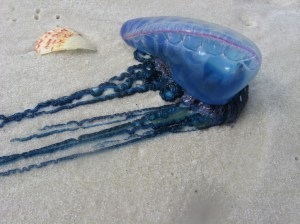
Physalia physalis is commonly known as Portuguese Man-of-War or in Australia, Blue Bottle. Despite often being labelled as jellyfish, physalids are actually siphonophores, which are colonies of many morphologically different individuals attached to each other and working together as a single entity. Physalia captures prey using venomous cells, which shoot out stinging barbs when disturbed.

Physalia washed up on a beach

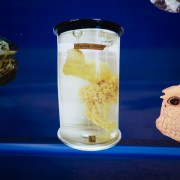
They appear translucent blue when alive, but unfortunately due to death and method of preservation this one has lost its brilliant colour. I value this specimen because of its preparation.

Great care would have been taken to collect and preserve it as, even when dead, physalids remain venomous. The techniques of preservation used here help to display the natural form. This has been done using glass floats attached to the pneumatophore (the individual polyp at the top, a gas filled ‘balloon’) which replicates the natural position of the specimen in the sea. This also helps to show the length of the tentacles.

_DSC4553
Physalia on the van

Without fluid preservation it would be almost impossible to use invertebrates such as this for educational purposes. This method of preservation captures not only the specimen but the development of techniques used over many years incorporating scientific and educational values together. This specimen is just one of approximately 25,000 jars of fluid preserved specimens in the Museum’s collections.

This piece is taken from the Museum’s 2010 exhibition A Few of our Favourite Things.

What's on the van?

What’s on the van? – Sunset moth

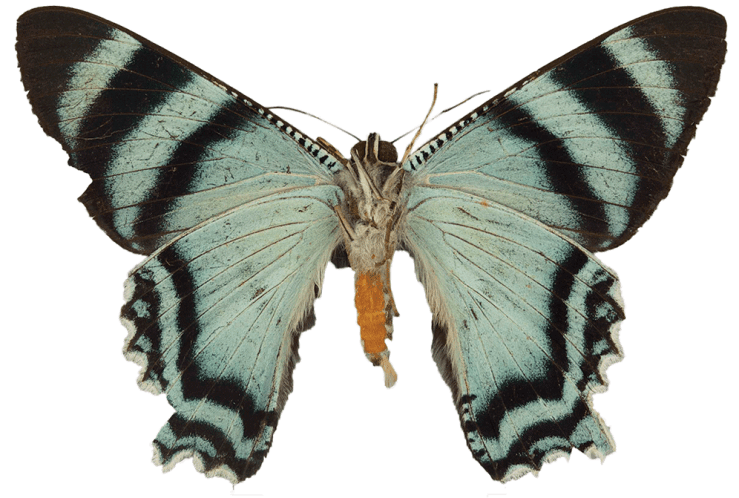
_LEPI2006l

This week’s What’s on the van? comes from Katherine Child, of the Museum’s Hope Entomological Collections.

This striking image shows the underside of a large tropical moth belonging to the family Uraniidae. Its scientific name is Alcidia boops, but it’s also known as a sunset moth due to its striking, shimmery colours. Unlike most moths, this species is active during the day. As the light shifts on the insect’s wings you can see the iridescent scales which act as a warning to predators. These bright colours advertise the fact that the creature is toxic and would not be a tasty mouthful.

Underside and topside of the sunset moth. Photographed by Katherine.

– Underside and topside of the sunset moth. Photographed by Katherine.

Not only is the specimen pictured very beautiful, it is also extremely important. It’s one of almost 4000 butterflies and moths which form the museum’s Lepidoptera Type collection.  A type specimen is the designated individual from which an entire species is first described. This specimen will be referred back to by researchers, and other specimens are checked against it, time and time again. Happily for me, over the last few years it’s been my job to photograph this entire collection; this is one of my favourite specimens from it, and one of the moths which has stood out the most as I’ve worked my way through them all.

Many of the types in our collection are very old and inevitably some are a little the worse for wear. This particular female was collected from the Indonesian island, of Aru in 1857 by the famous naturalist Alfred Russell Wallace, and despite the fact that it’s over 150 years old it’s in extremely good condition – still a really impressive sight.

What's on the van?

What’s on the van? – Granite

_granite_a98-5

This week’s What’s on the van? comes from Dr Dave Waters, Curator of Mineralogical Collections and Monica Price, Head of Earth Collections.

The rock that goes home for holidays
Every year, a group of Oxford undergraduates travel to north-west Scotland to unravel the fascinating geological history of the area by studying the local rocks and how they relate to each other. They stop at various places to explore the geology, including the ‘multicoloured  rock stop’, an exposure of rocks in a road-cut north of Loch Laxford. This is where our sample of granite was collected in 1998.

It is very old, part of a suite of ancient Precambrian rocks known as the ’Lewisian complex’, named after the Hebridean island of Lewis. It formed about 1.7 billion years ago when magma – hot molten rock – was intruded into an even older metamorphic rock called a gneiss. The magma cooled down, forming crystals of different minerals: pink potassium feldspar, white sodium feldspar, transparent grey quartz, and black grains of biotite mica and magnetite.

The students learn to identify the minerals by studying thin sections of the rock, just 0.03mm thick, under a petrological microscope. This allows them to examine the distinctive optical properties of each mineral under polarised light. The Oxford Earth Sciences Image Store shows you what they can see.

Each year, this piece of granite travels ‘home ‘ with the students on their fieldtrip, and helps to teach them about the different kinds of rock they will see in the field. It is part of the large collections of rocks, fossils and minerals in the University’s Earth Sciences Department and the Museum of Natural History that are available for students to study.

What's on the van?

What’s on the van? – Mosquito

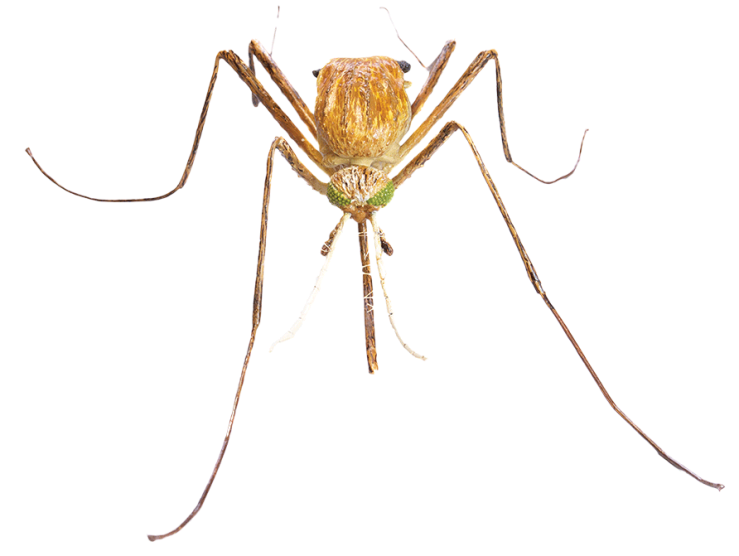
_mosquito_head_on

This week’s What’s on the van? comes from Zoë Simmons, of the Museum’s Hope Entomological Collections.

The word mosquito (formed by mosca and diminutive ito) is from the Spanish or Portuguese for “little fly”. Approximately 3500 species of mosquito have been described to date. The females of a few species require a blood meal in order to lay fertile eggs but many more do not and of those that do, only a handful are disease vectors (a carrier of disease).

These few species however, are of global importance to the human race as they can transmit diseases such as Yellow Fever and Malaria. As a consequence, the mosquito has been dubbed ‘the most dangerous animal in the world’. A large amount of scientific research has been put into combating mosquitoes and the diseases that they carry, but some of the most important information has come from entomologists who have studied mosquito behaviour and lifecycles in detail. From this, scientists have been able to get a better and more complete understanding of the species and thus develop more effective methods of eradication and disease management.

What's on the van?