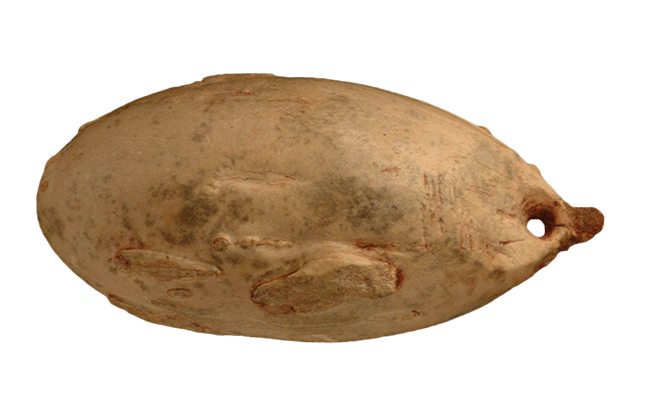
What’s on the van? – Paviland Mammoth Ivory Pendant
2234

This week’s What’s on the van? comes from Paul Jeffery, the Museum’s Assistant Curator of Geology.

This curious object lies at the intersection of many different threads of thought and belief.  It was discovered in 1823 by pioneering British geologist and palaeontologist, William Buckland in a cave on the Gower Peninsula, South Wales.

Found along with other ornamental items, it formed part of the grave goods of a slender youth whose body had been painstakingly daubed in red ochre during a burial ceremony.  Buckland took the remains to be those of a Romano-British witch or courtesan, a notion fostered by his religious beliefs, which supposed the World was created by divine forces a few thousand years ago.

Later studies have shown the remains to be male, not female, and have utilised the slow but imperturbable decay of radioactive isotopes naturally present in the environment to prove that the burial dates from the Late Palaeolithic, around 33,000 years ago.  This makes the skeleton the oldest anatomically modern human found in the British Isles, as well as the oldest ceremonial inhumation in western Europe.

Late Palaeolithic art is extremely rare, especially in the British Isles, which lay on the margins of both the culture and often of habitability. Items such as the Paviland pendant illuminate the contemporary society, showing it could support both creativity and belief in a significance to the body after death, suggesting a culturally rich life rather than a mere primitive struggle for survival.

The object itself is exceptionally curious: it is mammoth ivory, its odd shape is largely natural– only the top is carved, providing a hole through which a thread could be passed so the pendant might be worn.

Mammoths are extinct relatives of elephants, and like them it is probable that males would engage in bouts of fighting to establish herd dominance.  During fights, tusks can be broken and if the break is within soft tissue, infection may take-hold.  If it persists, a tumour can form in the pulp from which the tusk grows.  The Paviland pendant is a unique example of such a tumour, as proved by the residue of the dismantled tusk from which it came, later found nearby.

What's on the van?

What’s on the van? – Moss agate

_02-OUMNHMossAgate[1]

This week’s What’s on the van? comes from Monica Price, Assistant Curator of the Museum’s Mineralogical Collections.

This beautiful polished moss agate is about 8 cm across. It is one of 26 moss agate slices collected by John Middlemiss Luff, and given to the Museum in 1909. John Luff was a civil engineer who, as a young man in 1863, took a posting to the public works department in Bengal, India. Some of the finest moss agates come from India, and every one of the samples in John Luff’s collection is of the best quality.

Despite its name, moss agate doesn’t contain any plant material at all. The orange and brown ‘moss’ is made up of crystals of iron minerals, mostly goethite (iron hydroxide).  The crystals grew in a translucent white gel composed of silica (silicon dioxide) which solidified to form a mineral called chalcedony. Moss agates are found filling fractures and gas bubbles in volcanic lava. When the lava is eroded away by rivers or the sea, the hard lumps of moss agate survive, to be washed up as pebbles on river banks or beaches.

Moss agates take a beautiful polish and they have been prized as semi-precious gemstones for thousands of years. Brown moss agates are sometimes known as ‘mocha stone’. This has a connection with ‘mocha’ coffee beans, for both are named after the port of Mocha in Yemen, from which they were traditionally exported.

What's on the van?

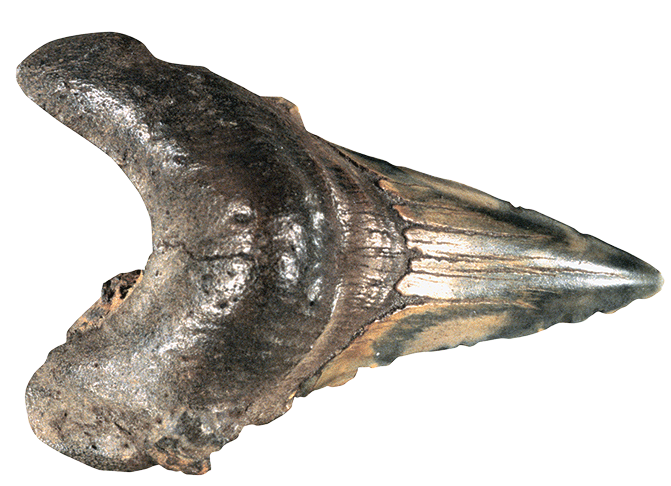
What’s on the van? – Shark tooth fossil

_Lhwyd-1260-original

This week’s What’s on the van? comes from Paul Jeffery, assistant curator of the Museum’s Geological Collections.

The oldest known collection in the Museum is that of Edward Lhuyd (1660-1709), made during the 1680s-1690s. This collection formed the basis for Lhuyd’s ground-breaking monograph, Lithophylacii Britannici ichnographia – a systematic illustrated catalogue of the collection of fossils he was responsible for as Keeper of the Ashmolean Museum, which at that time was still based in its original building, now the Museum of the History of Science in Broad Street.

Lhuyd’s book set the framework for later works by authors such as Carl Linnaeus (1707-1778) and Gustavus Brander (1720-1787) who further systematised the naming and description of animals, plants and fossils, and introduced a Latin-based naming regime still used today.

Lhuyd also advanced thinking on fossils, recognising them as organic in origin, rather than spontaneous mineral concretions or sports of the devil. This was daring and radical for its time – an era when religious orthodoxy still strongly influenced philosophical and academic thought.

This particular shark’s tooth comes from the extinct species Otodus obliquus. It is from the 50 million year old London Clay (Early Eocene), and was found on the Isle of Sheppey, Kent. Such teeth can still be found on the beaches there today, washed from the crumbling clay cliffs by rain and wave alike.

It is an uncommonly large species of shark – teeth may exceed 75mm in length, and represents one of the earliest steps in an evolutionary “arms race”. During the Palaeogene and Neogene this lineage of lamniform sharks evolved ever larger and more comprehensively serrated teeth, along with proportionately increased body sizes, to keep pace with early whale evolution, as they too increased from modest proportions to the giants of today.

It was a race the whales eventually won in the Early Pleistocene. Otodus’s descendant – the giant Carcharocles megalodon, a 20m long super-predator – disappeared around this time: outgrown by the whales, out-competed by new predatory species and displaced by global climatic cooling.

We will be exhibiting some of Lhuyd’s fossils in Natural Histories, a collaborative exhibition based at the Museum of the History of Science, opening on 14 May. More information about this will follow very shortly.

Paul Jeffery, Assistant curator of Geology

What's on the van?

What’s on the van? – Heliconius hecale

butterfly3This week’s What’s on the van? comes from Zhengyang Wang, an undergraduate volunteer in our Hope Entomology Collection

Belonging to the genus of Heliconius, this species of butterfly can be seen from Southern Mexico to north-central Bolivia, from dense forests to open savannah. Like many other species of this genus, Heliconius hecale has many different forms of a single species. The picture illustrates the form felix of this species, which is commonly found in Munchai, Rio Beni and Bolivia.

In one of the cabinets of the Hope Entomology Collection here at the Museum, you can find another form of the same species but of slightly different wing pattern, vestustus, usually found in Columbia. Sometimes the visual differences between forms of the same species can be quite stark: the fornarina form of Heliconius hecale from Guatemala, for example, is only black and white.

In fact, morphological differences within species is quite common among butterflies. As well as sexual dimorphism, where male and female body shapes differ, species found at different localities, different climates, and in different seasons can also exhibit variations in morphology.

Speaking of morphology, it also needs to be mentioned that many other species from different sub-families of brush-foot butterflies, such as Danaini and Ithomiini, mimic the morphology of these Heliconius butterflies. Why is that? It’s because many Heliconius butterflies are quite unpalatable to their predators, so a mimicry of them might tell predators “Don’t eat me, I’m poisonous.” This kind of mimicry of other species’ warning signals is called Mullerian mimicry.

Thanks to their choice of plant food, their differing wing patterns and the relative ease with which they can be monitored, the butterflies from the genus of Heliconius have also been widely studied to understand genetic evolution and co-evolution between butterflies and plants.

Zhengyang Wang, visiting student at Hertford College, Oxford and volunteer in the Hope Entomological Collection

What's on the van banner 2

What’s on the van? – Harlequin shrimp

_harlequin-shrimpno-29
Credit: Dr Arthur Anker

This week’s What’s on the van? comes from Sammy De Grave, assistant curator of the Museum’s Zoological Collection

Harlequin shrimps are monogamous, living in male-female pairs for life, sharing and actively defending a patch of reef of about 10 square meters. As you can see, they have exquisite colour patterns and a highly unusual morphology.

The main diet for the harlequin shrimp are starfish. Prey is located by either member of the pair, and even though the starfish may often be ten or twenty times larger than the shrimps, the harlequin shrimps flip over the starfish and drag them into their lair.

Once inside the lair, the starfish’s internal organs – tube feet and guts – are devoured, starting from the tips of the arms and working towards the central disk. This keeps the shrimps’ victim alive for as long as possible. It usually takes several days for the process to be completed. On occasion a starfish escapes, minus a leg or two, but usually they succumb.

A large scale program was initiated in the 1980s to attempt to harness this behaviour as a bioweapon against outbreaks of the Crown-of-Thorns starfish in the Pacific. However, due to their antagonistic territorial behaviour this was doomed because each pair of harlequin shrimps would kill all the others in close vicinity.

Sammy De Grave, Assistant Curator, Zoological Collection

What's on the van banner 2

What’s on the van? – Darwin’s dung beetle

_Beetle-wpin

This week’s What’s on the van? comes from Darren Mann, assistant curator of the Museum’s Hope Entomological Collection

On the 27 December 1831 a young naturalist by the name of Charles Darwin (1809-1882), on a ship by the name of the HMS Beagle, began a five year journey around the world. During this voyage he collected many specimens of plants and animals, which he later dispersed to some of the most eminent scientists of the day.

Of all the insects in this small collection, the beetle Onthophagus australis (Guérin, 1830) is by far my favourite, simply because it’s a dung beetle, which are my favourite insects. I think dung beetles are both beautiful in form and ecologically are extremely interesting.

This very specimen was collected by Darwin during 1836 at Hobart town, Tasmania. At the time, Reverend Frederick William Hope (1797-1862), the British entomologist who founded the Museum’s Hope Entomological Collection, thought the beetle was a new species to science; it had in fact already been described from Port Jackson, Australia by French entomologist Félix Guérin-Méneville (1799-1874). This is a widespread species found in Tasmania and south-western Australia, where it feeds on all sorts of dung.

During Darwin’s early life, Hope was a friend and mentor, and as such Darwin sent some of the Australian insects he collected to Hope for study. Sadly, Hope took ill and retired to Italy, never completing his work on Darwin’s insects.

To date we have found over 130 Darwin specimens in our collections. Some of these have even travelled back to Australia to form part of the temporary exhibition at the National Museum, which celebrates Darwin in Australia.

Darren Mann, Assistant Curator, Hope Entomological Collection

What's on the van?