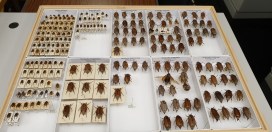
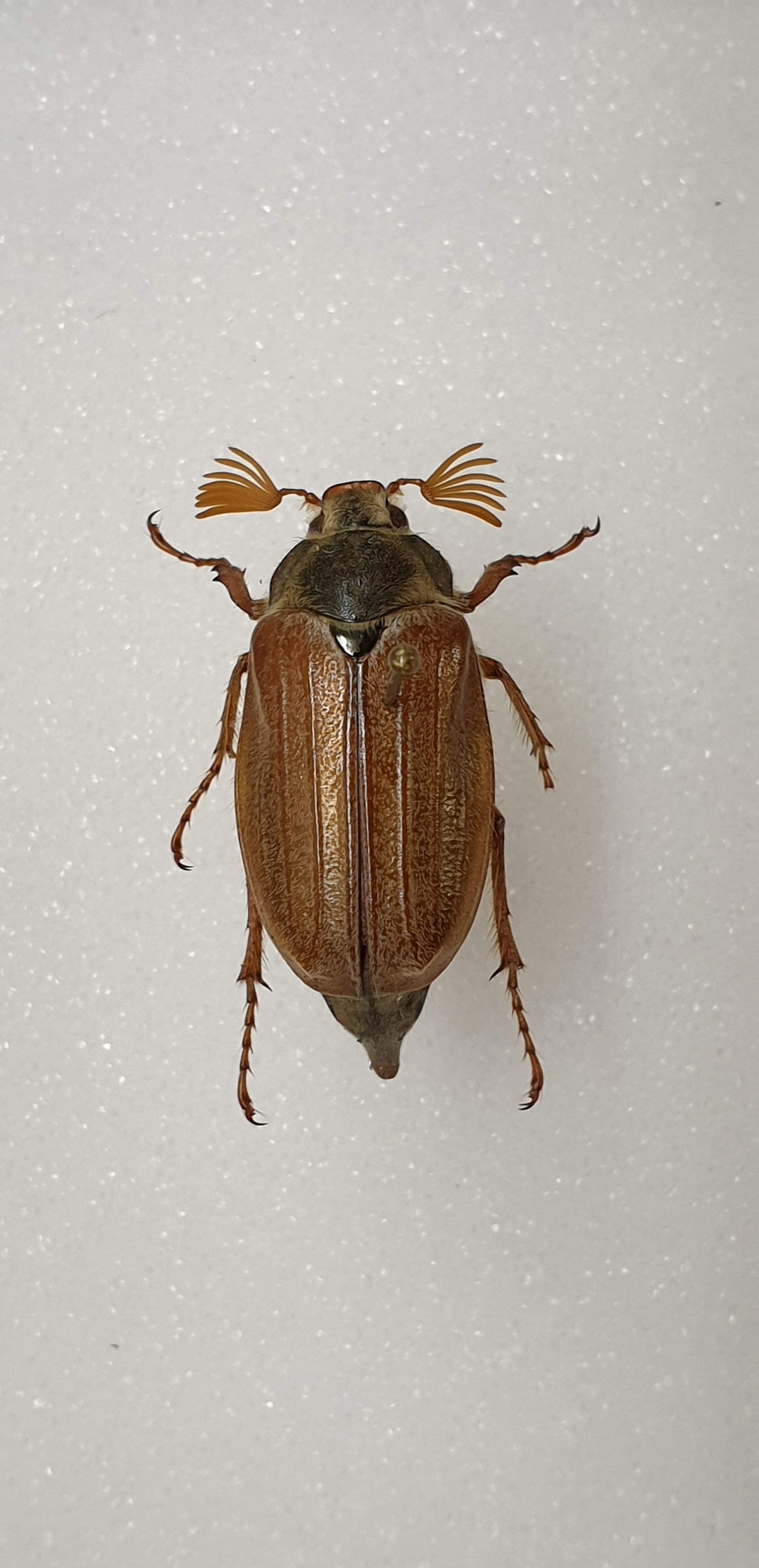
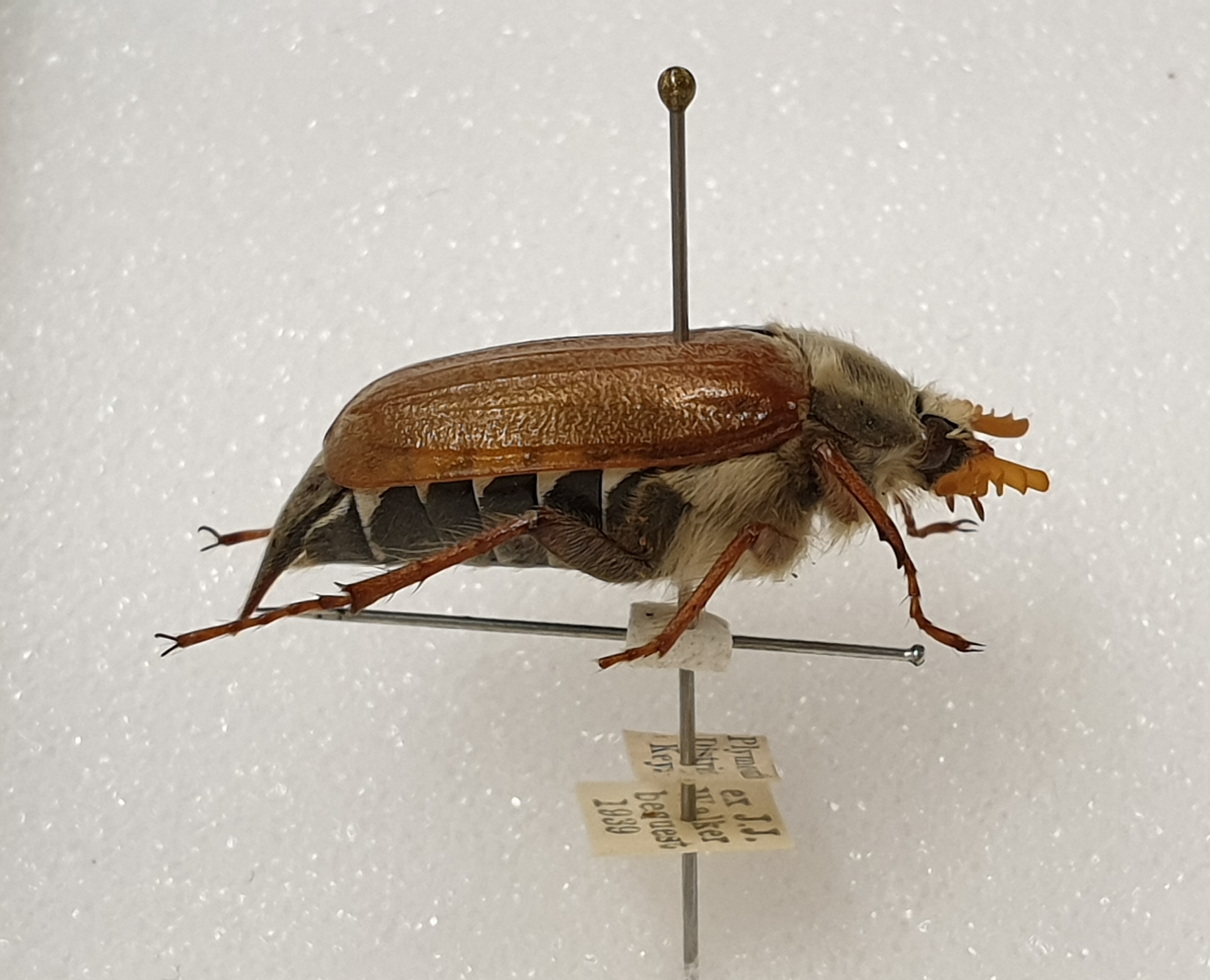
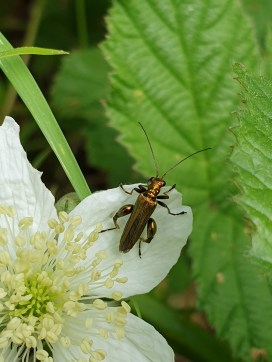
As the month of April fades into May a certain beetle can be found flying noisily about its business. Cockchafers, often called Maybugs, are relatively large members of the Scarab beetle family. There are three different species of Cockchafer found in Europe;
The common cockchafer, Melolontha melolontha
The forest cockchafer, Melolontha hippocastani
The large cockchafer, Melolontha pectoralis
Cockchafers spend most of their lives, 3 to 4 years, as larva, living underground, munching away at the roots of plants. In large numbers they can become pests, doing significant damage to crops.
It is as adults that they emerge above ground, flying around for roughly 5 to 6 week looking for a mate and feeding on the leaves of trees. They can usually be spotted making their noisy flight at dusk on warm evenings. You may even find them flying into and around your outside lights.
They are around 3cm long, with reddish brown wing cases and distinctive fan shaped antennae. Despite their intimidating size and noisy flight, they are actually harmless to humans. I once had one fly in the house and land on my big toe, waking me up from a nap!
Pesticides used farming in the mid-1900s brought them to the brink of extinction in the UK. However, changes in farming practises and pesticide use has allowed them to make a comeback. They can now be found across England, are particularly common in the south of England and the Midlands. They are much rarer in Scotland.
Do you know of any other insects that are considered pests by farmers? Let us know in the comments below or via the contact us section of the blog.
Despite being viewed as a pest by many a gardener, for munching the leaves of their prized lilies, the lily beetle (Lilioceris Lilii) is a favourite insect of Andrew Salisbury, principal entomologist for the Royal Horticultural Society (RHS). In this short film Andrew tells us a bit about the lily beetle and why he finds it so fascinating.
Are there any insects that are often considered pests that you have a particular interest in? Let us know in the comments below or via our contact us page.
Try out a new technique for finding insects with HOPE Learning Officer, Kate.
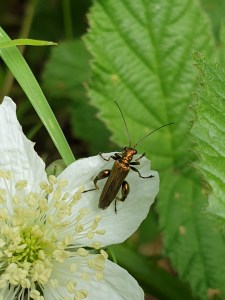
Have you found any interesting insects lately? Along with the other HOPE Learning Officers, I have been out and about in Oxfordshire schools where we have found some fantastic insects. Among my recent favourites is the thick-legged flower beetle, Oedemera nobilis .
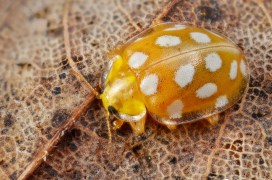
These beautiful beetles are distinctive with their stunning emerald-green colour and their chunky thighs which are seen only in the males. We have also found lots of varied species of ladybird including cream spot, 14-spot and eyed ladybirds. Generally, we collect insects using sweep nets and beating trays but, of course, you might be lucky enough to find some interesting insects just by looking in the right places. Under stones, logs, leaves, in amongst long grass or on flowers are all excellent places to start. Insects, however, are very good at hiding so why not make a pitfall trap? This can be a great way to find a range of insects, particularly ground beetles.
Here are the written instructions.
You will need:
A small pot such as a clean yoghurt pot
A trowel for digging
A few stones
A small piece of wood or a flat stone to act as a rain cover
What to do:
Find a good spot for your trap on level ground, amongst vegetation.
Dig a hole big enough to sink your pot so that it is completely level with the ground.
Place the pot into the hole. You can put a few leaves, small stones and twigs in the pot to make any insects you catch feel at home.
Build a cover over the trap by placing stones around the pot and resting a flat stone or piece of wood on top. Make sure there is enough space for insects to crawl under. This will stop the pot filling with water if it rains.
Wait for a few hours or, better still, overnight.
When you are ready, empty your pot carefully into a tray so you can see what has fallen in. Take photos so that you can have a go at identifying what you have caught.
Remember to check your pitfall trap every day and return any creatures carefully to a sheltered spot in vegetation.
We would love to know what you find! Let us know by commenting below or by using the Contact Us page. Happy insect collecting!
Here at Crunchy on the Outside we love insects and we also love cartoons. What could be better, then, than cartoon insects?!
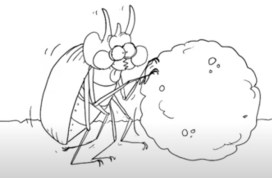
In this video Chris Jarvis shows us how to draw a mighty dung beetle called the Minotaur Beetle (Typhaeus typhoeus) complete with its own ball of dung!
Minotaur beetles grow to about 2cm in length and can be seen between September and July. They live in grassland and heathland with sandy soils. They feed on rabbit droppings and other dung (yum!) which they roll into balls and bury them in nests which can be over a metre deep underground. Male beetles may defend these nests using their long horns. The females lay their eggs in these nests. The eggs then hatch and the larvae feed on the tasty dung!
Watch the video carefully and you will see that Chris has included many of the key features of this fascinating beetle. He has deliberately left one insect feature out of his drawing. Can you spot what is missing? Here’s a clue: they help insects sense their environment.
Let us know what you think is missing by commenting below, or sending us a message using the Contact Us page. We’d also love to see you own cartoon insects!
Professor Helen Roy, President of the Royal Entomological Society, tells us about a group of insects that interest her most: ladybirds. Also known as ladybugs, ladybirds are in fact beetles. In this video, Helen shares three of her favourites.
Helen Roy shares her favourite ladybirds
Which ladybirds have you spotted? Can you find any of Helen’s favourites? Do you have a favourite of your own? Let us know in the comments section below, or send us a message via the Contact Us page.
Ladybird images credit: Flickr / Gilles San Martin CC BY-SA 2.0
Katherine Child, image technician in the Museum’s Life collections, doesn’t just use photography to capture the beauty of specimens. She is also an artist and has been trying out innovative techniques for her paintings. You may remember her amazing moth illustrations created with deposits of verdigris on pinned insects and she’s now using that technique to explore Museum staff’s favourite insect specimens.
Verdigris is a green corrosion often found on old pins within entomology collections (as well as elsewhere, on things like statues and copper pipes). Last year, after learning that the substance was once used as a pigment, I decided to try and make my own paint.
A clearwing moth before conservation, showing verdigris spreading where metal reacts with insect fats, or lipids.
Verdigris forms when copper or a copper alloy reacts with water, oxygen, carbon dioxide or sulphur. While a beautiful shade of green, the substance is damaging in natural history collections, where it can actually develop inside specimens and if left, split them irreversibly. So as part of the conservation of the Hope Entomological Collections, verdigris is removed.
I started to collect up the substance as it was cleaned from specimens and after about three years (you only get a little bit per pin) I was ready to make my paint! After my first moth project, the only question was, what to paint next…?
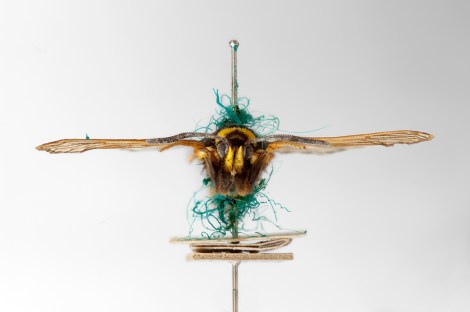
Byctiscus populi or ‘The Attelabid that changed my life’, chosen by Zoë (collections manager) who said ‘I saw a pink version of this species in the Natural History Museum in London and that’s when I decided I wanted to study entomology’.
With an estimated 6 million insects and arachnids in the entomology collections, it’s very easy to feel overwhelmed. You can pull open any one of thousands of draws and find astonishing specimens. While I have favourites, my first inclinations as to what to paint still felt a little arbitrary. After mulling over various possibilities, I decided to get help!
Chosen by DPhil student Leonidas, Agalmatium bilobum is a little bug which lays its eggs on tree bark, then covers them with mud to protect them.
I asked my co-workers what their favourite insects were, then opened the question out to regular volunteers and visitors of the Life collections. I loved finding out why people chose the things they did. Answers varied from ‘It was the first spider I ever looked at under a microscope aged 12’ to ‘Because they’re cool’ to ‘Because they have an ingenious way of manipulating spiders!’
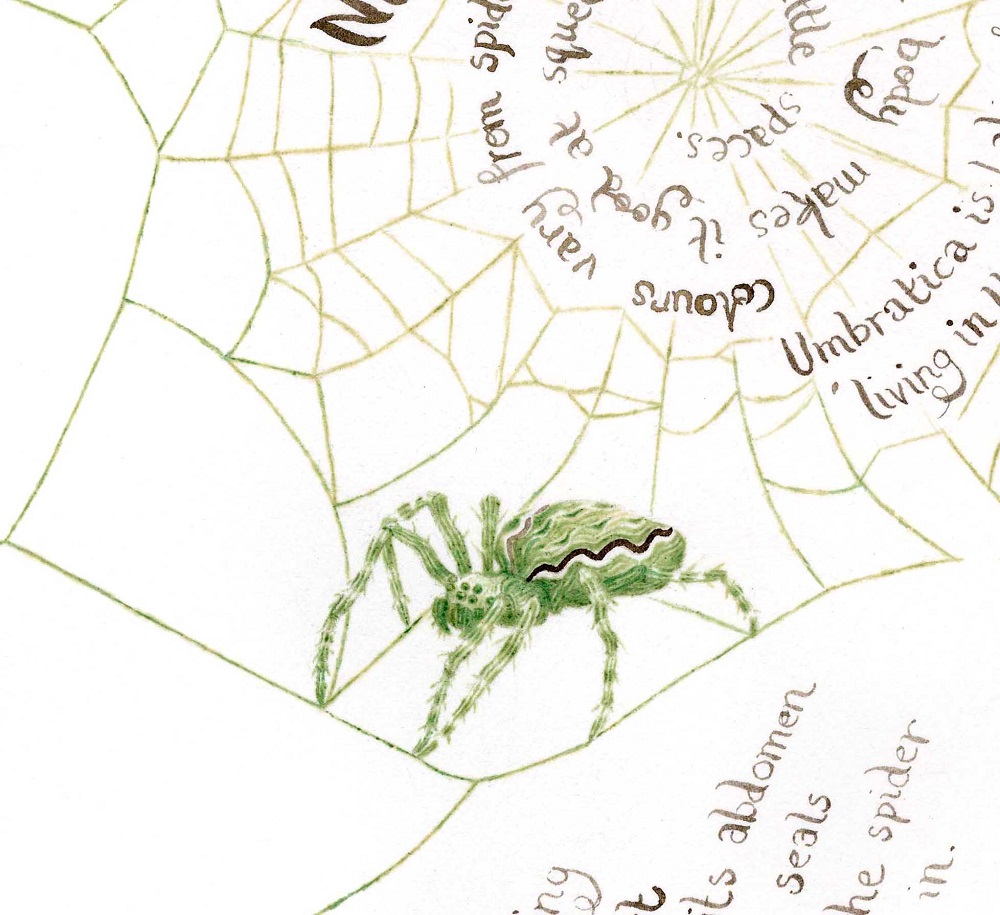
One of arachnologist Russell’s favourite spiders: Nuctenea umbratica. Though common in the UK, umbratica is Latin for “living in the shadows”, and it often hides away during the day. The slight transparency of the paint lends itself to a spider’s glittering eyes.
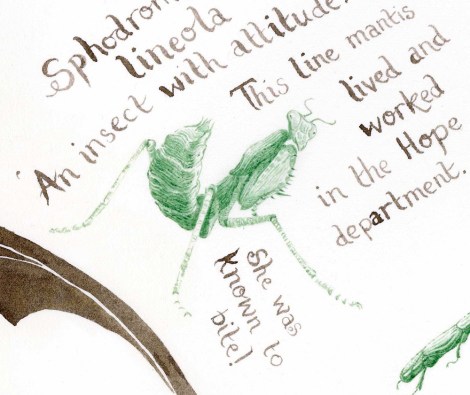
Painting this live African Mantis Sphodromantis lineola (chosen by conservator Jackie) was made slightly more challenging by the fact that the subject thought Katherine’s pencil might be tasty.
Most of the subjects I painted were based on specimens from the Museum’s collections or specimens individuals had brought in from their own collections, but one favourite was a live African Mantis, housed in the department to help with education and outreach. When I began to draw her she was intrigued by the movement of my pencil and came to the front of the tank, to follow every mark I made with her intimidating gaze.
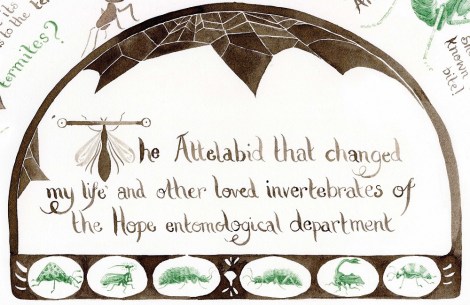
A detail from the final painting
Katherine’s fabulous finished painting, which will be framed and displayed in the Life collections department.
Though time consuming, the painting was loads of fun to research and do. It’s fantastic to be surrounded not only by extremely knowledgeable people, but also by people with a genuine passion for what they do and a love for the insects (and spiders) they study.