Why do we need pinned insect specimens?

Since we posted about ten-year-old Sarah’s amazing beetle discovery, we’ve had lots of queries as to why the insect needed to be caught and pinned. It’s a question we’re often asked, so here’s Darren Mann, Head of Life Collections at the Museum, to explain the value of ‘voucher specimens’.

The Museum’s collection houses over five million insect specimens, amassed over the past 300 years. This collection is, in effect, a biodiversity database, but unlike virtual databases, each data point has an associated ‘voucher specimen’ that was caught, pinned and labelled.

Although technical advances in digital macro-photography do reduce the need for some collecting, it is impossible to dissect an image to confirm an identification. So for many groups, even the best photograph in the world is inadequate for identification purposes.

Shingle CrawlerD18 (Psammoporus insularis Pittino, 2006) one of our few endemic insects.

Unlike plants and birds, many insects can only be identified with the aid of a microscope, to study tiny features that distinguish closely-related species. Some groups even require the dissection of minuscule genitalia to really tell them apart.

Entomologists take voucher specimens to enable this correct identification and these are later deposited in museum collections, making them available for further study in years to come. From an entomologist’s point of view, we believe we need to know what a species is, where it occurs and as much about it as possible, so we can inform biodiversity conservation.

The conservation assessment of UK insects by Natural England in their Species Status Reviews has only been possible with the data provided by entomologists, generated from collecting and identifying voucher specimens.

Entomologists follow a Code of Conduct for responsible collecting, which ensures they don’t remove too many species or damage the environment during their work .

There are numerous examples of the value and use of insect collections in contemporary science, including the discovery of previously unknown species in the UK and population genetics for butterfly conservation. Recently a species believed extinct in the UK was rediscovered. This was only made possible by checking the identification of several thousand museum specimens.

Museum collections also contain numerous examples of species now considered extinct in the UK. Without voucher specimens much of this research would be impossible and our understanding of insect distribution patterns, ecology and conservation would be significantly diminished.

Large Tortoiseshell butterflies, now considered to be extinct in the UK. The voucher specimens act as record in time of its occurrence in the UK.

What is rare?
Sarah’s False Darkling Beetle (Anisoxya fuscula) has been described as ‘rare’, but what does that mean in reality? For most invertebrates when we talk about a rare species we are not talking about a tiny number of individuals. This conservation status is based on their known distribution and the level of threat they face. A species can be rare if it is only found at one or two locations, but at those locations there may be many thousands of individuals.

The greatest threats to biodiversity are well known and include habitat loss, fragmentation and degradation and pollution, such as pesticides and light. Taking a small number of voucher specimens to confirm the identification of species has negligible impact on its population. But if we don’t know it’s there because we couldn’t identify it, then a housing development destroys its entire habitat… well you get the picture!

Further Reading
Ask an Entomologist
Entomological Collections
Natural England Species Status Reviews
To Kill or Not to Kill That is the Question Part 1
To Kill or Not to Kill That is the Question Part 2
To Kill or Not to Kill That is the Question Part 3
– Austin, J. J., & Melville, J. (2006). Incorporating historical museum specimens into molecular systematic and conservation genetics research. Molecular Ecology Notes, 6(4), 1089-1092.
– Colla, S.R., Gadallah, F., Richardson, L., Wagner, D., & Gall, L. (2012). Assessing declines of North American bumble bees (Bombus spp.) using museum specimens. Biodiversity and Conservation, 21(14), 3585-3595.
– Short, A. E. Z., Dikow, T., & Moreau, C. S. (2018). Entomological collections in the age of big data. Annual review of entomology, 63, 513-530.
– Suarez, A.V., & Tsutsui, N.D. (2004). The value of museum collections for research and society. AIBS Bulletin, 54(1), 66-74. Abstract available here
– Wandeler, P., Paquita, Hoeck, E.A. & Keller, L.F. (2007). Back to the future: museum specimens in population genetics. Trends in Ecology & Evolution 22.12, 634-642.

Carnivore conservation

A new choose-your-own-adventure board game created by researchers from the University of Oxford’s Department of Zoology puts players centre-stage in a global carnivore conservation challenge. The educational game is launching a Kickstarter fundraising campaign today and here co-designer Dr Cedric Tan tells us all about it…

Have you ever wondered what it’s like being a conservation biologist? We have spent the past year creating and testing a brand new board game – The WildCRU Game: Global Carnivore Conservation – that reveals some of the challenges faced by conservationists, the animals themselves, and the indigenous people who live with them. We’re now looking to get the game out to schools and communities all across the world with a £40,000 Kickstarter funding campaign featuring lots of rewards and discounts for our backers.

The game has been co-designed by Jennifer Spencer and myself to appeal to non-scientists and people of different ages. Players work together cooperatively as WildCRU researchers to gather the resources to complete carnivore conservation projects across the globe.

Stories in the game are taken directly from the real experiences of the WildCRU team. Players must decide what to do in choose-your-own-adventure-style encounters to gather the equipment, personnel, and transport resources they need for their projects.

In developing this game, we chose six varied WildCRU projects including the Hwange Lion Research project, based in Zimbabwe, and the famous water vole study in the UK, to show players the breadth of WildCRU’s research.
– Co-designer Jennifer Spencer, WildCRU

Multiple choice research questions are also based on real WildCRU research; they reveal more about the environment of each project – the flora, herbivores, competitor carnivores, and study species of the study sites. With the additional pressure of Global Events, players will learn about how difficult wildlife conservation projects can be.

It has been great to see that the game appeals to both kids and adults. People have found it to be an immersive experience in which players experience the challenges of real people, real situations and real research. We also hope that the game will provide local families with the opportunity to learn about the wildlife around them, and how to live in harmony alongside it.

Through the game and our other education efforts we’re hoping to increase environmental awareness and to introduce a wide variety of people to the science and processes behind real-world conservation.

Images and video: Laurie Hedges (lauriehedges.com)

Kelp our corals!

Many people know about the importance of conserving coral reefs to protect marine biodiversity, but here at the museum we also need to conserve the corals that are in our collections. These specimens provide a valuable picture of the diversity of life in the ocean, and document changes seen over time, which is more important than ever. So it’s essential that our conservation team make sure these corals are in the best shape possible. Stefani Cavazos, an intern from UCL’s MSc in Conservation for Archaeology and Museums, tells us how they’re going to do it.

As part of the ongoing effort to improve the museum’s collections storage we decided to give our soft corals and sponges a bit of TLC through some repacking and reorganisation.

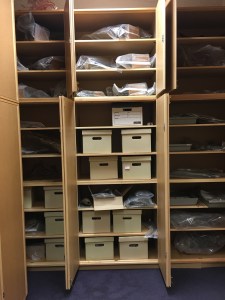
This collection – a mix of old display material and specimens not formally accessioned to the museum collection – isn’t currently stored as well as it could be and there is a danger of breakages and damage. The specimens are packed in non-conservation grade materials, such as cardboard boxes, which are notorious for creating acidic gases that can damage delicate specimens.

The current housing of our soft coral and sponge collection

So a new project, Kelp our Corals, will focus on two areas of improvement.

First, we’ll remove all old packaging and repack using new bespoke storage boxes made from conservation grade materials. At the same time, specimens will be photographed, catalogued, and given accession numbers.

The goal is not only to rehouse the coral and sponge collection, but to also make it more accessible to the public for use in teaching and for research. We don’t have a lot of documentation for these corals, so hopefully the project will help us fill in some gaps: Where did these specimens come from? What can they tell us about life on a reef?

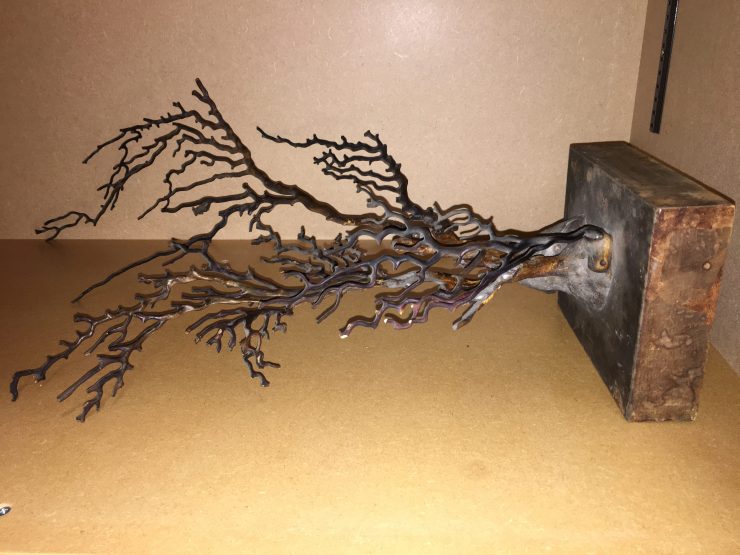
Large specimens are improperly laid on their sides with no protection from the environment and dust, causing weight stress on the specimen

Would you like to kelp, er, sorry – help? We are looking to recruit volunteers to help us with the work. We’re aiming to start in mid-February and finish by May this year. If you are interested in gaining some museum and conservation experience, or like to work with your hands, please do get in touch at volunteering@museums.ox.ac.uk.

Credit for image at top of post: USFWS/Jim Maragos via Creative Commons

Clean as a new pin

The spiky customer above has enjoyed a serious spruce-up from Stefani Cavazos, our current intern from UCL’s MSc in Conservation for Archaeology and Museums. Stefani tells us how she got this Spot-fin Porcupinefish looking shipshape, without receiving any serious injuries.

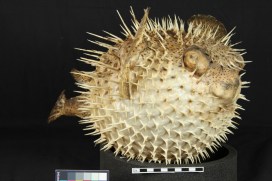
So far at the Museum I have been working on a range of specimens, from taxidermy and wet specimens to cleaning the whales, but my favourite project so far has been the conservation of this Spot-fin Porcupinefish from the displays. It is part of what is known as the Christ Church Collection, which came to the Museum in 1860. This makes the Porcupinefish at least 150 years old.

The specimen itself was covered in dust and all five of its fins were backed with deteriorating cardboard pieces. These were most likely attached to give some support during a previous restoration attempt. Unfortunately, cardboard is not a conservation grade material because over time it becomes acidic. Temperature and humidity changes in the Museum have caused it to bend forward, pulling the fins out of shape, so we felt it should be removed to prevent further damage.

The Spot-fin Porcupinefish (Diodon hystrix) before conservation treatment (left images), and close ups of the cardboard backings on the left pectoral fin (right images), where staining and bending are visible. The red arrow indicates where the paper has separated from the fin, and how thin the fins are.

The first step in the treatment was to clean the surface of the Porcupinefish using warm water and a cotton swab. This allowed me to get into the nooks and crannies of the body whilst (mostly) avoiding being poked by its spines. Next, the cardboard backings were softened with water vapor, causing them to break apart so they could be removed easily using tweezers and a scalpel blade.

Conservation can feel like detective work since we often uncover interesting information about specimens as we work on them. In this case, as we removed the cardboard pieces, we found writing on the underside. It appears to be from a shoe box! Though unexpected, it wasn’t entirely surprising. Preparators in the past used whatever materials were available to them at the time.

(Left) The cardboard was carefully removed from the caudal (tail) fin. (Right) The cardboard once removed from the fin, it appears to be from a shoe label.

After detaching the cardboard from all the fins, the remaining ink and adhesive residues were removed using a 50/50 alcohol and water mixture applied with a cotton swab. The edges of the fins were then coated with two thin layers of an acrylic adhesive to prevent any further breakage and to offer some support to the weakest areas. Cleaned, and free of damaging materials, this Porcupinefish is now ready to go back on display!

Photos of the Spot-fin Porcupinefish after treatment was completed. Without the cardboard backings, the fins are somewhat translucent.
Stefani takes her finished work out to one of our regular Spotlight Specimen sessions, giving visitors the chance to get a closer look and ask questions.

Seasonal sights

The Museum’s collections are on the move. For decades, a deconsecrated church has been used to house material from our Earth collections, but we now have a new and improved off-site space, and between now and the end of 2018 a huge project is underway to sort and shift these objects. You can find out more about all this in our Stories from the Stores article. 

Chantelle Dollimore, Move Project Assistant, recently emigrated from Australia and has been experiencing her first British autumn. Here she shares a glimpse of the natural encounters the collections move has offered so far.

**

As the project team for the collections move settles into the daily hustle and bustle of work there are extraordinary things happening outside. Winter is coming; we have already wound our clocks back for that extra hour of sleep. Leading up to that time, creatures great and small have been preparing themselves for seasonal changes.

Autumn leaves litter the footpath to the store

Something truly blissful in an English autumn is the deciduous trees shedding their leaves as the days grow shorter and chillier. The crunching underfoot of hues of browns, reds, yellows and oranges adds charm as we make the rounds of our 19th-century church workspace.

A Red Kite soars above the Museum’s offsite collections store

Driving from the Museum to the off-site store, we’re likely to see at least one Red Kite. Less than 30 years ago Red Kites were nearly extinct, but through conservation efforts they have flourished in the Oxfordshire countryside. Their distinct calls and unique silhouette, with long narrow wings and forked tail, are a haunting yet beautiful addition to the skyline.

A Red Kite (Milvus milvus) on display in the Museum

The move project team have also been visited by a different ‘bird’ altogether; the ladybird! At this time of year, when you find one you will most likely see many more close by. When a ladybird finds the perfect place to hibernate for spring it excretes a pheromone to attract more to the area. For some, the perfect place seems to be inside the church itself!

(Lady)birds of a feather flock together

Grey Squirrels and deer are also making appearances throughout the day while we’re working. One cannot help but watch as the bushy tail of the squirrel peeks through the hedges as it forages for food and admire the deer as they stroll through the fields happily unaware of our activities some 50 metres away.

Although it’s great to admire the specimens on display in the Museum, I love that my job allows me to get out and about to appreciate the wildlife of the Oxfordshire countryside. There’s always something unexpected… like a butterfly choosing its resting place on some disassembled storage shelves.

A butterfly (Nymphalidae sp.) in torpor finds shelter from the impending cold

To keep up with all the move project action, follow the museum hashtag #storiesfromthestore on Twitter @morethanadodo.

High time for a check up

by Bethany Palumbo, life collections conservator

This month marks three years since the completion of our ‘Once in a Whale’ project. The initial conservation undertaken in 2013 focused on the cleaning and stabilisation of five whale skeletons, which had hung from the roof of the Museum for over 100 years.

The skeletons were lowered into a special conservation space, where the team were able to work up close with the specimens. As well as the cleaning, they improved incorrect skeletal anatomy, replacing old corroded wiring with new stainless steel. For final display, the specimens were put into size order and rigged using new steel wiring, with the larger specimens being lifted higher into the roof space to make them a more prominent display than previously. You can read all about the project on our blog, Once in a Whale.

Three years on, our conservation team felt it was a good time to check on the specimens to see how they’re coping, post-treatment, in the fluctuating museum environment.

Conservation intern Stefani Cavazos works on high to clean the Beaked Whale

It’s been wonderful to see the whales on display and their new position looks very impressive. However, when the time came for making this recent conservation assessment, the new height was greater than any of our ladders could reach. Specialist scaffolding was brought in to allow the conservators to access the specimens. Starting at the highest level, with our Beaked Whale, cleaning was completed using a vacuum and soft brush for delicate areas. This removed a thick layer of dust and particulate debris: especially satisfying work!

Dust gathered on the Beaked Whale fin

With cleaning complete, visual assessments could then be undertaken. These showed that while the specimens were still very stable, a few areas of bone have continued to deteriorate, visible in cracking and flaking of the surface. In other areas, the fatty secretions which we previously removed using ammonia had once again started to emerge. We had expected to see this though, because, in life these whales’ bodies contained a lot of fat, deep within the bones and this is notoriously impossible to completely remove.

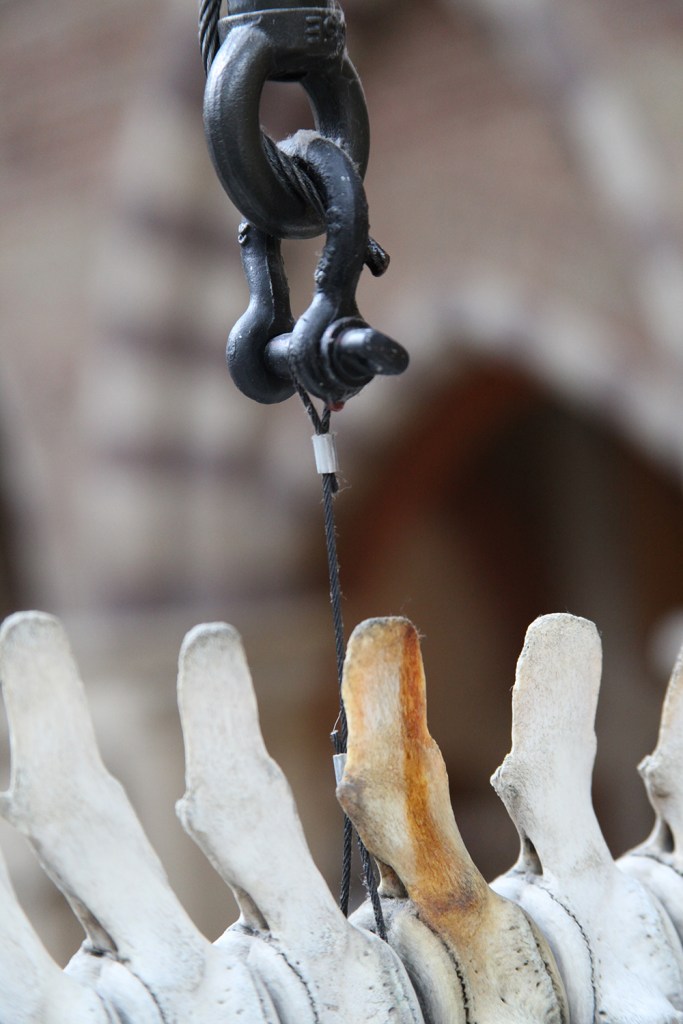
Lubricant stain seen on a vertebra

It was also observed that the lubrication used on the new rigging bolts had melted and dripped down the wires. You can see in the photo above how this has become drawn into the vertebrae of the Orca and Common Dolphin, staining them yellow. While no conservation treatment was undertaken due to time restrictions, thorough photography was performed to document these changes and once time permits this can be carried out.

This shows how conservation work, especially with natural history specimens, is a gradual, ongoing process. With frequent check-ups and specialist attention, these whales will be able to continue their life as our beautiful display specimens.