Museum’s Mary Anning Fossil Gets Stamp of Approval


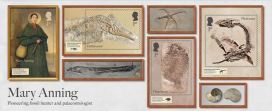
200 years since OUMNH’s very own Megalosaurus fossils were used in the first scientific description of a dinosaur, the Royal Mail has launched The Age of Dinosaurs, a two-part series of commemorative stamps. The stamps include one series of palaeo-art reconstructions of Mesozoic dinosaurs and reptiles and another series celebrating Mary Anning (1799-1847), a self-taught anatomist and fossil preparator, and one of the most important figures in early geology.

Dr Emma Nicholls and colleagues discuss some of the fascinating stories behind the species and specimens featured on these stamps.


Megalosaurus stamps

Two of the stamps in the Age of Dinosaurs stamp set include artistic reconstructions of Megalosaurus by the palaeo-artist Joshua Dunlop. The animal that nineteenth-century naturalists once understood to be a lumbering long-legged lizard is now depicted as a fearsome Jurassic predator that ran on its hind legs and tore into prey with its large serrated teeth. Dunlop shows Megalosaurus wading through shallow coastal waters, preparing to pounce on Cryptoclidus¸ a plesiosaur that lived alongside Megalosaurus in Jurassic Britain. The artwork also shows Megalosaurus covered in feathers. Although we don’t have any direct evidence that Megalosaurus was a feathered dinosaur, feather-like filaments have been found among the fossils of other dinosaurs such as Sciurumimus, meaning it is highly possible that Megalosaurus had feathers too.

Dapedium stamps

OUMNH collaborated directly with Royal Mail to help produce the Age of Dinosaurs miniature sheet, which showcases fossils collected by Mary Anning. One of the stamps in this collection features a photograph of the fossil of an extinct Jurassic fish, Dapedium, which is housed at OUMNH.

Despite Anning’s illustrious reputation, it wasn’t always known that this Dapedium specimen was connected to her — all that was known about it was that it had probably once belonged to William Buckland and had been collected from Lyme Regis.
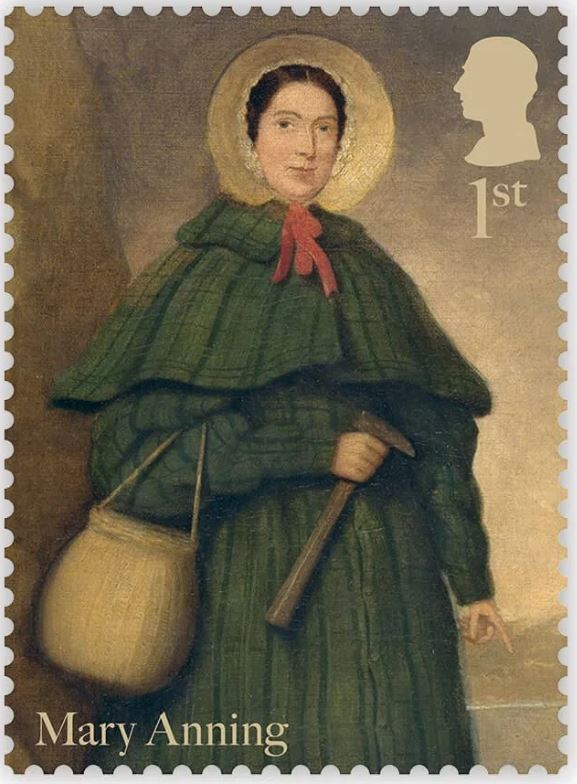
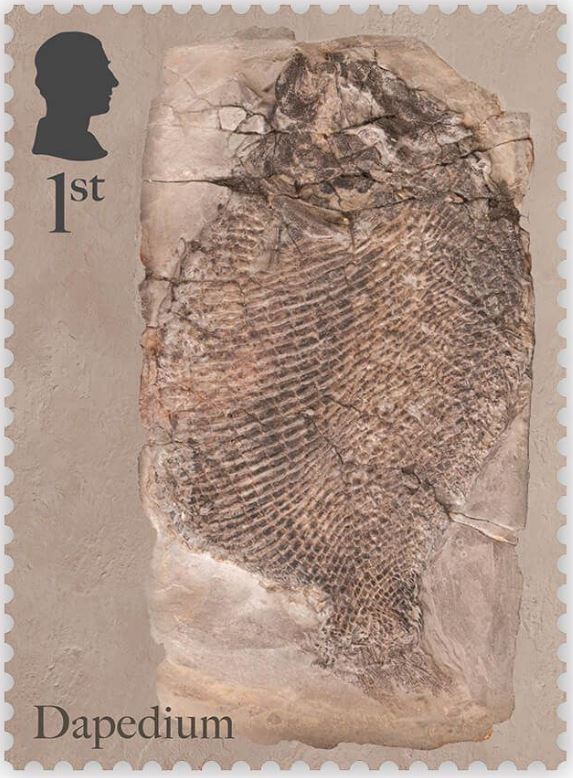
Although Anning is one of the most prolific fossil collectors to have worked in Lyme Regis, naturalists like Buckland often visited Anning to go “fossicking” together, or purchase fossils from her. There are very few archival records of transactions between Anning and other fossil collectors from this time, making it difficult to decipher exactly who extracted fossils such as this, found in nineteenth-century Dorset.

Fortuitously, while Dr Sue Newell was conducting research for her PhD on the Buckland Collection in 2021, she found an exciting letter in OUMNH Archive, dated 3rd September 1829. It was from a former student of Buckland’s, Beriah Botfield, and contained details of two fossils that Buckland had bought from Anning to present to the University of Oxford. Using evidence in the letter, Sue was able to work out that Botfield was referring to a Dapedium fossil which she later recognised tucked away in OUMNH’s fossil store.

Botfield had had the fossil mounted in an expensive (and very heavy!) stone frame, with “Presented by Beriah Botfield Esq. Dapedium politum. Lyme, Dorset” beautifully inscribed on the front surface. At the time, the identity of Anning as the fossil’s original finder, identifier, preparator and vendor, was probably common knowledge and, typically, Botfield did not consider these facts important enough to record on his presentation frame.

The Dapedium fossil is a near-complete example of this Jurassic fish, in which scale patterns and delicate fin structures are preserved in breathtaking detail. Dapedium is the first OUMNH object to grace a Royal Mail stamp – an ideal choice given its scientific and historic importance.


Visit the Museum to see the Dapedium fossil as well as temporary displays about the new stamp collection.

Find out more about our special programme of events, exhibitions, and activities honouring Megalosaurus in 2024: The Oxford Dinosaur That Started It All.
Bound by blood

It may sound like we’ve stumbled into a script-writing session for Jurassic Park, but one of our research fellows, Dr Ricardo Pérez-de la Fuente, along with an international team, has discovered a parasite trapped in amber, clutching the feather of a dinosaur. This small fossilised tick, along with a few other specimens, is the first direct evidence that ticks sucked the blood of feathered dinosaurs 100 million years ago. Ricardo tells us all about it…

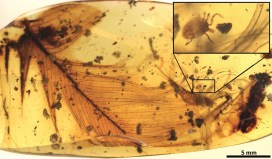
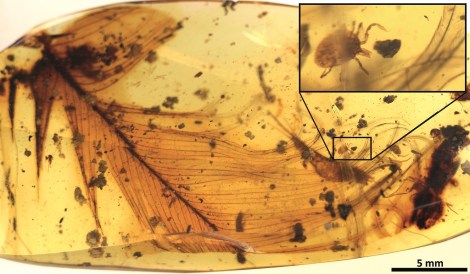
The paper that my colleagues and I have just published provides evidence that ticks fed from feathered dinosaurs about 100 million years ago, during the mid-Cretaceous period. It is based on evidence from amber fossils, including that of a hard tick grasping a dinosaur feather preserved in 99 million-year-old Burmese amber.

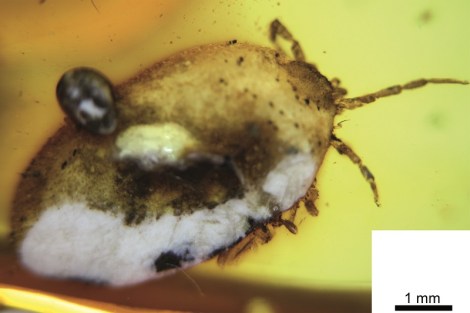
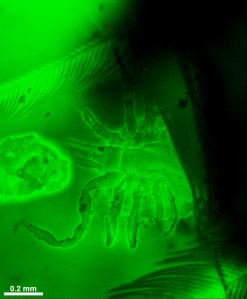
Fluorescence detail of the studied hard tick grasping a dinosaur feather. Extracted from the publication.

The probability of the tick and feather becoming so tightly associated and co-preserved in resin by chance is virtually zero, which means the discovery is the first direct evidence of a parasite-host relationship between ticks and feathered dinosaurs.

Fossils of parasitic, blood-feeding creatures directly associated with remains of their host are exceedingly scarce, and this new specimen is the oldest known to date. The tick is an immature specimen of Cornupalpatum burmanicum; look closely under the microscope and you can see tiny teeth in the mouthparts that are used to create a hole and fix to the host’s skin to suck its blood.

The structure of the feather inside the amber is similar to modern-day bird feathers, but it could not belong to a modern bird because, according to current evidence at least, they did not appear until 26 million years later than the age of the amber.

Feathers with the same characteristics were already present in multiple forms of theropod dinosaurs –  the lineage of dinosaurs leading to modern birds – from ground-runners without flying ability, to bird-like forms capable of powered flight. Unfortunately, this means it is not possible to determine exactly which kind of feathered dinosaur the amber feather belonged to.

But there is more evidence of the dinosaur-tick relationship in the scientific paper. We also describe a new group of extinct ticks, created from a species we have named Deinocroton draculi, or “Dracula’s terrible tick”. These novel ticks, in the family Deinocrotonidae, are distinguished from other ticks by the structure of their body surface, palps and legs, and the position of their head, among other characteristics.

Blood-engorged Deinocroton draculi tick (female). Extracted from the publication.

This new species was also found sealed inside Burmese amber, with one specimen remarkably engorged with blood, increasing its volume approximately eight times over non-engorged forms. Despite this, it has not been possible to directly determine its host animal:

Assessing the composition of the blood meal inside the bloated tick is not feasible because, unfortunately, the tick did not become fully immersed in resin and so its contents were altered by mineral deposition.
Dr Xavier Delclòs, an author of the study from the University of Barcelona and IRBio.

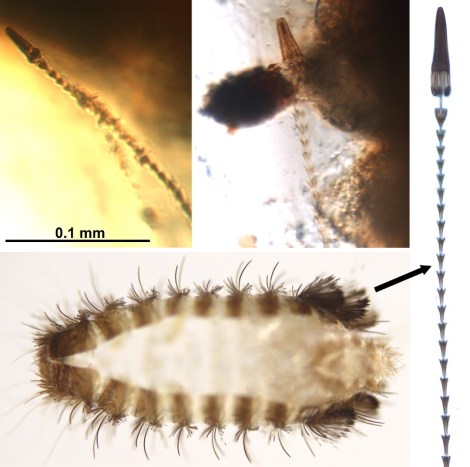
But there was indirect evidence of the likely host for these novel ticks in the form of hair-like structures called setae from the larvae of skin beetles, or dermestids, found attached to two Deinocroton ticks preserved together. Today, skin beetles feed in nests, consuming feathers, skin and hair from the nest’s occupants. But as no mammal hairs have yet been found in Cretaceous amber, the presence of skin beetle setae on the two Deinocroton draculi ticks suggests that their host was in fact a feathered dinosaur.

The hair-like structures, or setae, from skin beetles (dermestids) found attached to two Deinocroton ticks fossilised inside amber, in comparison with extant ones. Modified from the publication.

Together, these findings tell us a fascinating story about ancient tick behaviour. They reveal some of the ecological interactions taking place among early ticks and birds, showing that their parasite-host relationship has lasted for at least 99 million years: an enduring connection, bound by blood.

The paper “Ticks parasitised feathered dinosaurs as revealed by Cretaceous amber assemblages” is published as open access in Nature Communications. Direct link: http://dx.doi.org/10.1038/s41467-017-01550-z

Dinosaur WLTM friendly new carers

DSC_8255 small

It’s not often that one of our residents flees the roost to take up home elsewhere: usually once you’re in the Museum that’s it, accessioned for life (or, more accurately, death). However, one of our former dinosaur aisle characters is now looking for a new home…

The four-metre long Utahraptor model has been with the Museum since 2000, during which time it escaped to take up temporary residence in Blackwell’s book shop in Oxford city centre as part of the award-winning Goes to Town project. This time, however, the Utahraptor will be leaving us for the last time as part of a reorganisation of the Museum’s offsite store, where the model is currently residing.

The Utahraptor model in Blackwell's bookshop as part of the Goes to Town project. Photo: Mike Peckett
The Utahraptor model in Blackwell’s bookshop as part of the Goes to Town project. Photo: Mike Peckett

But rather than just ditch this Cretaceous creature unceremoniously we’d like to offer it out to new keepers, ideally somewhere with a public space where the model can be enjoyed by others. So, fancy yourself as a dinosaur owner? If so, check out our selection form for details of what it takes to keep such a pet.

We’re asking people to make a case for the Utahraptor to move to their venue and we will donate the model free of charge to whoever is selected. The closing date for submissions is 5 August and the selected venue will be announced by 12 August. We need to deliver the model to its new home on or before 23 September.

Get me outta this place!
“Get me outta this place!” – the Utahraptor is currently in the Museum’s offsite storage

At this point you probably want some Utahraptor facts to help with your decision, right? Well, here you go:

Utahraptor means ‘Utah’s predator’ and the animal is known from fragmentary fossils found only in Utah in the United States. There is just one known species, Utahraptor ostrommaysorum, which was alive in the early Cretaceous period, around 125 million years ago.

It is thought that like most dinosaurs of its type (dromaeosaurids) the Utahraptor was feathered, although no direct evidence has yet been found. The Museum’s model, made by Crawley Creatures, does not represent a feathered example of this species. It’s likely the beast was not bright orange too, but who knows?

We looking forward to reading your submissions…

www.bit.ly/utahraptor

For more information email communications@oum.ox.ac.uk.

The fossils of Stonesfield

A Spotlight Specimens special for Oxford Festival of Nature

By Eliza Howlett, Earth Collections manager

There was a time, more than 160 million years ago, when most of Oxfordshire was covered by a warm, clear, shallow sea. Offshore, the waters were agitated by waves and storms, but closer to land these forces were buffered by a submerged sandbank, and calm lagoons developed.

The area that is now Stonesfield was part of this lagoonal environment, and the fossils that have been found there provide a wonderful window into the living world of this Middle Jurassic sea.

So how would these sea creatures compare with British marine life today? Some things would have been very familiar. On the sea bed you would have found a huge variety of bivalves, or clams, along with lobsters, crabs and sea urchins; the waters above would have been full of fish, including several different types of shark.

IMG_9086
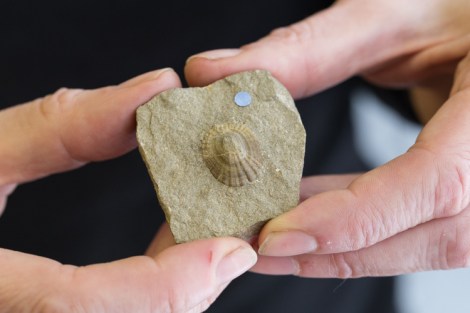
This fossilised limpet shell has its original colouration preserved

But there would have been other things too: squid-like belemnites, and nautiloids and ammonites with coiled shells, and tentacles like an octopus. Instead of dolphins and porpoises there would have been sea crocodiles and sea turtles, and in the skies above, flying reptiles known as pterosaurs rather than the usual sea birds.

And there’s more. Stonesfield fossils also include plants and animals washed in from nearby land: the leaves and seeds of conifers and cycads, beetle wing cases, reptile eggs, and the remains of both dinosaurs and mammals.

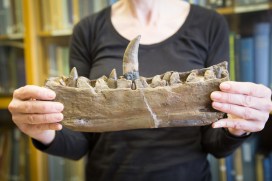
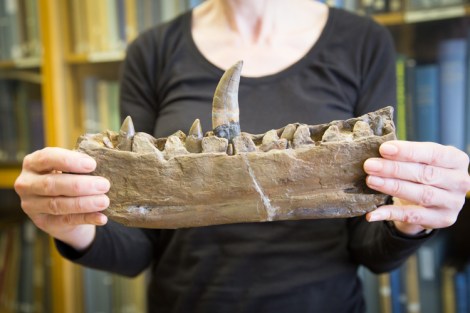
The jaw of the first named dinosaur, Megalosaurus bucklandii, found in Stonesfield, Oxfordshire
The lower jaw of the first named dinosaur, Megalosaurus bucklandii, found in Stonesfield, Oxfordshire in the early 19th century

One particularly spectacular find was the lower jaw of the carnivorous dinosaur Megalosaurus, nine metres long in life and weighing about a tonne. Megalosaurus became the first creature to be named a ‘dinosaur’, in 1824. Less obvious, but equally significant, are the tiny jaws of some of the shrew-like mammals that would have lived alongside the dinosaurs: Phascolotherium, Amphitherium, Amphilestes and Stereognathus – the first Jurassic mammals known to science.

Along with the preservation of delicate items such as dragonfly wings and the leg of a cricket, and the original colour patterns on some sea snails, limpets and barnacles, the fossil material from Stonesfield is really quite special.

OFoN_logo_green block_small