Amber time capsules

New Museum Research Fellow Dr. Ricardo Pérez-de la Fuente talks about his fascinating work with a special collection at the Museum of Comparative Zoology, Harvard University, and what he’ll be getting up to at the Museum of Natural History. 

Amber, fossilised resin, has fascinated humanity since prehistoric times due to its mesmerising colour, shine, and fragrance when burned. From a scientific viewpoint however, what makes amber unique is the ability that the resin has to capture small portions of the ecosystem and the organisms living within almost instantaneously, in an unaltered way, preserving them for tens of millions of years. This has an unmatched fidelity among the fossiliferous materials.

Fibla_carpenteri_holotype_RPF_President_and_Fellows_of_Harvard_College
Holotype of Fibla carpenteri Engel, 1995, a snake-fly. Credit: President and Fellows of Harvard College.

During a four-year postdoctoral fellowship at the Museum of Comparative Zoology (MCZ) at Harvard University, I had the chance to curate, identify and digitise one of the premier fossil insect collections worldwide. It holds about 50,000–60,000 specimens, including around 10,000 amber inclusions. One of the unexpected outcomes of my time there was helping to rediscover a forgotten loan of about 400 Baltic amber samples that had been brought to the MCZ from the University of Königsberg during the 1930’s.  This loan ended up sparing the specimens from being destroyed during the bombardment of the city of Königsberg (renamed Kaliningrad thereafter) in World War Two. The full-story as showcased by the Harvard Gazette can be found here.

Lagynodes_electriphilus_holotype_RPF_President_and_Fellows_of_Harvard_College
Holotype of Lagynodes electriphilus Brues, 1940, a megaspilid wasp. Credit: President and Fellows of Harvard College.

As a researcher specialising in fossil arthropods, one of the most remarkable challenges for me during the digitisation project at the MCZ was to overcome the thrill to learn more about the specimens that we were imaging. In what way were they different from their modern relatives? Were they perhaps new to science? What information were they providing from the ecosystem in which they lived? At present, I can fully embrace these questions and many more thanks to becoming a Museum Research Fellow at the Museum of Natural History.

Hypoponera_atavia_cotype_RPF_President_and_Fellows_of_Harvard_College
Cotype of Hypoponera atavia (Mayr, 1868), an ant. Credit: President and Fellows of Harvard College.

My research at the museum focuses on studying interactions between organisms in deep time and their behaviours, particularly in Cretaceous amber, such as plant-insect pollination relationships around 100 million years ago. During that time, a major shift was taking place in terrestrial ecosystems due to the diversification of angiosperms (flowering plants), which ended up replacing gymnosperms (non-flowering plants) as the dominant flora. There was also the appearance of key groups of organisms from the ecological perspective — ants and bees in the case of insects, for instance.

It is a well-accepted fact that preservation in amber is biased towards small organisms because the larger ones tend to escape the sticky resin more easily. But how easy it is for one to get lost in amber when examining its secrets and trying to unravel its mysteries! Becoming forever trapped within.

Some of the most remarkable Baltic amber specimens (about 40 million years old) returned to the Königsberg collection from the MCZ. Pictures: RPF. Credit: President and Fellows of Harvard College.

A rare beetles turns 21

by Darren Mann, Head of Life Collections

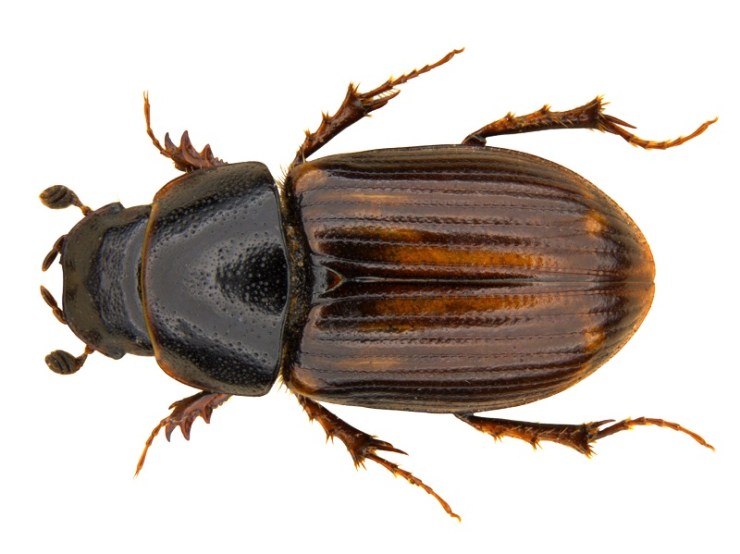
Many years ago, when re-identifying dung beetles in the collections of the British Entomological and Natural History Society, I found a specimen that I didn’t immediately recognise. So I borrowed it, and after a few hours of checking the European literature back in Oxford, I realised that I’d found a beetle that had not been recorded anywhere in Britain before.

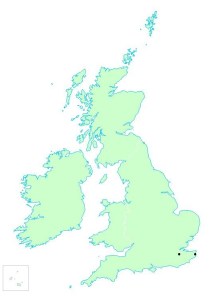
The small black circles show the locations of known records for Melinopterus punctatosulcatus.

The dung beetle in question was Melinopterus punctatosulcatus, a species widely distributed across Europe but until this discovery unknown in Britain, despite its presence in the BENHS collection. This is because it had been misidentified as a different species: the beetle superficially looks like two closely-related species, and so had been overlooked by beetle collectors for over a hundred years.

Since that initial specimen, I have scoured numerous UK museum collections and to date have found a total of just 20 specimens, distributed across the World Museum in Liverpool, the National Museum Wales in Cardiff, and here in the Museum of Natural History in Oxford. All these specimens are from Deal, Kent and were caught between 1891 and 1910.

The last known record is of a single specimen from Ryarsh, Kent collected in 1938, which just happens to be the first specimen I found some 20 years ago in the BENHS collection.

The male genitalia of Melinopterus punctatosulcatus. The appearance of the genitalia is one of the best ways of identifying one species of beetle from another.

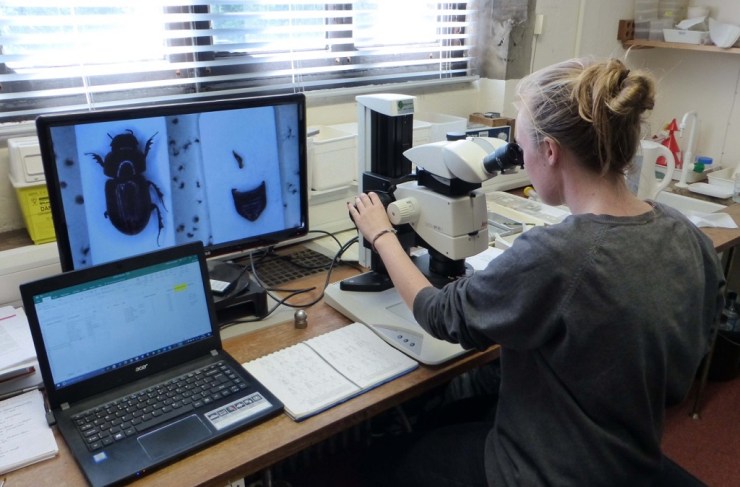
But this week, the 21st known specimen was discovered in our collections by Mary-Emma, a placement student who is with us from the University of Reading. She uncovered the beetle during the re-curation and identification of a collection made by A. J. Chitty. Thankfully the specimen was a male, so we were able to confirm the identification using the genitalia – one of the best ways of determining a species.

It seems that Mr Chitty had a knack for finding this particular species of dung beetle, since 14 of all the known specimens were caught by him at Deal. It’s just a shame that he didn’t realise his amazing discovery at the time.

Mary-Emma identifies Melinopterus punctatosulcatus by examining the dissected genitalia, visible on the right hand side of the monitor screen.

In the recent Conservation Status Review of dung beetles, Melinopterus punctatosulcatus was designated as Regionally Extinct in the UK because there have been no known sightings since that one in 1938. So this species possibly went extinct in Britain before we even realised that it was here. And were it not for museum collections we may never have known it once lived in Britain at all.

Delightful dung beetles

The latest display in our changing Presenting… case showcases a wonderful array of dung beetles. Darren Mann, head of our Life Collections, tells us why they are so important.

Worshipped during ancient Egyptian times, dung beetles have a long history of human appreciation. Jean-Henri Fabre (1823-1915), one of the first to popularise insects in his writings, began his Souvenirs entomologiques series with the Sacred Scarab, and even Charles Darwin appreciated the weaponry adorning many dung beetles.

Dung beetles can be divided into three main groups based on their nesting behaviour. The rollers, often seen on television wildlife documentaries, make a ball out of dung and roll it some distance before burying it. The tunnellers dig directly below the dung pile and bury as much as needed for nest construction. Finally, the dwellers nest within the dung pile.

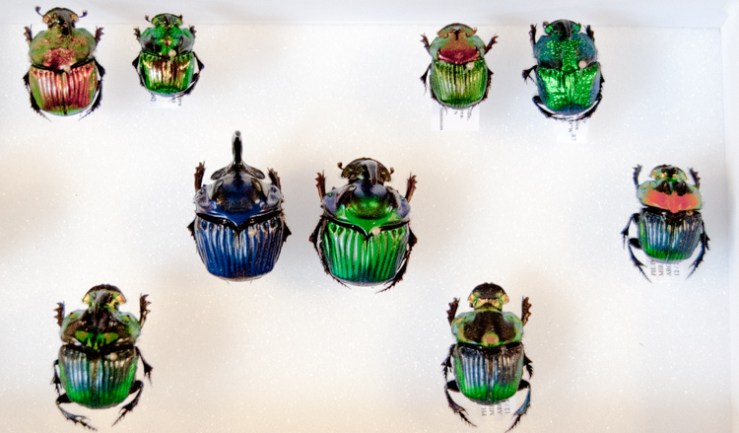
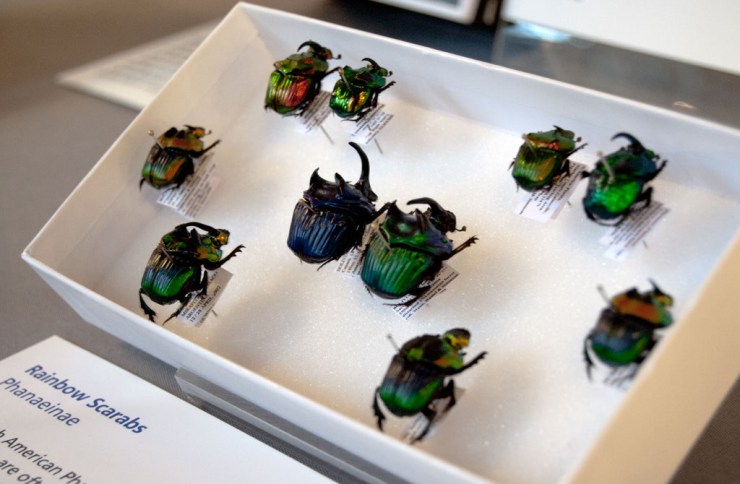
The South American Phanaeinae is one of most colourful groups of beetles. They are often referred to as Rainbow Scarabs due to their bright metallic bodies. We don’t fully understand why these beetles are quite so colourful.

Dung beetles are one of the more popular groups of insects used in ecological and evolutionary research today. They can help us to understand questions about how biodiversity loss impacts on ecosystems, or act as model organisms in the field of evolutionary development.

Unlike the much-publicised importance of bees and their pollination services, dung beetles are relatively unknown, despite their huge ecological and economic value. Their feeding and nesting behaviours provide many useful ecosystem services such as dung removal, pest fly control, parasite suppression, nutrient cycling, plant growth enhancement, improvement of soil structure, secondary seed dispersal, and a possible reduction of greenhouse gas emissions.

Through these activities, one study calculated that dung beetles are worth around £367 million a year to the UK cattle industry alone.

The largest dung beetles belong to the genus Heliocopris, which can reach up to 69 mm (pictured is Heliocopris dominus). These large beetles specialise on elephant and rhino dung. From around 2 mm in length is the oriental genus Panelus. These small beetles probably feed on the ‘dung’ of other insects and fungi.

Ancient Egyptians believed that the dung beetle kept the Sun moving across the sky like a giant ball of dung, linking the insect to the god of the rising sun Khepri. Some historians believe that it was through observing dung beetle behaviour and biology that Egyptians developed ideas about life after death.

The two most widely depicted species in Egyptian art are Kheper aegyptiorum and Scarabaeus sacer. Nowadays, only Scarabaeus occurs in this region of Africa; Kheper is now a more southern species, possibly indicating climatic changes since Ancient Egyptian civilization.

Kheper aegyptiorum on display in the museum’s Presenting… case

The UK has about 60 species of dung beetle and most of these belong to the ‘lesser dung beetle’ subfamily Aphodiinae. The largest of our dung beetles are the Dor Beetles which can reach 28 mm. Our smallest, Plagionus arenarius, is a meagre 2.5 mm. Sadly, over 50 per cent of our dung beetles are in decline due to agricultural intensification, pesticides and habitat loss.


Imitation game

Last month we had the pleasure of hosting artist and scientist Dr Immy Smith as part of her week-long takeover of @IAmSciArt on Twitter. Drawing inspiration from the Museum’s collections, Immy has created some beautiful paintings. Here she tells us a little more about her interests and work…

My current artwork is focused on crypsis and mimicry – the ways that animals and plants disguise themselves or pretend to be something they’re not. Cryptic camouflage helps animals to avoid being seen, often to help them catch prey – or to avoid becoming prey themselves! Mimicry is also often about trying not to get eaten: the harmless hornet moth, for example, mimics a stinging insect to deter predators. I use these themes to develop print art projects, and also public workshops to help people learn more about the ecology of cryptic animals.

Cryptic Cards by Immy Smith

In my arts practice I try to imagine how animals and plants might evolve to camouflage themselves on human-made materials, and what they might look like. Will we one day find moths adapted to hide on advertising hoardings, or beetles mimicking litter? I made an entire deck of Cryptic Cards as a response to this kind of question.

Another project I’m working on at the moment is called Emergent Crypsis. This is a collaboration with Norweigan generative artist Anders Hoff who makes art using algorithms executed by a computer. I’m imagining how creatures might adapt to an extreme example of human-made patterns – computer generated abstract images.

Violin Beetle (Mormolyce phyllodes) by Immy Smith

My work requires me to closely study many animals and plants, but how do I learn about all these species in order to draw their imaginary relatives? How do I make my art a convincing representation of how life might find ways to hide on human-made art?

One answer is of course, the internet. I’ve been lucky enough to find many wildlife photographers online who are kind enough to let me use their images as reference. But photographs alone are not always enough to get to know the fine details and defining characteristics of a species: the joints and articulations of small insects, for example, are best studied from specimens. And some species are rare, or even extinct, and it can be hard to find photographic a reference.

Leaf-footed Bug (Diactor bilineatus) by Immy Smith

This is where scientific collections come into the picture. The collections held in museums and other institutions are not only essential for scientists and scientific illustrators, they are also an invaluable resource for artists of many disciplines, science communicators, and educators of many kinds. In the collections at the Oxford University Museum of Natural History I can photograph and sketch leaf-mimicking insects, for example, that are native to the forests of South America which I may never visit. I can study in minute detail the articulation of beetles that are rarely seen, and which might be difficult to find – and irresponsible to collect – myself.

A display of terrestrial bugs (Heteroptera) in the Museum, including the Leaf-footed Bug painted by Immy Smith

Not only do I find specific species that I want to study in natural history collections, I often see new ones – animals I didn’t know about or hadn’t thought of drawing before. In the same week that I visited Oxford, I also made a trip to Herbarium RNG in Reading to study plant mimicry, and found similar inspiration there. I can channel all this into both aesthetic art destined for print and sciart workshops that communicate the wonders of insects or plants with the wider community.

Working on sciart projects and educational workshops helps me appreciate the multitude of ways in which collections benefit research and education. We must try to communicate the plethora of roles they play, and the host of ways they cross into our lives – whether through scientific research on insects pollinators of the crops we eat, or via a deck of cards made by someone like me for mainly recreational purposes. We must fight to protect scientific collections because they are a resource that benefits all of us as a society.

On a dung beetle’s trail

dung-beetles-blog-post

Thanks to the work of our Head of Life Collections Darren Mann, and the Dung Beetle UK Mapping Project team, the conservation status of the UK’s dung beetles, chafers, and stag beetles (Scarabaeoidea) is currently undergoing a comprehensive review.

Contributing to this effort, Jack Davies, one of our summer interns, has been on the trail of a species that has proven to be particularly rare in the UK…

Aphodius lividus
Aphodius lividus

I am on the hunt for Aphodius lividus, a dung beetle with a truly cosmopolitan distribution, being found across most of the globe, but which is rather rare in Britain. Since 1990 it has been recorded at only six sites, though historical accounts suggest it was more common in the past.

Most of these historic records are from the south east of England, particularly Kent and the London area, but there are several geographically isolated records from across England and Wales too. So might A. lividus, whilst being extremely local, actually be widespread across the UK?

During my time at the Museum I have been contributing to a comprehensive review of this species’ distribution by helping to verify these records. This has involved a thorough search of collections, journals and the Museum archives, a process which revealed that many of the recordings of A. lividus were almost certainly erroneous.

We were able to discount the only two Welsh records, as well as single records from Cheshire, Leicestershire and Lincolnshire. Our reasons for doing so included a lack of supporting evidence, the unreliability of certain collectors, and the confirmed misidentifications of some specimens.

IMG_9966
Jack Davies working on a collection of Aphodius lividus

The number of known localities for A. lividus decreased further when we realised that three of the reported sites in Kent most probably all refer to the same location. This is a common problem in this type of research, due to the very broad locality names found on Victorian specimen labels.

So it has become clear that this incredibly scarce beetle is even rarer than we first thought. But it’s not all bad news for A. lividus; our research has uncovered reports from localities in Devon and Northumberland in the old literature, which we found to be trustworthy records.

Aphodius lividus
Map showing the distribution of the dung beetle Aphodius lividus in the UK

All the verified data from the project has been collated to produce this map of the distribution of A. lividus in the UK. Its very local distribution, and the very low number of recent records, confirm that this species should be classified as Vulnerable to Extinction in the UK.

Although it would be a shame to lose this species in Britain, we don’t believe it should be a priority for conservation efforts. Since Aphodius lividus has a strong preference for high temperatures, it’s likely that the UK is simply at the very edge of its range.  It is also a very abundant species in many areas around the world, and it contributes little in terms of ecosystem services in Britain compared to many of our other dung beetles.

So conservation should instead aim to preserve the dung beetle ecosystem as whole, which supports a huge number of species and also brings many benefits to agriculture.

The bully bee

Bee3

Young volunteers Genevieve Kiero Watson and Poppy Stanton tell the tale of the Museum’s resident Wool Carder Bee and their investigative bee work in our Life Collections…

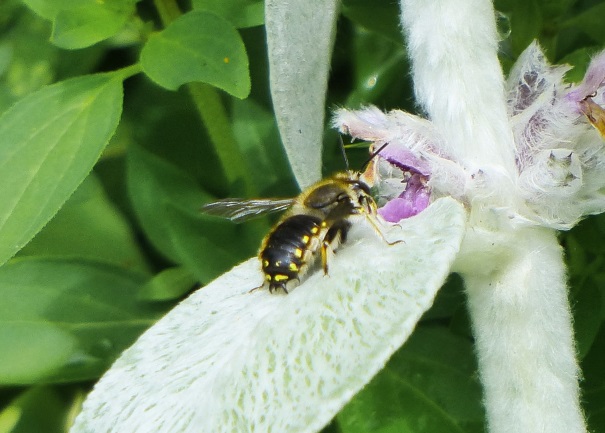
A small guardian patrols its territory among the luscious bed of Lamb’s-ears that grow at the front of the Museum. This feisty critter, the Wool Carder Bee (Anthidium manicatum), is just one of the roughly 270 bee species that buzz around Britain. Having spotted this unusual hovering bee we seized the opportunity to identify, photograph and explore the species a little further.

The male of this solitary bee species is fiercely territorial, fighting off other males as well as any other insects it considers to be intruders. Techniques used in combat vary from skilful aerial hovering to ferocious wrestling. But perhaps its greatest weapon is a series of stout spines found at the tip of the abdomen. These are used to bully an intruder into submission, or even to kill it. In so doing, the male protects the precious supply of pollen for the smaller females which in turn collect it on stiff bristles on the undersides of their abdomens.

Females, being slightly less aggressive, are in charge of constructing the nests, which are built in existing cavities such as beetle holes. Hairs shaved off plants, such as the favoured Lamb’s-ear, are used to create the brood cells for the next generation.

Male Wool Carder Bee on Lamb's ear in the Museum's front garden
Male Wool Carder Bee on Lamb’s ear in the Museum’s front garden

The Museum houses many specimens of the Wool Carder Bee and our job was to pull out the data from each one to help with an ongoing online survey about this species. Although making friends with hundred-year-old bees was enjoyable, trying to comprehend the miniscule handwritten labels accompanying them was altogether more trying.

Every label explains where and when the bee was captured, who collected and identified it, and gives the reference for its current collection. All this on a slip of paper no bigger than half a stamp.

One of the Musuem's Wool Carder Bee specimens, circled, featured in a display of all 270 species of British bee in the Bees (and the odd wasp) in my Bonnet exhibition by artist Kurt Jackson
One of the Museum’s Wool Carder Bee specimens, circled, featured in a display of all 270 species of British bee in the Bees (and the odd wasp) in my Bonnet exhibition by artist Kurt Jackson

After recording data from 120 labels we began to find the grid reference of the location each was originally collected. This too was challenging as many place names have changed in the last hundred years. Ultimately, the information will be used by the Bees, Wasps & Ants Recording Society (BWARS) to improve the distribution map for the Wool Carder Bee.

Why not see if you can spot the Wool Carder Bee in your garden? Characteristics to look out for include small spines on the tip of the abdomen and lateral lines of yellow spots on either side of the abdomen. The bees themselves are about 11-13mm long for females, and 14-17mm for males. Good luck!