One in a million find

By Rachel Parle, Public Engagement Manager

The Museum’s collection of British insects already houses over a million specimens, and now it boasts one more special insect.

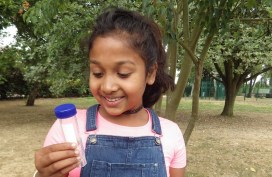
Ten-year-old Sarah Thomas of Abbey Woods Academy in Berinsfield, Oxfordshire discovered a rare beetle in her school grounds while taking part in a Museum outreach session. To Sarah’s excitement, the beetle is so important that it has now become part of the collections here at the Museum – and it is the first beetle of its kind to be added to the historically important British Insect Collection since the 1950s.

Sarah Thomas examines her beetle under the microscope with Darren Mann, entomologist and Head of Life Collections at the Museum

Sarah’s class took part in a HOPE Discovery Day, where they were visited by a professional entomologist, learnt about insect anatomy and how to identify and classify specimens, and went on the hunt for insects in the school grounds. HOPE – Heritage, Outreach and Preservation of Entomology – is reaching out to students in state primary schools across Oxfordshire, using the Museum’s British Insect Collection to spark curiosity and foster a love of natural history. It’s all part of a bigger project at the Museum, supported by the Heritage Lottery Fund, to safeguard this important Collection for the future and engage people with natural heritage.

Sarah brought her family to the Museum to see her beetle in the British Insect Collection.

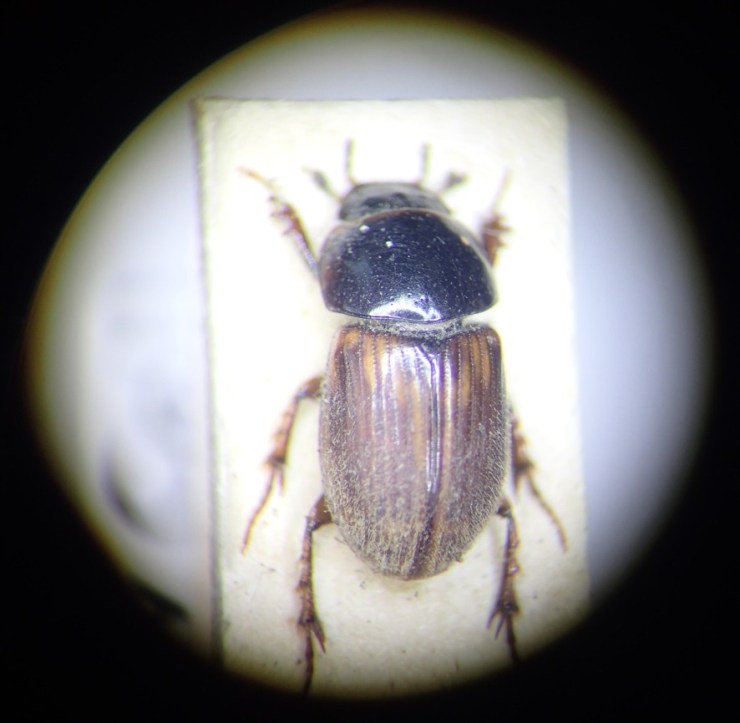
After some searching, Sarah spotted a 5mm insect lurking under a leaf. To the untrained eye it looked rather like any other tiny shiny beetle, but luckily Darren Mann, Head of the Museum’s Life Collections, was visiting as part of the HOPE team. Darren spotted it as something unusually and took it back to the Museum to get a closer look under the microscope. He was then able to identify it as a False Darkling Beetle.

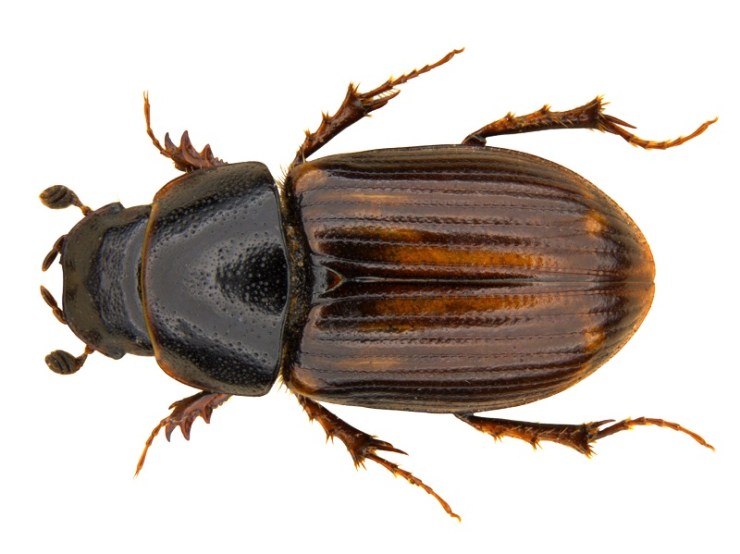
It’s Anisoxya fuscula, which is rated as Nationally Scarce in Great Britain. We seldom see these outside old forest habitats and this is the first beetle of its kind to be added to the collections for around 70 years.

– Darren Mann, Head of Life Collections

The False Darkling Beetle under the microscope and labelled in the Museum’s British Insect Collection as found by Sarah Thomas

The tiny beetle has been labelled with Sarah’s name and the location of her find, and added to the British Insect Collection. Though she’s very excited to have her specimen in the collections, Sarah admits that she hasn’t always been a big fan of insects:

Before Project Insect I didn’t really like insects, but now I really do.

– Sarah Thomas

Everyone at the Museum is really pleased with Sarah’s fantastic find and we hope it spreads the word to inspire others to become budding young entomologists too.

The beetle Sarah discovered will be stored in this drawer in the British Insect Collection.

Deal or no deal

Melinopterus

by Darren Mann, Head of Life Collections

In a previous article on this blog I reported the discovery, in an insect collection, of the 21st British specimen of the ‘Regionally Extinct dung beetle Melinopterus punctatosulcatus. And since then, I’ve been on the hunt for more…

Heading out to numerous other museum collections I discovered more specimens, all collected in the same locality – Deal in Kent. In Ipswich Museum there are six, collected by C. Morley in 1896; there are two in the Natural History Museum, London, collected by G.C. Champion; and in the Museum of Zoology, Cambridge there are two collected by G.C. Hall in 1883.

Ipswich Museum
A view through the microscope of Melinopterus punctatosulcatus held in the collections of Ipswich Museum, collected by C. Morley in 1896

But the earliest and most recent finds are both in the National Museum of Scotland – one from May 1871, in the G.R. Waterhouse collection, and one from 1923, in the T. Hudson-Beare collection. So now we know of 42 specimens of this beetle with data and we know that the species occurred at Deal for about 50 years. But why are there no records after this time?

The Deal sandhills in Kent were famous for their insects, but even as long ago as 1900 entomologists* were discussing the negative impact of “summer camping-out stations and the modern craze for the ‘Royal and Ancient Game of Golf'” on beetles and butterflies in the area.

Today, most of the sandhills are gone and there are no grazing animals other than a few rabbits. Most of the surrounding land is either developed as a golf course or under agricultural management. So, is the possible local extinction of this dung beetle due to habitat loss and a lack of dung?

Deal
Deal, Kent: the original locality for Melinopterus punctatosulcatus, with remnants of the sandhills in the distance

To try and answer this question, naturally I went looking for poop in Deal. In a field in Sandwich Bay I could hear sheep bleating in the distance, although poo was scarce. Eventually I found a few old plops and inside were ten Calamosternus granarius, a small dung beetle. This was good, but my main target was Melinopterus punctatosulcatus.

Melinopterus punctatosulcatus edit
A specimen from the Museum of Melinopterus punctatosulcatus, previously listed as ‘Regionally Extinct’ in Britain, but now rediscovered in Deal, Kent

I probed the poop further. To my delight, crowded in the remaining squishy bit were four other species. On close inspection, one of these was hairy, so a male, and much darker than its close relatives. It fitted perfectly with my expectations for Melinopterus punctatosulcatus after seeing so many examples in museum collections. Success! This beetle, misidentified in museum collections for so long, and not seen since the 1920s in Deal, is indeed hanging on in Kent.

Disappointingly, after a further few days of searching, only a handful more specimens were seen. This suggests that either the species exists at low population levels, or that it was it was not the peak emergence period when I was there. Nonetheless, a species not recorded anywhere in the UK for over 70 years is actually still here.

Now hopefully we can encourage local land owners to help conserve this all-important dung fauna and flora.

* Walker, J.J. 1900. The Coleoptera and Hemiptera of the Deal Sandhill. Entomologist Monthly Magazine 36: 94-101.

All that glitters…

The latest display in our changing Presenting… series showcases some of the incredible colours seen in many insects. Zoe Simmons, collections manager in our Life Collections, explains how such wonderful hues are created.

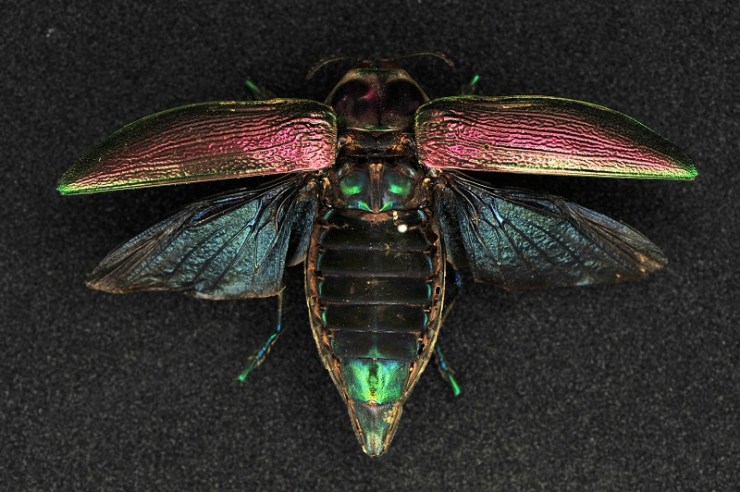
Reflected and refracted light creates the many bright and shining colours found in some insects. The dazzling natural display shown in the specimens here is formed through a combination of embedded pigments and sculpted surfaces on each insect’s external skeleton.

Some species can be variable in colour. Here a pair of Lamprima, a genus of Stag Beetles, shows off the range of colours present in the species.

Different pigment chemicals are responsible for different colours. Carotenoids produce yellow, orange and red hues, while bilins may be green, or blue if linked with proteins. They reflect and absorb different wavelengths of light, and the wavelengths that are reflected are the ones that we see as colour. Typically humans can see wavelengths of 390-700 nanometres, with the lower wavelengths perceived as blue, and the higher ones as red.

Many of the Leaf Beetles (Chrysomelidae) exhibit metallic colours.

Many insects also have multiple thin layers over their upper surfaces to help protect them and prevent dehydration. Variations in thickness and chemical composition of these layers can interfere with the transmission of light, refracting and scattering it back.

Some of the most striking metallic colours are found in the genus Chrysina, where species can be rose, silver or gold.

The shape of the surface layer can reflect light in a multitude of directions, with micro-folds, grooves, pits, hairs and scales all helping to produce complex colours and effects.

The formation and purpose of these colours is scientifically interesting, with research having applications in areas such as nanotechnology. But these insects are also simply beautiful examples of the spectacular diversity of the natural world.

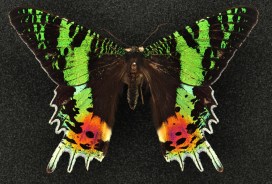
Sunset moths (Uraniidae) are so called because of the dazzling array of colours on their wings. As day-flying moths they are brightly coloured like many butterfly species.

Seasonal sights

The Museum’s collections are on the move. For decades, a deconsecrated church has been used to house material from our Earth collections, but we now have a new and improved off-site space, and between now and the end of 2018 a huge project is underway to sort and shift these objects. You can find out more about all this in our Stories from the Stores article. 

Chantelle Dollimore, Move Project Assistant, recently emigrated from Australia and has been experiencing her first British autumn. Here she shares a glimpse of the natural encounters the collections move has offered so far.

**

As the project team for the collections move settles into the daily hustle and bustle of work there are extraordinary things happening outside. Winter is coming; we have already wound our clocks back for that extra hour of sleep. Leading up to that time, creatures great and small have been preparing themselves for seasonal changes.

Autumn leaves litter the footpath to the store

Something truly blissful in an English autumn is the deciduous trees shedding their leaves as the days grow shorter and chillier. The crunching underfoot of hues of browns, reds, yellows and oranges adds charm as we make the rounds of our 19th-century church workspace.

A Red Kite soars above the Museum’s offsite collections store

Driving from the Museum to the off-site store, we’re likely to see at least one Red Kite. Less than 30 years ago Red Kites were nearly extinct, but through conservation efforts they have flourished in the Oxfordshire countryside. Their distinct calls and unique silhouette, with long narrow wings and forked tail, are a haunting yet beautiful addition to the skyline.

A Red Kite (Milvus milvus) on display in the Museum

The move project team have also been visited by a different ‘bird’ altogether; the ladybird! At this time of year, when you find one you will most likely see many more close by. When a ladybird finds the perfect place to hibernate for spring it excretes a pheromone to attract more to the area. For some, the perfect place seems to be inside the church itself!

(Lady)birds of a feather flock together

Grey Squirrels and deer are also making appearances throughout the day while we’re working. One cannot help but watch as the bushy tail of the squirrel peeks through the hedges as it forages for food and admire the deer as they stroll through the fields happily unaware of our activities some 50 metres away.

Although it’s great to admire the specimens on display in the Museum, I love that my job allows me to get out and about to appreciate the wildlife of the Oxfordshire countryside. There’s always something unexpected… like a butterfly choosing its resting place on some disassembled storage shelves.

A butterfly (Nymphalidae sp.) in torpor finds shelter from the impending cold

To keep up with all the move project action, follow the museum hashtag #storiesfromthestore on Twitter @morethanadodo.

Paint it green

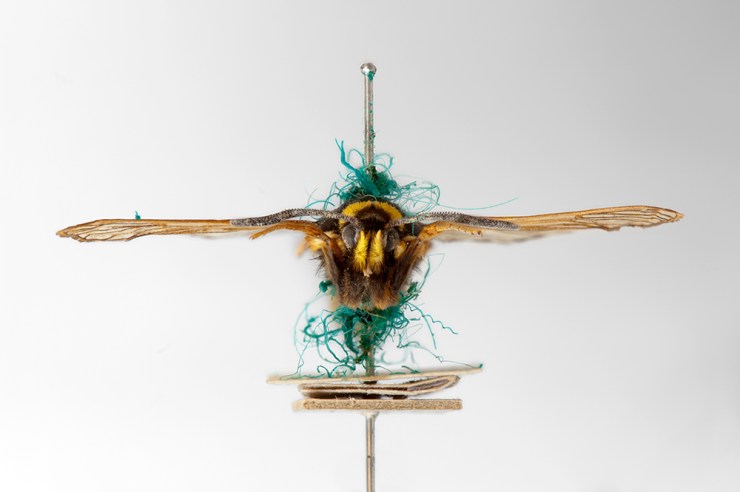
In the process of researching or conserving old pinned insects, it’s common to find a green deposit clustered around the pin. This is known as verdigris and is a natural patina created when the metal oxidizes over time. Katherine Child is Image Technician in the Museum’s Life collections and takes photos of insects for researchers, students, artists and publications. She is also an artist in her own right, so when she witnessed verdigris being removed during a conservation project, she came up with an inspired idea.

A clearwing moth before conservation, showing verdigris spreading where the metal and the insect fats, or lipids, react.

A few years ago I read a book called Colour: Travels Through the Paintbox, by Victoria Finlay, and was interested to learn that verdigris was once used as a pigment. Verdigris, which I now know translates from French as ‘Green of Greece’, is a word that’s been in my vocabulary since I was small.  I loved its rich bright blue-green colour, which is often seen on old copper piping or copper statues.

Verdigris forms when copper or a copper alloy reacts with water, oxygen, carbon dioxide or sulphur.

L: Three years’ worth of verdigris, ground and ready to make into paint.
R: A second attempt at mixing the paint, this time using linseed oil.

As early as 5thcentury AD, it was used in paint-making, and until the late 19th century it was the most vibrant green pigment available. But it was unstable – Leonardo da Vinci warned that it ‘vanishes into thin air if not varnished quickly.’ These days synthetic pigments provide a more constant alternative.

Despite its past uses, verdigris is a big problem in pinned insect collections. Nowadays stainless steel pins are used, but pins containing copper still remain in old collections and these react with air and insect fats. The more fatty the insect, the more verdigris tends to form and, if left, it can damage a specimen irreparably.

Comprising around five million or so insects, the Hope Entomological Collections here in the Museum take quite a bit of looking after. A few years ago a project to catalogue and conserve many of its butterfly and moth specimens was undertaken and the removal of verdigris and repining of insects was part of this.

With paint-making in mind, I asked that the beautiful, but problematic, substance be saved.  About three years on I finally got around to using the pigment, which I had also been adding to while photographing the collections.

I chose a variety of differently shaped moths to paint (most of the verdigris came from moths, so moths seemed the most apt subject). To narrow my options further I went for green moths. Some of the specimens I chose had verdigris on their pin, so I was able to take pigment and use it to paint the very specimens from which it came!

Katherine tested out the newly made verdigris paint in her sketchbook.

After a first failed attempt to make watercolour paint (during which pigment and water remained stubbornly separate due to the greasy insect fats still present), I tried again, this time using linseed oil to make oil paint – and it worked! Traditionally a flat bottomed tool called a muller was used to press pigment into the water or oil. Not having one of these, I used the flat end of a pestle and a mortar which did the trick.

A Miscellany of Moths, the finished verdigris painting.

The paint went surprisingly far and, following on from the 14 green moths, I plan to use up the remainder to paint beetles.

Katherine’s Miscellany of Moths painting can be seen on display in the Museum’s Community Case until 18th October.

Amber time capsules

New Museum Research Fellow Dr. Ricardo Pérez-de la Fuente talks about his fascinating work with a special collection at the Museum of Comparative Zoology, Harvard University, and what he’ll be getting up to at the Museum of Natural History. 

Amber, fossilised resin, has fascinated humanity since prehistoric times due to its mesmerising colour, shine, and fragrance when burned. From a scientific viewpoint however, what makes amber unique is the ability that the resin has to capture small portions of the ecosystem and the organisms living within almost instantaneously, in an unaltered way, preserving them for tens of millions of years. This has an unmatched fidelity among the fossiliferous materials.

Fibla_carpenteri_holotype_RPF_President_and_Fellows_of_Harvard_College
Holotype of Fibla carpenteri Engel, 1995, a snake-fly. Credit: President and Fellows of Harvard College.

During a four-year postdoctoral fellowship at the Museum of Comparative Zoology (MCZ) at Harvard University, I had the chance to curate, identify and digitise one of the premier fossil insect collections worldwide. It holds about 50,000–60,000 specimens, including around 10,000 amber inclusions. One of the unexpected outcomes of my time there was helping to rediscover a forgotten loan of about 400 Baltic amber samples that had been brought to the MCZ from the University of Königsberg during the 1930’s.  This loan ended up sparing the specimens from being destroyed during the bombardment of the city of Königsberg (renamed Kaliningrad thereafter) in World War Two. The full-story as showcased by the Harvard Gazette can be found here.

Lagynodes_electriphilus_holotype_RPF_President_and_Fellows_of_Harvard_College
Holotype of Lagynodes electriphilus Brues, 1940, a megaspilid wasp. Credit: President and Fellows of Harvard College.

As a researcher specialising in fossil arthropods, one of the most remarkable challenges for me during the digitisation project at the MCZ was to overcome the thrill to learn more about the specimens that we were imaging. In what way were they different from their modern relatives? Were they perhaps new to science? What information were they providing from the ecosystem in which they lived? At present, I can fully embrace these questions and many more thanks to becoming a Museum Research Fellow at the Museum of Natural History.

Hypoponera_atavia_cotype_RPF_President_and_Fellows_of_Harvard_College
Cotype of Hypoponera atavia (Mayr, 1868), an ant. Credit: President and Fellows of Harvard College.

My research at the museum focuses on studying interactions between organisms in deep time and their behaviours, particularly in Cretaceous amber, such as plant-insect pollination relationships around 100 million years ago. During that time, a major shift was taking place in terrestrial ecosystems due to the diversification of angiosperms (flowering plants), which ended up replacing gymnosperms (non-flowering plants) as the dominant flora. There was also the appearance of key groups of organisms from the ecological perspective — ants and bees in the case of insects, for instance.

It is a well-accepted fact that preservation in amber is biased towards small organisms because the larger ones tend to escape the sticky resin more easily. But how easy it is for one to get lost in amber when examining its secrets and trying to unravel its mysteries! Becoming forever trapped within.

Some of the most remarkable Baltic amber specimens (about 40 million years old) returned to the Königsberg collection from the MCZ. Pictures: RPF. Credit: President and Fellows of Harvard College.