On a dung beetle’s trail

dung-beetles-blog-post

Thanks to the work of our Head of Life Collections Darren Mann, and the Dung Beetle UK Mapping Project team, the conservation status of the UK’s dung beetles, chafers, and stag beetles (Scarabaeoidea) is currently undergoing a comprehensive review.

Contributing to this effort, Jack Davies, one of our summer interns, has been on the trail of a species that has proven to be particularly rare in the UK…

Aphodius lividus
Aphodius lividus

I am on the hunt for Aphodius lividus, a dung beetle with a truly cosmopolitan distribution, being found across most of the globe, but which is rather rare in Britain. Since 1990 it has been recorded at only six sites, though historical accounts suggest it was more common in the past.

Most of these historic records are from the south east of England, particularly Kent and the London area, but there are several geographically isolated records from across England and Wales too. So might A. lividus, whilst being extremely local, actually be widespread across the UK?

During my time at the Museum I have been contributing to a comprehensive review of this species’ distribution by helping to verify these records. This has involved a thorough search of collections, journals and the Museum archives, a process which revealed that many of the recordings of A. lividus were almost certainly erroneous.

We were able to discount the only two Welsh records, as well as single records from Cheshire, Leicestershire and Lincolnshire. Our reasons for doing so included a lack of supporting evidence, the unreliability of certain collectors, and the confirmed misidentifications of some specimens.
IMG_9966
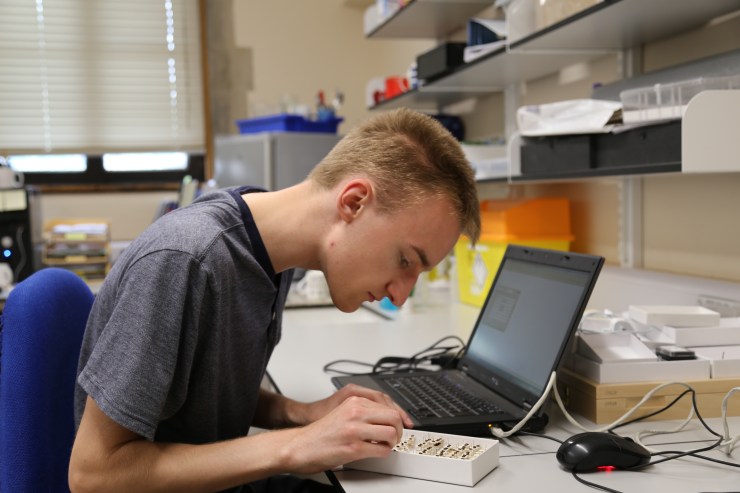
Jack Davies working on a collection of Aphodius lividus

The number of known localities for A. lividus decreased further when we realised that three of the reported sites in Kent most probably all refer to the same location. This is a common problem in this type of research, due to the very broad locality names found on Victorian specimen labels.

So it has become clear that this incredibly scarce beetle is even rarer than we first thought. But it’s not all bad news for A. lividus; our research has uncovered reports from localities in Devon and Northumberland in the old literature, which we found to be trustworthy records.

Aphodius lividus
Map showing the distribution of the dung beetle Aphodius lividus in the UK

All the verified data from the project has been collated to produce this map of the distribution of A. lividus in the UK. Its very local distribution, and the very low number of recent records, confirm that this species should be classified as Vulnerable to Extinction in the UK.

Although it would be a shame to lose this species in Britain, we don’t believe it should be a priority for conservation efforts. Since Aphodius lividus has a strong preference for high temperatures, it’s likely that the UK is simply at the very edge of its range.  It is also a very abundant species in many areas around the world, and it contributes little in terms of ecosystem services in Britain compared to many of our other dung beetles.

So conservation should instead aim to preserve the dung beetle ecosystem as whole, which supports a huge number of species and also brings many benefits to agriculture.
The bully bee

Bee3

Young volunteers Genevieve Kiero Watson and Poppy Stanton tell the tale of the Museum’s resident Wool Carder Bee and their investigative bee work in our Life Collections…

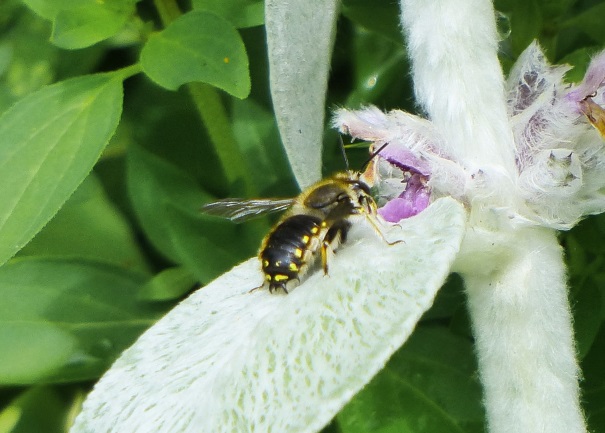
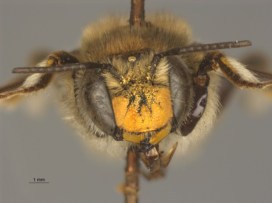
A small guardian patrols its territory among the luscious bed of Lamb’s-ears that grow at the front of the Museum. This feisty critter, the Wool Carder Bee (Anthidium manicatum), is just one of the roughly 270 bee species that buzz around Britain. Having spotted this unusual hovering bee we seized the opportunity to identify, photograph and explore the species a little further.

The male of this solitary bee species is fiercely territorial, fighting off other males as well as any other insects it considers to be intruders. Techniques used in combat vary from skilful aerial hovering to ferocious wrestling. But perhaps its greatest weapon is a series of stout spines found at the tip of the abdomen. These are used to bully an intruder into submission, or even to kill it. In so doing, the male protects the precious supply of pollen for the smaller females which in turn collect it on stiff bristles on the undersides of their abdomens.

Females, being slightly less aggressive, are in charge of constructing the nests, which are built in existing cavities such as beetle holes. Hairs shaved off plants, such as the favoured Lamb’s-ear, are used to create the brood cells for the next generation.

Male Wool Carder Bee on Lamb's ear in the Museum's front garden
Male Wool Carder Bee on Lamb’s ear in the Museum’s front garden

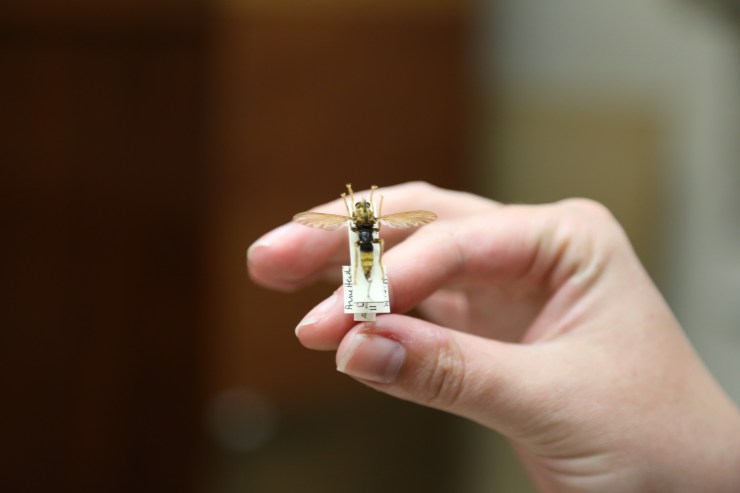
The Museum houses many specimens of the Wool Carder Bee and our job was to pull out the data from each one to help with an ongoing online survey about this species. Although making friends with hundred-year-old bees was enjoyable, trying to comprehend the miniscule handwritten labels accompanying them was altogether more trying.

Every label explains where and when the bee was captured, who collected and identified it, and gives the reference for its current collection. All this on a slip of paper no bigger than half a stamp.

One of the Musuem's Wool Carder Bee specimens, circled, featured in a display of all 270 species of British bee in the Bees (and the odd wasp) in my Bonnet exhibition by artist Kurt Jackson
One of the Museum’s Wool Carder Bee specimens, circled, featured in a display of all 270 species of British bee in the Bees (and the odd wasp) in my Bonnet exhibition by artist Kurt Jackson

After recording data from 120 labels we began to find the grid reference of the location each was originally collected. This too was challenging as many place names have changed in the last hundred years. Ultimately, the information will be used by the Bees, Wasps & Ants Recording Society (BWARS) to improve the distribution map for the Wool Carder Bee.

Why not see if you can spot the Wool Carder Bee in your garden? Characteristics to look out for include small spines on the tip of the abdomen and lateral lines of yellow spots on either side of the abdomen. The bees themselves are about 11-13mm long for females, and 14-17mm for males. Good luck!


Mustachioed Robber Flies

To celebrate National Insect Week 2016 we thought we would introduce you to the custodians of the Hope Entomology Collection here at the Museum. Our insect collection is made up of a whopping 6 million specimens, so our resident entomologists definitely have their work cut out. However, they have taken a little time out to tell us all about their specialisms and why their favourite insects are the best.

Zoë Simmons – Life Collections

Zoe

I have many favourites in the collections that I look after- insects demonstrate an immense diversity of form and behaviour. So much so in fact that I defy anyone that says that there is not one thing that they do not find interesting among the almost one million species described to date.

One of the groups that I often find myself returning to though is the Asilidae or Robber Flies. This is a group of predatory flies that feed on a wide range of insect species. Many species sport heavily bristled moustaches, which are thought to protect their faces as they feed but have the added bonus of making the on-trend hipster insect of the moment.

Mustachioed Robber Fly
A ‘moustachioed’ Hornet Robber Fly in the wild

As is common with predators they have exceedingly good eyesight and will sit, perched until they spot movement, at which point they will strike at the prey item in the air.

The legs are furnished with long spines that help hold the prey and the mouthparts have evolved into a hardened beak-like structure which can stab through even the tough exoskeleton of beetles. Entomologists who specialise in catching Asilids have to be wary as these flies are not afraid to use this to their advantage.

IMG_9298

As it happens, the largest and most striking species of fly in Britain is the Hornet Robber Fly, or as it is more commonly known, Asilus crabroniformis. Superficially, its appearance closely resembles that of a hornet. Seen from a distance it is easy to see how the two species may be confused by the casual observer (pro-tip: look for the antennae. Hornets have long, obvious yellow-brown antennae whereas those of the Robber Fly are dark and small), so much so in fact that the species name for the Robber Fly crabroniformis, translates as ‘hornet-form’. This mimicry of a species that is able to sting affords the Robber Fly a level of protection. It does not have a sting itself but the bluff works well.

IMG_9311.JPG

Also of interest, and linked to the next post by Darren Mann, is the fact that this species is one of the top predators of dung beetles. The females require dung from a herbivore such as a horse or cow to lay their eggs in. As a consequence adults can often be found hanging out in fields near to piles of dung, hoping to meet the mustachioed mate(s) of their dreams, whilst snacking on dung beetles that fly in to start their own dung-related romance story. The presence of this Robber Fly species is often indicative of the quality of the dung and its associated beetle fauna, and as such should be greeted with warmth and a hearty ‘hurrah’ if spotted for it means that the habitat is healthy.

Making Microsculpture

Microsculpture

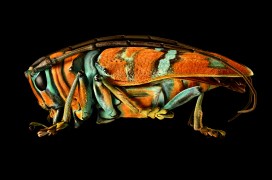
Today we are excited to be opening our new special exhibition, Microsculpture: The Insect Photography of Levon Biss. You may well have already heard about Microsculpture, and have perhaps watched the video showing how Levon Biss made these incredible portraits of insects from the Museum’s collection.

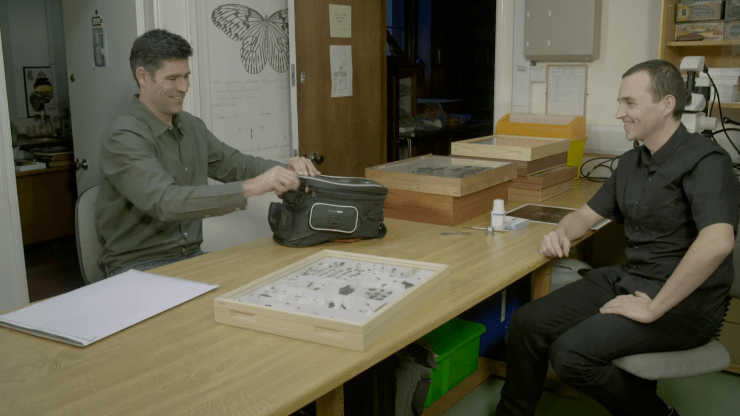
As we open the show in the Museum’s main court we wanted to give a little more insight into the process that Dr James Hogan, an entomologist in our Life Collections, went through to select and describe the specimens for the project. So I put a few questions to James to explain the making of Microsculpture from his point of view.

James Hogan (right) selecting specimens with Levon Biss

There are 23 specimens on show in the exhibition: how did you choose these particular ones?
We wanted a wide variety of specimens that would all show some interesting surface detail. Some were also chosen for their spectacular colours, interesting shapes or strange appearance.

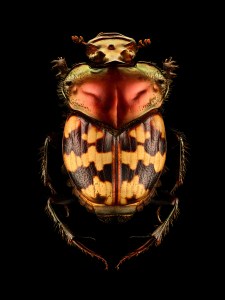
Splendid-necked Dung Beetle (Helictopleurus splendidicollis). From Madagascar. Length: 10 mm
Splendid-necked Dung Beetle (Helictopleurus splendidicollis) from
Madagascar. Length: 10 mm

But perhaps 95 per cent of the specimens we initially considered were rejected because we had some pretty strict criteria; very hairy specimens, which includes most bees, were out as the image processing was too difficult; the specimens had to be intact, so no broken antennae or legs.

Probably the biggest problem was finding specimens which were clean enough. Because Levon’s technique reveals so much detail, any dirt on the specimen is glaringly obvious. And the whole idea was to look at the surface structures, which are obviously very small and easily obscured by any dirt.

How did you prepare them for their close-ups?
All the specimens needed a bit of preparation work before being ready for Levon’s photography. First they needed to be remounted on the end of long pins to allow more clearance space for the lighting setup. Some of the specimens are very small and fragile and this is the stage where damage is most likely to occur.

After remounting, all the insects needed at least some degree of cleaning under the microscope. For this I used a range of fine paintbrushes; we also make our own tools from micro-pins bent into different points and hooks. Again, I had to be careful to not damage the specimens – easily done by over-enthusiastic cleaning!

Where do the specimens come from?
The specimens in the exhibition are from the Museum’s very large insect collection, stored behind the scenes in many different rooms. The insects in the show are from all over the world, from a back garden in England to a remote island near Antarctica. Some were collected over 150 years ago while others were collected very recently by Museum staff.

Of particular historical significance is the Tricolored Jewel Beetle (Belionota sumptuosa) which was collected by the Victorian naturalist and explorer Alfred Russel Wallace, co-publisher of the theory of evolution with Charles Darwin in 1858.

Tricolored Jewel Beetle (Belionota sumptuosa), collected by Alfred Russel Wallace in Seram Island, Indonesia. Length: 25 mm
Tricolored Jewel Beetle (Belionota sumptuosa), collected by Alfred Russel Wallace in Seram Island, Indonesia. Length: 25 mm

How big are the actual specimens in comparison with the photos?
The actual specimens are mostly pretty small, ranging from 6 mm to about 30 mm. Some of the larger printed photographs will be about a thousand times larger than the specimen!

Orchid Cuckoo Bee (Exaerete frontalis) from Brazil. Length: 26 mm
Orchid Cuckoo Bee (Exaerete frontalis) from Brazil. Length: 26 mm

What do you hope people will get out of the pictures in the exhibition?
To me insects are beautiful creatures and Levon has done an outstanding job of revealing this. I hope the photographs will spark people’s interest in insects and inspire more people to study them.

The photographs certainly pose some interesting questions, and reveal that there is so much we don’t know, particularly about the functions of all their strange and varied adaptations.

Is it valuable to showcase specimens from the collections in this way?
One of the most exciting parts of this exhibition for me was the opportunity to show part of the Museum’s collection which visitors don’t normally see.

The collection is used all the time by scientists, artists and educators, but unfortunately most of it is unsuitable for display because the specimens are so small. Levon’s ultra-high resolution photography has in a way solved this problem, allowing us to showcase some of these spectacular, but tiny and fragile creatures in all their beauty.