Bethany Milne from the Museum’s Visitor Experience team has spent some time working alongside the Exhibitions team to deinstall a temporary art exhibition. She has reflected on the day – what she enjoyed and what she learnt along the way.
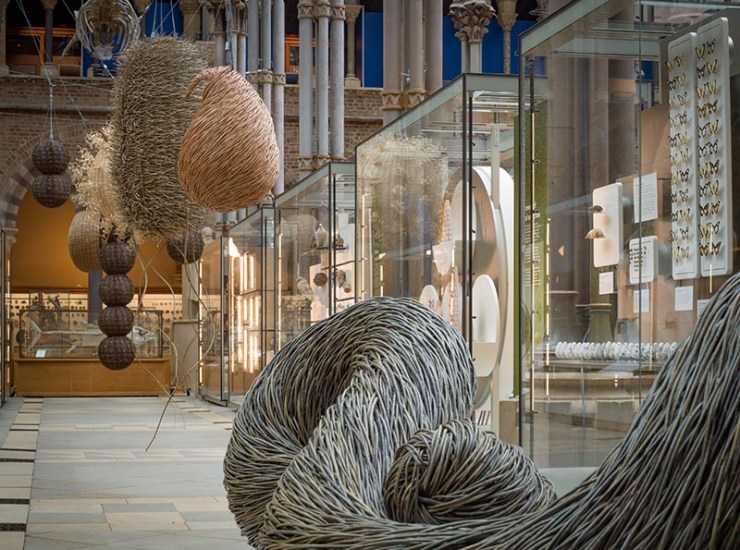
The deinstall of the Museum’s Deadly Six art installation is my first introduction into the world of exhibitions and an exciting one to start with. I have seen the display since it was first installed in September 2024 and I began working at the museum, watching it on my patrols of the court to make sure it stays intact and safe from all the little hands that pass through our doors every day. I didn’t imagine what it would be like to touch them myself until I found out I had the opportunity to join the team in taking them down.
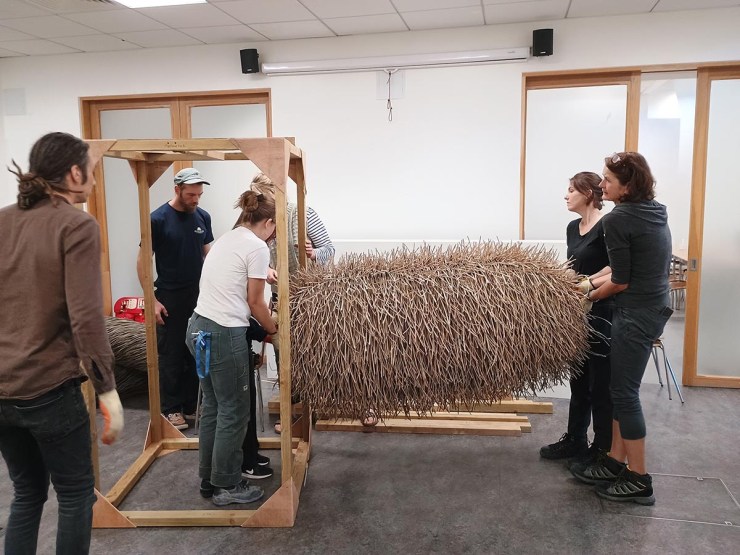
On September 8th I came into the museum at 8:30am to shadow the exhibitions team as a development day. Most of the staff and contractors were already there and so I started by talking to the Head of Exhibitions, Rachel, about what needed to be done. She showed me her schedule of the day, starting at 8am, going through to 5pm, in which we would derig all the sculptures and get them set up safely out of the public areas and into storage. After, I helped set up hoarding to keep the aisle where the work was being done secluded, as the museum would be open to the public as usual around us. This aspect was an interesting learning opportunity for me as I have no earlier experience with the manual labour aspect of the work, but I enjoyed being hands-on.
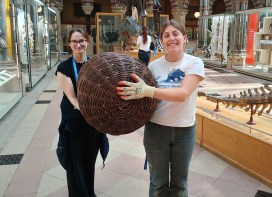
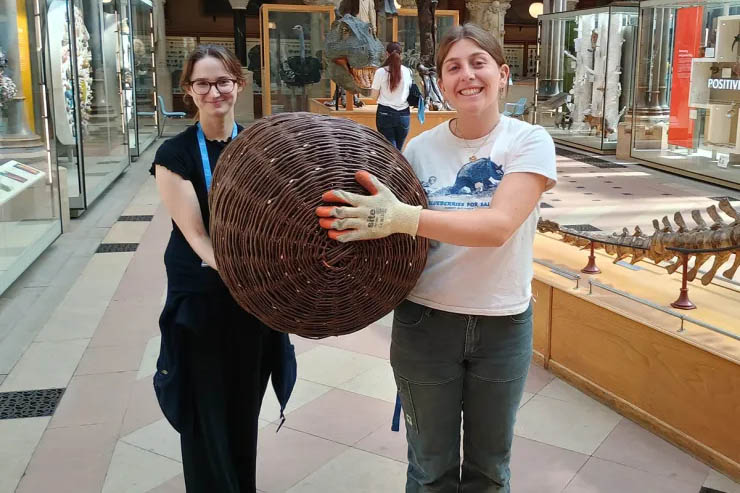
As I was doing this, the team from Outback Rigging worked on carefully lowering the suspended works to the ground and to our surprise; the take down was ahead of schedule. Most of them were removed by the middle of the day and these ones were simple to move. This was interesting to me as they seem so delicate, being large structures made of woven willow, but they proved sturdier than I thought. However, some were more difficult to take down than others, including the COVID sculpture. This was the most difficult to get down to the storage space, due to its intricate structure and its large size. Too wide to take down the stairs we usually use, Rachel organized with the Pitt Rivers to take it through their door, along the road and back into the Museum of Natural History through another door! What made this procedure more complicated was the sculpture itself, as its round construction meant there were no handholds. Luckily, the artist Issy Wilkes created some by looping some zip ties through the metal frame and, learning from the setup of the exhibition, used foam sheets to wrap around these painful to hold ties, to make the journey even easier. I felt it was an extremely rewarding process when we were finally able to put it down, as it required a lot of teamwork and shimmying about corridors to make it – I was very relieved we were able to keep it in one piece.
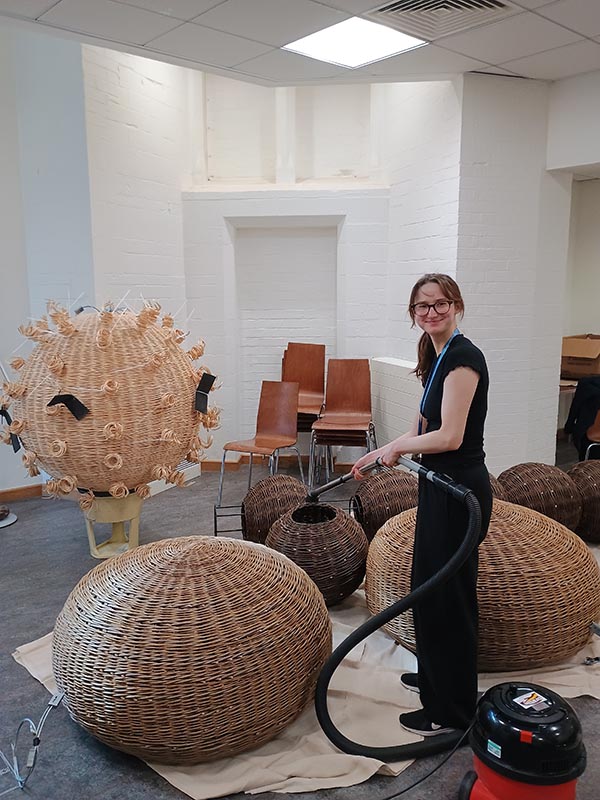
As the day went on and the sculptures were down and put away safely, I began to do smaller, but equally important tasks. The works themselves weren’t the only part of the exhibition, so I aided in removing the signage that was in the aisle that explained the meaning of each part. We also moved these down to the storage room, out of the way of the surrounding visitors and I began the task of removing the labels from inside. Another small step was vacuuming the sculptures. Despite regular conservation cleaning, hanging up in the court for so long had meant they had accumulated a lot of dust, which had to be cleaned out before they moved to their next home. These tasks were ones I wouldn‘t have thought of before the experience, but I realise that the smaller aspects are just as important as the larger ones when it comes to taking care of the exhibitions. It is our job to not only display the works as best we can, honouring their artistic intent and presenting to the audience in a way they understand, but this experience showed me how important the after care is, ensuring that they are well maintained to carry on their purpose and that the museum is returned to its original state.
In February 2023, the Museum was lucky enough to acquire an important historical archive – a collection of notes, correspondence, artworks, photographs and family documents belonging to geologists William and Mary Buckland. But before the archive can be enjoyed by visitors and researchers, it must first be cared for, ensuring its preservation for generations to come. Thanks to generous funders, the Museum was able to hire a Project Paper Conservator, Anna Espanol Costa. Considering the Museum had not had a paper conservator since the mid-1990s, Anna was incredibly resourceful with her use of tools and materials, utilising everything from makeup sponges and soft brushes to tweezers and dental picks. In this blog post, we share insights from the eight months she spent assessing, cleaning and repairing some of the most at-risk and important material in the archive, as well as some unexpected surprises she found along the way…
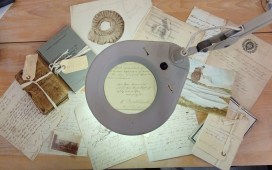
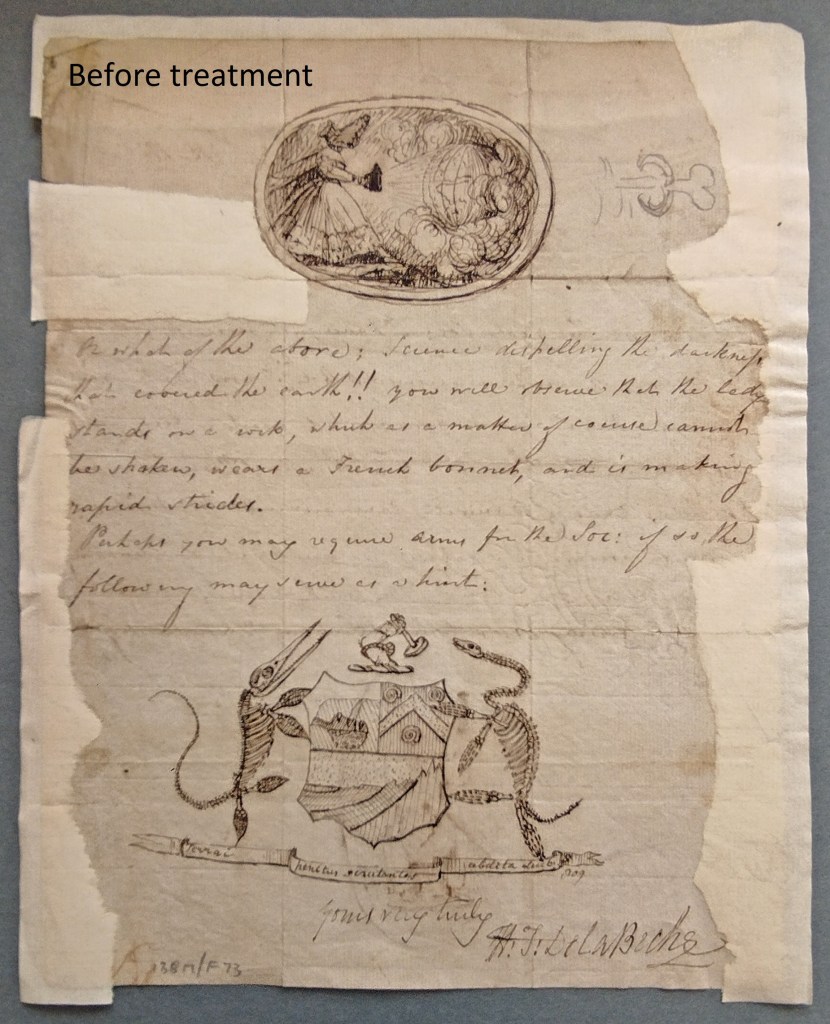
Paper can be used to store information for decades, if not centuries, but it is still vulnerable to frequent handling and poor environmental storage conditions. When the Museum acquired the Buckland archive it was around two hundred years old and, unsurprisingly, many of its items needed care and restoration. Over the years, the papers had been housed in the standard file folders and boxes you would use for office documents, rather than an important historical archive. Many of the folders were overcrowded and had been tied together with string. Some manuscripts had been damaged due to too many items being stored in the same folder, and there were places where the string had cut into the larger pieces of paper causing tears. The most fragile and vulnerable items showed signs of chemical and physical damage, including iron-gall ink corrosion; chemicals in the ink had started to eat through the paper, causing cracks and loss of ink, and consequently text, in some areas.
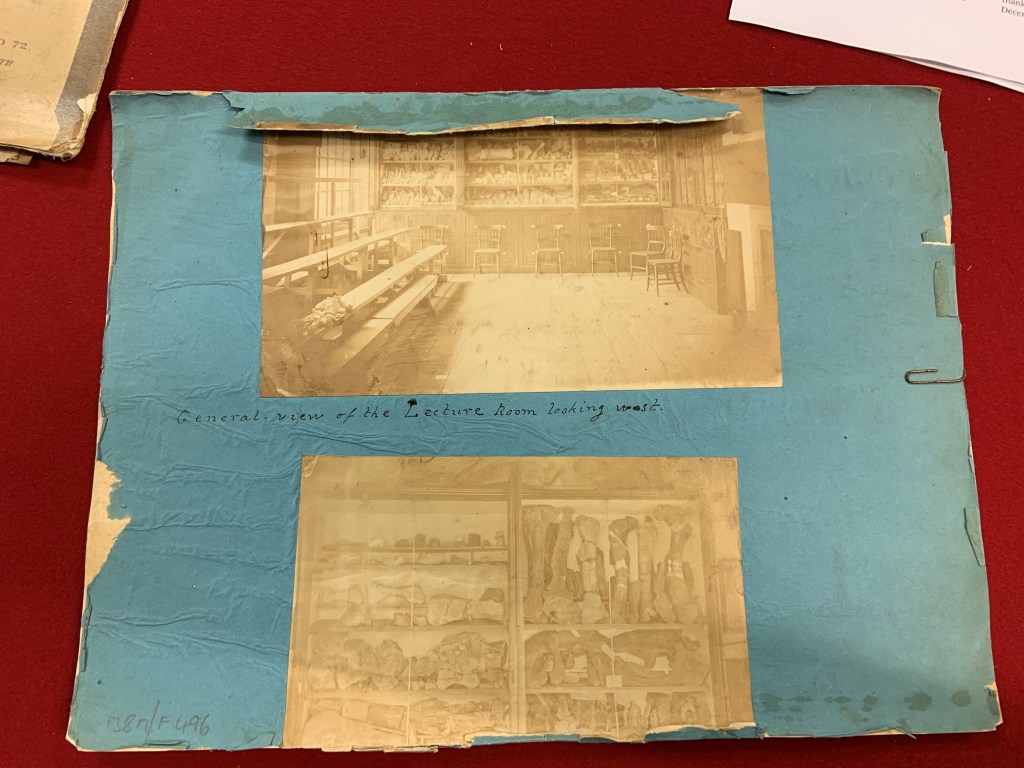
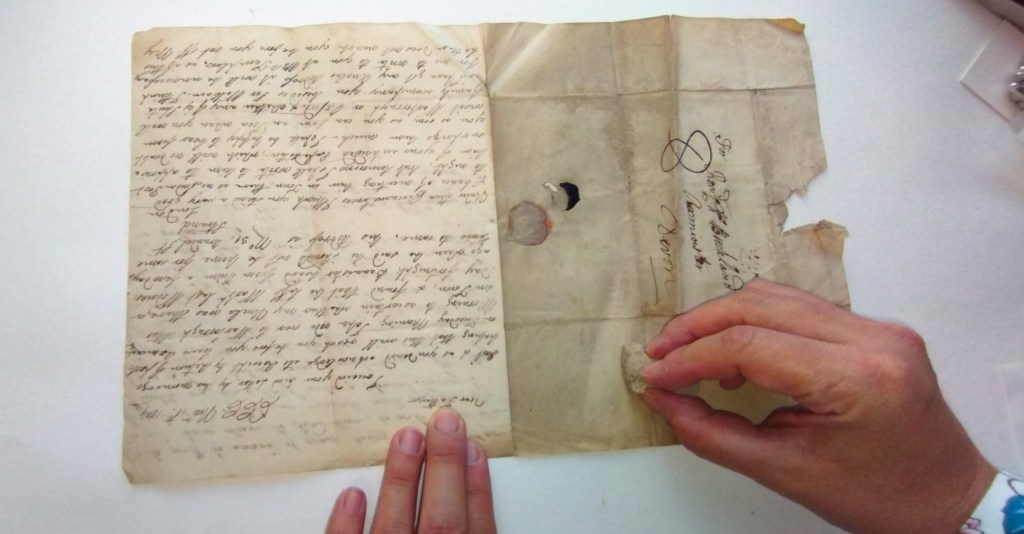
Before treatment: Photographs mounted on an unsuitable bright blue backingBefore treatment: An unsuitably preserved letter with ingrained dirt
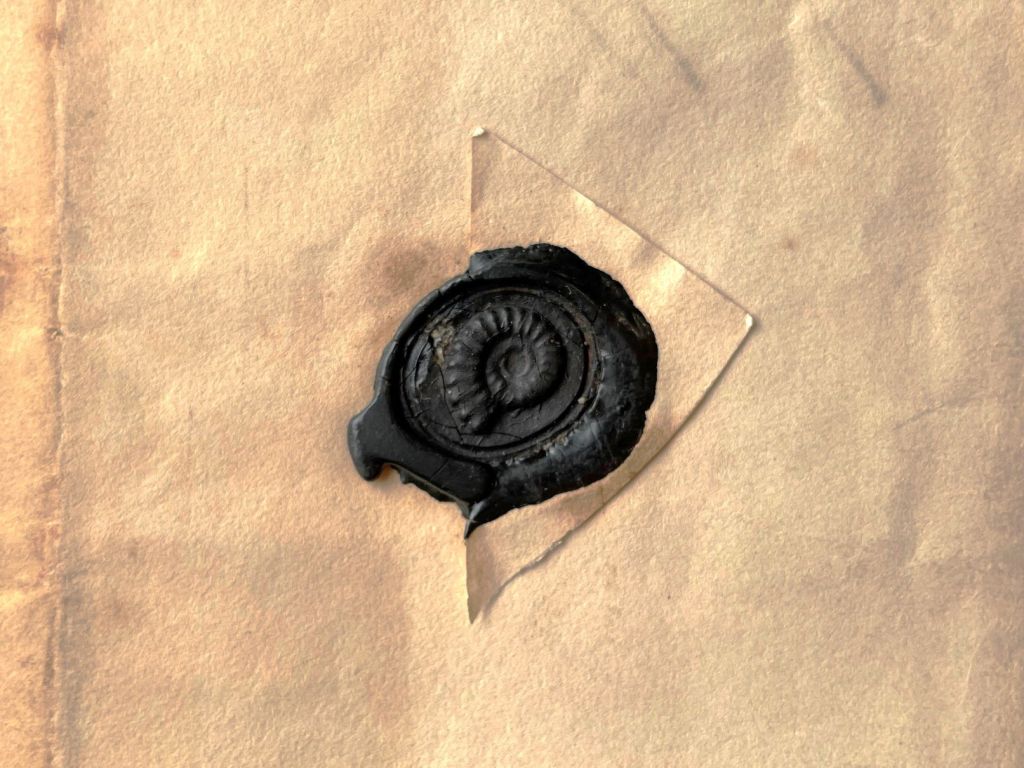
Past efforts had been made to restore the documents, but sometimes these had disfigured the original manuscripts: “in-fills” had been made with unsuitable paper, and backing sheets had been added in bright colours like blue or green. The archive was also being held together with unstable and rusty paper clips, and many of the original wax seals had cracks. It would have been a great shame to lose any of the seals, which feature beautiful examples of natural history icons, like ammonites and cephalopods.
PRESERVING HISTORY
The objective of my work was to stabilise the Buckland archive to ensure its long-term preservation and restore the appearance of the collection so it could be safely handled, digitised and exhibited in future.
One of the most important principles behind conservation is doing the ‘least amount to do the most good’. Conservation aims to slow down the ageing and deterioration process by using treatments that will not damage or disfigure the integrity of the original document. Conservation may be preventative — for instance, moving documents to a new box that creates the right ‘microclimate’ for their preservation. It may also be interventive — e.g. repairing with non-acidic and reversible materials that can be easily removed at any time, and that also can stand the test of time.
During my time at the Museum, I have been able to conserve a number of the most at-risk and important pieces of archival material. In some cases, this involved a light clean with a soft brush and re-housing of the most overcrowded items. In other cases, I performed more interventive and invasive conservation treatments including mechanical surface cleaning with smoke sponges, relaxing folds with paperweights or steam, stabilising iron-gall inks with gelatin to prevent further corrosion, mending tears with different grades of Japanese papers and tissues, and cleaning and consolidating cracks in the wax seals on the letters to prevent further loss. I also tackled some of the previous ‘repairs’ by eliminating old animal glue which had left the manuscripts shiny in places, carefully removing the unsuitable paper, and adding supports where necessary, thus leaving no traces of the bright blue backing paper.
Cleaning a letter to remove ingrained dirtA wax seal on a letter in the archive, featuring an ammonite motif
INTERESTING AND UNEXPECTED STOWAWAYS
As well as undertaking conservation repairs, I also documented the condition of the items; photographing the manuscripts before and after conservation treatments to ensure the Museum, or any other future conservators, have a record of my work. Whilst undertaking conservation treatments, I found some interesting and unexpected stowaways in the archive. What looked to be small holes in one of the pages of a letter ended up being recognised by one of the Museum’s entomologists as spider frass (poop). A moth had also decided to call the papers home at some point in the last two hundred years as I came across a small cocoon that was now long dead, desiccated (dry) and dusty. The most unusual find, however, was a small black dot that I initially thought was an insect. However, employing the help of a microscope and one of the Musuem’s entomologists, we realised that it was actually a seed! What kind of seed, and how or when that seed came to reside in the Buckland archive, we don’t know, but it shows the archive had a life and story of its own long before it came to rest here in the Museum.
A JOB WELL DONE
Overall, I was pleased with the amount of work I was able to accomplish at the Museum. I managed to conserve a significant amount of the archive and was fortunate enough to work with, and learn from, a range of museum staff, including palaeontologists, geologists, zoologists, entomologists and the Life and Earth collections conservators. It has been a privilege to share and exchange knowledge with my colleagues and work collaboratively on the preservation of an important archive. I look forward to hearing about some of the research findings it produces, and to see it shared with the public in future exhibitions and displays.
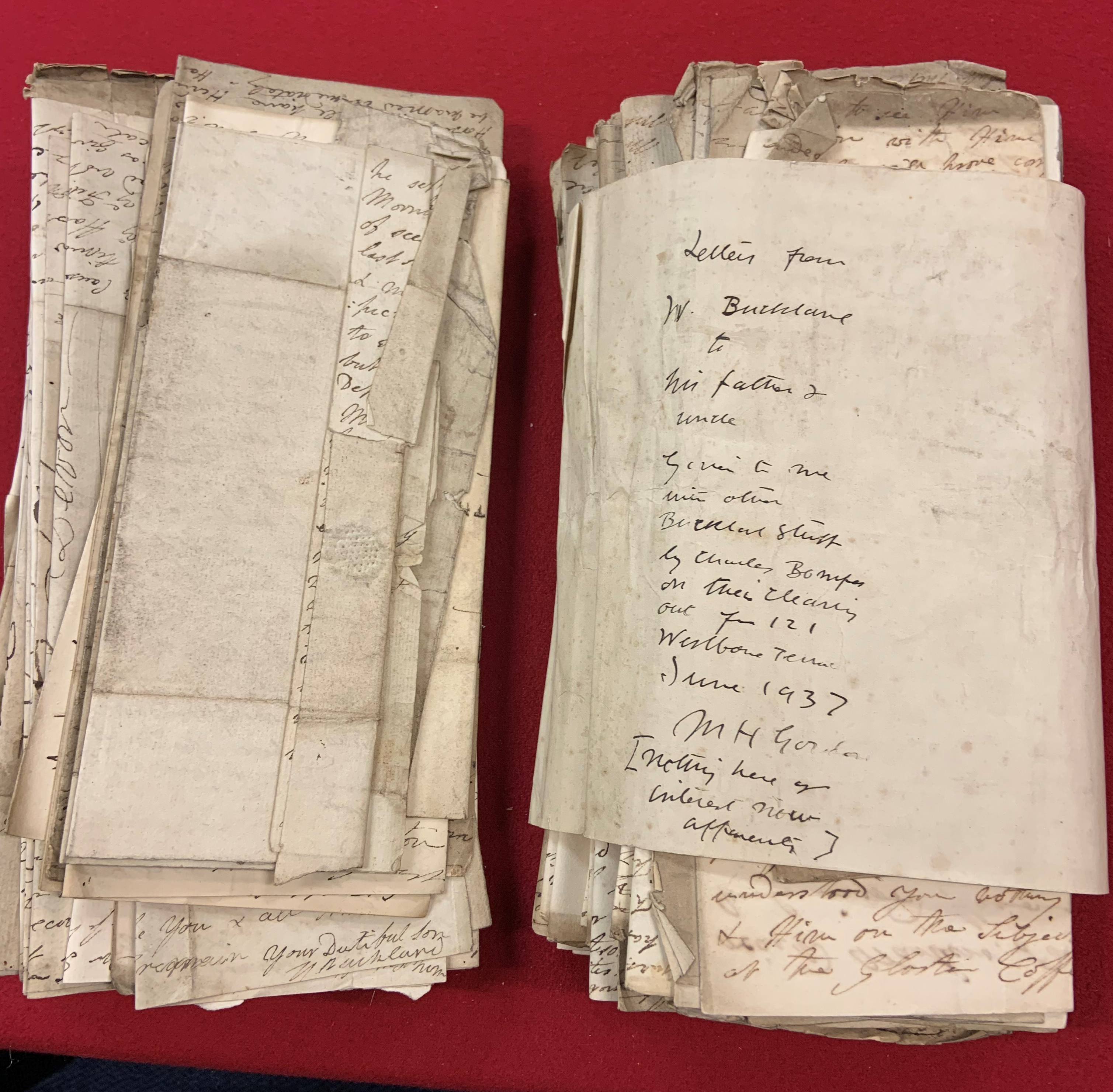
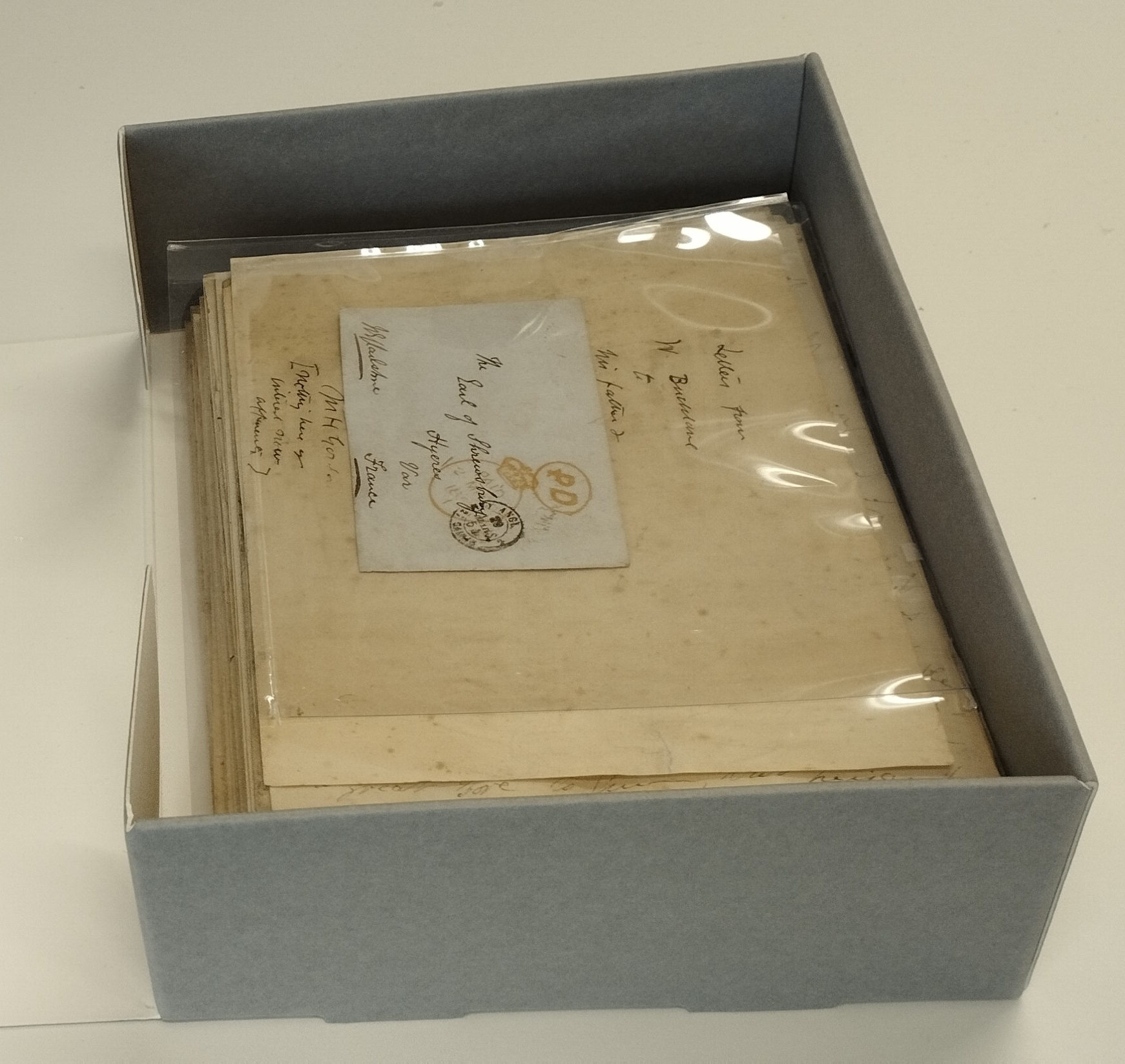
Bundle of letters before treatmentBundle of letters after treatment
Thank you to the National Manuscripts Conservation Trust and Helen Roll Charity for funding Anna’s work. Items from the Buckland archive will feature in the Museum’s upcoming exhibition ‘Breaking Ground’ opening 18th October 2024.
THE INVISIBLE HISTORY OF THE MUSEUM’S GLASS DISPLAY CASES
Glass cases play an integral role in museums and galleries, but they are designed to be overlooked and ignored. In this blog post, Librarian and Archivist Danielle Czerkaszyn uses research collected by Helen Goulston (AHRC Collaborative Doctoral Partnership PhD Candidate) to uncover the invisible history of OUMNH’s glass display cases and considers how they have evolved alongside the museum during its 160-year history.
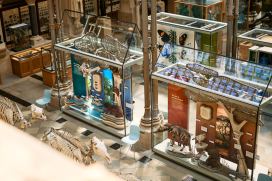
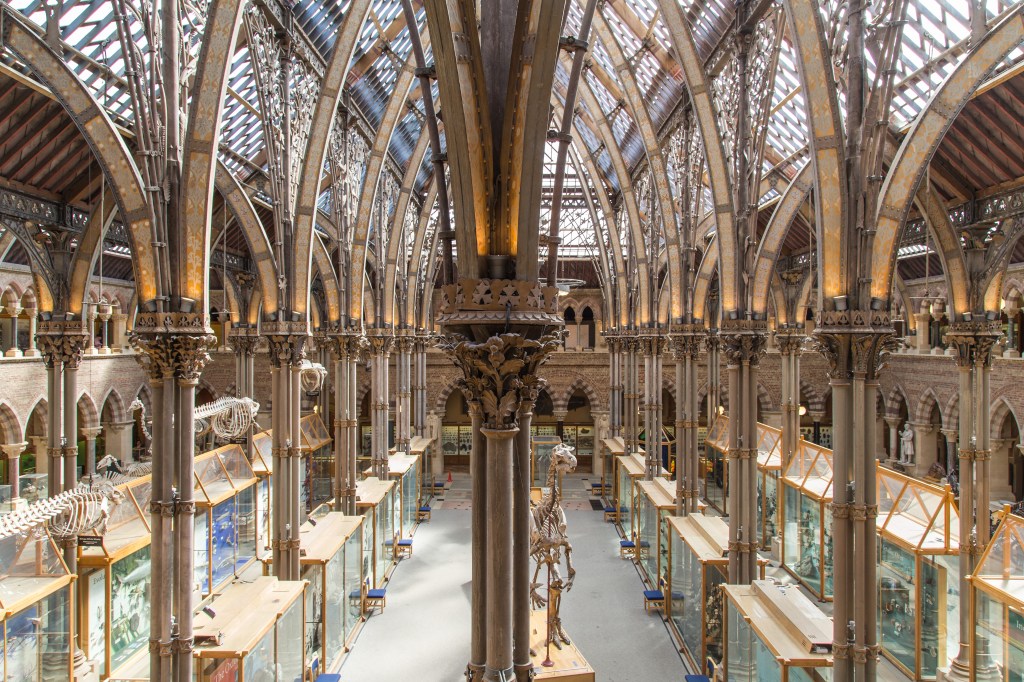
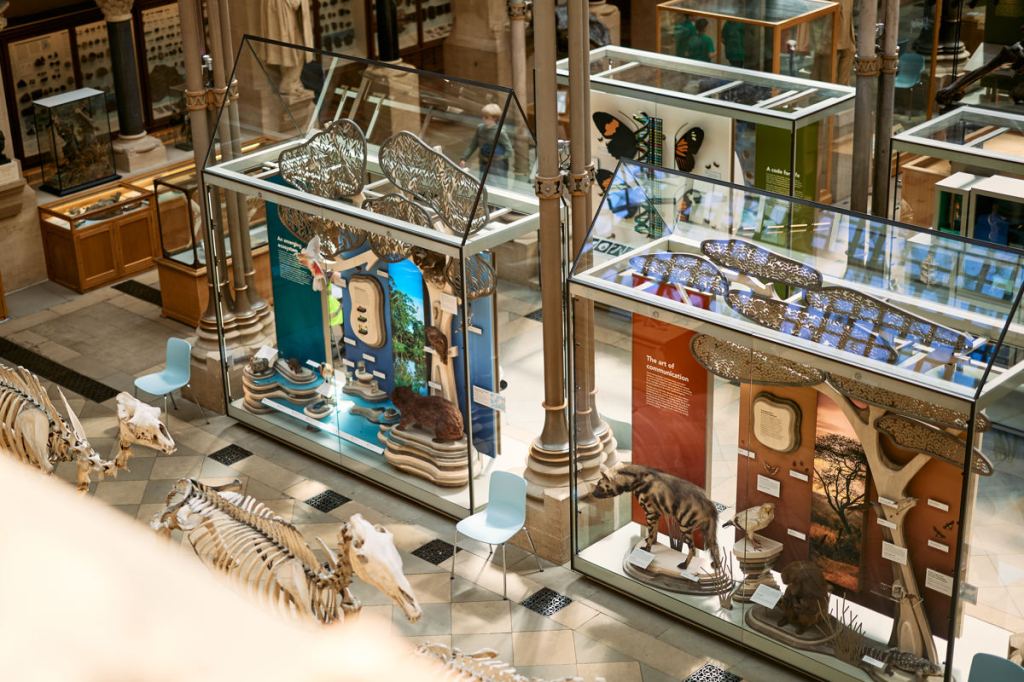
Since 2018, the Museum has been working to refresh its Main Court by installing new permanent displays. This morning, we placed the final specimen in our brand new “Open Oceans” display, concluding the latest phase of the redisplay project. The “Open Oceans” display is housed in one of eight new conservation-grade glass cases installed last year. While some visitors have welcomed the new cases, others have mourned the loss of the wooden cases or questioned why they needed to be replaced. Others have wondered why the tops of the new glass cases have roofs with different heights. To answer these questions, we need to dive into the museum archive…
A CASE HISTORY
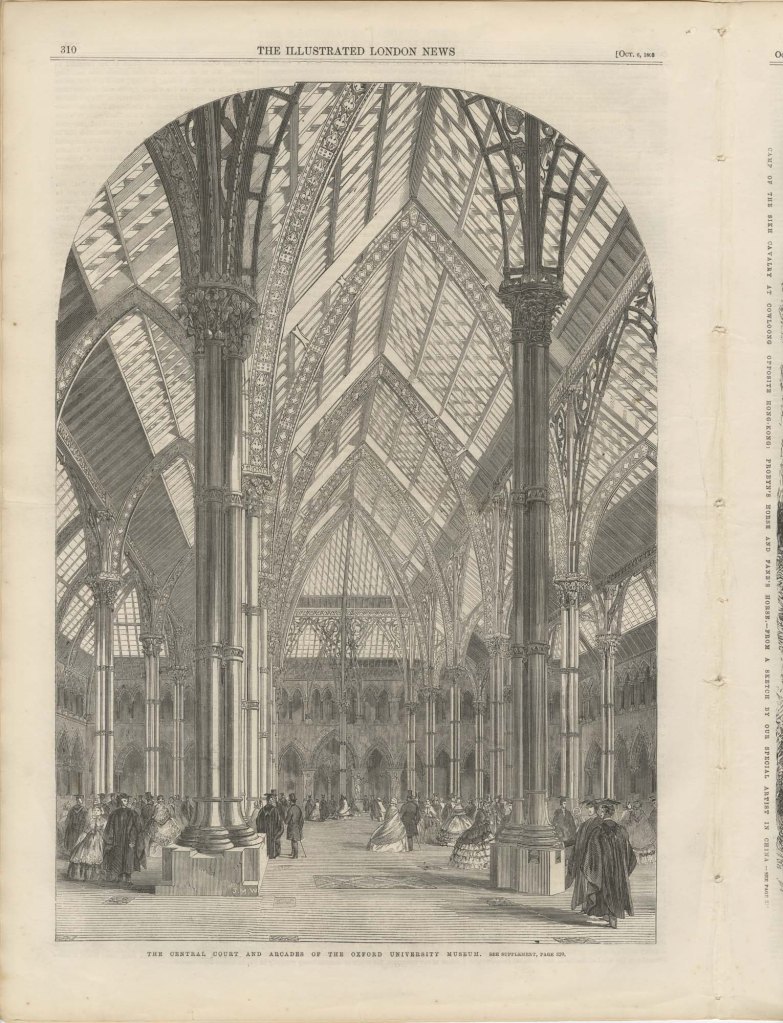
When visitors arrived at the newly-opened museum in 1860 they would have been greeted by an empty central court, devoid of displays. While the fabric of the building was more or less complete, and preparation for the installation of displays had already begun, the university’s scientific and natural history collections had not yet been transferred to the building.
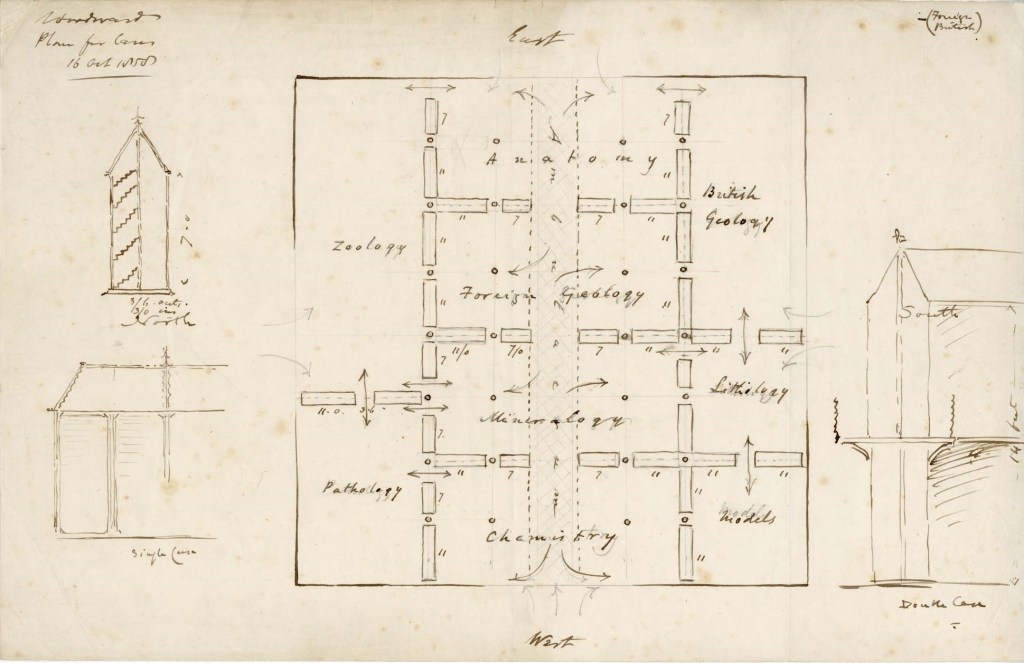
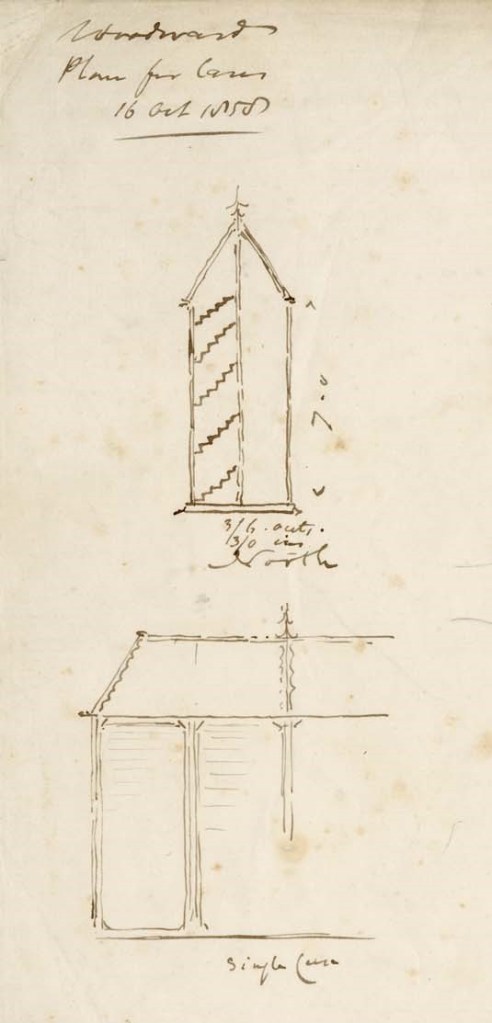
A sketch in the archive dated 16 October 1858 by architect Benjamin Woodward shows an early plan for the display cases to be arranged between the iron columns in the Main Court, allowing visitors to circulate among the exhibits, with display cases echoing the Gothic revival architecture. The right of the document shows grand double-height displays with a central balustrade that were never realised, but cases similar to those on the left would be ordered in January 1862.
The empty Main Court of the Museum when it opened in 1860, London Illustrated NewsSketch by Benjamin Woodward showing an early plan for the arrangement of displays in the Main Court, 16th October 1858Close-up from Benjamin Woodward’s 1858 sketch envisaging similar display cases to those that would be ordered in January 1862
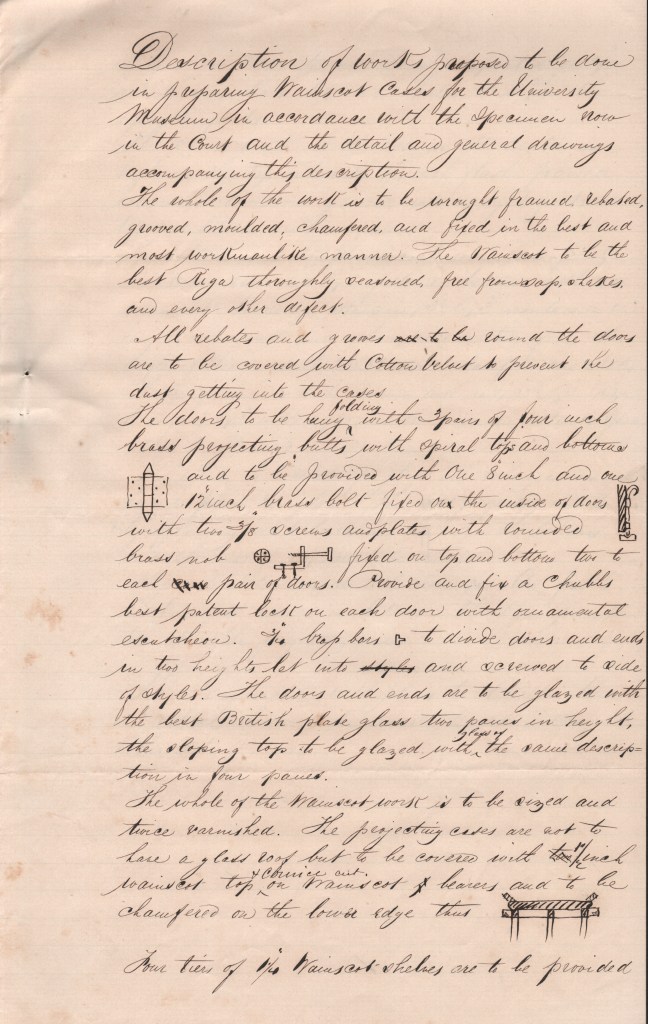
The 1862 tender document written by William Bramwell, Clerk of Works at the Museum, shows two types of upright display cases ordered for installation between the iron columns — some with pitched roofs and others with flat tops, which were considerably cheaper. Though the design of the cases resembles Woodward’s original sketches, the tender included detailed specifications that addressed the practicalities of displaying specimens, such as cotton velvet door linings to stop dust from getting in.
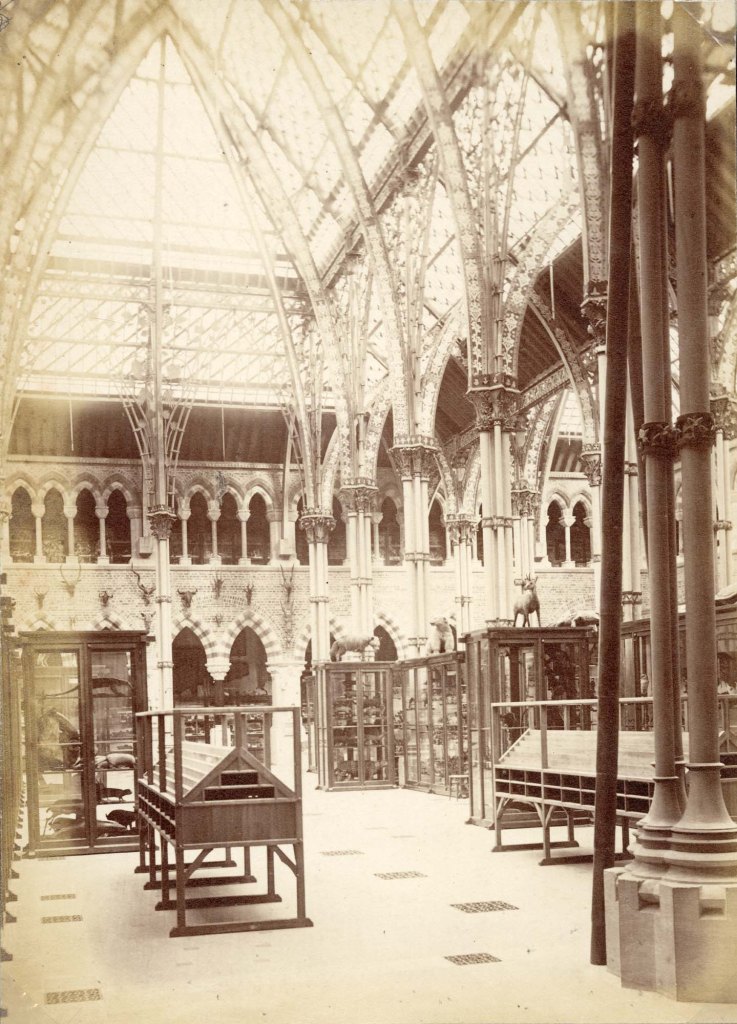
In addition to the upright centre court cases, ten table cases were ordered from the high-end London cabinet makers, Jackson and Graham, at a cost of £344.10. The same firm was also commissioned to fit the tall wall cases in the outer corridors. Plans and photographs from the archive show that the installation of these cases was piecemeal and it wasn’t until 1866 that all the display cases were fully in place.
A tender document written for the Museum’s first display cases, written by William Bramwell in 1862The Main Court of the Museum prior to 1864
WHY REPLACE THE CASES?
The wooden display cases that we have been replacing may look old, but few of the original cases from 1866 survive. While some of the old display cases were moved behind the scenes for preservation, others found homes in different museums or were disposed of when they were beyond repair. The most recent timber-framed cases in the Main Court are 20th-century replicas that have been heavily modified, particularly in the late 1960s-early 1970s, and again in the early 2000s when the clear acrylic roofs were added. Some of these modifications affected the stability of the cases, particularly when the doors were opened, making them unsafe for staff to access. Other modifications meant the cases were no longer dust or pest-proof, which poses a risk to specimens.
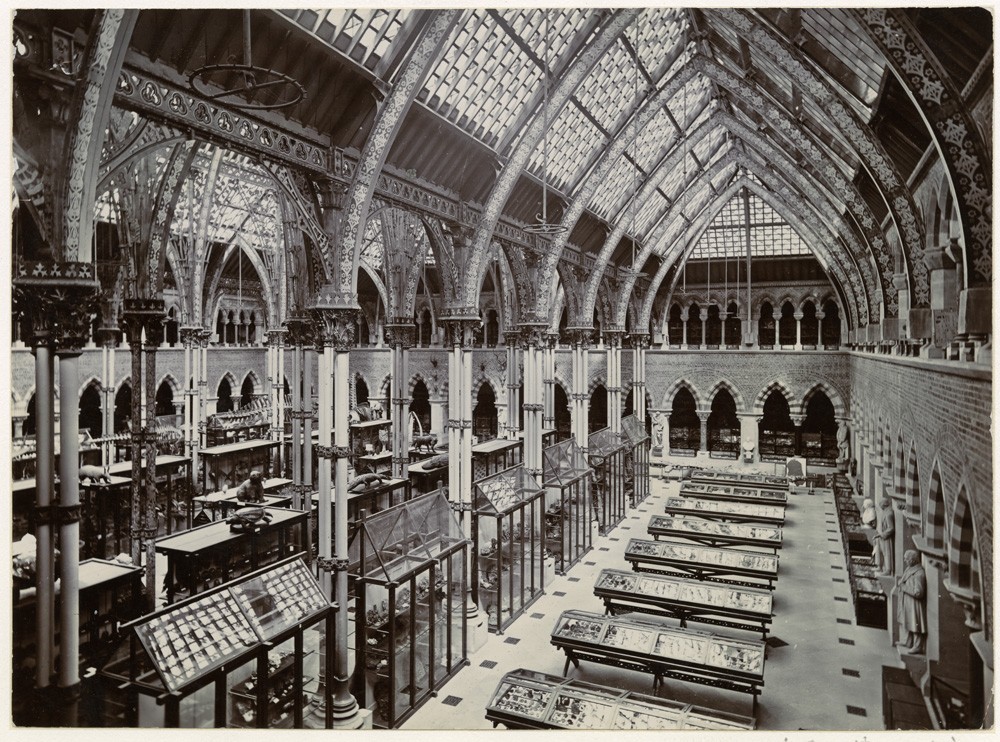
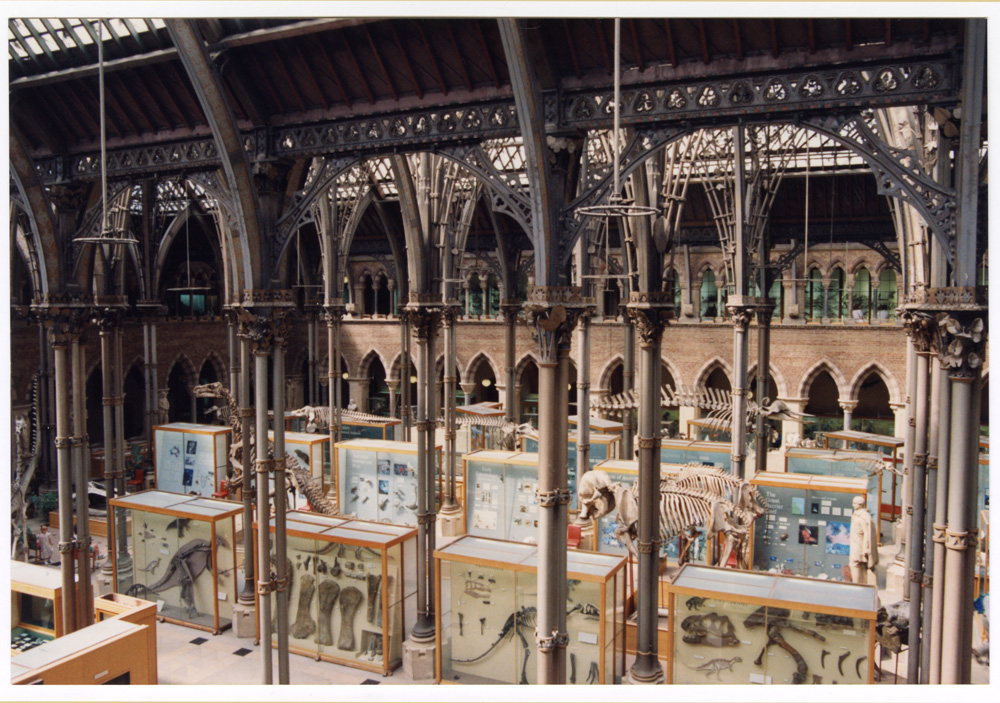
Main Court in 1870s, by Henry Taunt, showing roofed display cases with alternating pitchesMain Court in 1990s, with un-roofed display casesMain Court in 2017 with acrylic roofs re-added to the display cases
As these wooden display cases neared the end of their life, the museum and Oxford University Estates worked with Oxford City Council and Historic England to approve the replacement of the cases and ensure the redevelopment was historically sensitive to our Grade 1 listed Victorian building.
For this reason, the new cases retain the original 1866 arrangement and are built to the same dimensions. We have also returned to the original form, including outer aisle cases with alternating pitched and flat roofs. It was decided early on that the new cases would not be lined in wood because timber can be detrimental to the conservation of certain specimens. However, the design of the edges of the new cases sought to mirror the craftmanship of the 1866 cases by emulating the beading on the edges – albeit much more subtly, and in bronze rather than timber – complementing the colours of the ironwork in the museum roof.
New display cases, photographed in 2024Close-up of bronze beading on the new display cases
A CASE FOR THE FUTURE
The new glass cases are built by museum showcase experts ClickNetherfield and provide a stable, pest-proof environment for our delicate and historically important specimens. Their design artfully captures the character of the museum building, while still focusing the visitor’s attention on their contents. It is hoped that the new displays will last for at least another two decades, and the cases even longer. During that time, millions of eyes will be cast over our displays, but the glass cases that protect them may barely even be noticed.
LEARNING ABOUT ANCIENT FASHION FROM NATURAL HISTORY COLLECTIONS
By Ella McKelvey, Web Content and Communications Officer
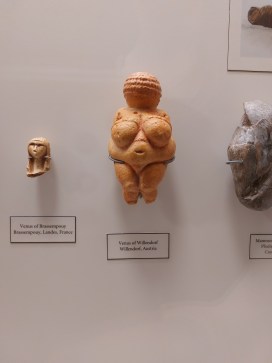
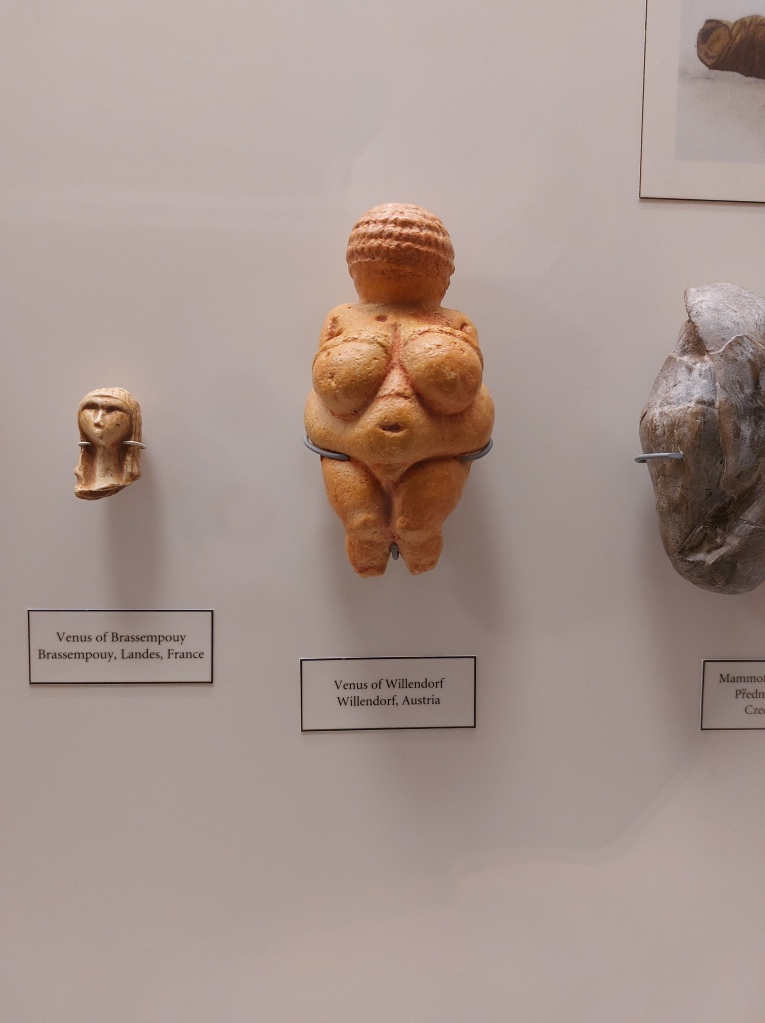
Tucked in a display case in the southwest corner of the Museum is a sculpture of an unidentified female figure, small enough to fit in your coat pocket. It is a replica of one of the most important examples of Palaeolithic artwork ever discovered; a 25,000-year-old carving known as the Venus of Willendorf. The Venus of Willendorf is one of several Palaeolithic statues found in Europe or Asia believed to depict female deities or fertility icons. Known collectively as the Venus Figurines, the carvings are similar in size and subject matter, but each has her own peculiarities. Many are naked, but some of the later examples are wearing distinctive garments, clothes we might describe today as ‘snoods’ or ‘bandeaux’. The Venus of Willendorf is easily distinguished by her statement headpiece; perhaps a spiralling hair-braid or ceremonial wig. But there is another, more exciting interpretation — this strange, thimble-like adornment might actually represent a woven fibre cap, making it the oldest ever depiction of human clothing.
The ‘Venus of Willendorf’ is known for the distinctive markings on her head. Are these the oldest representation of human clothing ever discovered?A cast of the ‘Venus of Willendorf’ is on display in the ‘Ancient Toolmakers’ case in OUMNH.
The Venus Figurines are incredibly important to the study of human fashion because they significantly predate any direct archaeological evidence of ancient clothing. The oldest surviving garment dates back an astonishing 5,000 years; an exceptionally-preserved linen shirt discovered in an Egyptian tomb. But our species, Homo sapiens, has a much longer history, perhaps up to a quarter of a million years. How much of this time have we spent wearing clothing? And why did we even begin to dress ourselves in the first place?
By comparing human genes to those of our furrier primate relatives, researchers have been able to estimate that modern humans lost their body hair around 240,000 years ago. A mutation in a gene called KRTHAP1 likely led to a decrease in our production of the protein keratin, the building block of hair. The exact reason why this mutation spread through the population is still up for speculation. One commonly held theoryis that, with less body hair, our ancestors could sweat and tolerate higher temperatures, allowing them to expand their habitats from sheltered forests into sun-drenched savannahs. But at some stage, our ancestors started covering their skin again — leaving us to wonder when nakedness became a nuisance.
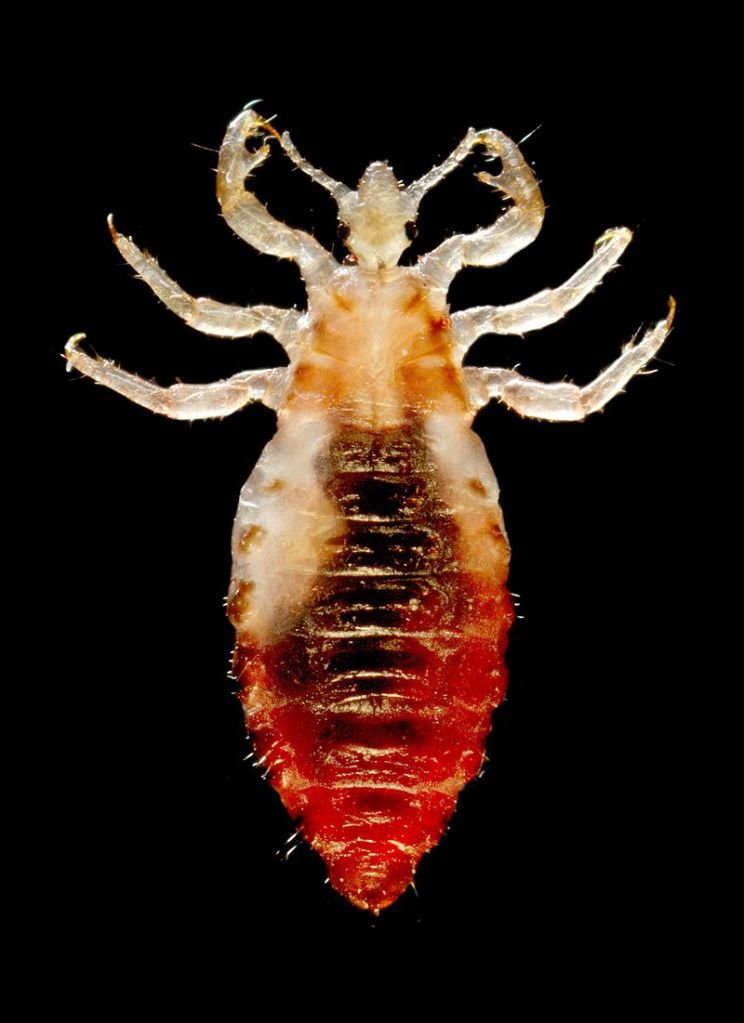
An intriguing clue about the circumstances that led to the adoption of clothing has come from studying the DNA of our parasites — namely, clothing lice. In 2010, researchers used genetic sequencing to determine that clothing lice split from their ancestral group, head lice, between 170,000 and 83,000 years ago. When compared with genetic data from our own species, we can begin to weave a story about the origins of clothing that ties in with human migration. Gene sequencing has helped us work out that Homo sapiens originated in Africa but must have begun migrating towards Europe between 100,000 and 50,000 years ago, a window which overlaps neatly with the evolution of clothing lice. Is it possible that clothing lice are a consequence of the widespread adoption of clothing; a result of humans migrating into more northerly latitudes with cooler temperatures?
Sharp-eyed visitors can spot body lice on display on the First Floor of the Museum.Studying the divergence of clothing lice and body lice allows us to estimate that humans have been wearing clothes for 170,000 years.
Curiously, there are indications in the archaeological record that human clothing could date to an even earlier stage in our species’ history than the expansion of humans into Europe. In 2021, researchers uncovered 120,000-year-old bones from a cave in Morocco believed to be used to process animal hides. There is a strong possibility that humans would have used these tools to make wearable items out of hunted animals, including blankets, cloaks, or perhaps more structured garments.
It seems likely that the first clothes humans made from hides were loose-fitting capes or shawls, which may have been more important for protection or camouflage than keeping warm. There are numerous reasons why other animals cover themselves with foreign objects besides thermoregulation. ‘Decorating’ behaviours occur in animals as diverse as crabs, birds, and insects, allowing them to disguise themselves from predators, or protect themselves from UV radiation. While early humans might have only needed simple clothing items to aid with disguise, as the climate began cooling 110,000 years ago, cloaks probably wouldn’t have cut it; our species must have learned how to make multi-layered and closer-fitting garments to maintain high enough body temperatures. Archaeology provides a similar estimate for the adoption of constructed garments, based on the discovery of 75,000-year-old stone awls — tools used for puncturing holes in hides to prepare them to be sewn together.
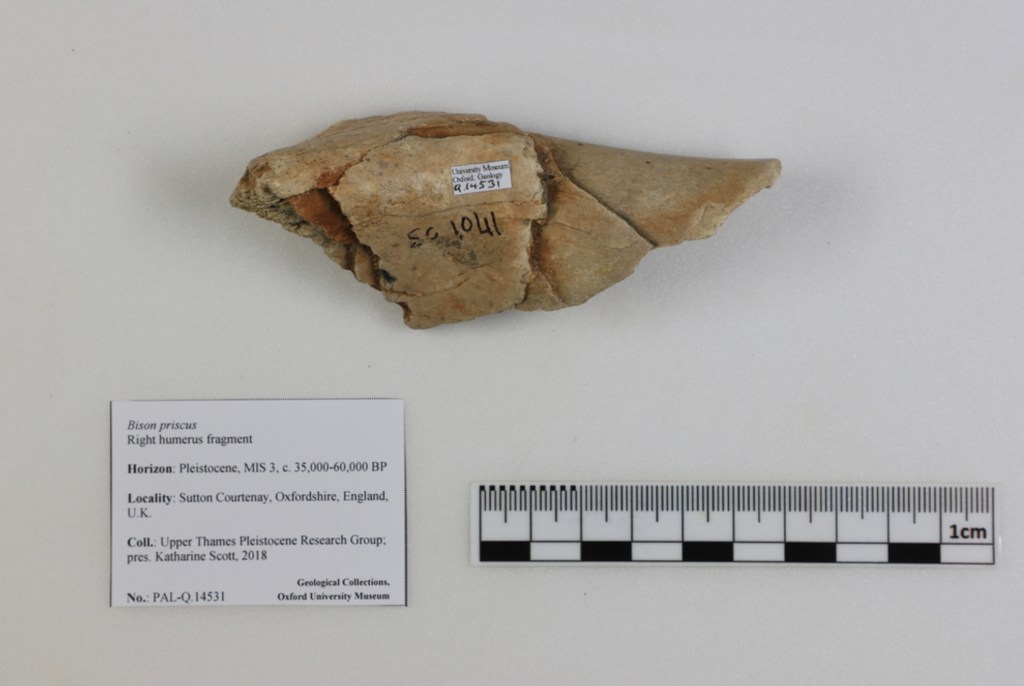
Homo sapiens‘ ability to make complex clothing items may have helped give our ancestors a competitive edge over the Neanderthals in Europe. Researchers have studied sub-fossil material in museum collections to learn about the changing distributions of European mammals throughout human history, allowing them to deduce that Neanderthals only had access to large animals like bison to make cape-like clothing from. But, in addition to bison, Homo sapiens lived alongside other, fluffier animals like wolverines during the last Ice Age, which could have been hunted to make warm trims for our clothing. Studies like these are highly speculative, but with such a threadbare archaeological record, they contribute valuable insight into the landscapes of ancient Europe.
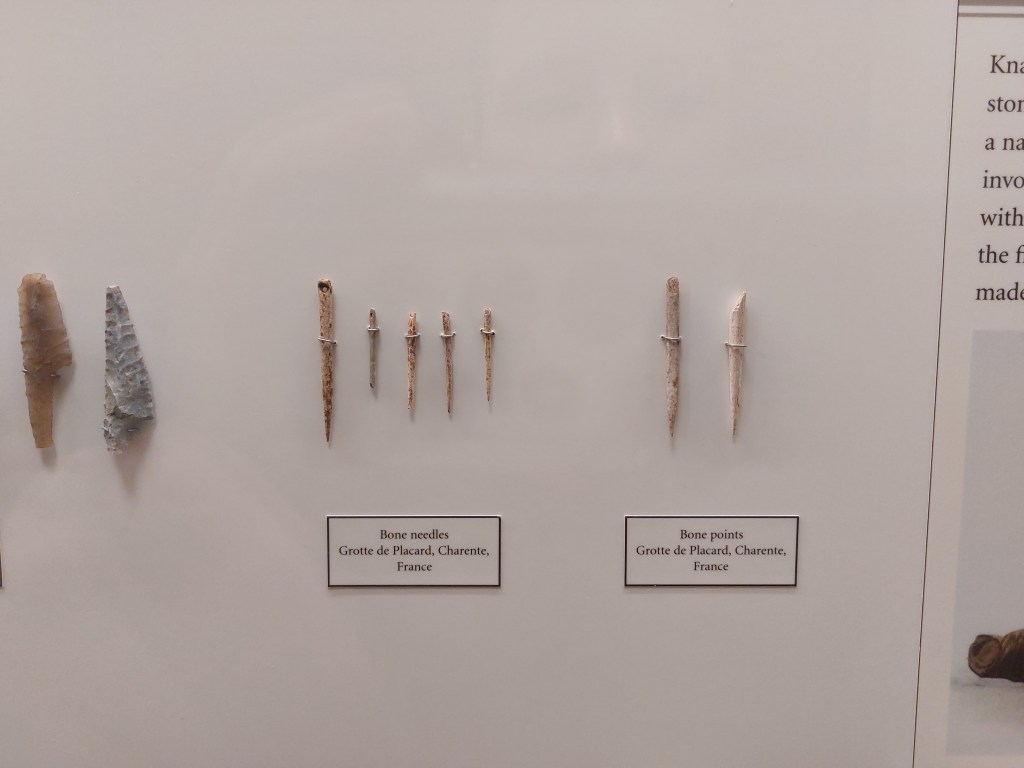
Museum collections can teach us about the species that lived alongside humans in ancient Europe. Homo sapiens and Homo neanderthalis might have used the hides of species like bison to make clothes.On display in the Ancient Toolmakers case are bone needles from the Placard Cave, around 17,000 years old. But huans may have been sewing clothes for much longer, perhaps 75,000 years.
The Neanderthals might have been less well-dressed than our Homo sapiens ancestors, but we can’t be certain that humans of our own species were the only prehistoric fashionistas. The oldest sewing needle to have ever been discovered dates to 50,000 years before present and was actually found in a cave associated with Denisovans — a group of extinct hominins we know little about. The Denisovans may be an extinct subspecies of Homo sapiens, but they might also have formed an entirely separate species altogether, perhaps learning how to sew independently of modern humans.
Following the invention of sewing was another crucial innovation in the history of human clothing — the ability to make textiles. In 2009, a group of researchers discovered 36,000-year-old evidence of textile-based clothing in the form of microscopic flax plant fibres that had been dyed and twisted together. There are many potential uses of twisted fibres such as these, but scientists have been able to study the organisms associated with the fibres, finding the remains of skin beetles, moth larvae, and fungal spores that are all commonly associated with modern clothing. Humans do not simply fashion clothes, we also fashion microhabitats, capable of supporting organisms as diverse as insects, fungi, and bacteria.
The discovery that humans have been making textiles into clothing for 36,000 years lends credence to the theory that the Venus of Willendorf is wearing a woven cap — but we might never be able to draw any certain conclusions about such an ancient artefact. Until just ninety years ago, humans could only make textiles from biodegradable materials, meaning that we have very little evidence about the clothing that our ancient ancestors wore. Thankfully, however, the story of human fashion is closely interwoven with the natural histories of hundreds of other species, allowing us to stitch together a patchwork history, utilising evidence from all corners of the kingdom of life.
Looking through the collections at OUMNH never gets boring, but sometimes a drawer will open up to reveal something even more eye-catching than the fossils usually found inside. Whilst working on the Museum’s Jurassic marine reptiles a few weeks ago, I came across something particularly surprising: a jewel-green box with a fantastic piece of art on the front. I was instantly intrigued and reminded of all the other times I had encountered a holder as fascinating as the specimen inside it.
Storage in museum collections is an ongoing pursuit of balance between ideal environmental conditions, specimen accessibility, and efficient use of space. This balance applies to all levels of storage: from building to room, cabinet to specimen tray. OUMNH’s Earth Collections are stored in conservation-grade, acid-free boxes or trays made of plastic or cardboard. These boxes are sometimes layered with low-density foam or ‘plastazote’ which can be carved to fit the specimen and keep it from being jostled or damaged. Holders with lids can also provide a micro-environment for specimens to help minimise their exposure to changes in humidity and temperature. The use of these standard materials not only helps protect specimens from degradation but can also deter pests from harbouring in collections spaces.
However, historical collections like those at OUMNH may retain holders that are not standard use. Sometimes, a clean and empty plastic Ferrero Rocher box is the perfect size for that small mammal skeleton that needs storing! Other times, an unusual holder might have been the only thing a field collector had on hand to transport a specimen to the Museum.
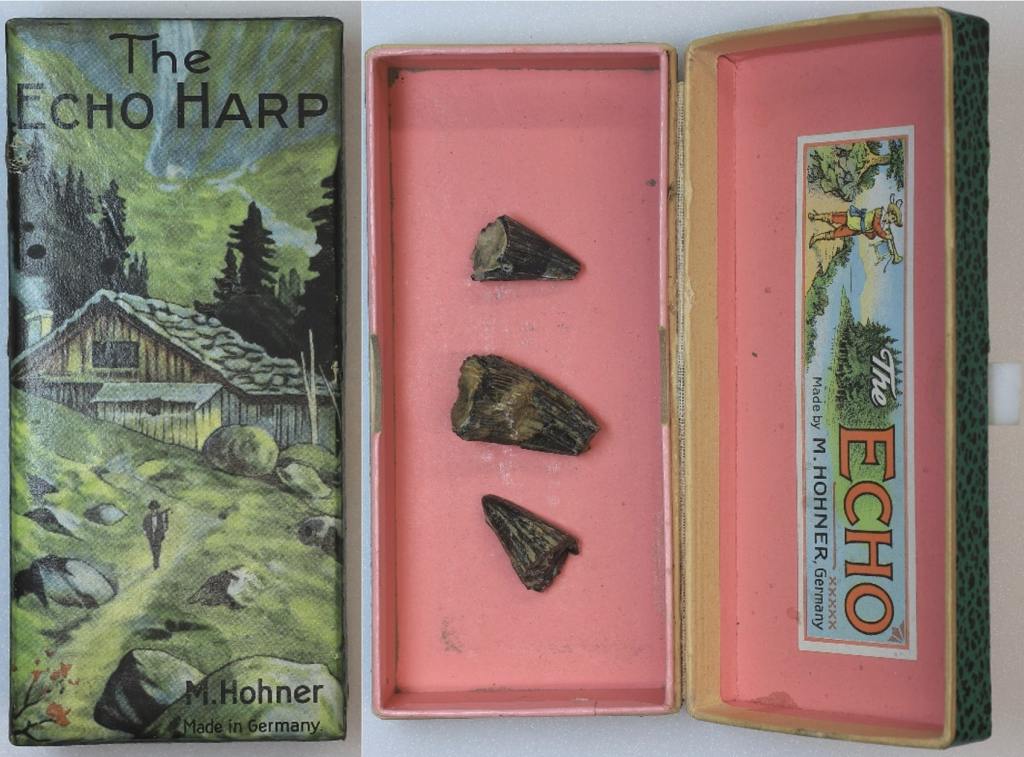
A harmonica box containing pliosaur teeth, a marine reptile that lived during the Jurassic (145.5 million – 201.6 million years ago).
One example of an unusual specimen holder is this ‘Echo Harp’ box by pre-eminent German harmonica manufacturer Hohner, likely from the 1960s. The box no longer holds a harmonica, but instead accompanies pieces of Jurassic pliosaur teeth from Weymouth, Dorset. Pliosaurs were a kind of carnivorous marine reptile related to plesiosaurs, with four flippers, and long tails and necks. If they hadn’t gone extinct in the Cretaceous-Paleogene extinction event 66 million years ago, perhaps they would have come to appreciate the harmonica and its artistic packaging!
Aside from their artistic value, museums may sometimes retain unusual holders because they contain primary source information on the specimen. One such example is a ‘Bryant and May’s Patent Safety Matches’ box in our Earth collections, bearing a packaging design from the early 1900s. The box actually houses a chicken tarsometatarsus bone excavated from “High St. New Schools” in Oxfordshire and is accompanied by a label which describes the particular layer of gravel the specimen was found in — important information for any archaeological or palaeontological find. Although the specimen is stored alongside Pleistocene fossils (10,000 – 2.6 million years ago), chickens did not originate in the UK, so the bone is likely from much more recent times. Someone still must have thought it was important enough to keep in its own special holder!
A Tate and Lyle sugar bag containing a Jurassic specimen, with handwriting on the outside describing the stratigraphy the fossil was found in.
Similarly, this ‘Tate and Lyle Granulated Sugar’ paper bag features a handwritten original notation in blue pen on the outside. The bag originally contained a specimen found in a collection of Jurassic gastropods and bivalves from Somerset, with the handwriting describing the fossil’s stratigraphic information. The bag also features a recipe for cinnamon apples on the reverse, which we have yet to try!
A wooden box and the Quarternary fossils (up to 2.6 million years ago) it originally housed. An accompanying letter describes the delivery of the fossils to William Buckland, Oxford University’s First Reader in Geology.
In addition to primary source information, original holders may also provide specimens with provenance. This ovular wooden box filled with organic stuffing material originally contained Quarternary fossil specimens found in Peak’s Hole, Derbyshire. The Museum archive also holds a handwritten letter describing the specimens inside the package and how they were found. The letter dates to 1841 and is addressed to Oxford University’s first Reader in Geology, William Buckland. The specimen holder forms part of a group of objects with such a strong interconnection, and such strong documentation, that retaining the box is a matter of course.
All in all, it’s great that we’ve come so far in the advancement of safe and stable housing for specimens. At the same time, it’s always fascinating to see what else has made its way into collections, just by nature of being able to hold things, either for a short time or a long one. Despite living in the Earth Collections – among fossils, rocks, and the geological past – these objects offer us a little bit of human history too.
UNEARTHING THE PECULIAR EATING HABITS OF A TRIASSIC MAYFLY SPECIES
During the summer months, the beaches of Mallorca offer an irresistible draw for tourists and palaeontologists alike. Visitors to the small Spanish island find themselves lured by its glittering seas, captivating coastline, and tasty white sands…
…well, tasty for some, at least!
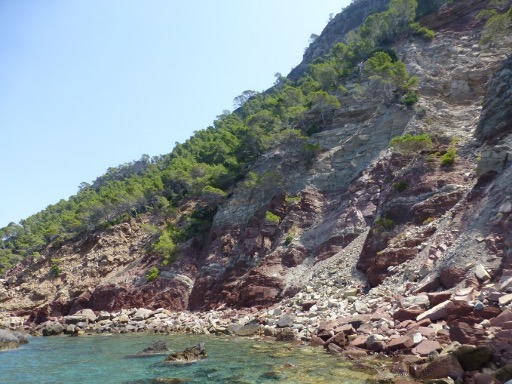
Coastal cliffs near Estellencs (Mallorca, Spain). Palaeontologists working here discovered fossils of Triassic mayfly nymphs with unusual gut contents. (photo: Balearic Museum of Natural Sciences)
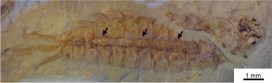
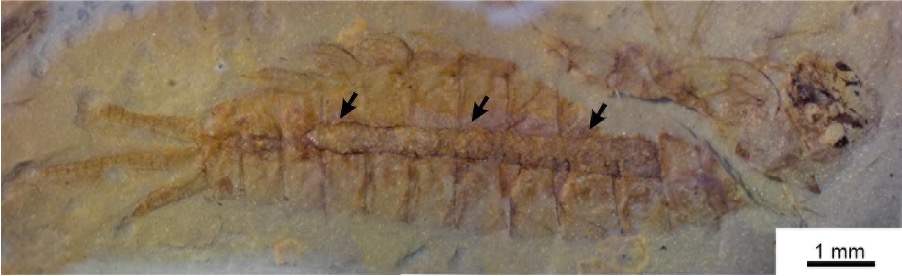
Following recent fossil excavations near the the coastal town of Estellencs in southwest Mallorca, palaeontologists have discovered evidence of a species of mayfly with a pretty peculiar diet. The mayflies in question lived 240 million years ago in bodies of water associated with ancient floodplains. Some of the juvenile mayflies (nymphs) were so well-fossilised that it has been possible to study the contents of their guts. A research team, led by Dr Enrique Peñalver, and featuring OUMNH’s own Dr Ricardo Pérez-de la Fuente, discovered that the mayflies’ digestive tracts contained a mixture of detritus (the decomposed remains of other organisms) and particles of a type of rock known as claystone. The most likely explanation for this strange food-pairing? It seems that the nymphs actually survived by eating muddy sediments that had settled to the bottom of the swampy-waters they lived in – yum!
If you’ve ever tried eating a sandwich on the beach, you’ll be familiar with the feeling of sand in your teeth. The sharp crunch of mineral sediment is worth the sacrifice for the delicious, digestible portion of your sandwich – the bread and fillings. Animal digestive systems are unable to extract energy from inorganic mineral matter, like sand. Instead, we rely on organic material for nutrition, i.e. matter derived from plants and other animals. It seems that the Triassic mayfly nymphs found in Mallorca would have munched through large quantities of sediment; digesting the organic detritus it contained, and excreting the inorganic remainder.
One of the numerous Early Triassic mayfly nymphs from Mallorca preserved with gut contents. These inclusions result from the original sediment the nymphs fed on (cololite, labelled here with arrows). Image adapted from Peñalver et al. (2023).
Sediment-based diets are extremely rare among living insect species. A handful of modern mayfly species have been observed to munch on the muddy sediment that surrounds the openings of their tunnels, but this is a very rare occurrence. Sediment is a pretty challenging food source, and it’s hard to say why insects may have relied more heavily on it in the ancient past. It is possible that the mayflies found in Mallorca adopted their diet as a result of the Permian mass extinction, which killed off more than 80% of all the species on Earth, ‘just’ five million years prior. With fewer choices of organic material available to eat, perhaps the mayflies were left without a better choice? Or maybe they were simply exploiting new environmental niches that opened up in the aftermath of this catastrophic event?
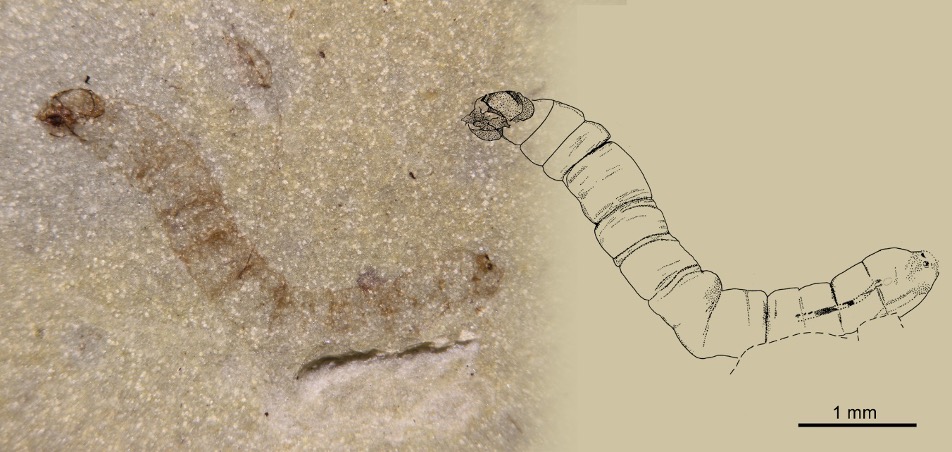
One of the reasons why it is so difficult to theorise about the evolution of species following the Permian mass extinction is the dearth of fossil evidence dating from the period. Luckily, the coastal cliffs of Mallorca can offer us a rare, exciting glimpse into some of the ecosystems that existed ~247 million years ago. The research team behind the Mallorcan mayfly discovery have also used fossils from the same site to describe the world’s oldest-known dipteran (a group of insects including flies, mosquitoes, gnats, and midges), naming the species Protoanisolarva juarezi. These flies would have lived on land, in back swamp areas, rather than in the water. However, much like the Triassic mayfly nymphs, they would have fed on detritus, and played a key role as recyclers of organic matter in these ancient ecosystems.
The larva of the oldest-known gnat, 247 million years old, was found near Estellencs in Mallorca. (Image: CN-IGME CSIC).
It is by paying attention to tiny insect fossils like these that we might hope to find answers to one of the biggest questions in palaeontology: how did life rebuild in the aftermath of our planet’s worst mass extinction? And what might this teach us about ecosystem responses to future mass extinction events?
By Ella McKelvey, Web Content and Communications Officer






 More Than A Dodo