The Dark Edged Bee-Fly

The Dark edged bee-fly, Bombylius major, is one of the most conspicuous insects to emerge in early spring because of it’s large size and ability to hover in mid air. It is the most common species of Bee-fly in the UK and can be seen in woodland, heathlands, grasslands and gardens from February to June. It has several other common names known as the ‘dark bordered beefly’ or ‘large beefly’. They get these names from their large size and from the dark wavy leading edge of their wings.
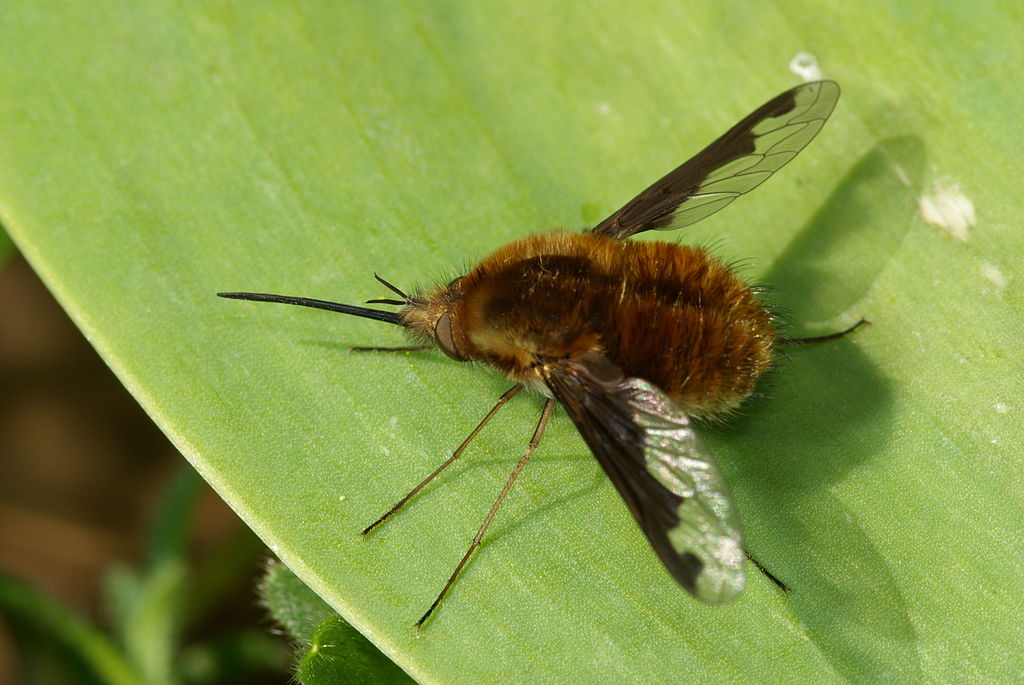
Dark edged bee-fly, Bobylius major. Image credit – Flickr / Jean-Marie Hamon, CC BY-SA 3.0

So, is it a bee or a fly? The single pair of wings tells us that this is a fly. A bee would have two pairs of wings. Why would a fly evolve to look like a bee? We think this is to trick predators into thinking it is more dangerous than it is. It certainly works with humans: many people think that the beefly has a large ‘sting’ at the front. In fact, this is just part the fly’s mouth and is quite harmless. The proboscis is adapted to drink the nectar from a wide variety of early-flowering plants. These include primrose, bugle, blackthorn, and cherry blossom. Because they transfer pollen from flower to flower, they are important pollinators in the spring.
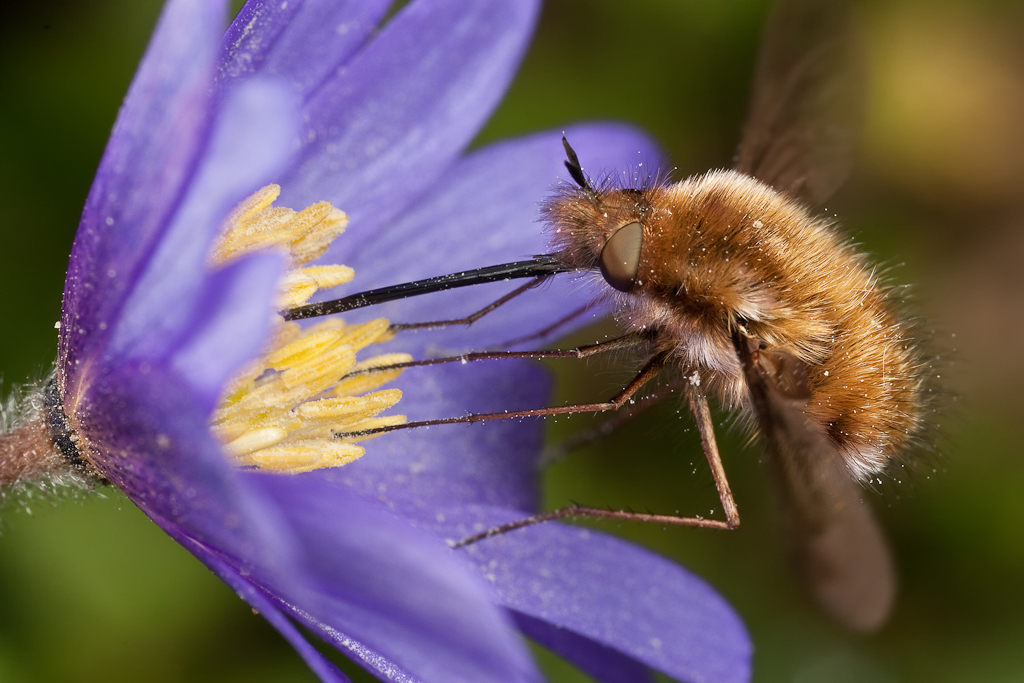
Bee-fly feeding on nectar. You can see pollen grains on its legs and body. Image credit – Flickr / Robert Ault, CC BY-SA 2.0

Bee-flies may be harmless to humans but their life cycle is a bit grisly! Females lay their eggs in the underground nests of solitary mining bee nests such as Clarke’s Mining Bee (Andrena clarkella), the Early mining bee (Andrena haemarrohoa), and the Tawny mining bee (Andrena fulva). They collect sand or dust at the end of their abdomens. This sticks to their eggs, making them heavier. It may also help camouflage them. They then flick their eggs into the nest burrows of the bees. Once the eggs hatch, the bee-fly larvae crawl further down the burrows and wait for the bee larvae to grow until they are near full size. The bee-fly larvae then begin to feed on the mining bee larvae, drinking their body fluids and gradually eating them alive. When they have finished feeding, the bee-fly larvae then pupate and overwinter inside the burrow. The next generation of adult bee-flies then emerges from the burrows the following spring.
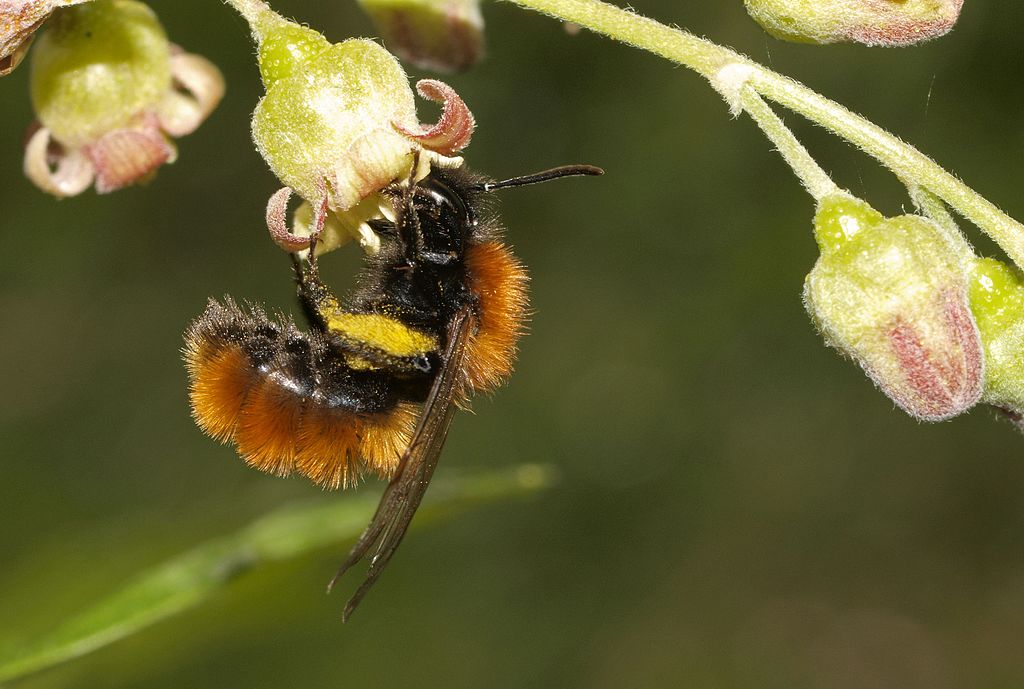
The Twany mining bee, Andrena fulva. Bee-fly larvae feed on its larvae. Image credit – Flickr / Line Sabroe, CC BY 2.0

You might think that means that bee-flies are bad for other bee species, but this is relationship evolved a long time ago and is part of the complex interaction between living things that exists in all ecosystems. Bee flies do feed on individual mining bees, but there is no evidence that they are harmful to bee populations.

If you spot a bee-fly this spring or summer, you can add your sighting to the national database by completing a simple online form on the Bee-fly Watch website. Why not let us know too? You could even take a picture or draw a picture. Who will spot the first bee-fly of 2021?

Butterfly Origami

Have a go at making an origami butterfly. Origami is the art of folding paper into shapes and decorations, that originated in Japan. All you need to make this origami butterfly is a square piece of paper and a spare few minutes:

Here are written instructions for making the origami butterfly, in addition to the video:

  1. Take a square piece of paper. Fold it diagonally, press along the fold, and unfold. Repeat the other way.
  2. Turn the piece of paper over. Fold the bottom edge to the top edge, press along the fold, and unfold. Fold the left edge to the right edge, press along the fold, and unfold.
  3. Fold the left edge to the right edge, allowing the other edges to fold inward along the creases. This will form a triangle shape.
  4. Fold the top layer from both bottom corners of the triangle towards the top corner, but each slightly to either side of that top corner. Press along the creases.
  5. Fold the bottom layer from the top of the triangle towards the bottom flat edge, so that it overlaps a little, and fold it over. Press carefully along the crease, as the bottom “wings” will be drawn up.
  6. Press along the middle crease to help keep the fold over in place.

We would love to see pictures of your creations, please do share them with us.

Welcome to Crunchy on the Outside!

Crunchy on the outside is a new blog for and by young entomologists.

Interested in insects? Perhaps you saw something we posted online, came to the museum, or maybe we visited you at school for an Insect Discovery Day. However you heard of us, if you’re interested in insects this is the place for you!

We’ll be sharing news about insects and the natural world, people who work insects and help to protect them, what goes on at the museum, and new things for you to make and do. Look out for:

  • A peek behind the scenes at the museum
  • Insect related things to make and do
  • Info about people who work with insects, both past and present
  • Cool facts and stories about the amazing insects we can find in this country
  • A chance to have your say regarding what is in this blog and the museum
  • First dibs on related events

Crunchy on the outside is your opportunity to tell us what you would like from the museum, share your ideas and to get involved. We’d love to hear your ideas so please get in touch using the CONTACT US page if there is something you’d like to see.

Crunchy on the outside is part of the HOPE for the Future project at Oxford University Museum of Natural History. The project is funded by the National Lottery Heritage Fund.

Excavating amber

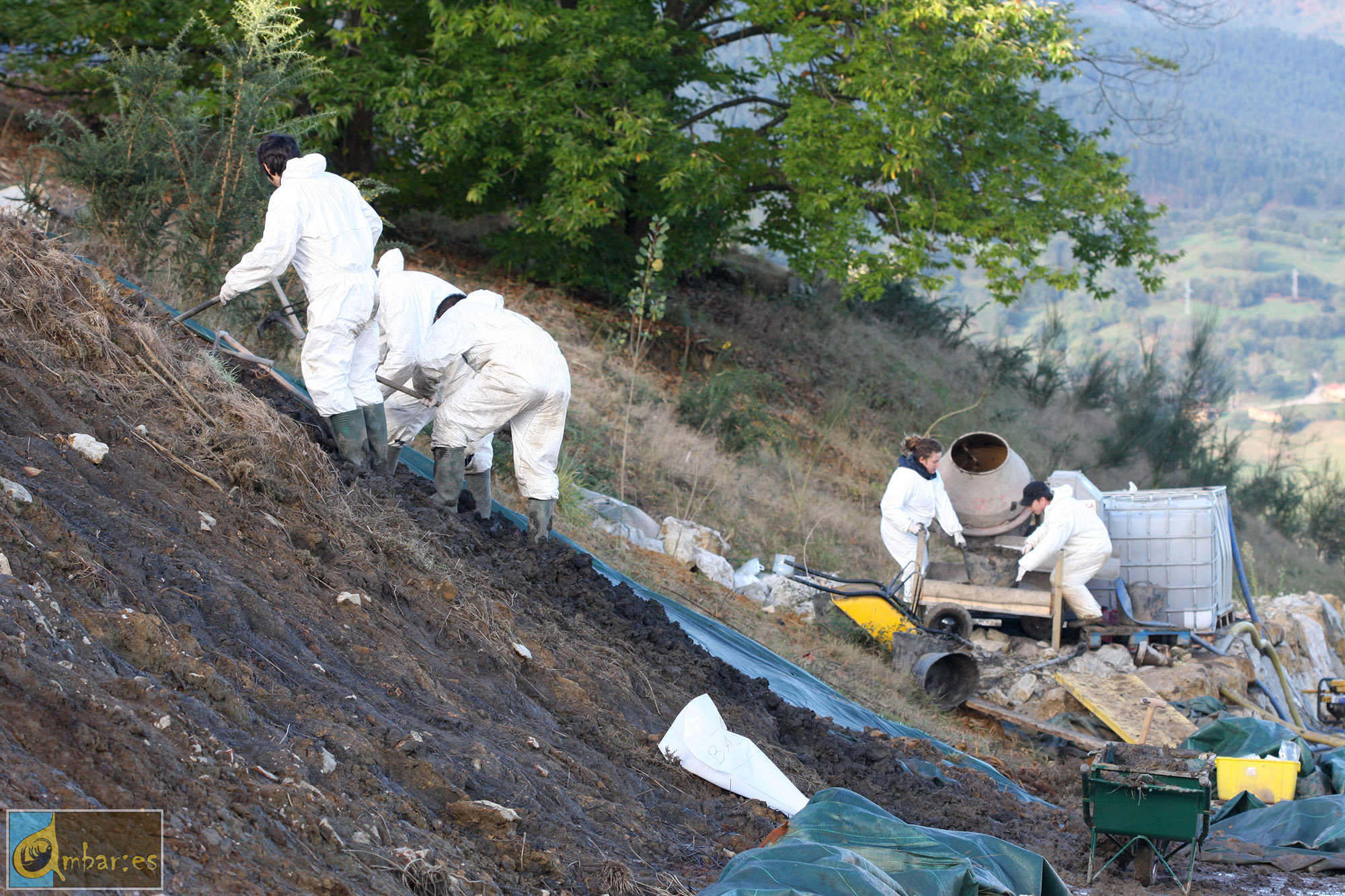
First amber excavation in the El Soplao outcrop, Cantabria, N Spain in 2008. Credit IGME-UB.

By Dr Ricardo Perez-De-La Fuente, Research Fellow

Amber, or fossilised plant resin, is a unique material to learn about the history of life on Earth. Its incredible preservation and ability to capture life “in action” are well known thanks to the Jurassic Park saga, but fewer people know where amber is found, what it looks like in the field, and how it is gathered.

Cretaceous amber, about 130 to 70 million years old, is the oldest amber that provides abundant fossils, specifically insects and spiders. Ecosystems drastically changed during this period due to global greenhouse conditions and the diversification of flowering plants, among other factors. Amber from that time has been discovered in Lebanon, Spain, France, Myanmar, eastern United States, Canada, and northern Russia.

My research team and I carry out regular amber excavations in northern Spain, working in teams of six to ten people. The outcrops that we excavate are often located next to roads and highways because amber is typically uncovered during roadworks. Excavations take place during the summer or fall to try and minimise the risk of rain, and we usually embark on one field trip each year.

The goal is to recover as much amber as possible – usually a few kilograms – from the muddy and sandy sediments. These materials were transported downstream tens of million of years ago by heavy rain and river swellings from the forests where the resin was produced, before being finally deposited in near-shore areas.

Manual extraction of amber. Credit IGME-UB
Manual extraction of amber in the El Soplao outcrop, Cantabria, northern Spain in 2008. Credit: IGME/UB.

I find amber excavations quite romantic. In the field, amber has a dull appearance that makes it difficult to distinguish from rocks or woody remains. This is due to an opaque crust resulting from oxidation in the sediments and other processes.

This outer layer makes detecting potential fossils inside the amber highly unlikely while the excavation is ongoing. So, in the field we just gather as many amber pieces as possible, and hope for the best.

Only when amber is polished – or shows broken surfaces – does its distinct yellowish to reddish shine emerge, and any possible fossils within become evident. Some ambers are highly fossiliferous, while others are very poor in fossils.

Amber can be gathered by hand using regular tools such as hammers. However, the most efficient method to extract amber from soft sediments is with concrete mixers! This rather unsophisticated piece of equipment provides the best way to recover medium quantities of amber in the field.

We charge water and amber-bearing sediments into the mixer, and after stirring for a while amber floats to the top because it is less dense than muddy water. Then, the surface of the water containing the amber is poured into sieves, which separates even the tiniest pieces.

Amber pieces recovered in a sieve after washing
Amber pieces recovered in a sieve after having been “washed” from their sediment. First amber excavation in the La Manjoya outcrop, Asturias, northern Spain in 2017.

After fieldwork, many hours will be spent looking for fossils within the amber and preparing them. Gathering raw amber is just the first part of a process in unearthing the secrets held within – fragments of encapsulated time.

Top image: First amber excavation in the El Soplao outcrop, Cantabria, N Spain in 2008. Credit: IGME/UB.