Fossil-finding

By Jack J Matthews, research fellow

On the southern shores of Newfoundland in Canada lie rocks containing the oldest known evidence of large, architecturally-complex life. Deposited within the Ediacaran Period, some 565 million years ago, these deep marine deposits have been the focus of palaeontological research since the first discovery of fossils there in 1967, and the locality – Mistaken Point Ecological Reserve – now sits in the UNESCO World Heritage list.

As part of my research on these rocks, alongside colleagues from Memorial University of Newfoundland, and the University of Cambridge, I created a new geological map of the area, covering 35 km of coastline in and around the Reserve. As well as providing new insights into the rocks themselves, and what environments they were deposited in, this mapping had an unexpected outcome – the discovery of some totally new fossil sites.

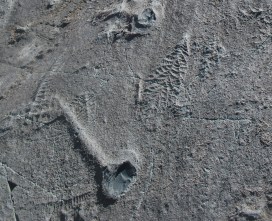
Overview of the Mistaken Point outcrop of the famous ‘E’ Surface

One site in particular, dubbed the ‘E’ surface, is the focus for Ediacaran fossils in Newfoundland. It is an area about the size of three Olympic boxing rings, containing more than 3,000 fossil organisms. Through the mapping we found a number of other outcrops of this same surface, but each shows slightly different types of fossils.

This is a mystery: if all the outcrops are from the same geological surface, why do they show different fossil assemblages?

The clue to the answer came while photographing the fossils and overlying volcanic ash at Mistaken Point, when I heard a loud, deep boom: a freak wave had struck the bottom of the cliff below the outcrop, sending a large splash of salty spray over much of the surface.

This got me thinking – how are processes such as weathering and erosion affecting the fossil surfaces now? Closer observation revealed those outcrops of ‘E’ with pristine beautiful fossils tended to be further from the sea, have a shallower dip, and the overlying ash tended to fall away in little flakes revealing beautiful, crisp, fossils. Other outcrops with scruffy fossils were usually close to the sea, battered by waves and rocks, steeply dipping, and the overlying ash, and often the fossils below it, would gradually abrade away as they are attacked by the sea.
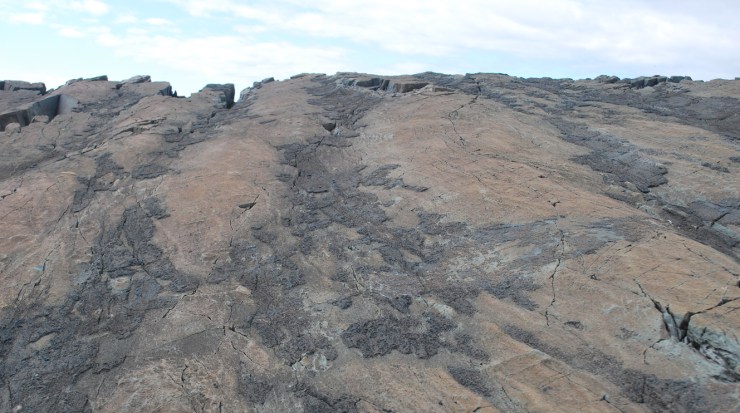
Looking along the ‘E’ surface showing areas still covered in ash (black) and revealed fossil surface (red and grey)

Palaeontologists often discuss how changes during the fossil preservation of an organism can affect what we discover today, but they rarely discuss how processes occurring after preservation – metamorphism, exhumation, weathering, erosion, and even the time, manner, and conditions in which the fossil is recorded – might all affect how we analyse and interpret the original community of life which became fossilised.

Our new paper, published by the Geological Society of London, talks about these Post-Fossilization Processes, and recommends that when researchers are collecting fossil data they consider how their measurements might have been biased by such factors.

For 50 years now, the coastline of Newfoundland has yielded some of the most important finds in understanding the rise of the early life of the Ediacara, and through that the first evidence of animal life. Discoveries over the past few years show there is still much more to be found, and we’ll just have to hope that the post-fossilization processes fall in our favour to allow for many more significant discoveries.

The ‘birth’ of dinosaurs

by Hilary Ketchum, Earth Collections manager

In April 1842, 175 years ago this year, the dinosaurs were created – in a taxonomic sense at least. In a landmark paper in the Report for the British Association for the Advancement of Science, Richard Owen, one of the world’s best comparative anatomists, introduced the term ‘Dinosauria’ for the very first time.

Owen coined the term using a combination of the Greek words Deinos, meaning ‘fearfully great’, and Sauros, meaning ‘lizard’, in order to describe a new and distinct group of giant terrestrial reptiles discovered in the fossil record. He based this new grouping – called a clade in taxonomic terms – on just three genera: Megalosaurus, Iguanodon, and Hylaeosaurus.

In the Museum’s collections are some specimens of those three original dinosaurs, collected and described during this exciting early period of palaeontology. These discoveries, amongst others, helped to revolutionise our understanding of extinction, deep time, and the history of life on earth, and paved the way for the theory of evolution by natural selection.

Megalosaurus

The right lower jaw of Megalosaurus bucklandii from the Taynton Limestone Formation, Middle Jurassic, Oxfordshire, UK. OUMNH J.13505.

A nine metre long, 1.4 tonne carnivore that roamed England during the Middle Jurassic, about 167 million years ago, Megalosaurus has the accolade of being the world’s first named dinosaur. It was described by William Buckland, the University of Oxford’s first Reader in Geology, in 1824, and was discovered in a small village called Stonesfield, about 10 miles north of Oxford. The toothy jawbone of Megalosaurus is on display in the Museum.

The sacrum of Megalosaurus. One of the characteristics that made Richard Owen realise dinosaurs were a distinct group was the presence of a sacrum with five fused vertebrae, visible here in the specimen on display at the Museum.

Iguanodon
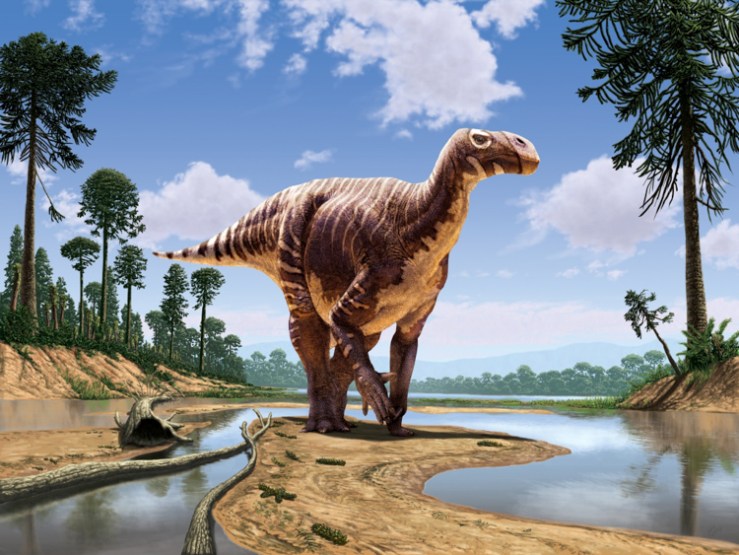
Iguanodon was a plant-eating reptile with a spike on the end of its thumbs, and teeth that look like those of an iguana, only 10 times bigger! Iguanodon lived in the Lower Cretaceous, around 130 million years ago and was named by Gideon Mantell in 1825.

When first discovered, Iguanodon’s spike was thought to go on its nose, like a rhinoceros or a rhinoceros iguana, rather than on its thumb, which is rather unique. In fact, we still don’t know why Iguanodon had such prominent thumb spikes.

Tooth of Iguanodon from the Wealden Group, Lower Cretaceous, Cuckfield, Sussex, UK. Gideon Mantell Collection. OUMNH K.59828.
The Iguanodon’s spike was first thought to go on its nose, rather than on its thumb. A paper label attached to the specimen reads, “Cast of the Horn of the Iguanodon, from Tilgate Forest; in the possession of G. Mantell, Castle Place, Lewes.”

Hylaeosaurus
A squat, armoured, plant-eating dinosaur with long spines on its neck and shoulders. It is the least well known and smallest of the three dinosaurs originally described, but arguably the cutest. Hylaeosaurus was also named by Gideon Mantell, in 1833.

A dorsal spine, probably from the holotype of Hylaeosaurus armatus from the Wealden Group, Lower Cretaceous, Sussex, UK. OUMNH K.59799. Accompanying label in Gideon Mantell’s handwriting.

The exact specimen used by Mantell to describe Hylaeosaurus armatus is in a big block of rock in the Natural History Museum in London. But recently I spotted a specimen in our collections that Mantell had sent to William Buckland in 1834. It has the following label with it, written by Mantell himself:

Extremity of a  dorsal spine of the Hylaeosaurus from my large  block –

Perhaps Mantell just snapped a bit off to send to his friend. Or perhaps more likely, it was one of the broken fragments Mantell said were lying near the main block when it was dug out of the ground.

*

From just three genera included in Dinosauria in 1842, we now have around 1,200 species nominally in the group. The study of dinosaurs has come a long way since those early days; new finds, new technologies, such as micro CT scanning and synchrotron scanning, and new statistical techniques are helping us to better understand these iconic animals and re-evaluate older specimen collections.

The Museum’s dinosaur specimens are exceptionally historically important, but are still used heavily by scientists from across the world for their contemporary research. This is something that I think William Buckland, Gideon Mantell and Richard Owen would be very pleased about.

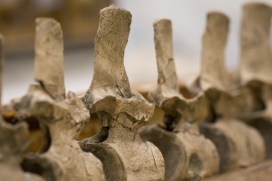
Cetiosaurus fossil bones on display in the Museum

The one that got away…
Although Owen didn’t know it, other dinosaurs were known in 1842, including Cetiosaurus, the ‘whale lizard’. When Owen named it in 1841, he thought it was a giant marine reptile that ate plesiosaurs and crocodiles. By the following year, he suggested it was actually a crocodile that had webbed feet and used its tail for propulsion through the water.

It wasn’t until 1875, after more substantial remains had been found that Owen recognised Cetiosaurus as a land-living sauropod dinosaur. Interestingly, however, research published last month presented a new hypothesis for dinosaur relationships which, if the previous definition of Dinosauria had been adhered to, would have placed all sauropods outside of the group. So perhaps Owen’s earlier omission wasn’t so wrong after all.

Nature’s medals

By Sarah Joomun, Documentation officer

In the 1820s a young geologist named Charles Lyell travelled around France studying the landscape and rock formations to try and work out the processes that created them.

In between these field-trips, he met the people who had been studying the geology of France and from these discussions and his observations he created The Principles of Geology, one of the first significant popular science books on the subject and a foundation for the methods of modern geology.

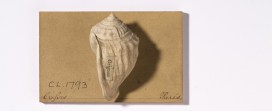
pal_cl01718_01

Lyell collected many samples from the rocks he studied, amassing thousands of fossils during his lifetime. The Museum has a collection of some 16,000 of them, around 90 per cent of which are shells, mostly gastropods (snails) and bivalves (clams), many collected during his travels in France.

The reason for this prodigious collection of fossil shells, or testacea as they were then known, was that Lyell believed them to be the most useful clue to understanding the Earth’s history.

The testacea are by far the most important of all classes of organic beings which have left their spoils in the subaqueous deposits : they are the medals which nature has chiefly selected to record the history of the former changes of the globe.

– Lyell’s Principles of Geology, Vol III, 1833.

Fossil shells can show how the animal that lived inside the shell behaved, and whether it lived on the land, in freshwater or in the sea. Species of shelled animals have a wide geographical range and individual species survive for a long time, so they can be compared across time and space.

pal_cl01742_02

This allowed Lyell and his colleagues to determine the relative ages of the rock layers that the fossil shells came from. He looked at the proportion of shells that belonged to living species and determined that the rock layers with the lowest proportion of living species were likely to be older than rocks with higher proportions of living species.

And so three main groups of rock layers were found: the Eocene, containing fewer than 4% living species; the Miocene, with fewer than 18% living species; and the Pliocene, with more than a third of living species.

Although what is now known as the Eocene (from 56 to 34 million years ago), Miocene (23 to 5.3 million years ago) and the Pliocene (from 5.3 to 2.6 million years ago) don’t denote exactly the same periods as Lyell described, we still use these terms for some of the youngest geological epochs today.

Tales from the Jurassic Coast

marybuckland_philpot_2

Britain’s Jurassic Coast is a famous location for fossil hunters. Dorset’s Lyme Regis in particular was a collecting ground for two very important Victorian palaeontologists – Elizabeth Philpot (1780-1857) and Mary Anning (1799-1847) – and the site yielded some of the earliest specimens of Ichthyosaurs and Plesiosaurs.

Last weekend Channel 4’s Walking Through Time series focused on the Jurassic Coast and featured two members of staff from the Museum, Eliza Howlett and Hilary Ketchum from our Earth Collections. To coincide with the programme, Eliza here delves into the Museum’s Philpot archive to paint a picture of the relationship between Elizabeth Philpot, Mary Anning, and Oxford University’s first Reader in Geology, William Buckland.

*

Elizabeth Philpot moved to Lyme Regis around 1805 with two of her three sisters, Mary and Margaret, where they soon became involved in fossil collecting and where they remained for life. At this time Lyme-born Mary Anning was still a young girl, but so began an affectionate relationship with the Philpot sisters which transcended any barriers of age, social origins or educational background.

Caption
A letter from Elizabeth Philpot to Mary Buckland dated 9 December 1833.

As the Philpots’ fossil collection grew it became known in the geological community. One familiar visitor was William Buckland, whose earliest published reference to the ‘Miss Philpots’ is in his 1829 paper on the pterosaur found at Lyme by Mary Anning.

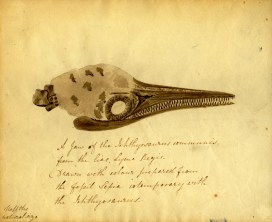
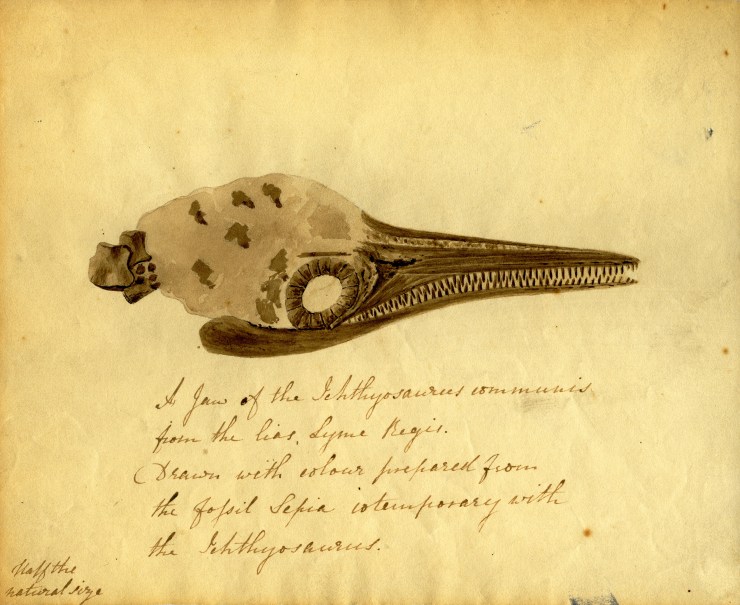
In one letter to Buckland’s wife, Mary, dated 9 December 1833, Elizabeth Philpot enclosed a sketch of an ichthyosaur head that she had painted using ink from a fossil squid of the same age as the ichthyosaur, 200 million years old; this is pictured at the top of the article. The letter also contained a colourful description of Mary Anning’s escapades:

Yesterday [Mary Anning] had one of her miraculous escapes in going to the beach before sun rise and was nearly killed in passing over the bridge by the wheel of a cart which threw her down and crushed her against the wall. Fortunately the cart was stopped in time to allow of her being extricated from her most perilous situation and happily she is not prevented from pursuing her daily employment.

Next, it sends a reminder to William Buckland, a man well-known for forgetting things:

May I beg you to remind Dr. Buckland that he has borrowed from me some Plesiosaurus vertebre. As it is some time since I will mention that it is a section of a vertebre, one with the process, ten others, and a chain set in a box.

These letters from Elizabeth Philpot are now held by the Museum, along with the Philpot collection of around 400 fossils. Mostly from Lyme Regis, this collection includes more than 40 type specimens, the reference specimen for a new species, which is a remarkable total for any collector. A brief list of people known to have examined the collection is practically a roll call of the key figures in 19th-century palaeontology: William Buckland, William Conybeare, John Lindley and William Hutton, Richard Owen, James Sowerby, and (from Switzerland) Louis Agassiz.

But the collection was also made available to the ordinary people of Lyme, and the handwritten labels by Elizabeth Philpot sometimes included detailed explanations of what these extinct animals would have looked like. Both the letters and the specimens remain deeply evocative today, conjuring up visions of what it must have been like to call on these three remarkable sisters.

Because of the risk of light damage the material is not normally on display, but it can be viewed by appointment. Email library@oum.ox.ac.uk or earth@oum.ox.ac.uk for more information.

A plesiosaur named Eve

A Spotlight Specimens special for Oxford Festival of Nature

by Juliet Hay, Earth Collections preparator and conservator

I feel myself very lucky to have a job that involves working with the fossil remains of long-extinct animals. One of the things my colleagues and I are currently working on is a plesiosaur – a marine reptile that lived in the sea millions of years ago.

This particular specimen was found in a clay pit near Peterborough by members of the Oxford Clay Working Group in 2014, and is a near-complete example of its kind. The palaeontologists who found the specimen named it Eve, although we don’t know if it was male or female, and perhaps never will.

The discovery of large fossil vertebrates like this is rare, so we are fortunate to have had the specimen donated to the Museum by the quarry owners Forterra.

Juliet at work on the plesiosaur skull

The plesiosaur is 165 million years old and, when alive, was around 5.5 metres long. It had a long neck, a barrel-shaped body, four flippers and a short tail. The find is particularly exciting as the skull was also discovered. It is encased in a clay matrix, which is relatively easy to remove, but the work has to be carried out under magnifying lenses and microscopes.

As the skull is quite small relative to the size of the body, the features are very delicate and it is a painstaking process to remove the sediment without damaging the fossil bone or losing any tiny fragments. Fortunately, pictures of the skull have been produced using CT scanning technology, and the images are proving invaluable as an aid to assist in its preparation. It’s a bit like having a jigsaw puzzle with the picture on the lid to refer to!

sdfsd
A belemnite hooklet at 12x magnification, found with the plesiosaur remains and possibly part of Eve’s last meal

The clay covering the skull is being sieved and examined and tiny hook-shaped fossils have been found. These came from the arms of squid-like creatures called belemnites, which may have formed a large part of the plesiosaur’s diet.

It is too early to say for sure, but Eve could represent a species new to science, as some features, such as the shape of the flipper bones and some of the surfaces of the bone in the skull, are quite unusual. Further research needs to be done before the findings can be published in scientific journals – watch this space.

And if you’re visiting the Museum before 25 July, you can see some of the fossilised remains of Eve for yourself, in our Presenting… display case.

OFoN_logo_green block_small