Paint it green

In the process of researching or conserving old pinned insects, it’s common to find a green deposit clustered around the pin. This is known as verdigris and is a natural patina created when the metal oxidizes over time. Katherine Child is Image Technician in the Museum’s Life collections and takes photos of insects for researchers, students, artists and publications. She is also an artist in her own right, so when she witnessed verdigris being removed during a conservation project, she came up with an inspired idea.
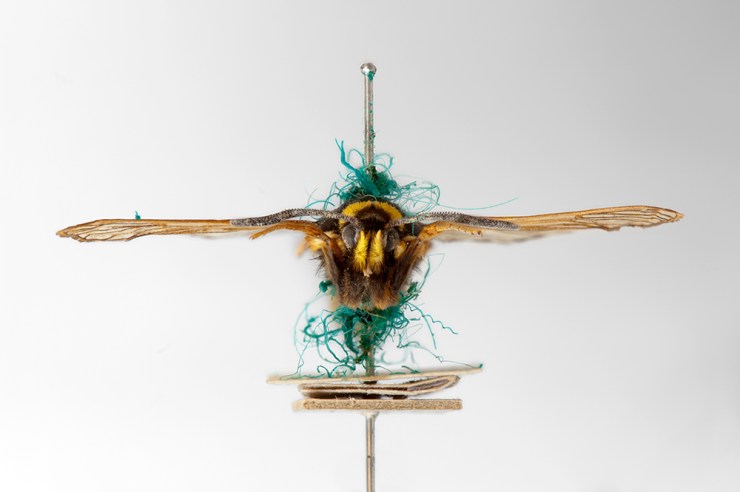
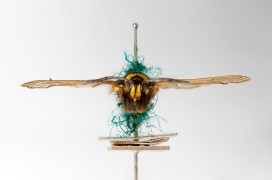
A clearwing moth before conservation, showing verdigris spreading where the metal and the insect fats, or lipids, react.

A few years ago I read a book called Colour: Travels Through the Paintbox, by Victoria Finlay, and was interested to learn that verdigris was once used as a pigment. Verdigris, which I now know translates from French as ‘Green of Greece’, is a word that’s been in my vocabulary since I was small.  I loved its rich bright blue-green colour, which is often seen on old copper piping or copper statues.

Verdigris forms when copper or a copper alloy reacts with water, oxygen, carbon dioxide or sulphur.

L: Three years’ worth of verdigris, ground and ready to make into paint.
R: A second attempt at mixing the paint, this time using linseed oil.

As early as 5thcentury AD, it was used in paint-making, and until the late 19th century it was the most vibrant green pigment available. But it was unstable – Leonardo da Vinci warned that it ‘vanishes into thin air if not varnished quickly.’ These days synthetic pigments provide a more constant alternative.

Despite its past uses, verdigris is a big problem in pinned insect collections. Nowadays stainless steel pins are used, but pins containing copper still remain in old collections and these react with air and insect fats. The more fatty the insect, the more verdigris tends to form and, if left, it can damage a specimen irreparably.

Comprising around five million or so insects, the Hope Entomological Collections here in the Museum take quite a bit of looking after. A few years ago a project to catalogue and conserve many of its butterfly and moth specimens was undertaken and the removal of verdigris and repining of insects was part of this.

With paint-making in mind, I asked that the beautiful, but problematic, substance be saved.  About three years on I finally got around to using the pigment, which I had also been adding to while photographing the collections.

I chose a variety of differently shaped moths to paint (most of the verdigris came from moths, so moths seemed the most apt subject). To narrow my options further I went for green moths. Some of the specimens I chose had verdigris on their pin, so I was able to take pigment and use it to paint the very specimens from which it came!

Katherine tested out the newly made verdigris paint in her sketchbook.

After a first failed attempt to make watercolour paint (during which pigment and water remained stubbornly separate due to the greasy insect fats still present), I tried again, this time using linseed oil to make oil paint – and it worked! Traditionally a flat bottomed tool called a muller was used to press pigment into the water or oil. Not having one of these, I used the flat end of a pestle and a mortar which did the trick.

A Miscellany of Moths, the finished verdigris painting.

The paint went surprisingly far and, following on from the 14 green moths, I plan to use up the remainder to paint beetles.

Katherine’s Miscellany of Moths painting can be seen on display in the Museum’s Community Case until 18th October.

A photographer’s eagle eye

3-landing-on-snow-800px

To coincide with our display of the Oxford Photographic Society‘s annual show, here Society member Ron Perkins recounts how he captured these great shots of the magnificent Bald Eagle.

Bald eagles, the national birds of the USA, are charismatic, powerful creatures. Young eagles are tawny brown but acquire their majestic black plumage, with white heads, after two years.

In early winter the Alaska Chilkat Bald Eagle Preserve attracts up to 3,000 eagles which pause on their seasonal migration to the south in order to feed on the salmon that swim up the river to spawn.

2-eating-salmon-800-px
A Bald Eagle eating salmon on the river bank

Having discovered this photo opportunity via the internet I easily recruited three Oxford Photographic Society members to travel to Alaska. The journey took two and a half days via Seattle and Juneau by air and on to the small town of Haines by an 80-mile ferry trip.  Haines is near the Pacific coast so although there was snowfall most days the daytime temperatures were about -5C.  Each day we drove 20 miles along the banks of the river to the best photographic locations to get our shots.

4-adult-attacking-800px
An adult eagle attacking a juvenile

After spawning, the fish die in the shallows at the edges of the river. Then the eagles drag the dead salmon onto the snow-covered banks. The fish weigh up to 15 pounds so moving them is difficult; some adult eagles watch juvenile birds moving the salmon onto the riverbanks and then attack to drive away the juveniles.

1-noticeboard-800px
Arriving at the preserve

Eagles always attack into the wind, so it is easy to plan and position yourself to capture these shots. And the combination of large numbers of eagles with frequent dramatic action is a powerful attraction for wildlife photographers.

Oxford Photographic Society’s Natural World exhibition runs until Sunday 22 January in the Museum’s Café Gallery.


Making Microsculpture

Microsculpture

Today we are excited to be opening our new special exhibition, Microsculpture: The Insect Photography of Levon Biss. You may well have already heard about Microsculpture, and have perhaps watched the video showing how Levon Biss made these incredible portraits of insects from the Museum’s collection.

As we open the show in the Museum’s main court we wanted to give a little more insight into the process that Dr James Hogan, an entomologist in our Life Collections, went through to select and describe the specimens for the project. So I put a few questions to James to explain the making of Microsculpture from his point of view.

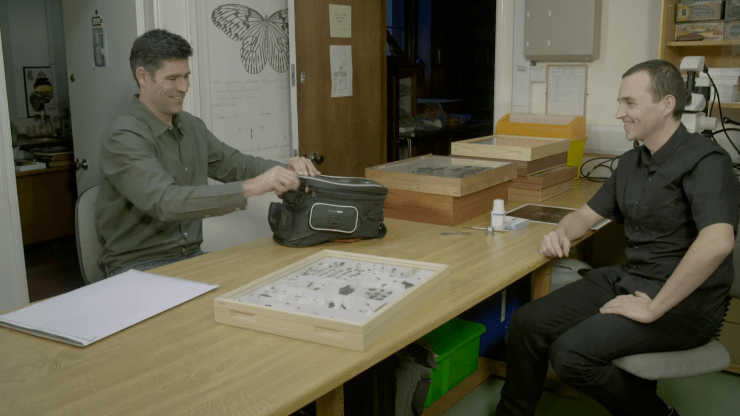
James Hogan (right) selecting specimens with Levon Biss

There are 23 specimens on show in the exhibition: how did you choose these particular ones?
We wanted a wide variety of specimens that would all show some interesting surface detail. Some were also chosen for their spectacular colours, interesting shapes or strange appearance.

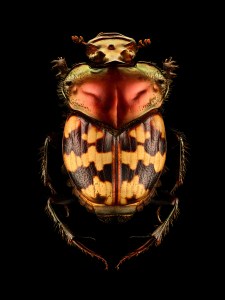
Splendid-necked Dung Beetle (Helictopleurus splendidicollis). From Madagascar. Length: 10 mm
Splendid-necked Dung Beetle (Helictopleurus splendidicollis) from
Madagascar. Length: 10 mm

But perhaps 95 per cent of the specimens we initially considered were rejected because we had some pretty strict criteria; very hairy specimens, which includes most bees, were out as the image processing was too difficult; the specimens had to be intact, so no broken antennae or legs.

Probably the biggest problem was finding specimens which were clean enough. Because Levon’s technique reveals so much detail, any dirt on the specimen is glaringly obvious. And the whole idea was to look at the surface structures, which are obviously very small and easily obscured by any dirt.

How did you prepare them for their close-ups?
All the specimens needed a bit of preparation work before being ready for Levon’s photography. First they needed to be remounted on the end of long pins to allow more clearance space for the lighting setup. Some of the specimens are very small and fragile and this is the stage where damage is most likely to occur.

After remounting, all the insects needed at least some degree of cleaning under the microscope. For this I used a range of fine paintbrushes; we also make our own tools from micro-pins bent into different points and hooks. Again, I had to be careful to not damage the specimens – easily done by over-enthusiastic cleaning!

Where do the specimens come from?
The specimens in the exhibition are from the Museum’s very large insect collection, stored behind the scenes in many different rooms. The insects in the show are from all over the world, from a back garden in England to a remote island near Antarctica. Some were collected over 150 years ago while others were collected very recently by Museum staff.

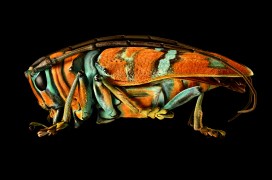
Of particular historical significance is the Tricolored Jewel Beetle (Belionota sumptuosa) which was collected by the Victorian naturalist and explorer Alfred Russel Wallace, co-publisher of the theory of evolution with Charles Darwin in 1858.

Tricolored Jewel Beetle (Belionota sumptuosa), collected by Alfred Russel Wallace in Seram Island, Indonesia. Length: 25 mm
Tricolored Jewel Beetle (Belionota sumptuosa), collected by Alfred Russel Wallace in Seram Island, Indonesia. Length: 25 mm

How big are the actual specimens in comparison with the photos?
The actual specimens are mostly pretty small, ranging from 6 mm to about 30 mm. Some of the larger printed photographs will be about a thousand times larger than the specimen!

Orchid Cuckoo Bee (Exaerete frontalis) from Brazil. Length: 26 mm
Orchid Cuckoo Bee (Exaerete frontalis) from Brazil. Length: 26 mm

What do you hope people will get out of the pictures in the exhibition?
To me insects are beautiful creatures and Levon has done an outstanding job of revealing this. I hope the photographs will spark people’s interest in insects and inspire more people to study them.

The photographs certainly pose some interesting questions, and reveal that there is so much we don’t know, particularly about the functions of all their strange and varied adaptations.

Is it valuable to showcase specimens from the collections in this way?
One of the most exciting parts of this exhibition for me was the opportunity to show part of the Museum’s collection which visitors don’t normally see.

The collection is used all the time by scientists, artists and educators, but unfortunately most of it is unsuitable for display because the specimens are so small. Levon’s ultra-high resolution photography has in a way solved this problem, allowing us to showcase some of these spectacular, but tiny and fragile creatures in all their beauty.