
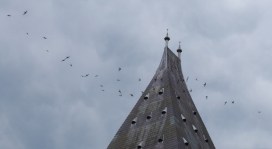
Image: (c) Mark Garrett

All hail the swift

Image: Maciej Szymański

By Chris Jarvis, Education Officer

This week is Swift Awareness Week and that means it’s time to celebrate our screaming summer visitors – the avian ones, that is.

Here at the Museum we eagerly await the return of these long distance migrants each May. This is not only because for many of us they herald the start of summer, but also because the swifts that nest each year in the Museum tower are part of the longest-running continuous study of any bird species in the world.

Taking the long view of these amazing birds we know that, like all birds, they evolved from a particular group of dinosaurs. Birds, in effect, are living dinosaurs. The earliest fossil swift, the ‘Scania Swift’, is around 49 million years old and shows us that by this time they had already evolved in forms that are virtually indistinguishable from today’s birds. Today, they have diversified into around 100 different species including our Common Swift (Apus apus).
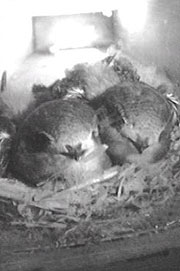
Swifts in the tower nests as seen on webcam
Swift chicks in a nestbox in the Museum tower, shown on the webcam feed

Swifts have taken life on the wing to the extreme. Not only are they the fastest recorded bird in level powered flight, reaching speeds of nearly 70mph, but once launching themselves from the nest that they hatched in they may not land for the next two years of their lives!

They are so adapted to life in the air that they are capable of eating, mating and even sleeping on the wing. During sleep, it is thought that the two hemispheres of the brain take it in turns to nap as the swift slowly circles at heights of up to 30,000 feet. They do not even land to collect nesting material, instead relying on whatever feathers or pieces of plant material are floating in the air to build their nests.

During this two-year flight they will follow their food – the seasonal blooms of flying insects that appear after summer rains – on a 14,000 mile annual migration to southern Africa and back, living in perpetual summer.

Whilst for a long time scientists thought swifts were closely related to similar looking birds, swallows and martins, DNA analysis has revealed that they are the product of another amazing type of evolution – called convergent evolution – where organisms with similar lifestyles independently evolve similar traits. It turns out that whilst swifts may look like swallows, they are actually more closely related to hummingbirds; swallows, on the other hand, are more closely related to kingfishers than to swifts.
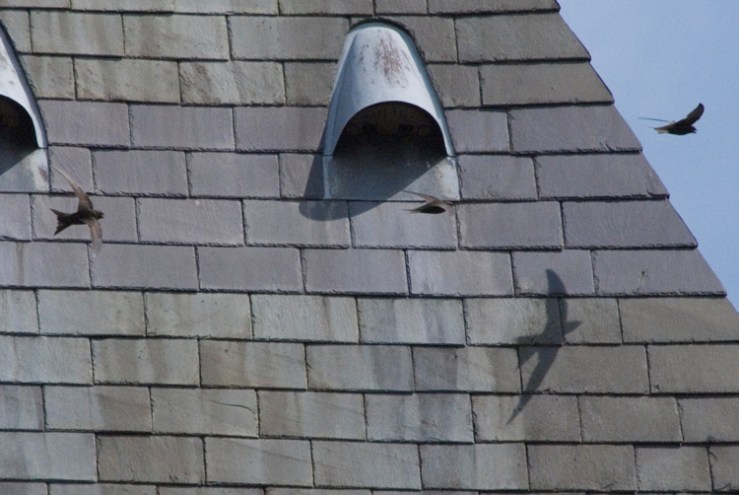
Swifts flying around the Museum tower
Swifts circle the entrances to the nest areas in the Museum’s tower. Image: Gordon Bowdery

Studies show that the population of breeding swifts in the UK has roughly halved between 1995 and 2016. The causes of this decline are debated: Lack of nest sites, lack of food, and changes to global weather patterns have all been implicated. The truth is that a bird which lands only once a year is extremely difficult to study.

We hope for a successful breeding season here in the tower, but if you would like to observe them yourself you can watch the swifts on our nest cam and compare the ups and downs of their populations over the years on our website.


Oxford Swift City takes flight

The Museum is really pleased to be a partner in Oxford Swift City, a major new initiative to protect and nurture the city’s populations of swifts. Here Keo Baxendine at RSPB Midlands tells us more about the project…

Swift expert George Candelin shares his experience of researching the swifts at the Museum. Image: Colin Wilkinson.

The swifts have just returned to the UK after their long migration from Africa. At the Museum they have begun circling the tower where they nest each year.

These charismatic birds, Apus apus, are commonly recognised throughout the UK as a sign of summer. They also have a long cultural association with Oxford as a symbol of knowledge and dexterity. Yet sadly, the national swift population has fallen by 42 per cent since 1994, due to a lack of nesting sites and food.

The Oxford Swift City project hopes to turn the birds’ fortunes around by protecting existing swift nesting sites as well as encouraging the creation of new ones. Last night, project partners and guests gathered at the Museum to kick off the project.

The swift is an iconic species whose appearance announces the start of summer. Sadly the swift is in trouble. Numbers have dropped dramatically, putting the birds at risk of disappearing completely from the UK. The Oxford Swift City community project provides local people with a great opportunity to learn about this important bird and discover how to take action to help give swifts a home in Oxford.
– Lucy Hyde, Oxford Swift City Project Officer

Swift chicks in a nestbox in the Museum tower, shown on the webcam feed

There are lots of ways to get involved: take part as a swift survey volunteer; help out at a community event; or just put up a nestbox or plant wildflowers in the garden. You can also join a local swift expert on a number of ‘swift walks’ through Oxford over the summer.

The colony of swifts which nests in the Museum has been the subject of a research study since 1948, and is one of the longest continuous studies of a single bird species in the world. This work has contributed much to our knowledge of the swift.

Fittingly, Oxford Swift City is running a ‘Swift Tower’ design competition. Subject to approval, the winning design will be constructed in Oxford next year, providing ideal nesting spaces for swifts – so get scribbling!

Funded by the Heritage Lottery Fund, the RSPB-led Oxford Swift City project is supported by many local partners, including Oxford University, Oxford University Museum of Natural History, Oxford City Council, Thames Valley Environmental Records Centre, Environment Resources Management and the local Wildlife Trust.

For more information please email oxfordswiftcity@rspb.org.uk.