Mandy on a mission

Mandy featured

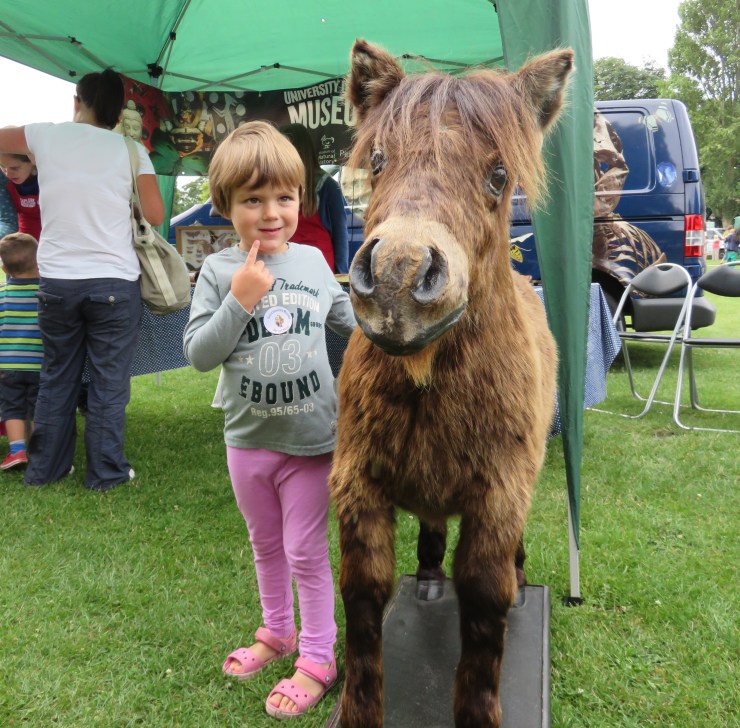
Regular visitors to the Museum will have noticed a certain Shetland Pony hasn’t been seen for a while. After living in Knaresborough Zoo during the 1980s, Mandy went on to spend over 10 years on display as touchable taxidermy – admired, adored and stroked until she could take no more. With the arrival of our new Sensing Evolution displays, it was time for a revamp and Mandy has gone into retirement. But, as our Community Outreach Officers explain, she’s now embarked on a brand new adventure…

**

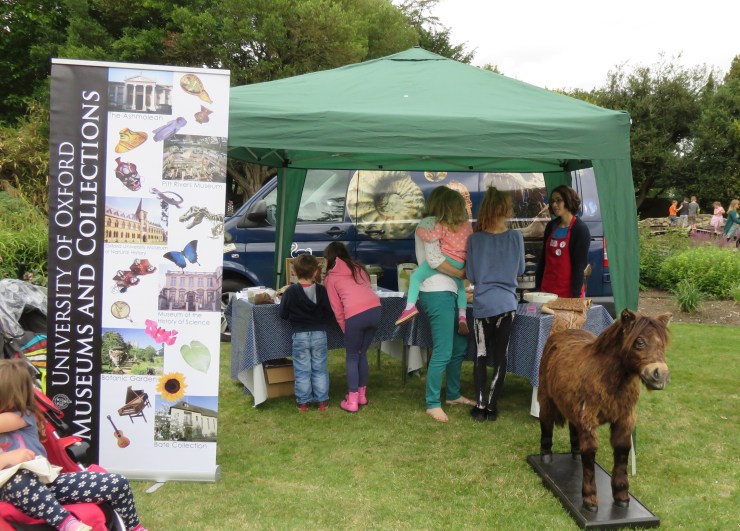
Mandy hasn’t disappeared! Instead of being in the Museum of Natural History, she now comes out to community family events with Oxford University Museums’ outreach team. This summer she has been all around Oxfordshire at Playdays, organised with Oxfordshire Play Association, and also with us at community festivals such as the Cowley Road Carnival and the Leys Festival. These brilliant indoor and outdoor activities are completely free for everyone to attend.
IMG_1189
Mandy takes pride of place at an Oxfordshire Playday

Oxfordshire Playdays offer children the support, space and resources to develop play and explore other activities available in Oxfordshire. The carnivals celebrate the places, spaces and communities in which we live, offering people an opportunity to be part of their local community.
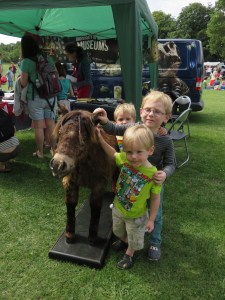
Some of Mandy's admirers come to say hello
Some of Mandy’s admirers come to say hello

At these events Mandy has pride of place in front of the museums’ outreach gazebo, so everyone can see her. The outreach team represent all the Oxford University Museums and Collections, giving people a flavour of what they can find. So, along with an elephant’s tooth, Megalosaurus footprint and Madagascan Hissing Cockroaches, Mandy comes with us to represent the Museum of Natural History. Once people give Mandy a stroke, they often come and hold a Cockroach or talk to the Outreach Officers about the other objects.
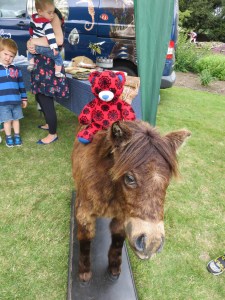
Teddy takes a ride
Teddy takes a ride

When parents, children (and dogs!) see Mandy, they are delighted. A lot recognise her from the Museum of Natural History, but others are just drawn to her soft, cuddly fur. Lots of children stroke her, pretend to feed her and put their teddies on her to give them a ride. Often we hear:

It’s the horse from the museum! Is she alive? How did she die? Where did she live?

So Mandy has not been forgotten. Instead she’s roaming Oxfordshire, bringing smiles to lots of children’s faces and has become a very valued member of Oxford University Museums’ outreach team!

Nicola Bird and Susan Griffiths, Community Outreach Officers
5 fantastic earwig facts

P1110897

Nigel Cook is one the last of our summer interns to fly the nest. He’s just come to the end of an eight-week placement as part of his MA in Museum Studies at Leicester University, and has been based in our Life Collections. Over this time with us, he’s developed an affection for an unlikely insect.

**

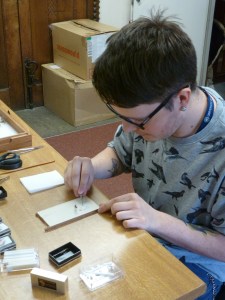
Nigel working on an earwig specimen

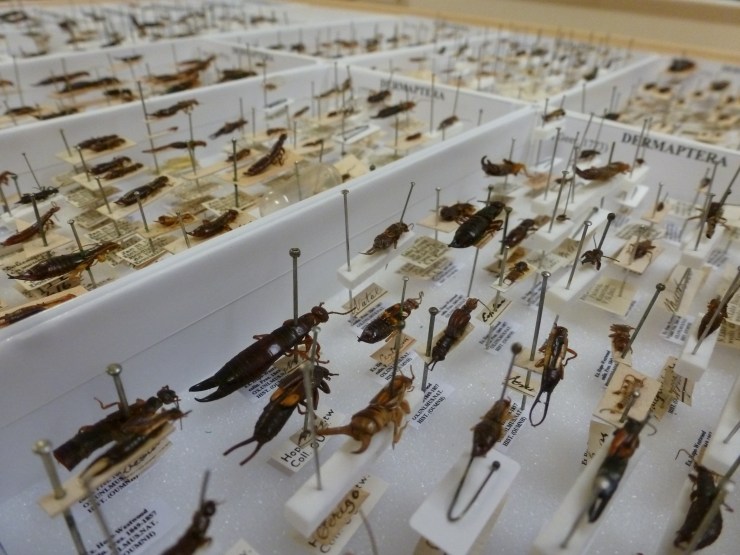
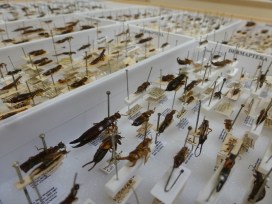
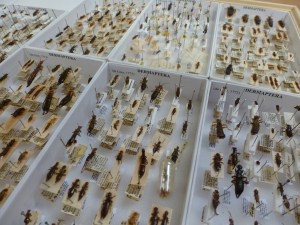
I have been working with a historic collection of earwig specimens (some over 100 years old!), ensuring that they are safely moved into new storage and given some care and attention on the way. There was a time when the word ‘earwig’ would send a shiver down my spine, as I recalled childhood tales of eggs being laid in my ear as I slept. But now I know better; earwigs don’t make their homes in ear canals, you are much more likely to discover them under stones, or the bark of a tree.

Like me before the start of my project, few people know anything about this fascinating order of insects, so here are 5 amazing facts I have learned during my internship that might change the way you think about them.

  1. Mum’s the word

Unusually for non-social insects, earwigs make great mums! In several species, earwig mothers will stay and care for their eggs in a makeshift nest. They provide the eggs with warmth, fend off predators, and even clean the eggs regularly in order to prevent fungus growth.

  1. “Skin wings”
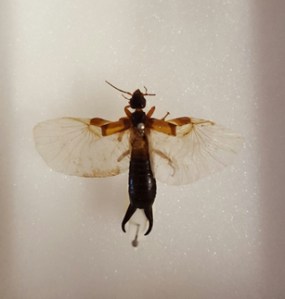
An earwig with wings unfolded

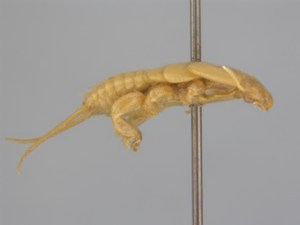
Earwigs belong to the order ‘Dermaptera’, a Greek name which is derived from the roots “derma”, meaning skin, and “ptera”, meaning wings. This is because most species have a pair of thin hind wings which fold neatly under a shorter pair of forewings, called tegmina, which act like a protective casing.

Yes, earwigs can fly! Although they rarely use this ability, it has helped them to spread worldwide.

  1. A strong grip

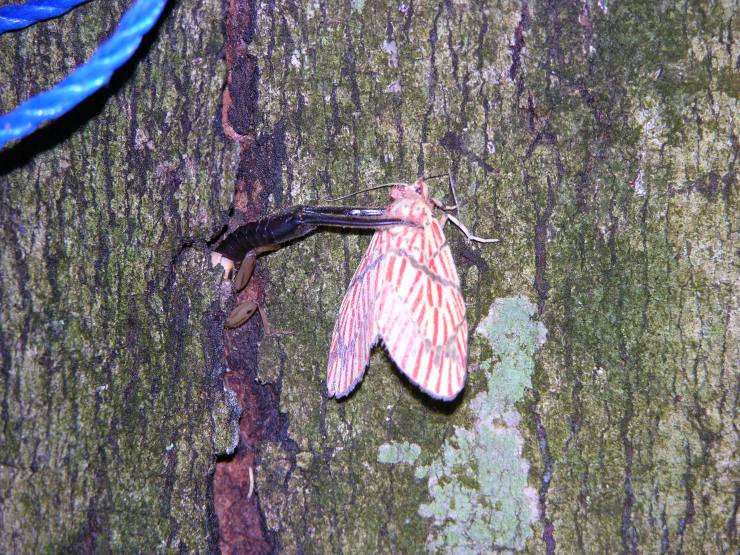
Moth earwig large

Many earwig species feed on decaying plant and animal matter, some eat living plants and others are predators. These carnivores usually prey on smaller insects, but with the use of the pincers (or ‘cerci’) on their abdomens, some earwigs are capable of snaring much larger insects. These pincers can vary in shape and size from species to species, and even between males and females.

  1. That itching feeling…

Earwig pinIn the jungles of Africa, there are giant pouched rats far larger than the rats we might see scurrying around our cities. Within the fur of some of these rats lives a very odd earwig; those of the family ‘Hemimeridae’.
These tiny insects are ‘ectoparasites’, spending their entire lives on the rats. Wingless and blind, they barely resemble earwigs at all.

  1. Darwin’s collection

During his great expeditions around the globe, Charles Darwin personally collected many specimens to support his theories. Amongst these specimens were earwigs, some of which survive in museum collections to this day, including several here at the Museum of Natural History.

P1110899Although earwigs have carried a bad reputation for many years, it’s important to realise that they pose no risk to humans.
They are a diverse, widespread and very successful order of insects that have been wrongly labelled as ear-invaders. So the next time you find an earwig, see it the way I do now: as a fascinating insect that’s just a little misunderstood.

Nigel Cook, Entomology Intern

Getting a grip on Life

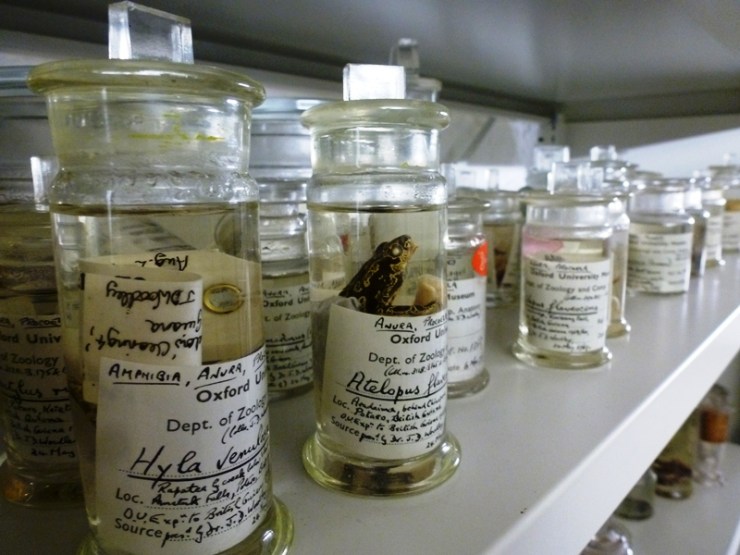
Frogs

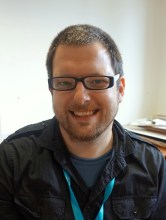
Hello. My name is Mark Carnall and this is my first post for More than a Dodo. It’s my third week as the new collections manager for Life Collections here at the Museum, which means I now have responsibility for all of the life-related material that isn’t entomological (so no insects, spiders, millipedes and other creatures which loosely fall under the term ‘minibeasts’).

Mark CarnallWhile I’m thankful that my job is made a little easier for not including roughly two thirds of animal life, it’s challenging enough: microscopic snail shells up to entire whale skeletons – and everything in between – fall under my purview.
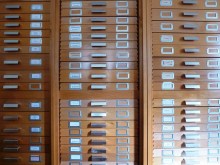
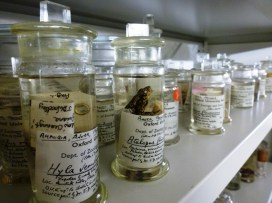
There are approximately half a million specimens in my care: mammals (including humans), birds, fish, reptiles, amphibians, sponges, corals, jellyfish, molluscs, echinoderms (starfish, sea urchins and their allies), and a whole host of more obscure but equally interesting animals.

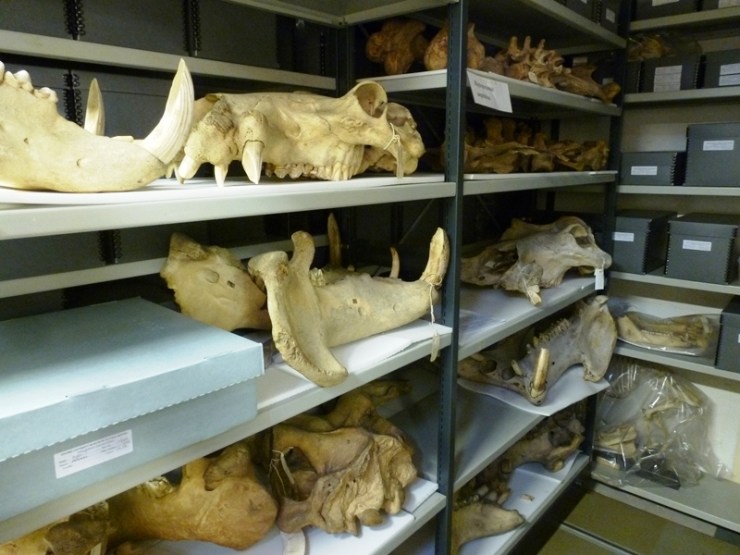
Hippopotamii, hippopotamuses Skulls of hippos in the mammal osteological store

How does one go about getting to grips which such a large and varied collection? Well, rather than starting at aardvarks and working through to zebras, perhaps the best way to learn about the collection is by facilitating the use of it.

Already, enquiries have been coming in from researchers, other museum professionals and members of the public. So far, I’ve had questions about preserving giant squid; the number of gorilla specimens we hold; the sexy parts of crabs; the history of the whale specimens on display; the identity of a bird-footed cup; and a number of queries about our human remains material.

I’ve also been taking the time to geek out over explore the collections, and there’s barely a drawer or cabinet that doesn’t have a first, largest or oldest. It’s not all treasures though: there’s material that scientists might regard as barely interesting as a data point, but is perfect for engaging and enthusing visitors in displays, events and workshops.

Molluscs- Sun dappled mollusc cabinets. I love the smell of molluscs in the morning.
Sun-dappled mollusc cabinets. I love the smell of molluscs in the morning.

This was highlighted in my first week here when a visitor brought a specimen in for identification. Although it was ‘just a cow tooth’, its owners were so happy to solve their mystery that they wanted to print and frame the identification (hopefully this sparked a lifelong interest in natural history too).

So I’ll be spending the next weeks finding my way around the collections and you’ll be discovering it all at the same time through blog posts here, my Spotlight Specimen slots in the Museum and no doubt through our jam-packed public events programme.

Next time, I’ve got a whale of a tale for you. Or perhaps that should be tales of a whale for you…

Mark Carnall, Collections Manager, Life Collections

Presenting… the Gault Clay

IMG_5120

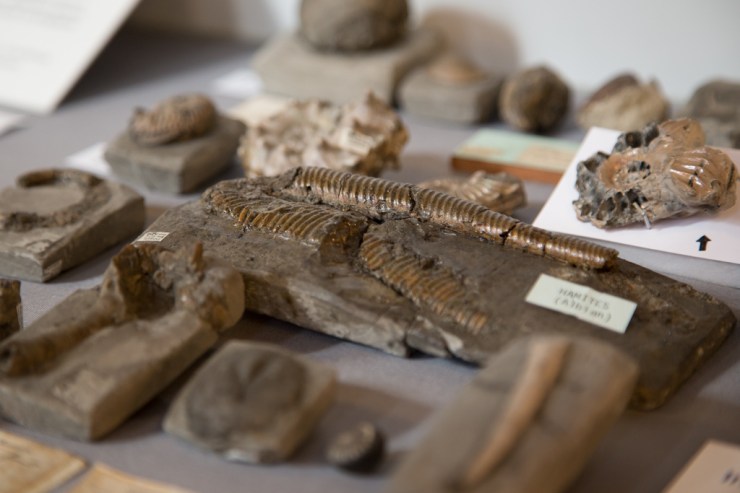
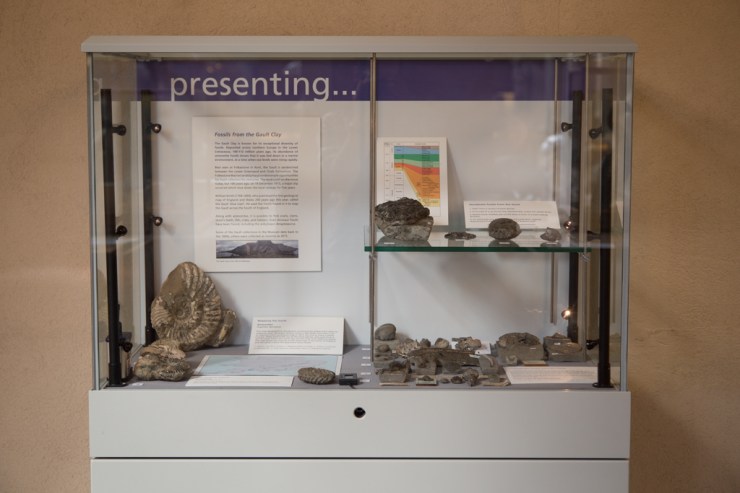
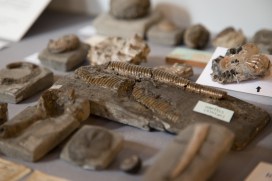
Our changing Presenting… display offers a look at highlights, themes and topical material drawn from the Museum’s collections. The current display presents a rich selection of fossils taken from a formation known as the Gault Clay. This will be on show until 21 September (Madagascar is up next), so it’s almost your last chance to see it.

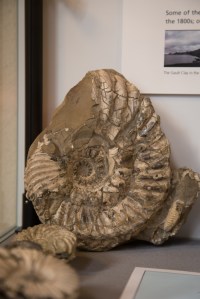
The Gault Clay is known for its exceptional diversity of fossils. Deposited across northern Europe in the Lower Cretaceous, 100-112 million years ago, its abundance of ammonite fossils shows that it was laid down in a marine environment, at a time when sea levels were rising rapidly.

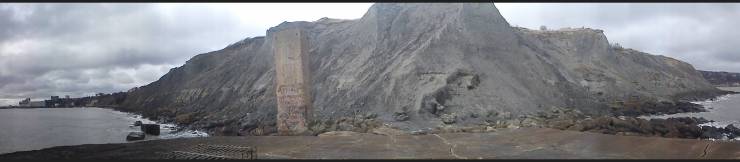
The Gault Clay in the Cliffs at Folkestone

Best seen at Folkestone in Kent, the Gault is sandwiched between the Lower Greensand and Chalk formations. The Folkestone Warren landslip has provided ample opportunities for fossil collectors for centuries. The land is still on the move today, but 100 years ago, on 19 December 1915, a major slip occurred which shut down the local railway for five years.

IMG_5122
Ammonite (Hoplites dentatus)

William Smith (1769-1839), who published the first geological map of England and Wales 200 years ago this year, called the Gault ‘blue marl’. He used the fossils found in it to map the Gault across the South of England.

Along with ammonites, it is possible to find snails, clams, shark’s teeth, fish, crabs, and lobsters. Even dinosaur fossils have been found, including the ankylosaur Anoplosaurus.

Some of the Gault collections in the Museum date back to the 1800s; others were collected as recently as 2015.

The Presenting... display, near the entrance to the Museum
The Presenting… display, near the entrance to the Museum

Adam and the Edmontosaurus

Edmontosaurus re-instate 011
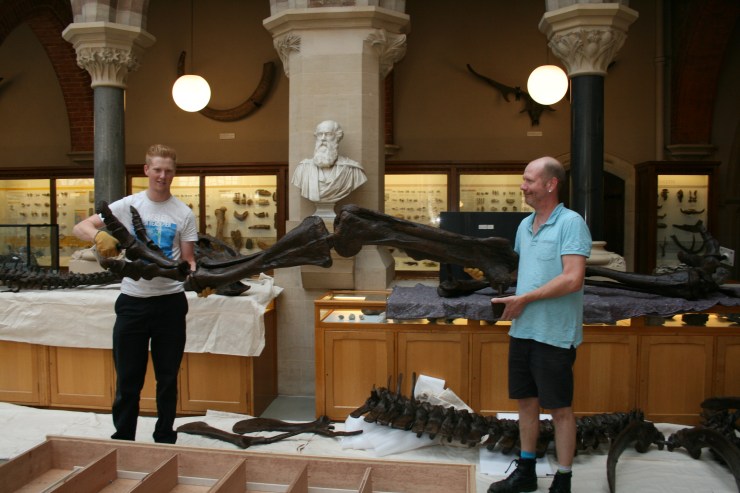
Adam (left) and Pete carrying a hind leg, presided over by the statue of Henry John Stephen Smith, Keeper of the Museum 1874 -1883

Fossil Fridays don’t get much bigger than this. This morning a team from the Museum have started the process of reinstating our large Edmontosaurus cast. The 49 pieces that make up the skeleton were brought back into the Museum after going out on the road, and now sit ready and waiting in the middle of the Museum.

For many of the team, lugging dinosaurs around is an everyday challenge, but one member of staff is very new to this sort of thing. Meet Adam Fisk, our new apprentice who joined the Museum only 2 weeks ago. Working alongside his supervisor Pete Johnson, he’s already helped with all sorts of tasks around the building, such as removing old display panels and fixing lights, but this one has to be a new experience.

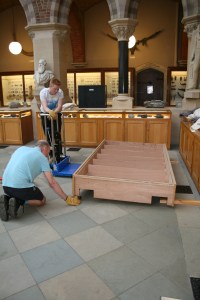
Returning the Edmontosaurus base to the museum court with supervisor Pete Johnson
Returning the Edmontosaurus base to the Museum court with supervisor Pete Johnson

Adam is fresh into the Museum following his GCSEs this summer and he says it all feels like a dramatic change of scene;

Only 8 weeks ago I was sitting in a classroom – now look at me stride!

The Edmontosaurus was dismantled back in June and went to the Cheltenham Science Festival with Professor Phil Manning of Manchester University. It was displayed in the ‘Dinozone’ exhibition, which received 14,000 visitors over 6 days.

The Edmontosaurus bones attract attention from a visiting primary school.

The cast is made up of 15 sections (plus 34 ribs) which bolt together. First to go on are the back legs and pelvis, then the spine and the skull, followed by the upper limbs. Lastly, the 34 ribs can be carefully slotted into place. The giant puzzle of fitting it altogether will begin on Monday.

Here’s how Pete describes Adam’s Edmontosaurus experience:

One small step for A-dam, one giant leap for apprentice-kind!

Rachel Parle, Interpretation and Education Officer