The Museum is home to a vast collection of natural history specimens but is perhaps less well-known for its substantial art and object collection. This material became the focus of Charlie Baker and Imogen Stead, two of our summer interns, as they spent six weeks researching, organising and curating it for the Museum.
The range and amount of material was formidable: numerous prints, non-scientific objects, paintings, photographs and sculptures from across the Museum, all coming together into a single organised collection for the first time. Here, Charlie and Imo unearth just a small sample of some of the items they catalogued during their time at the Museum:
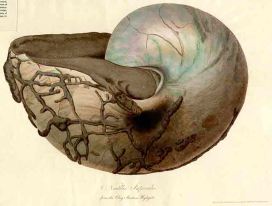
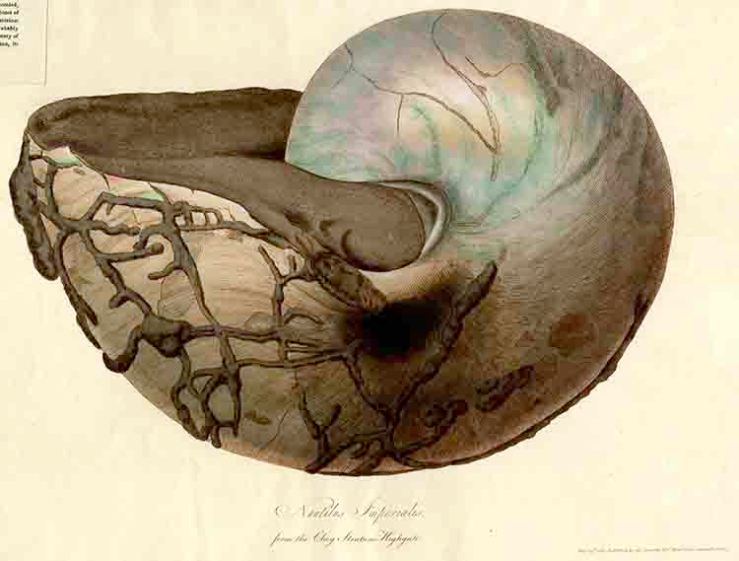
Nautilus Imperialis This beautiful print shows a fossil of the Nautilus Imperialis. It is one of the largest prints the Museum holds: measuring 48cm x 43 cm, it’s too large for the scanner! It has a small pamphlet of text stuck to it, just visible in the picture, and we speculate that this may have been promotional material for James Sowerby’s Mineral Conchology of Great Britain, the first volume of which was published in 1812, the same year as this print.
Nautilus Imperialis print
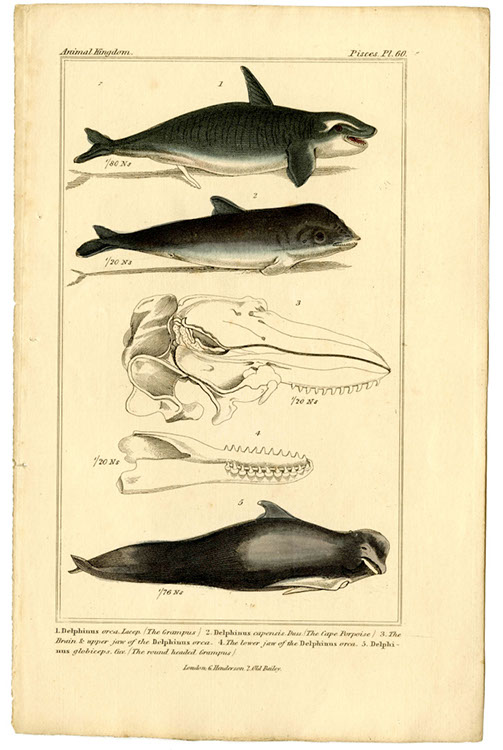
Plate 60 from The Animal Kingdom This is a plate from Henry MacMurtrie’s translation of Georges Cuvier’s Le Règne Animal, showing a few species of the genus Delphinus, or Common Dolphins. The Museums has 32 plates from this book in the collection. The publication demonstrates the intellectual collaboration between countries and the international appeal of Cuvier’s famous work. In fact, the collections holds plates from the original French and two different English translations.
Plate 60 from ‘Animal Kingdom‘ (Le Régne Animal) by Georges Cuvier, 1829
Slide cutter This tool was found in a chest of drawers in the Hope Library at the Museum. It initially baffled us, but staff identified it as a slide cutting tool. The circular blade scores the glass, and the notches are used to carefully break off the piece of glass. When cataloguing and storing it, we discovered the blade is still sharp enough to cut through a sheet of paper!
Slide cutter tool
Photo of Charles Darwin This framed photo of the great Victorian scientist is one of 22 pieces of art hanging in the Museum’s Hope Library. What makes this copy of the photo special, however, is the caption beneath it: “I like this photograph very much better than any other which has been taken of me.”
Photograph of Charles Darwin with his annotations
Monkeyana Cartoon One of the most bizarre items we came across was this 1828 satirical cartoon about lawyers. The collection has eight ‘Monkeyana’ cartoons, all by Thomas Landseer.
This is the second in a short series of articles to accompany the Stone Age Primates temporary display at the Museum, created with the Primate Archaeology group at Oxford University. Here, Dr Tomos Proffitt, Postdoctoral Research Assistant in Primate Archaeology, shows how the use of stone tools by modern primates might connect with our earliest human ancestors.
Over the past five years I have been fortunate enough to work with and study some of the earliest known stone tools, uncovered from archaeological sites at Olduvai Gorge, one of the most famous Palaeolithic archaeological sites on our planet. Olduvai Gorge seemingly appears out of nowhere as you drive down the dirt tracks of the north western slope of the Ngorogoro caldera and national park in Northern Tanzania.
The view from the top of Naibor Soit overlooking Olduvai Gorge. Photo Credit: Tomos Proffitt
It is here that the famous Louis and Mary Leakey uncovered evidence which proved that our evolutionary origins extended not thousands, but millions of years into the past, and over the years the site has provided a wealth of animal and early human, or hominin, fossils as well as tens of thousands of examples of the stone tools they made.
Two million years ago if you were sitting where I was in Olduvai, the most noticeable feature would have been a great lake surrounded by vast floodplains, occupied by a range of herbivorous and carnivorous animals taking advantage of the abundant grass, shrubs and fresh water constantly feeding the lake. It is in this setting that you would have found small groups of our hominin ancestors (Homo habilis) standing upright and walking across the floodplains in search of food.
Lake Ndutu located at the south western end of Olduvai Gorge. Early hominins would have occupied a similar lake environment. Photo Credit: Tomos Proffitt.
As a large part of my research involved closely studying and analysing the stone tools used by the hominins who once lived in this landscape my thoughts turned to how these individuals would have used tools for the different tasks they faced.
Once this hominin group had found a partially eaten carcass, possibly that of a Deinotherium (an extinct ancestor of the modern day elephant), they would have set about trying to make the most of this valuable resource.
By using quartz flakes with extremely sharp cutting edges, made by striking a quartz block with a round hammerstone cobble, they would have been able to cut the small scraps of meat that were still attached to areas of the carcass untouched by other predators, such as lions, hyenas, wild dogs and vultures. The hominins, would, however, also have been very interested in the leg bones because they contained an incredibly nutritious food source than not many other animals could easily get to – the bone marrow.
Examples of quartz anvils used by early hominins at Olduvai Gorge. Photo Credited to Mora and de la Torre, 2005.
After butchering the animal they would have carried the meat and bones back to another group, some of whom had been collecting various nuts and roots and were now busy preparing them to be eaten. They would be cracking open the nuts and pulverising the roots on a large flat quartzite anvil using rounded hammerstones. The group that had just arrived would have used the same tools to carefully open the elephant leg bones to access the marrow inside. A whole range of dynamic food gathering, eating, sharing, learning, teaching, tool making, communicating behaviour was taking place at this location.
Fast forward 2 million years: since that original meal, the site has been repeatedly buried in sand and sediment and eroded by flowing water and the only thing that remains from this location of vibrant activity and of the lives of these hominins are a few fossilised bones and a small collection of fragmented and broken stones. This is the type of material we were excavating in 2015.
Archaeologists use a range of methods to try and understand how stone tools were used and some of the most powerful insights can be gained through observing how stone tools are used today.
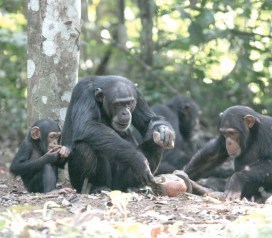
Chimpanzees using both a hammerstone and anvil to crack open nuts. Photo Credit: Haslam et al, 2009.
Transport yourself now to a small forest clearing in western Africa, where a group of our closest living relatives, chimpanzees, are quietly sitting underneath a number of nut- and fruit-bearing trees. This group is taking advantage of these important food sources, and is doing so by using stone anvils and stone hammers not too dissimilar from the group of hominins at Olduvai Gorge, two million years earlier.
A hammerstone used by a capuchin, on display in the Museum
But it is possible to directly observe the chimpanzee behaviour, recording how the tools are being made and used, what waste is being produced, the learning processes going on between infant and adult, and the range of social interactions that are happening. This modern primate behaviour represents a valuable window into the types of activities that some of our earliest hominin ancestors may have also undertaken.
The Stone Age Primates exhibit at the Museum showcases these types of stone tools and how they are used by modern primates. By closely studying how our closest living primate ancestors, including chimpanzees, capuchins and macaques, make, use and discard stone tools it is becoming increasingly possible to better understand the dynamic range of early human behaviours behind similar types of hammers and anvils found at Olduvai Gorge and other East African archaeological sites.







 More Than A Dodo