A rare beetles turns 21

by Darren Mann, Head of Life Collections

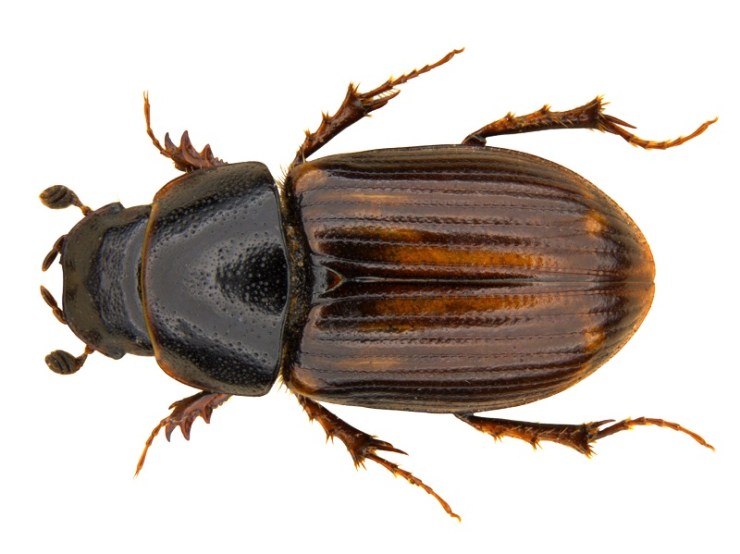
Many years ago, when re-identifying dung beetles in the collections of the British Entomological and Natural History Society, I found a specimen that I didn’t immediately recognise. So I borrowed it, and after a few hours of checking the European literature back in Oxford, I realised that I’d found a beetle that had not been recorded anywhere in Britain before.
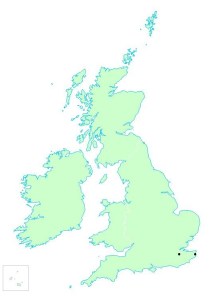
The small black circles show the locations of known records for Melinopterus punctatosulcatus.

The dung beetle in question was Melinopterus punctatosulcatus, a species widely distributed across Europe but until this discovery unknown in Britain, despite its presence in the BENHS collection. This is because it had been misidentified as a different species: the beetle superficially looks like two closely-related species, and so had been overlooked by beetle collectors for over a hundred years.

Since that initial specimen, I have scoured numerous UK museum collections and to date have found a total of just 20 specimens, distributed across the World Museum in Liverpool, the National Museum Wales in Cardiff, and here in the Museum of Natural History in Oxford. All these specimens are from Deal, Kent and were caught between 1891 and 1910.

The last known record is of a single specimen from Ryarsh, Kent collected in 1938, which just happens to be the first specimen I found some 20 years ago in the BENHS collection.

The male genitalia of Melinopterus punctatosulcatus. The appearance of the genitalia is one of the best ways of identifying one species of beetle from another.

But this week, the 21st known specimen was discovered in our collections by Mary-Emma, a placement student who is with us from the University of Reading. She uncovered the beetle during the re-curation and identification of a collection made by A. J. Chitty. Thankfully the specimen was a male, so we were able to confirm the identification using the genitalia – one of the best ways of determining a species.

It seems that Mr Chitty had a knack for finding this particular species of dung beetle, since 14 of all the known specimens were caught by him at Deal. It’s just a shame that he didn’t realise his amazing discovery at the time.
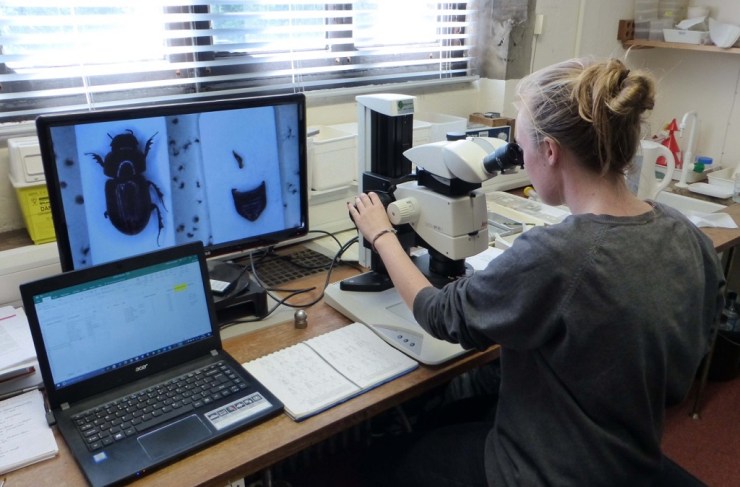
Mary-Emma identifies Melinopterus punctatosulcatus by examining the dissected genitalia, visible on the right hand side of the monitor screen.

In the recent Conservation Status Review of dung beetles, Melinopterus punctatosulcatus was designated as Regionally Extinct in the UK because there have been no known sightings since that one in 1938. So this species possibly went extinct in Britain before we even realised that it was here. And were it not for museum collections we may never have known it once lived in Britain at all.
A model ancestor

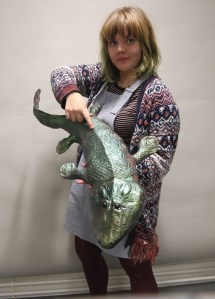
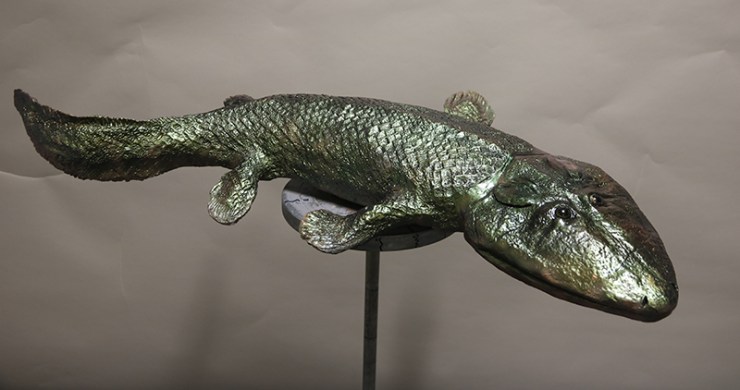
This bizarre creature, somewhere between fish and early four-legged land animals, is called Tiktaalik. The more scientists learn about this 375 million year-old beast, now long extinct, the more it intrigues them. Recent discoveries suggest its strong pelvis and hind limbs allowed it to move effectively through water, but also to clamber on the river bed and possibly onto mud flats.

Education Officers here at the Museum often use Tiktaalik as an example of how animals moved out of water and onto land and how that relates to the history of life on Earth. Until now, this has been a bit of a challenge: our education activities all focus on using specimens, but only a few fossilized bones remain from this ancient animal. Enter Robyn Hill, model maker! Here she explains how she tackled the task of bringing Tiktaalik to life:

Robyn brandishes her Tiktaalik model

For the last 3 years I have been studying model-making at Arts University Bournemouth. For a final year project we were required to find a client and create a model in 7 weeks. One of my fellow students put me in contact with Chris Jarvis, an Education Officer at the Museum of Natural History, who gave me the project. He’s been very supportive and incredibly enthusiastic about the collaboration. The whole experience has been a boost in confidence as this was the first model of this type and scale I had made.

The model will be used as a tool to illustrate the story of the Tiktaalik during schools workshops. The Tiktaalik is important in the evolutionary timeline as it is the cross over between historic fish, such as the Coelacanth, and the first four-legged animals, the tetrapods.

Robyn used clay to flesh out an armature she made from steel, aluminium wire and chicken wire.

I decided to make the model out of fibreglass as it would withstand more wear and tear, such as being stroked by school children, and it is light enough to be carried by a single person when holding up and demonstrating.

The head was probably the easiest part to model, because I could use the direct evidence from fossil remains. Then it was a case of imagining where the muscles and flesh would lie over the skull. I used written explanations of the creature alongside illustrations to help me create the final look.

To make this mould, Robyn applied silicon to the clay sculpture, followed by a fibreglass jacket to add support. She then filled them with fibreglass for the final model.

When posing Tiktaalik I looked into how much the body would realistically curve. I referred to the fossil remains and animations of how it would have moved, alongside images of preserved footprints. Tiktaalik was one of the first animals with a neck, which is something I hope I illustrated in my design.

Once it was released from the mould, Robyn sanded and filled the model, then sprayed it with colour.

The Coelacanth is a living relative of Tiktaalik and has a similar type of scales, so I used images of this animal to help my research. I also looked at fish which live in similar conditions. I was experimental with the paint, as no one is certain what colour its scales would have been. I used changing pigments over a detailing layer of airbrushed cellulose paint.

On the final model, you may see a few scars: some of these I made on purpose, some made by mistake, but I believe it gives the creature more character, because it was a predator and would have had to fight for its place!

Is it real? – Skeletons and bones

One of the most common questions asked about our specimens, from visitors of all ages, is ‘Is it real?’. This seemingly simple question is actually many questions in one and hides a complexity of answers. 

In this FAQ mini-series we’ll unpack the ‘Is it real?’ conundrum by looking at different types of natural history specimens in turn. We’ll ask ‘Is it a real animal?’, ‘Is it real biological remains?’, ‘Is it a model?’ and many more reality-check questions.

This time: Skeletons and bones, by Mark Carnall

Them bones, them bones… They are all over the place in most museums of natural history: suspended above you, parading around you, or towering menacingly over you in the case of the attention-grabbing Tyrannosaurus rex. When it comes to skeletons you might think the ‘Is it real?’ question is pretty easy to answer; the bones are there, tangibly real, right?

The articulated skeleton of a Barn Owl

Bones are only found in fish, amphibians, reptiles, birds, and mammals. Other animals possess hard parts which can confusingly be named using similar language, such as the cuttlebone of cuttlefish, or the ‘skeletons’ of corals. These hard parts may resemble bone but are formed in different ways to true bone like the ones we possess.

Unlike taxidermy, discussed in the previous instalment, on the face of it bones are less easy to manipulate and so less likely to be subjectively represented. But individual bones did not exist individually in life, and articulated skeletons, where bones have been attached together, have been manually reassembled to illustrate the shape of the whole animal. The accuracy of an articulated skeleton can depend on a number of things, including the skill and knowledge of the person doing the assembly, the completeness of the bone material, and even the preparation of the bones themselves.

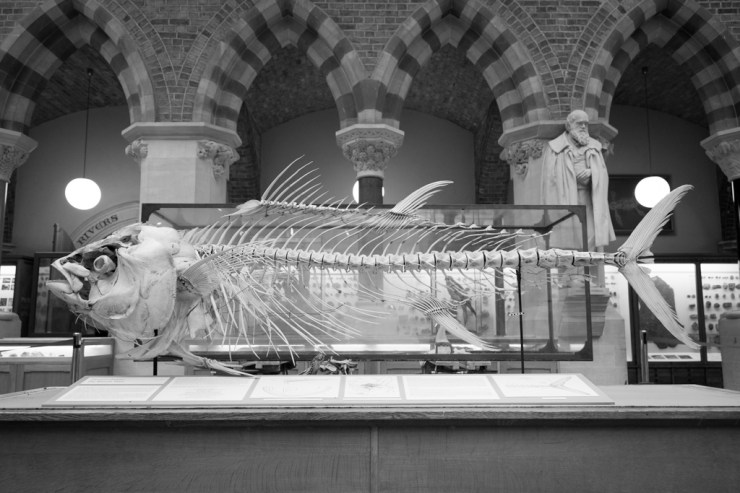
The skeleton of an Atlantic Bluefin Tuna, on display in the Museum

In life, the skeletons of the bony animals are also supported by hard but spongy cartilage and tendons which are not so easily preserved after death. Yet it is the support of the cartilage and tendons, and the form of the surrounding muscle tissue, which gives an animal its natural appearance.

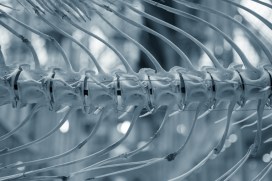
Some articulated skeletons do not account for this non-bony connective tissue. For example, all of the vertebrae in an articulated backbone may be touching each other, whereas in life there would actually be a disc in between each vertebra. Articulated skeletons are often positioned so that parts of the skeleton can be easily seen and accessed, even if the positioning is not realistic or even physiologically possible.

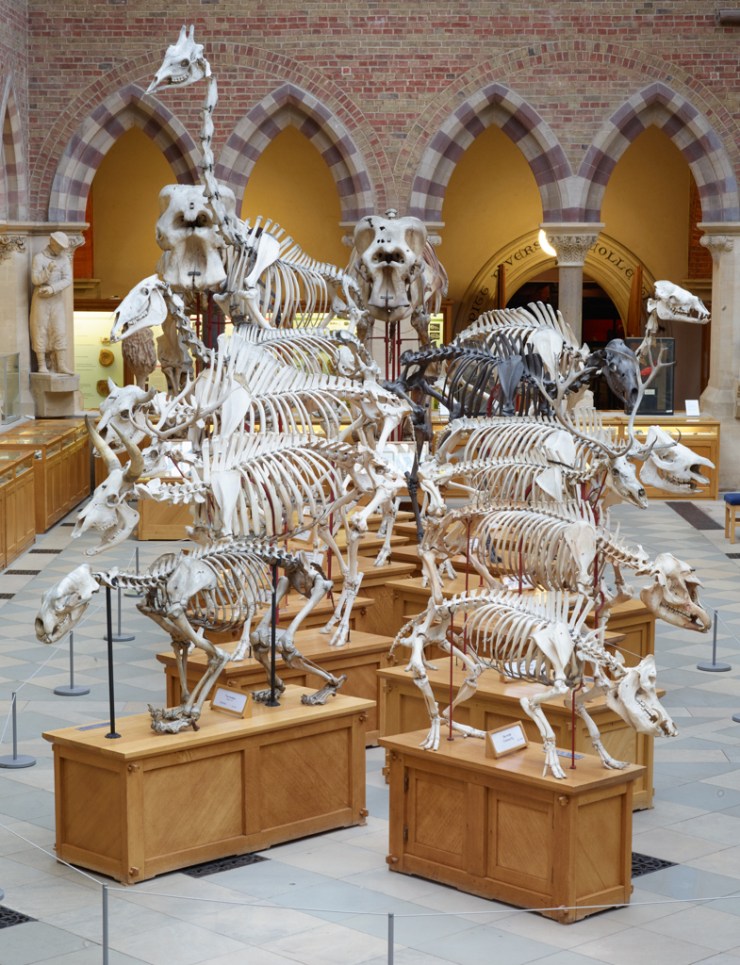
The Museum’s parade of articulated mammal skeletons – no cartilage or tendons in sight…

There are also lots of smaller bones which often aren’t preserved as they are too fragile or don’t attach to other bones in life. Examples include clavicles, or collar bones, penis bones, and the hyoid, a bony structure in the neck that supports the tongue. Some skeletons are composite specimens, so they may be made up of bones from multiple individuals to replace missing or damaged parts. Other parts of skeletons on display in museums may have been reconstructed with plaster or filler.

The way that a specimen is ‘skeletonised’ – the processes used to prepare a skeleton from a carcass – can also have a huge effect on the size and shape of bones, altering the size by up to 10 per cent, which can introduce errors in bone measurement, especially for small-boned bats, rodents, lizards, frogs, and fish.

So while there’s a tendency to assume that skeletons are more ‘real’ than other kinds of preserved specimens, they too have their biases. The next time you look at a skeleton try to imagine what is natural and unnatural about its construction, and ask yourself – is it real?

Next time… Fossils
Last time… Taxidermy

Calling all artists

We’re happy to announce an exciting opportunity to coincide with our  new exhibition – Settlers, opening at the Museum of Natural History in February 2018.

Settlers is the upcoming exhibition in our Contemporary Science and Society series. The latest of the series, Brain Diaries: Modern Neuroscience in Action is currently running until 1 January 2018.

The history of the people of Britain is one of movement, migration and settlement. Tracing patterns revealed by genetics, archaeology and demography, Settlers: Genetics, Geography and the peopling of Britain will tell the dynamic story of Britain’s ever-changing population.

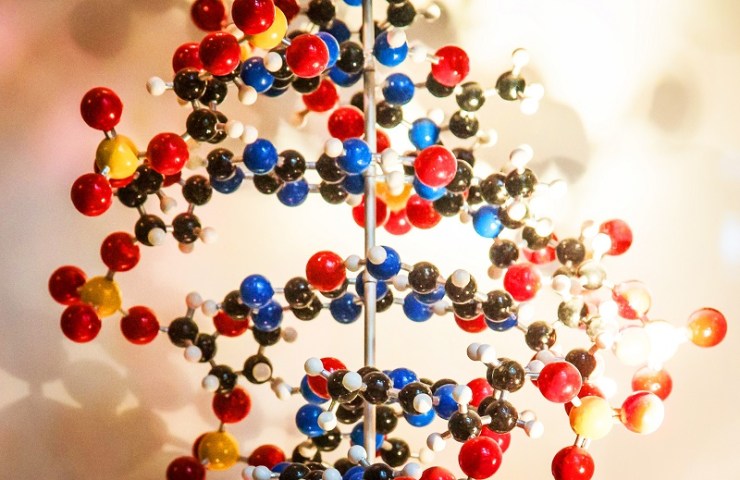
DNA image for call out blog post

Planning for Settlers is going well and we’re happily getting to grips with the science and archaeology, but we’d also love to have some artistic input. Can you help us?

The Museum would like to commission up to two pieces of contemporary art that explore themes such as genetics, DNA, migration, settlement and ancestry.

We’re particularly interested in work that will provoke thought and discussion and engages with 18-25 year olds, and we welcome all media, including digital and installation art.

The artwork could be displayed in the gallery itself, in the main court or even on the museum lawn.

centre-court
The Museum’s centre court

If you like the sound of adding some artistic flair to Settlers, you can find out more here:.  Don’t delay, though; the deadline for applications is Friday 1 September 2017.

What big teeth you have…

Not many summer placements involve being face to face with a grey wolf. The latest intern getting her hands dirty in the Life Collections Conservation Lab is Kathryn Schronk, from the BSc Conservation of Objects in Museums at Cardiff University. Here she tells us a little bit about herself and what she’s been working on during her time at the Museum…

Desiring a bit of a respite from broken pottery and rusty metal, I came to the Museum of Natural History to gain some experience with different objects and materials: namely taxidermy. I mean, why not? The possibility of getting up close and personal with wild animals was tempting, and I wouldn’t get a limb gnawed off or an eye poked out either, as might be the case with live creatures. A win-win situation!

Kathryn airbrushing synthetic hair in the Conservation Lab

Natural history specimens were always off in some strange yet fascinating realm I knew nothing about until a few weeks ago. Curiosity got the better of me, and here I am, surrounded by dead things and not the least bit freaked out. Except for the spiders; they’re still creepy, dead or alive.

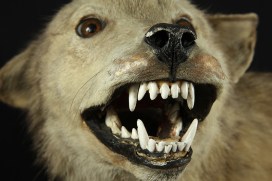
The wolf who cried for help, before treatment.

My first project was a taxidermy grey wolf (Canis lupis). After many years on display, the skin has dried out and become brittle, causing it to crack and tear. These tears were visible around each hind legs, the neck, and at the tail, actually separating it from the body.

Some of the filthy cotton pads

I first cleaned it to remove dust and dirt; using a museum vacuum followed by 50:50 alcohol and water on large cotton pads for the more stubborn, ingrained dirt.

My attention was then turned to the tears at the legs. While quite long in length, there was not much of a gap between the two pieces of skin, which would make a repair easier to undertake. These were repaired with adhesive film and polyester cloth as a support material, which I slid underneath the skin and behind both sides. This was done to reduce the stress upon the brittle, dry skin and prevent the tears from increasing.

The tear around the left leg, before (left) and after (right) repair

There were massive cracks inside the mouth, where the old fill material had failed. After some testing, I chose a fill material that was flexible and able to withstand a fluctuating museum environment. This was an EVA adhesive, coloured with pigments to match the surrounding gum.

The muzzle needed substantial retouching, due to fur loss around the nose and eyes. Using conservation grade acrylic paints, I layered the colours, matching the various shades of the wolf’s coat. A very fine bristled brush was used to create the natural texture, painting on each hair practically one by one.

Lastly, I created a synthetic patch of fur made out of polyester teddy bear stuffing to combat the bald patches in front of the legs. The fibres were airbrushed with acrylic paints to match the coat and then felted onto a backing material which was adhered to the wolf using EVA adhesive. These repairs made the tears less noticeable and the wolf more aesthetically pleasing and realistic.

The wolf after conservation treatment

The wolf has now returned to the museum display, looking much livelier. Let’s hope he attracts a wolf whistle or two.

Going, going… not gone?

by Darren Mann, head of Life Collections

Extinct or not extinct; that is a question raised by a report into the status of the beetles of Great Britain, published last year by Natural England. It may sound easy to determine whether a species is extinct or not, but tiny insects can be very hard to spot, despite the best efforts of many people.

The results of the report were alarming: using the International Union for Conservation of Nature criteria, just over half of our dung beetles are in decline, five have gone regionally extinct, and a further four were classified as Critically Endangered (Possibly Extinct) in Great Britain.

Prompted by this assessment, targeted surveys were made at known historic sites for some of our rarest and possibly extinct species. Over the past two years we have already made some exceptional discoveries, including new sites and new county records for several rare dung beetles.


My favourite finds from recent field exploits are the discovery of two new populations in Gloucestershire for the Critically Endangered Aphodius quadrimaculatus, and the rediscovery of Heptaulacus testudinarius in the New Forest, Hampshire after 35 years with no records. But sadly we have failed to find four of our target species at their last known sites.

Finally, after ten years of repeated site visits, we did finally find one of our rarest species, the Ainsdale dung beetle Amoecius brevis. This small beetle, just 3.5-4.5 mm long, was first found in Britain in 1859. It’s restricted to the Ainsdale and Birkdale sand dunes of Lancashire, where there were several records from the early 20th century, one record in 1962, and four records from the 1990s.

A specimen of Amoecius brevis from the Museum, collected in 1903

The last known record was of a single specimen caught in 1996. The lack of recordings for the past 20 years, despite a large number of surveys, led us to proclaim it Critically Endangered and ‘Possibly Extinct’ in the Natural England report.

Unlike many of our other dung beetles, which prefer fresh dung, Amoecius brevis breeds in older dung of large herbivores, such as cattle and horses, and rather unusually, in the UK it is also found breeding in rabbit latrines.

So it was in pursuit of rabbit latrines that we spent five days walking up and down sand dunes, covering an area of about 5km2. We then used a fine mesh sieve and tray to search through the dung and sand beneath. When our first beetle appeared it took a few minutes for the euphoria to fade, and then to our delight a further three were found in the next handful of sand and rabbit dung, along with a few more a little way down the coast.

In one sense, proclaiming a small, inconspicuous and evidently hard to find beetle as ‘Possibly Extinct’ is premature, but without that designation who would bother to go and look? Would wildlife conservationists give it any attention?

Since the Natural England Status Review was published, surveys have been commissioned for four rare dung beetles; in the case of the Ainsdale dung beetle at least, this has proven very successful.

I hope that the rediscovery of this very rare beetle will highlight the importance of invertebrate conservation as a whole. In the meantime, our data will feed in to conservation management plans for the Ainsdale site, safegaurding this little beetle’s future.