

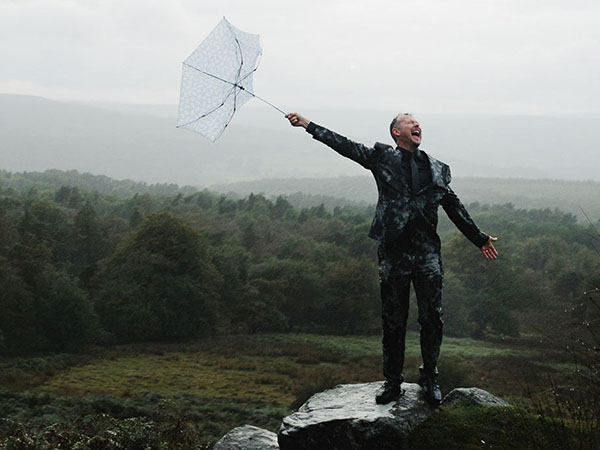
by Chris Jarvis, Education Officer
In a lecture in 1884, the Victorian art critic John Ruskin described a ‘plague-wind’ darkening Britain’s skies. After decades of looking closely at weather he believed that the atmosphere itself had changed, and that the smoke and ‘filth’ of industrial society formed part of the cause. His argument was urgent:. Under the title ‘The Storm-Cloud of the Nineteenth Century’ he described changes in the appearance of the sky and its relation to the pollution and industrial modernity of his time.
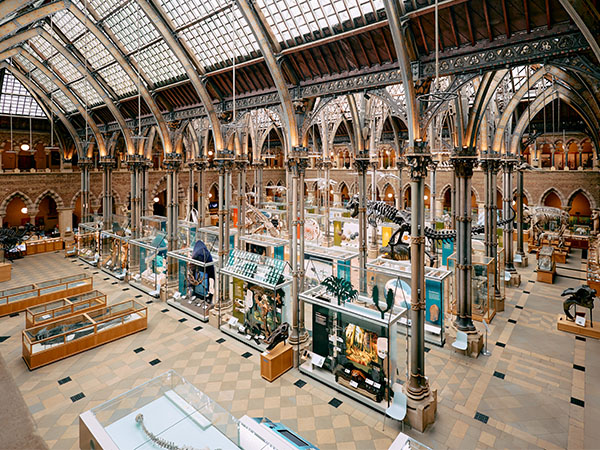
Ruskin was hugely involved in the building of the Museum of Natural History in Oxford. Its Neo-Gothic architecture and ornate pre-Raphaelite decoration was chosen to relate to a purer time when people were more in tune with the beauty of what was seen as an unspoiled nature. The Museum’s huge, airy, glass-roofed central court allows light and air to suffuse the building, offering a view of the changing skies overhead. It was a reaction to – and rejection of – what Ruskin viewed as the insidious march of Victorian industrialisation.
With current concerns about climate change, extreme weather events and environmental pollution, Ruskin’s lecture seems remarkably prescient and his work continues to stimulate conversations today.
On 24 October 2026, in the same lecture theatre that Ruskin used for his 19th century talk, we hosted Dr Tom Payne of the Sheffield Creative Industries Institute at Sheffield Hallam University. Tom brought Ruskin’s lecture back to life with a public performance called Storm-Cloud: Observations of the Sky as part of an event in partnership with IF Oxford, the annual science and ideas festival. Part research project and part provocative performance, ‘Storm-Cloud’ melds Ruskin’s original lecture with projected digital artwork created by Jake Goodall, enriched by a soundscape by David John Brady.
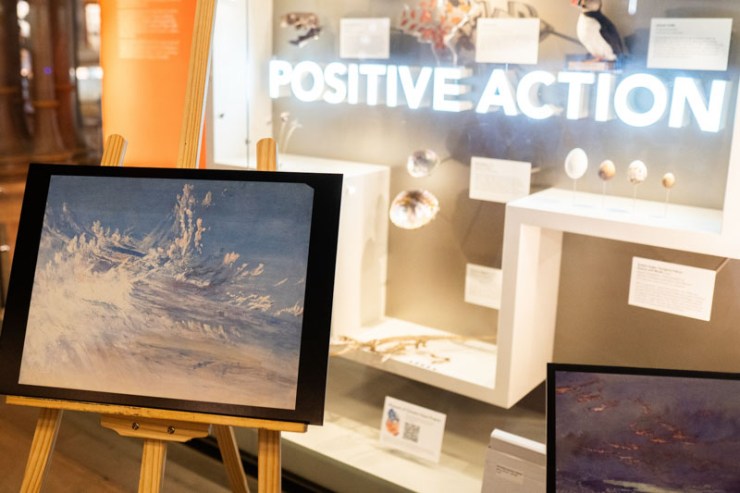
Prior to the performance itself visitors were able to see prints of Ruskin’s paintings of his observations of the skies (thanks to the Ashmolean Museum for the loan of these). In these pictures, Ruskin had visually documented the environmental changes he was seeing.
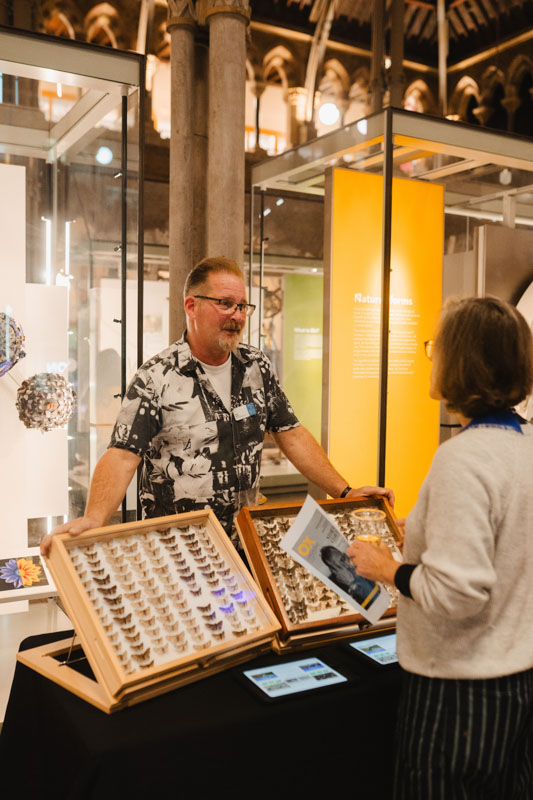
Museum staff also presented specimens from the collections to talk about how scientists can use them to demonstrate human-caused changes to nature over time. These included Bernard Kettlewell’s famous Peppered Moths, which showed how the smog of industrial Britain had influenced natural selection in a species, and feathers from Victorian birds that can help us feed better information into climate change models and understand changes in pollutant levels today.
I think John Ruskin would have thoroughly approved of this powerful blend of art and science. The event highlighted how museums are still places of public debate, provocation and discussion, and how the millions of natural history specimens and the data they hold can be used to inform us about environmental change today.


Published by