What’s on the van? – Mosquito

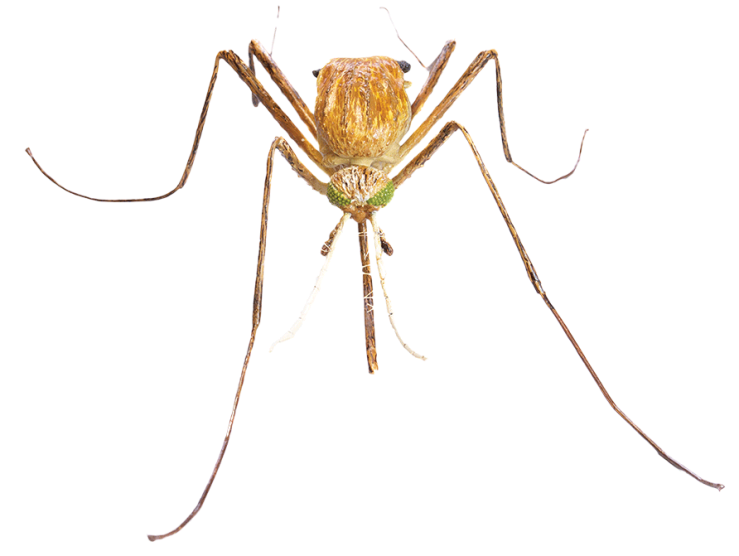
_mosquito_head_on

This week’s What’s on the van? comes from Zoë Simmons, of the Museum’s Hope Entomological Collections.

The word mosquito (formed by mosca and diminutive ito) is from the Spanish or Portuguese for “little fly”. Approximately 3500 species of mosquito have been described to date. The females of a few species require a blood meal in order to lay fertile eggs but many more do not and of those that do, only a handful are disease vectors (a carrier of disease).

These few species however, are of global importance to the human race as they can transmit diseases such as Yellow Fever and Malaria. As a consequence, the mosquito has been dubbed ‘the most dangerous animal in the world’. A large amount of scientific research has been put into combating mosquitoes and the diseases that they carry, but some of the most important information has come from entomologists who have studied mosquito behaviour and lifecycles in detail. From this, scientists have been able to get a better and more complete understanding of the species and thus develop more effective methods of eradication and disease management.

What's on the van?

Hidden Treasures

ammoAs you know, the Museum of Natural History is closed to the public throughout 2013 for restoration work on its leaky vaulted roof. Although our central galleries are thrown into shadow, there’s still plenty going on behind closed doors.

But if you’re missing your visits to the Museum, or have always wanted a peek behind the closed doors of our collections, now is your chance! On Saturday 24th August you can join one of our FREE behind-the-scenes tours as part of the national Hidden Treasures campaign

Hidden treasures logo_small

Expert staff from the museum’s collections will be your guides; see where fossils get fixed, explore the high-tech kit used to see inside minerals and even meet the oldest pinned insect in the world! I’ll be there on the day and would love to meet some “Darkened” followers. Don’t forget to book your places through our What’s On page.

Rachel Parle, Education Officer


What’s on the van? – Aragonite

_DSCN8449

This week’s What’s on the van? comes from Monica Price, Head of Earth Collections.

Can you believe your eyes?
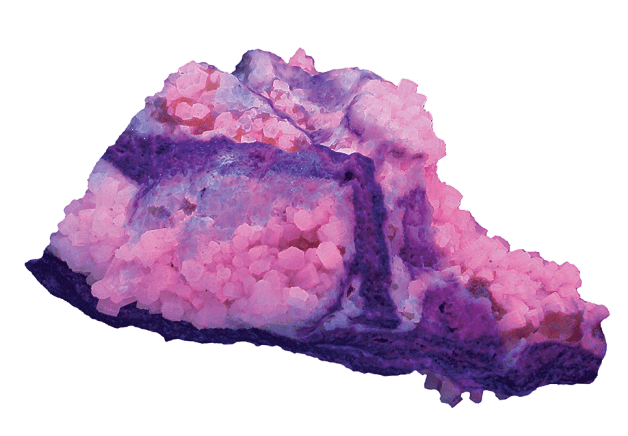
If I were to tell you that these crystals of aragonite (composed of calcium carbonate) from Sicily are a dull grey colour, you might not believe me. Look at them in daylight or under ordinary room lights, and you will see that they really are! The picture on the van shows how they look when they are fluorescing – glowing pale salmon pink under an ultraviolet light.

Ultraviolet (UV) light is part of the electromagnetic spectrum, like visible light, microwaves, radio waves and X-rays. Humans cannot see UV light, which is why we sometimes refer to it as ‘black light’. It has just a little bit more energy than the visible light which we can see.

Some minerals contain a chemical activator which allows them to fluoresce. When UV light shines on a fluorescent mineral, the energy bounces some of the mineral’s electrons out of their orbitals. A tiny bit of the energy is converted to heat, so that when the electrons fall back, the rest of the energy is emitted again, but now it is visible light. The mineral literally glows in the dark.

As long as ultraviolet light shines on the mineral, it will continue to glow. You will be able to see lots of fluorescent minerals when the Museum reopens next year!

What's on the van?

Roof with a view

Roof top at sunset
Credit: Mike Peckett

Earlier this week, sunshine and storm clouds created the perfect conditions for this dramatic shot. Mike Peckett, who is a member of the Front of House team and an excellent photographer, was up on the Museum’s roof capturing the latest developments in our restoration project. More to come on that soon, but I couldn’t resist sharing this beautiful image to end the week.

Rachel Parle, Education Officer

What’s on the van? – Four-horned trunk fish

_17320a

This week’s What’s on the van? comes from Malgosia Nowak-Kemp, Collections Manager in the Museum’s Zoological Collections.

The name “four-horned trunk fish”, Acanthostracion quadricornis, comes from this animal’s unusual appearance. The fish looks rather like a stiff box or trunk with solid walls that allow only small openings for the tail, fins, eyes and mouth, but keeps all the internal organs safe from predators. Some members of this group are not only protected by the box’s shape and its structure, but also have the ability to release a poison when threatened. Acanthostracion quadricornis, can be easily identified by the presence of four “horns”, two at the front of the head and two at the back of the body. The animal’s other name of “cowfish” makes a clear reference to them. This and other members of its family, Ostraciidae, live in shallow waters of oceans: Atlantic, Indian and Pacific

This particular example is one of the oldest specimens in the country, as it dates from the seventeenth century. It belonged to the Tradescant Collection, also known as the “Tradescant Ark”, assembled by the two John Tradescants, father and son. Their collection of “Naturalia” and “Artificialia” contained not only exotic, hitherto unknown animals and plants, but also portraits,  clothes, weapons and jewels brought by sailors and traders from newly discovered  lands. The collection was displayed for many years at the Tradescants’ home in Lambeth, London and all the specimens were listed in 1656 in the very first printed museum catalogue in the country.

In 1678 their collection became the property of Elias Ashmole, who in turn offered it to Oxford University. In 1683 fourteen carts containing the collection travelled on barges to Oxford to be displayed in the newly built Ashmolean Museum, then located on Broad Street. This ancient fish is now one of the real treasures of the Museum of Natural History’s collection.

What's on the van?

Getting about

Westwood

With our Goes to Town exhibits in place all over Oxford city centre, we are keeping our collections hard at work even while the Museum is closed. But it isn’t just our specimen collections that are getting all the action – material from the Archives has journeyed outside the Museum walls too…

In association with the Friends of Summertown Library, we have put together a display from our archival collections celebrating former Summertown resident and Museum scientist John Obadiah Westwood. Westwood was the first Hope Professor of Zoology at the University in the late 19th century, and in addition to being a leading figure in the development of entomology as an academic discipline, he was also an amazing artist.

Westwood was so well known for his ability to accurately capture the details of insect specimens in his own work that he was commissioned to complete illustrations for a number of important entomological texts of his time.

Chairman of the Friends of Summertown Library, Marcus Ferrar, with the display at Summertown Library

Our archive is full of examples of Westwood’s talents, though most of his drawings have never been on display to the public before. This first-of-a-kind display for our Archive features a number of original copies of his work, including drawings of butterflies, beetles and even medieval manuscripts. It also features lots of interesting facts about Westwood, including his love of gardening and his fascination with biblical texts.

Westwood by Chris JarvisThe exhibit in Summertown Library runs until 18 October 2013 and can been seen during library opening hours. If you’re there with children don’t forget to ask for a Museum of Natural History colouring sheet, featuring this drawing of Westwood in action by our other talented Museum artist and Education Officer, Chris Jarvis.

A big thanks goes to the Friends of Summertown Library for working with us to make this unique opportunity happen. Do let us and the library know what you think.

Kate Santry, Head of Archival Collections