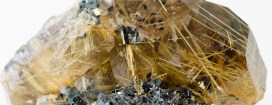
We have been doing a spot of mineral photography today, as part of an imaging project being undertaken by Dara Lohnes, a Leicester Museum Studies student who will be based with us for the next eight weeks. This is one of her shots – beautiful isn’t it?
It shows crystals within crystals – sprays of golden brown rutile crystals (titanium dioxide) inside colourless crystals of quartz (silicon dioxide). The metallic silver is a mineral called hematite (iron oxide). The specimen comes from Ibitiara, Bahia, Brazil and was purchased by the Museum in 2007.
This week’s What’s on the van? comes from Monica Price, Assistant Curator, Mineral Collections.
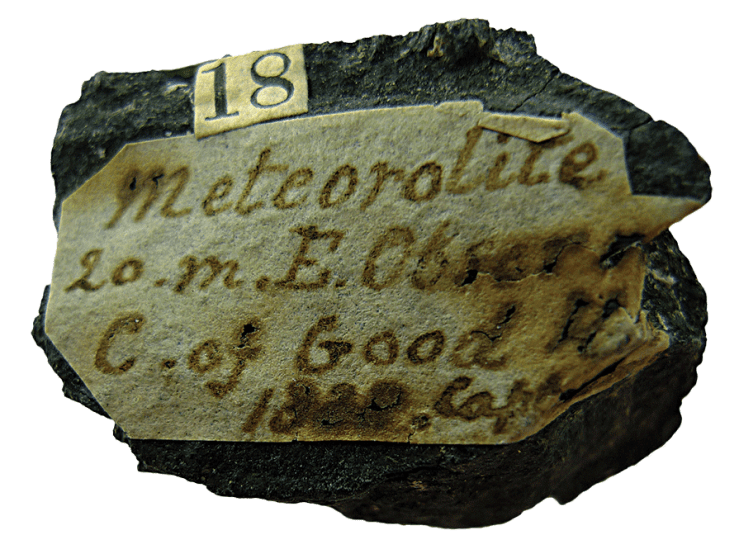
“The loudest thunder we had ever heard…” It’s a very good thing this little piece of dull grey rock, less than 30mm across, has a label on it to say what it is! ‘Meteorolite’ is an old name for a meteorite, and this is part of one that fell over the Cold Bokkeveld valley, Cape Province, South Africa, on 13 October 1838. Kieviet, a servant out collecting wood, gave an eye witness account:
‘It was a fine clear morning; there were no clouds in the sky, and there was no wind. At about nine o’clock a.m., whilst we were busy loading the waggon with wood, close to the foot of the mountain, we heard a strange noise in the air resembling the loudest thunder we had ever heard, and on looking up we perceived a stream passing over our heads, issuing a noise which petrified us with terror; a burst took place close to the waggon, when something fell and a smoke arose from the grass. My master sent me to look what it was that had fallen, when I found a stone quite warm, so much so that I could not hold it in my hands’. (Phil.Trans.Roy. Soc., vol. 130, 1840, 177-182)
The Cold Bokkeveld meteorite came all the way from the asteroid belt, where large and small chunks of rocky debris, left over from the formation of the planets, orbit in a band between Mars and Jupiter. When asteroids collide with each other and get knocked out of their orbits, some pieces find themselves on a collision course with Earth to become meteorites.
The other side shows the meteorite itself
This one is a ‘carbonaceous chondrite’, a kind of meteorite that is particularly interesting for scientists because it contains large organic molecules such as amino acids. These are also essential for living organisms; just possibly, meteorites played a role in the origin of life on Earth. It also contains minute diamonds.
The meteorite is about 4.5 billion years old, as old as the Earth itself. The diamonds in it are much older – real star dust from outer space!
Michael Rosen enters the ‘Alice Door’, Christ Church Oxford
I had a magical day of wonderland adventures recently. Each year Oxford celebrates one of its favourite literary daughters with Alice’s Day, a festival of theatre, art, stories and general silliness that takes place throughout the city. As we’re closed this year, we couldn’t join in on the day, so we decided to do something special in the run up.
Along with the Story Museum, Christ Church cathedral and Blackwell’s, the Museum has created the Alice Team… or A Team! Our mission is to show Oxford’s children what an inspiring city they live in, tell them tales of Alice in Wonderland and help them create something fit for an imaginary world. With this year’s Alice’s Day theme set as nonsense, we created a project called Dodo Loco.
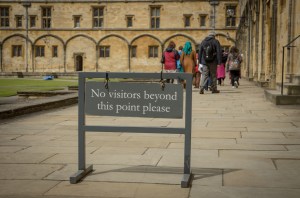
Dodos may be extinct, but we certainly tracked a few down on our hunt around Christ Church. Children from Larkrise, East Oxford and St Ebbe’s Primary Schools joined us for an exciting behind-the-scenes trail, visiting special spots like the rooms where Lewis Carroll (aka Charles Dodgson, or Dodo Dodgson) lived, and the lawn where the real Alice (Alice Liddell) played croquet.
Along the way, they tracked down nonsense words dotted around the college and cathedral. Once we were fired up and had soaked up the atmosphere of Alice in Wonderland, we all marched over to the Story Museum for the next stage of our Alice adventure.
The 120 children (and the A Team members) were treated to a spectacular nonsense poetry workshop by the fabulous Michael Rosen. He got everyone laughing and moving as he performed some of his own poems; my favourite was Hand on the Bridge and I really recommend watching this video for a glimpse of his style. Then, using the words gathered around Christ Church and lots of ideas from the children, he created some more hilarious nonsense poetry, before handing over to the children themselves.
I must admit to being enormously in awe of Michael, so it was great to see how patient and warm he was towards the children and even the adults! He joined my group for the tour around Christ Church, which was both exciting and quite nerve-wracking! He was great, though, joining in with the activities and even telling me a few extra stories about the Alice in Wonderland characters. Here I am with Michael, enjoying another inspiring story.
Over the past six months the Museum Archive has been working on project to catalogue and digitise the William Smith collection. Often referred to as the ‘Father of English Geology’, William Smith was a land surveyor and mining expert in the early 19th century. He developed the techniques of geological mapping that are still used today.
William Smith
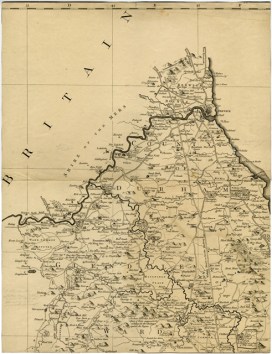
The Museum’s collection came from Smith’s nephew, John Phillips, a geologist and first keeper of the Museum. It contains Smith’s notes, diaries and correspondence, as well as a large selection of geological maps. While digitisation projects are always complex, Smith’s maps have presented some challenging problems, including the fact that a number of them have been cut up into small pieces!
Recently, work-experience students Matthew and Alex (hiding under his hat in the photograph) helped to sort out Smith’s maps of Yorkshire and Northumberland, which were stored as a large number of rectangular pieces. Both were likely cut up by Smith himself, or his nephew John, to use in the field.
Matthew and Alex were quick to catch on to the best technique for sorting a map- do the outside pieces first, just like a puzzle!
Large and detailed maps were necessary for the type of surveying and geological work undertaken by the two men in the early 19th century, but such documents were unwieldy to carry in their original format. Folding the map was also not a good idea, as the folds would wear quickly and tear, making it impossible to read along the tear lines.
Instead, maps would be cut into a number of small pieces and mounted to linen. This allowed the map to be folded to a nice portable size without wearing any section of the map. It looks as though Smith and Phillips never got around to mounting these.
Once the map was sorted into its original order, the students scanned it with the help of our collections assistant and digitisation expert Sarah Joomun. Even after some quick work we can see that the techniques used to recreate the map as a single piece were quite successful.
All of Smith’s maps and a large number of his notes and documents will be available online early next year, with the launch of the Archives’ new online catalogue. This work is being completed thanks to the generous funding received for this project by Arts Council England.
“Hi! My name is Helen, and I am a student at Derby University. I am starting an MRes (Master of Research) degree in Forensic Science in the new academic year, and I am working towards a future career in Forensic Entomology.
In July this year, I undertook two weeks of volunteering in the entomology department of the OUMNH. I was really excited to see another side of entomology, and to be able to get some more practical experience in the field. I have been interested in museum work for some time, so I was pleased to find that I really enjoyed the owrk that the team do.
When I arrived, I was given a tour of hte department and then given a drawer full of mixed specimens to sort to order level.
Drawer of insect orders to be sorted (there are some trick specimens in here)
It was really good practice for being able to trecognise the different orders, and I enjoyed looking at all the different specimens.
Later, I got some extra practice at recognising orders when I sorted some specimens collected in Bolivia.
In my first week, I attended an IPM (Intergrated Pest Management) conference, which helped me learn about the problems with pests in museums, and the methods which are avaliable to help prevent important collections from ebing eaten by hungry critters.
I also got to develop my skills in identifying insects using keys, and I had a go at point mounting some specimens – a technique used to moutn very small insects for identification and display purposes.
My first attempt at pointing insects
In my second week of volunteering, I was able to practice the new skills I had learned in my first week as well as gaining some nrw ones. I had a go at direct pinning some specimens and added some new labels to part of the collection which had belonged to W.J. Burchell. I also uised the auto-montage to create some amazingly detailed photographs.
An auto-montage photograph of Calliphora vicinia.
I would really recommend volunteering to anyone with an interest in entomology – it’s such a wonderful experience to be able to see what goes on beind the secenes in a museum, as well as having the chance to see such a huge variety of insects in the collections I would love to go back and do some more volunteering at the museum in the future.”
The department would like to thank Helen for all her hard work and the for the contributions she made during her two weeks with us.
This week’s What’s on the van? comes from Amo Spooner, of the Museum’s Hope Entomological Collections.
Reverend Frederick William Hope (1797- 1862) was a British entomologist whose interest in insects began in 1817 and his main passion was for beetles. He founded the Museum’s Hope Entomological Collection and in 1849 gave his entire invertebrate collection, along with his substantial library and collection of portraits and engravings to Oxford University.
Hope’s fascination with beetles seemed mainly focused on the large, shiny ones! One of his particular favourites was the Lucanidae, commonly known as Stag beetles. This specimen is Lamprima schreibersi, found by Hope in 1845. This is the only specimen housed in the HEC. It is a type specimen; these are the most important specimens within a collection, because they are the ‘original’ specimen to which all others are compared. In the original description they are usually designated to an entomological collection within a museum, this allows them to be kept safe and be accessible to researchers.
Larvae of stag beetles feed on rotten wood; they become adult once they have finished their three larval stages. The adults feed on tree sap and rotten fruit. Lamprima schreibersi is an Australia species, so it is likely that they would feed on Eucalyptus trees. However, limited research has been done into the behaviour of this species, so no conclusive information can be given.