Chris Packham Goes to Town

Chris Packham

We have had the pleasure of hosting the brilliant Chris Packham at the Museum recently. He has been filming with the collections for a forthcoming series for the BBC. Keep an eye out for that.

In the meantime, we chatted to Chris about our Goes to Town trail of specimens around Oxford city centre. He was very enthused about the idea and volunteered for this snap in front of our banner outside the front of the Museum.

Chris said: “I think this is a really good idea. If it encourages people who otherwise wouldn’t visit the Museum to come along and have a look at things then that is really worthwhile.”

It is almost a couple of weeks since the release of the specimens and we are now looking forward to receiving entries to our competition. To enter, you’ll need to visit all twelve specimens on the trail and tell us, via the website, which has the highest Danger rating and which has the highest Rarity rating. Prizes will be given to people whose names are drawn out of the hat when the Museum reopens in February next year.

But for you blog readers, here’s a sneaky taster:

Here's an escapee in situ. You'll have to get up close to read the all-important ratings...
Here’s an escapee in situ. You’ll have to get up close to read the all-important ratings…
Photo: Mike Peckett

Comings and goings

Minerals being organised
Naomi organising the minerals

The summer’s a time of comings and goings in the Museum, and a perfect opportunity for all sorts of people to get a bit of experience of working in a museum. Last week saw the end of a placement for Naomi, a 3rd year Earth Sciences undergraduate here at Oxford. She has just spent two weeks helping us to catalogue a large collection of North of England minerals. She was fascinated to find specimens of rare minerals from mines and quarries near her home and her student mapping area, both of which are in Cumbria. Many of the mines were still working when the collection was made, but today they are disused and many are flooded or lost.

Robert working on the displays

School student Robert also joined us for a week as part of his school work experience scheme. He spent a day repairing fossils and helping staff spruce up the palaeontology displays. There’s lots of competition for our very few work experience placement opportunities, but we could see why Robert was keen to work in the Museum. He loves geology and is really keen to study Earth Sciences at university – maybe here at Oxford.

Afternoon tea  break gave Robert the perfect opportunity to find out from Naomi what it is like to be an Earth Scientist at Oxford, and indeed what made so many of the staff sitting round the table want to study and make a career in geology. Geology is a subject that can make a big difference to lives, whether prospecting for ores, oil or water supplies, or understanding geo-hazards such as earthquakes and volcanoes. But there’s no doubt about it, working outdoors in the field was a big attraction… and so was working with amazing and rare specimens in a museum!

We’ll be looking forward to following Naomi and Robert in their geological careers.

Monica Price
Assistant Curator, Mineral Collections

What’s on the van? – Seahorse

Seahorse

This week’s What’s on the van? comes from Malgosia Nowak-Kemp, Collections Manager in the Museum’s Zoological Collections.

Although called a “seahorse”, it is of course a fish and its name Hippocampus comes from the Greek “hippo” meaning a horse and “kampus” meaning a “sea monster”. But it certainly does not look like a monster. Seahorses live in tropical or temperate seas where the water is shallow, with plenty of plants, reefs or mangroves. Different species are of different sizes, ranging from tiny ones measuring less than 2 cm to much bigger ones reaching about 36 cm. They are quite unlike any other fish as they swim upright with the head high up and the tail below and not like other fishes that swim in a horizontal position.

Their body also lacks the typical covering of a fish –the fish scales, but has special plates that are arranged in rings and covered by skin. The number of rings is most helpful in the identification of the 50 or so species of Hippocampus.

The seahorses are famous for the male carrying the fertilised eggs in a special body pocket, or pouch. Laying and fertilising the eggs is preceded by a courtship where the male and female swim together and engage in a courtship dance, after which the male becomes responsible for the care and protection of their brood. When the young are ready, a process similar to giving birth takes place. The male contracts the muscles and thus expels the young fish into the water. Although most of the seahorses release a large number of young, less than 1% survive and the urgent need for protection of most species is now recognised by marine conservation bodies.

If you want to learn more about these fascinating animals, then do check The Seahorse Trust website: www.theseahorsetrust.org and www.britishseahorsesurvey.org

What's on the van?

Shell-sorters

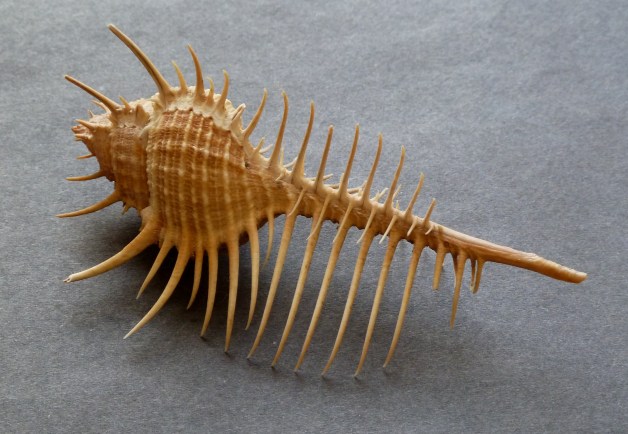
Venus Comb Murex (Murex pecten)The mollusc collection at the Museum is formidable, estimated to comprise in excess of 100,000 lots, collected by several notable amateur shell collectors over the last 200 years. Unfortunately, until quite recently, this collection was in a fairly disorganised state. Parts have been catalogued on paper in the past 40 years, but a much larger part was stored away in drawers and boxes, with some unopened for decades…
Spiny dye-murex (Bolinus brandaris)

Over the past ten years, the majority of these extra collections have been sorted into family level; that is, grouped by family classification but not further divided into genus and species.

To take this organisation further, the entire mollusc collection is now being properly curated and the details recorded on an electronic database so that researchers can find and access the material more easily.

Over the past three months, ten hard-working volunteers have given up their time every Monday to help with the current (very
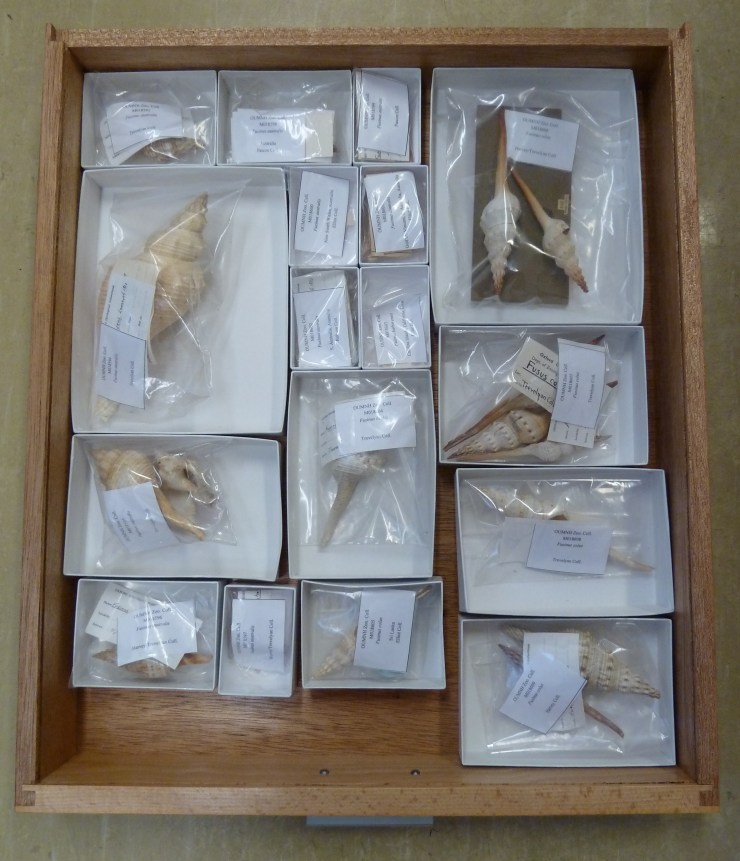
time consuming) stage in the process. Working mainly on marine gastropods, the volunteers first remove the shells from their original boxes or bags and re-package them using modern museum storage materials.

An unsorted drawer...
An unsorted drawer…

The species names are checked against an online database and updated where necessary. The volunteers then organise each family alphabetically by genus and within genus by species. The final stage in the process is to record the details of each specimen onto an online database and to label the newly-packaged shells. That’s a lot of work.

...and a newly-sorted drawer
…and a newly-sorted drawer

Thanks to their enthusiasm and great team work, our volunteers have sorted, checked and curated over 8,000 lots of shells and reorganised them into more than 250 drawers. Around 3,500 specimens have been added to the database since March, taking the total number of lots in the mollusc database to nearly 20,000.

Only another 80,000 to go!

Carolyn Lewis, Palaeobiology Technician

Goes to Town

A new exhibition is opening up around Oxford city centre. While the Museum of Natural History is closed in 2013, some of the inhabitants have made their way to Oxford town centre. Find them all before January 2014, record their Danger and Rarity ratings and enter our competition at the Goes to Town website.

Goes to town, OUMNH, exhibitions

The Hope Entomological Collections are missing a few of their insects. There are two displays featuring bugs around and about town which we hope you will enjoy. The first features the beautiful bookworm, literary critic and the second a selection of edible insects. Yes, insects that you can eat rather than ones that eat you.

 entomology, displays, OUMNH, town trail, bookworm, Anobium punctatum
The bookworm bites back- installation of the bookworm damaged book is complete!

If you are in Oxford town centre today (July 1st) then you might be lucky enough to see some members of the installation team that are out and about putting the various objects on display. They are easily spotted by their white lab coats emblazoned with the Goes to Town logo (as sort of seen in the above photo). Below is a sneak preview of the edible insects case:

edible insects, entomology, entomophagy, displays, OUMNH, town trail
Fancy a quick bite? Have alittle nibble on one of these tasty critters.