What’s on the van? – Social wasp

_3011789_2This week’s What’s on the van? comes from James Hogan, of the Museum’s Hope Entomological Collections.

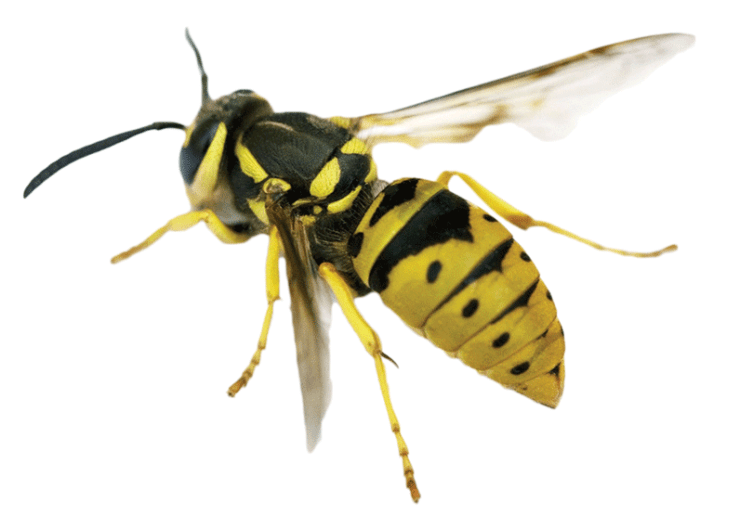
Social wasps are a group of insects belonging to the family Vespidae. In Britain we have 8 species of social wasps (species of Vespula and Dolichovespula) and the hornet (Vespa crabro).

Social wasps are viewed rather negatively by many people, perhaps understandable considering their stings and habit of building nests in houses. Despite this, I would argue that social wasps are much maligned creatures and play very useful roles as pollinators and pest controllers in the garden. During much of the spring and summer, social wasps are working away unseen, consuming large amounts of other insects such as flies, caterpillars and aphids. It is only in late summer when their normal food supplies are running out that they can make unwanted visits to picnics.

Paradox beetle
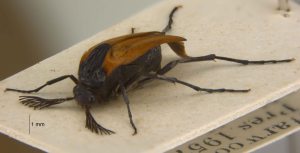
Paradox beetle – Metoecus paradoxus

In a wider and less human-centred context social wasps are part of the food chain, providing food for other animals such as birds and spiders. One very interesting aspect of the ecology of social wasps is that their nests provide a home for a whole range of insects found nowhere else. Two good examples are some of Britains largest hoverflies (species of Volucella) and the strange ‘paradox beetle’ (Metoecus paradoxus). The paradox beetle (Metoecus paradoxus) is a parasite of social wasps. This particular specimen was collected from a nest in a house in Yeovil.

So spare wasps a thought before reaching for that rolled-up newspaper!

What's on the van?


Ode to a Dodo

Professor Dodo

Now here’s a sad story
That you all should hear
About a funny old bird
Who had never known fear

Till explorers landed
Upon the isle of Mauritius
And the creatures they brought
Found this Dodo delicious

Too docile to fight
Too flightless to flee
Now a head and a foot
Are all you can see

There’s a rather nice article on the Guardian website today all about our famous Dodo remains. Journalist Henry Nicholls interviewed our zoological collections manager Malgosia Novak-Kemp, who showed Henry the only known surviving soft tissue remains from the extinct Dodo.

The article includes a reference to Hilaire Belloc’s poem, so it seemed appropriate to share this little Ode to a Dodo with you. We wrote it as part of our Goes to Town trail, which is launching in Oxford next week.

You can watch a short trailer about this at goestotown.com, but suffice to say that the Dodo will feature, along with his Ode, in one of our partner venues. See if you can find him and all the other exhibits from Tuesday next week.

Scott Billings, Communications coordinator

Saga pedo – the Spiked Magician

Orthoptera, identification, cricket, Tettignoidae, Saga pedo
Saga pedo, a species of bush cricket. Photograph courtesy of M. Steadman.

We get a number of enquiries each year from the general public asking us to identify various insects that they have found in their homes or gardens. The majority of these enquiries are of British insects (as you might expect) but we also get a handful of more exotic and exciting insects that people have seen whilst on their travels in other countries.
The photograph above was sent to us by Mr M. Steadman and was taken whilst on holiday in Turkey.

The large and very impressive insect pictured is Saga pedo- a species of cricket belonging to the family Tettigonidae. It is an unusual species for a number of reasons but in particular because it is predatory. Nearly all crickets are herbivores, feeding on a wide variety of plant species. Saga pedo feeds primarily on insects and has been known to cannabilise members of its own species. There are even a number of reports of this species hunting small reptiles and young birds.

This species is also unusual because it appears to reproduce asexually by parthenogenesis. Specimens are therefore female and can be identified by the long spear shaped ovipositor at the rear of their body (as seen in the photograph above). There has yet to be a reliable sighting of a male specimen of Saga pedo.

Look out Oxford…

GTT

There’s a flurry of last minute activity around here at the moment. Display cases are being collected; a funny proto-human ape creature model is being cleaned and prepared for the limelight; and logo-adorned lab coats are being freshly starched and pressed. We are preparing to go to town.

Mobile site
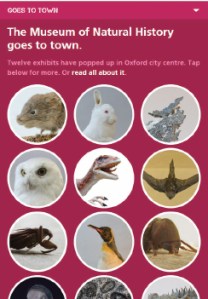
The smartphone-friendly Goes to Town website

You may have seen our teaser trailer a few weeks back. If not, you can check it out here. It didn’t give much away, but regular readers of this blog deserve a proper heads-up: Next week we will be installing twelve specimens in venues all around Oxford city centre, creating the Goes to Town trail, accompanied by a specially-designed mobile website.

You can see what the goestotown.com website will look like on the right here. It features lots of extra info about each specimen on the trail, along with audio recordings about each exhibit made by Museum staff and Oxford University scientists. The site will go fully live after the specimens are all safely in their new homes next week.

Goes to Town will remain in the twelve Oxford venues for six months. During that time residents and visitors to the city can complete the trail and enter our competition. Every specimen display has two Top Trumps-style ratings, one for Danger and one for Rarity. If you tell us which has the highest rating in each category we’ll enter you into a draw for prizes to be awarded when the Museum reopens in February 2014.

There will be another little film to follow too, so watch out for that. In the meantime we need to get back to preparing our crate-clad displays. As you can see below, the workshop chaps are beavering away at this right now…

See you in town!

Crate
Preparing the displays

Scott Billings – Communications coordinator

What’s on the van? – What a gem!

_00816-Corundum--001

This week’s What’s on the van? comes from Monica Price, Assistant Curator of the Museum’s Mineralogical Collections.

What is that fine large blue gemstone on the van? Did you guess it was a sapphire? You were absolutely right; it is after all, the most famous of all blue gemstones. But did you know that sapphire is not always blue? It can be yellow, green, purple, pink, even colourless!

Sapphire is the name given to nearly all the coloured gem varieties of corundum, a mineral composed of aluminium oxide. Corundum is one of the hardest of all minerals and is used in industry as an abrasive. It is found in various aluminium-rich igneous and metamorphic rocks and it is so hard that it resists breakdown when the rocks undergo erosion by rivers and streams. Instead it accumulates in river gravels, which can be mined for gem quality crystals.

Most corundum is rather drab, not very exciting at all. Only the best coloured and least flawed crystals are suitable for cutting as gemstones. The colour in blue sapphire is due to a tiny amount of titanium and iron. When corundum contains a tiny amount of chromium instead, it is a beautiful shade of red, and it has a name of its own – ruby. Ruby and sapphire are simply different coloured varieties of exactly the same mineral!

What's on the van?

Red rug to a dodo

Red carpet OxTalent
Enjoying our moment on the red carpet

Wow, we have an award-winning blog! I’m pleased to say that Darkened not Dormant was announced as a runner up for an OxTALENT award this evening. The awards “recognise and reward excellence in teaching and learning supported by ICT” within Oxford University.

Communications Officer Scott Billings and I attended the celebrations and we were genuinely flattered to have been nominated, let alone get a prize.

OxTalent celebrations
Celebrations after the awards

The blog was recognised in the Use of Technology for Outreach and Engagement category, and there was also a mention of the Museum’s Twitter account @morethanadodo. It turns out that the Dodo has quite a following around Oxford!

Rachel Parle, Education Officer