High-tech insect origami

By Dr Ricardo Pérez-de la Fuente, Research Fellow

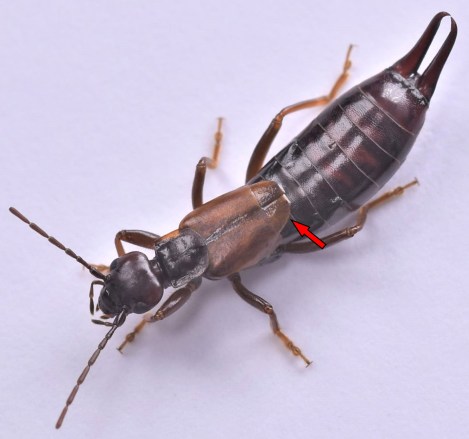
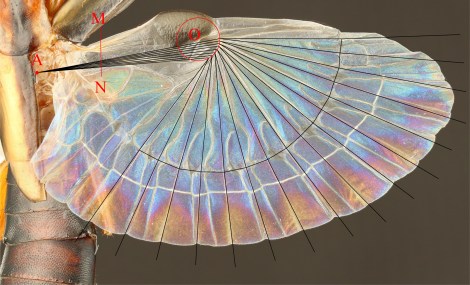
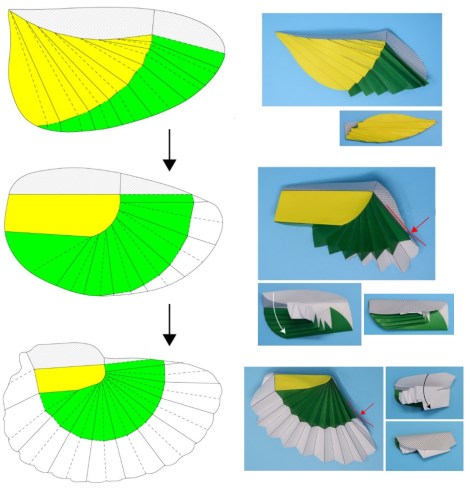
Earwigs are fascinating creatures. Belonging to the order Dermaptera, these insects can be easily recognised by their rear pincers, which are used for hunting, defence, or mating. But perhaps the most striking feature of earwigs is usually hidden – most can fly with wings that are folded to become 15 times smaller than their original surface area, and tucked away under small leathery forewings.

With protected wings and fully mobile abdomens, these insects can wriggle into the soil and other narrow spaces while maintaining the ability to fly. This is a combination very few insects achieve.
I have been working on research led by Dr Kazuya Saito from Kyushu University in Japan, which presents a geometrical method to design earwig wing-inspired fans. These fans could be used in many practical applications, from daily use articles such as fans or umbrellas, to mechanical engineering or aerospace structures such as drone wings, antennae reflectors or energy-absorbing panels!
Dr Saito came to Oxford last year for a six-month research stay at Prof Zhong You’s lab, in the Department of Engineering Science at the University of Oxford. He introduced me to biomimetics, an ever-growing field aiming to replicate nature for a wide range of applications.

Biological structures have been optimised by the pressures of natural selection over tens of millions of years, so there is much to learn from them. Dr Saito had previously worked on the wing folding of beetles, but now he wanted to tackle the insect group that folds its wings most compactly – the earwigs.

He was developing a design method and an associated software to re-create and customise the wing folding of the earwig hind wing, in order to use it in highly compact structures which can be efficiently transported and deployed. Earwigs were required!

Here at the Museum we provided access to our insect collections, including earwig specimens from different species having their hind wings pinned unfolded. These were useful to inform the geometrical method that Saito had been devising.

Dr Saito was also interested in learning about the evolution of earwigs and finding out when in deep time their characteristic crease pattern established. Some fossils of Jurassic earwigs show hints of possessing the same wing structure and folding pattern of their relatives today.

However, distant earwig relatives that lived about 280 million years ago during the Permian, the protelytropterans, possessed a different – yet related – wing shape and folding pattern. That provided the chance to test the potential and reliability of Saito’s geometrical method, as all earwigs have very similar wings due to their specialised function.
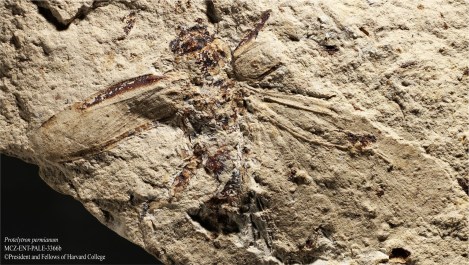
The geometrical method turned out to be successful at reconstructing the wing folding pattern of protelytropterans as well, revealing that both this extinct group and today’s earwigs have been constrained during evolution by the same geometrical rules that underpin the new geometrical design method devised by Dr Saito. In other words, the fossils were able to inform state-of-the-art applications: palaeontology is not only the science of the past, but can also be a science of the future!

We were also able to hypothesise intermediate extinct forms – somewhere between protelytropterans and living earwigs – assuming that earwigs evolved from a form closely resembling the protelytropterans.
As a collaboration between engineers and palaeobiologists, this research is a great example of the benefits of a multidisciplinary approach in science and technology. It also demonstrates how even a minute portion of the wealth of data held in natural history collections can be used for cutting-edge research, and why it is so important to keep preserving it for future generations.

Soon these earwig-inspired deployable structures might be inside your backpacks or used in satellites orbiting around the Earth. Nature continues to be our greatest source of inspiration.

Original paper:  Saito et al. (2020). Earwig fan designing: biomimetic and evolutionary biology applications. Proceedings of the National Academy of Sciences of the United States of America.
Stop, look, listen

By Sarah Lloyd, Head of Education, and William Sharpley, Youth Forum member

Connecting with the natural world around us is important for many reasons. It’s proven to help our mental health, it’s enjoyable and fascinating, and it gives us an insight into the rhythms and changes of the life that surrounds us. And during the pandemic lockdown this has taken on more significance than ever.

Over the past few months we have been keeping in touch with the Museum’s youth groups as part of our HOPE for the Future project, which is supported by the National Lottery Heritage Fund. The project is themed around the Museum’s British insect collection and our discussions with the youth groups have triggered a particular interest in the diversity of insects in our outdoor spaces.

Common Cardinal Beetle (Pyrochroa serraticornis). These beetles are often found basking in the sun on leaves and flowers in woodland margins. Image: William Sharpley.

A great way to become more observant about the world around you is through photography. During a recent lockdown walk, Youth Forum member William Sharpley took out his camera and captured the beautiful images of insects you can see in this post. Looking at insects more closely made William curious about what he could find in his garden, where he noticed a colony of bees active around a compost bin.

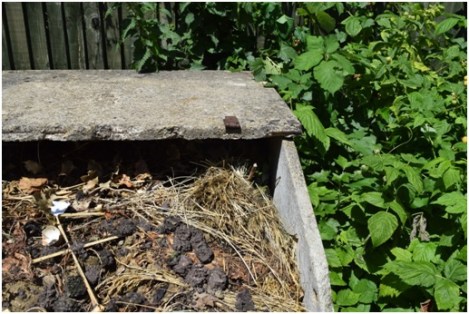
The compost bin is in an old coal bunker. It gets very hot in the sunny weather. I have watched the bees going in and going out of here.

The compost bin in an old coal bunker provides a good habitat for a colony of Tree Bumblebees (Bombus hypnorum). Image: William Sharpley.

Noticing what animals are present, and learning to identify them, helps to build a picture of how the natural world may be changing.

Bees are a good case study. The image below is of a Tree Bumblebee (Bombus hypnorum). Tree Bumblebees were first recorded in the UK in 2001, and since 2007 they have thrived in our increasing urban environments, with numbers and range rising dramatically. They are now a common sight in gardens, establishing colonies in enclosed spaces above ground. William’s old coal bunker compost heap is the perfect spot.

Tree Bumblebees (Bombus hypnorum) like this one have increase in numbers and range dramatically in the UK over the past couple of decades. Image: William Sharpley.

By noticing new species around us we are reminded that populations of living things change over time. Some species, like the Tree Bumblebee, have become more common, while others, such as the Great Yellow Bumblebee (Bombus distinguendus), are now much rarer than they once were.

Great yellow bumble bee (Bombus distinguendus). Image by Nick Owens.

Once we know what is around us we can turn our attention to patterns of behaviour. William went on to use his science skills to plan an investigation.

I will be trying to find out if bees are more active during the morning or in the afternoon. I will count the bees going in and out of the nest at different times during the day.

The Youth Forum conducted a similar study earlier in the spring, observing when female Hairy-footed Flower Bees and Honeybees were active and feeding on garden plants. They found that the Hairy-footed Flower Bees foraged mostly in the morning, and the Honeybees in the afternoon.

Feeding behaviour in bees is an interesting thing to study because it may be affected by some pesticides called neonicotinoids. Honeybees exposed to low levels of these pesticides spend less time feeding, and over a long period their reduced food intake causes a hive of bees to decline and become more susceptible to other pressures, such as disease, habitat destruction, or extreme weather.

Rather than relying on a handful of chemicals like neonicotinoids, farmers are now encouraged to use a range of methods to control pests. These include using natural predators – known as biological control – and organic methods.

From these relatively simple observations of the natural world we can gain important information about changing environments. And by sharing what we notice, and encouraging others to do the same, we are better able to understand environmental changes and we’ll feel more connected to nature as a bonus. So head out and start looking!

The Museum’s Youth Forum was established to connect with and learn from local young people. The group meet every month to take part in a programme of activities designed for and by the group.

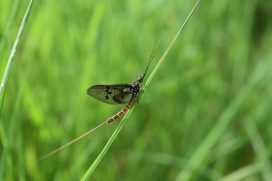
Top image: Common mayfly (Ephemera Danica) by William Sharpley.

When life got hard

By Dr Duncan Murdock, Research Fellow

Whether you’re a great white shark with a deadly conveyor belt of teeth, a deep sea snail with a coat of armour or a coral building the Great Barrier Reef one polyp at a time, mineralized skeletons are a crucial part of many animals’ way of life. These hard skeletons – shells, teeth, spines, plates and bones – are all around us.

The fossil record is full of the remains of the skeletons of long-extinct critters, so much so that entire layers of rocks can be composed almost completely of them. But this has not always been the case…

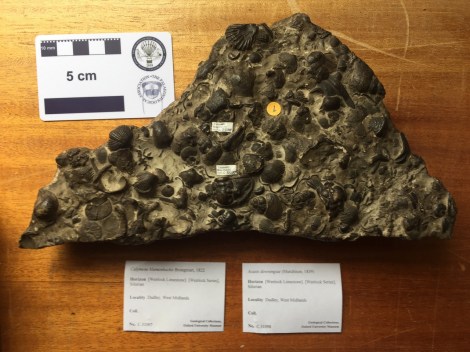
A piece of 425 million year old sea floor containing the skeletons of trilobites, brachiopods, bryozons, corals and gastropods preserved as limestone

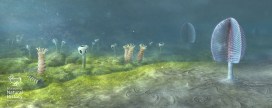
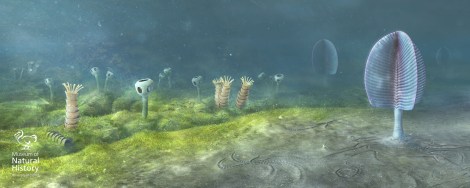
Travel back some 570 million years to a time known as the Ediacaran and the picture is very different. Although there were large-bodied creatures that were possibly animals, they were entirely soft-bodied. Then, right at the end of the Ediacaran Period, the first animals with hard skeletons evolved, creating strange tubes, stacked cones, and other bizarre forms such as Namacalathus, which resembles a baby’s rattle!

Some of the first animals with skeletons, Cloudina and Namacalathus alongside the soft-bodied Ediacaran fauna. Reconstruction based on rocks from Namibia, Southwest Africa, from 543 million years ago. Image: Mighty Fossils.


In the following few tens of millions of years, in the early part of the Cambrian Period, a whole host of animals burst onto the scene baring their ‘teeth’, hiding in their shells, and bristling their spines. In fact, we can trace the origin of almost every kind of animal skeleton to this relatively short window of the Earth’s past.

In my research, I have compiled the evidence for how and when these skeletons first appear. Three key observations have emerged. First, skeletons evolved independently many times in different animal groups. Second, there is both direct and indirect evidence, such as exceptionally preserved fossils and trace fossils, for entirely soft-bodied examples of animal groups that later evolved skeletons. And lastly, the first animal skeletons are less complex and more variable than later examples.

Added to what we know about how living animals build their skeletons, this all points to one explanation: Animal skeletons evolved independently in different groups by utilising a common ‘toolkit’ of genes, inherited from their common ancestor but used in different ways in different skeletons.

In other words, the soft-bodied ancestors of animals with hard parts had inherited all they needed to build simple skeletons that were then honed into the array of shells, teeth, spines, plates and bones we see today. For these skeletal pioneers, armed with their genetic ‘toolkit’, the environmental and ecological pressures of the early Cambrian prompted the evolution of similar, but independent, responses to their changing world – when life got hard.

Murdock, DJE. 2020. The ‘biomineralization toolkit’ and the origin of animal skeletons, Biological Reviews, is available for free here.

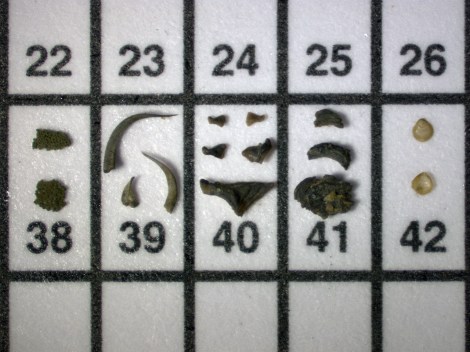
Top image: Tiny fragments of early skeletons, shells and spines, from around 510-515 million years ago.


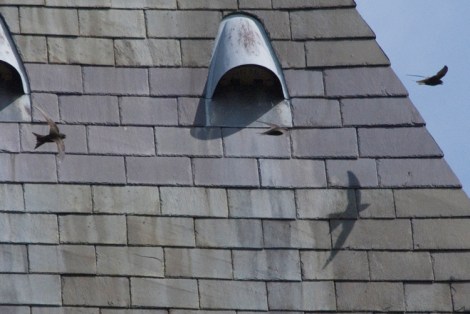
Swifts flying around the Museum tower

Flight and fight

By Chris Jarvis, Education Officer

Last week’s observations of the swift nest boxes in the Museum tower highlighted the drama the colony faces in the struggle for survival. This week’s survey made that struggle even more explicit…

Clambering through the darkened spaces of the Museum tower, lit faintly by the red lights that the swifts cannot see but which help give surveyors a dim view of the ladder rungs and observation platforms, I peered briefly into each nest box to count the birds and eggs.

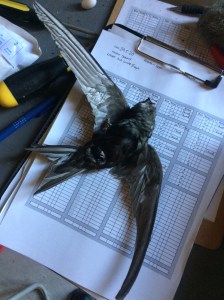
In one box I came across a dead bird, alone and lying on its back. Carefully bagging up the body for later investigation I continued my count while pondering the cause of its death, the sadness relieved slightly with the discovery of new eggs in other boxes and the promise of new life to come.

The body of a dead swift found during the weekly survey of the colony of birds in the Museum tower

Screams and banging from birds prospecting for nest sites are a regular backdrop to each survey. Birds call and swoop past the boxes only inches from my ears, separated by just a few roof slates. The birds within scream back in answer. But on this occasion, half way down the tower, I became aware of particularly loud and persistent screams and banging, coming from within a box.

A quick peek inside revealed a hectic struggle between at least three swifts, wings drawn back, wrestling and rolling around, pecking and slashing at each other with their sharp claws. It was actually impossible to see if the fight involved three or four birds as the struggle filled every inch of the small box with wings, beaks, claws and feathers.

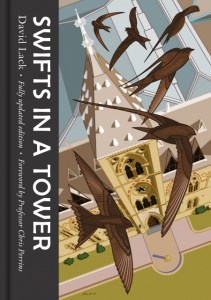
David Lack first documented these fights in his excellent book Swifts in a Tower. He proposed that they were the result of birds entering an already occupied box in the struggle to find a suitable nest site.

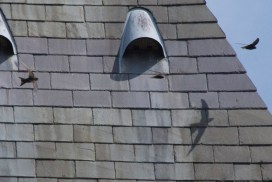
Swifts flying around the Museum tower
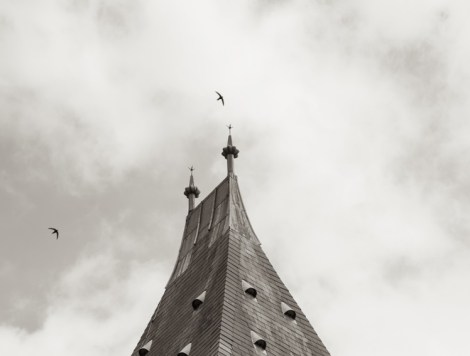
Swifts circle the tower prospecting for potential nest sites, screaming and banging to check which are occupied and which are vacant. Image: Gordon Bowdery

Sitting and anxiously listening beside the box, I recorded the fight lasting 15 minutes from the time I became aware of it. Lack documented ‘gladiatorial shows’ that lasted five and three quarter hours; they were painful to watch, he admitted, as the swifts have a surprisingly strong grip and claws capable of drawing blood, but rarely resulted in death.

When the noise died down, I gently lifted the cloth blind to take another look. Only two birds remained, both looking exhausted and fiercely gripping each other’s feet, one lying under the other. A quick flurry and the upper bird disengaged and jumped from the nest box entrance.

Cover of 2018 edition of Swifts in a Tower by David Lack
Cover of the 2018 edition of Swifts in a Tower by David Lack

Lack also mentions in his book that it is usually the bird underneath in these struggles that is the winner and I was relieved when the remaining bird picked itself up and returned to the two eggs, which had somehow remained in the nest, settled on top of them and preened itself. This suggested that the nest’s original occupant had won, driving off an intruder.

The screaming and banging outside the boxes is a check for a screamed response from within. It reveals whether a box is already occupied or empty, before the bird risks entry. Presumably, the fight I witnessed was the result of a bird not hearing a response or perceiving it as coming from another box.

The drama of the fight illustrates the incredible importance of nest sites and the fidelity the swifts have to them after a year on the wing. Nest sites are at a premium and swifts are almost totally dependent on nesting in old buildings as there are so few forests with suitably old, cavity filled trees remaining.

Once a nest is occupied the owners will fight furiously to defend it and David Lack did record occasional incidents of birds fighting to the death. So perhaps this was the cause of the dead bird I had found lying on its back, but that will have to wait for a later examination.

Meanwhile keep an eye on our nest box; you never know what drama may play out next…

It is important to record nest sites and, if you can, put up nest boxes. RSPB’s Oxford Swift City project, which the Museum and Oxford City Council were involved in, annually surveys and records nesting sites so that development in these areas is restricted during the breeding season and developers must include plans to protect and provide new nest sites when repairs to property or new building takes place. If you would like to help with the work of conserving one of the most dramatic annual migrants to our shores visit the RSPB site.

Robin

The dawn chorus

By Chris Jarvis, Education Officer

With the noises of the hectic morning commute temporarily silenced, it has never been a better spring to enjoy the sounds of the dawn chorus. If you are able to get out early it’s a great way to reduce some of the stresses of lockdown. But if you can’t, or would rather have a lie-in, here we bring a little of the dawn chorus to you.

The video above shows the beautiful grounds of Harcourt Arboretum, a site a few miles outside Oxford that is part of Oxford University’s Gardens, Libraries and Museums. The chirruping, tweeting soundtrack was recorded at the start of the pandemic lockdown, and is an excerpt from 50 minutes of uninterrupted dawn chorus which you can listen to in full here (recommended background while WFH!):

The enveloping sound of the dawn chorus is an ensemble piece, but who are the individual players? To hone your birdsong identification skills and practice picking out individual songs of some common British birds, Andy Gosler at the Edward Grey Institute for Ornithology has put together this beautiful resource.

So now we’re in the zone, let’s find out a little more about the dawn chorus and how it’s made.

A sense of dawn
Why are so many birds singing at dawn and not at another time of day? There are several good reasons which may explain this.

At dawn, there are fewer other environmental noises cluttering the airwaves and the air density and temperature allow sound to travel further. Many migrant birds arrive in the UK overnight and early morning, and those that are ready to breed begin looking for mates and territories early in the day. So singing at this time stakes a clear claim to new arrivals and announces that the territory is already taken.

For insectivorous birds and those that use sight to find food, dawn is the least profitable time to search. Insects are more dormant in colder temperatures and food less easy to spot in dawn’s lower light levels and early morning mists. It’s a better use of time and energy to sing!

But why spring? What triggers birds to start singing? It clearly makes sense to breed at this time of year when there is a steady supply of food, as insect population growth coincides with the re-growth of the plants that feed many insects.

But the real trigger is day length. Increased light boost hormones in birds that spark incredible physiological changes. Unlike humans, birds have an amazing ability to reduce and increase the size of various organs according to their use, carefully regulating the amount of energy expended by those organs.

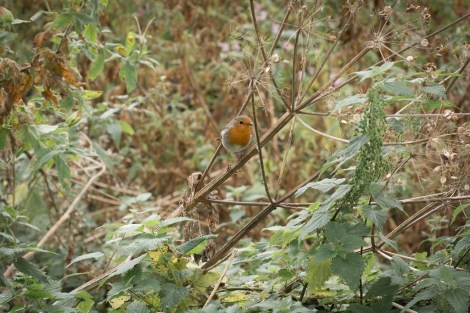
Robin
The Robin (Erithacus rubecula), Britain’s national bird, is one of the many voices contributing to the dawn chorus. Image: Scott Billings

Shifting sounds
As hormone levels increase, not only do birds’ sexual organs increase in size ready for the breeding season, but the part of their brains dedicated to sound processing and sensitivity also increases, meaning that birds’ hearing abilities fluctuate throughout the year.

Imagine not being able to recognise what people were saying or who was talking in winter, then suddenly being able to pick out every minute difference in tone, volume and timbre in spring! When you listen to the cacophony that is the dawn chorus, this is exactly what each bird is doing – recognising each individual and its territorial and breeding condition – and many birds show less acuity for this outside the breeding season.

Sound location also improves. Humans have relatively large, wide heads and this allows us to judge the direction a sound is coming from by detecting the slight differences heard by each ear. With their tiny heads, birds cannot do this when their heads are still, so they move their heads around a lot to help locate sounds.

You might be thinking that with such sensitive hearing birds would be in danger of going deaf during a raucous dawn chorus. But they have another adaptive trick up their sleeves. Inside the inner ears are tiny cilia, or hairs, that detect the vibrations of sound. In mammals, these hairs gradually diminish over time and don’t grow back, but birds have the ability regrow cilia throughout their lives!

Hidden music
Birds are also able to process birdsong much more quickly and fully than we can, hearing things that our brains are just too slow to cope with. Whilst we may love the musicality of the dawn chorus, we are actually missing many of the individual notes.

A verdant scene at Harcourt Arboretum

Sonograms of bird songs show that where humans often hear just a couple of notes there may be several more emitted at rapid speed.

How do they do it? We sing by passing air over flaps of skin in our sound-producing organ, the larynx, a bit like blowing over a piece of grass trapped between your thumbs. But birds have separately evolved another and more impressive way of singing. They don’t just have one organ to produce song, they have two – called syrinx.

Syrinx are more like drum skins that can be tightened or loosened by muscles as sound passes over them. They can be operated independently or together enabling a single bird to sing a chord of several notes at the same time in harmony with itself!

Time to tune in to the dawn chorus and marvel at the complex, beautiful phenomenon of birdsong…

Eggs in the tower

By Chris Jarvis, Education Officer

We have our first eggs! After an earlier than usual return from the warmth of Africa, followed by a cold snap of north easterly winds, our swifts have begun to lay their first clutches of eggs in the tower.

Ten eggs were counted on 14 May, some in pairs and some lying singly on nests. Birds in other nests appear to be incubating as well, sitting in pairs and screaming out at any newcomers investigating possible nesting sites.

More swifts are arriving daily and screaming parties are urgently exploring for potential nesting locations. They buzz the tower’s nesting holes at speed and bang on the entrances with their wings like naughty teenagers playing a vociferous game of ‘knock and run’!

Typically, no bird has yet elected to nest in either of the boxes fitted with webcams. But as the weather warms and more swifts take up residence every day, we’re sure you’ll be able to follow all the drama of the Swifts in the tower very soon.

The swifts circle the Museum tower looking for suitable nesting sites

The delicate art of laying
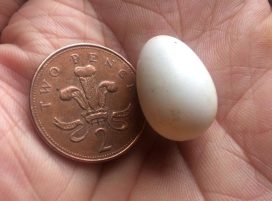
Swifts tend to lay their eggs in the mornings, usually between 8am and 11am. The small, fragile eggs are white to reflect light, an adaptation shared by most cavity-nesting birds that makes the eggs more visible to adults in the dark of the nest.

The first eggs this year appear to be quite early in the season compared with the observations by David Lack in the 1940s and 50s. At that time, when the study of the Museum’s colony began, the first eggs were recorded on average between 17 and 22 May, but sometimes none was laid until the first week of June.

Egg production and laying in swifts are very closely tied to the weather, and production seems to be triggered by the availability of food. Swifts feed exclusively on small airborne insects, which are more abundant in the warm thermals and light winds we experience on good summer days.

It takes a swift five days to produce and then lay an egg. Five days before our first eggs were laid it was sunny and warm, just before the strong, cold north easterly winds swept down over the weekend and lowered the temperature. The warmer early start to the summer seems to have triggered this early laying; whether this is a trend that is increasing as the climate changes is something we should able to answer with long-term datasets provided by studies like this.

Dealing with the weather
Whatever climate change has in store for us it is becoming clear that we won’t experience repeated hot summers. The unpredictability of the British summer reigns supreme.

Swifts have evolved several wonderful adaptations to deal with the vagaries of our weather. Their eggs can be left without an adult to keep them warm for several days. There are records of eggs being left unattended for almost a week and still developing normally. Although adults usually take it in turns to feed and brood the eggs, sometimes during the day the eggs are left unattended by both birds which are then able to forage far afield for food.

Unlike many songbirds which produce one egg a day until their clutch is completed, swifts are able to space out their laying. In a clutch of two or three eggs, the second or third may be laid two or three days after the first, depending on weather conditions. The birds will also limit the size of clutches, with clutches of three eggs the average in warm weather and two eggs the average in cold weather. This helps the adults to supply all of their young with enough food.

Finally, swifts may also eject eggs and lay a second clutch. Some studies have linked this behaviour to cold weather but this has not always been the case at the Museum colony and is a further line of investigation in the ongoing studies of these most secretive of birds.

From laying to hatching usually takes about 19 days, depending on the weather. So we should be seeing our first chicks at the very beginning of June, hopefully streaming live on the Swiftcam

*

Screaming parties prospecting for nest sites are a good way for you to see if you have nesting swifts nearby. Any records really help with our understanding of the current population in the UK. You can help conservation and recording for the Oxford Swift City project, or use the RSPB’s Swift Mapper for the rest of the UK.