Image credit - Gilles San Martin, licensed under CC BY-SA 2.0

Decoding the honeybee dance

Image credit - Gilles San Martin, licensed under CC BY-SA 2.0

This article is taken from European research magazine Horizon as part of our partnership to share natural environment science stories with readers of More than a Dodo.

Unravelling one of the most elaborate forms of non-human communication – the honeybee’s waggle dance – could help researchers better understand insect brains and make farming more environmentally friendly.

It’s part of a field of work looking at insect neurology which is helping to unravel the complexity of their brains.

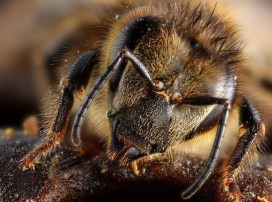
Bees have evolved a unique, and ingenious, way to communicate with each other – the waggle dance. By shaking their abdomens in a particular way, a bee can tell others in its hive the specific direction and distance of a food source or a new site for a nest.

‘If nectar or pollen is in the direction of the sun, a bee will run a figure of eight that is orientated towards the top of the hive. If pollen is found 90 degrees from the sun they will point that way instead,’ explained Dr Elli Leadbeater, a bee expert from the School of Biological Sciences at the University of London, in the UK.

The longer the bees spend dancing corresponds to the better quality of a food source, while the more time spent on each figure eight represents the distance from the pollen or nectar.

Researchers now believe that decoding this information-packed dance further could reveal a link between bees’ brains and how the surrounding environment affects them. In a project called BeeDanceGap, Dr Leadbeater is working to identify the exact genes in the bee brain that play a role in helping the insects understand this waggle dance.

To do this, researchers must first identify the best dancing bees in a test hive and watch them as they reveal a food source to other worker bees. The newly educated bees are then captured as they leave the hive so their brain tissue can be genetically analysed to determine which genes associated with learning and memory were activated from following the waggle dance.

Only a few individuals are used in this way and the genetic data provides a deep insight into the neurology of a bee’s brain – at a time crucial to their future.
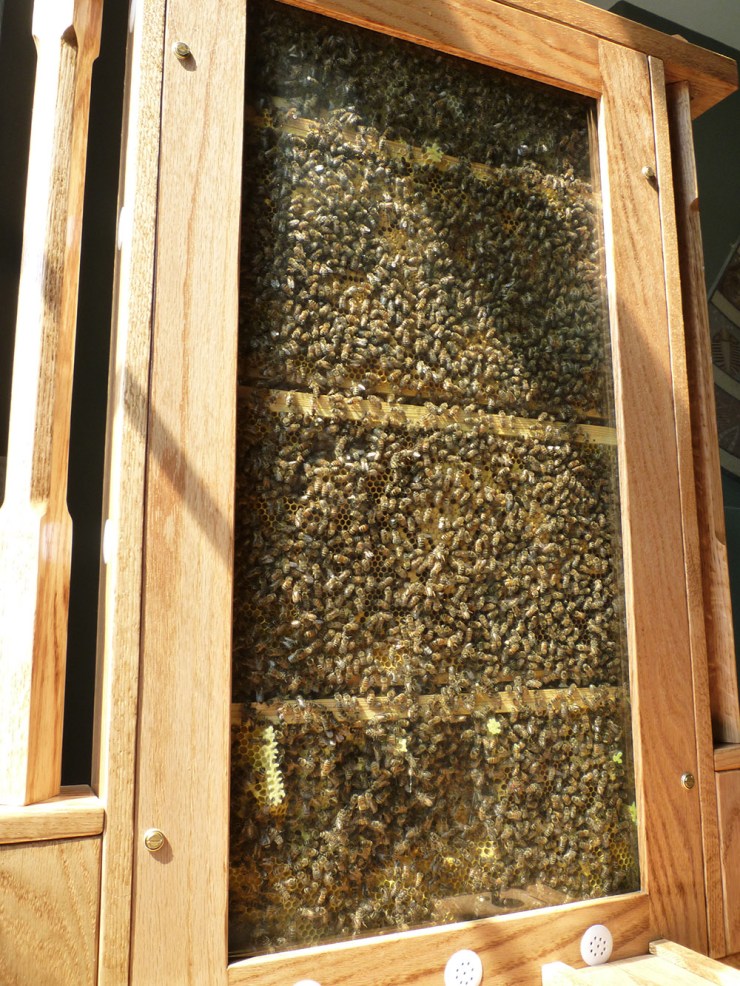
The observation bee hive at the Oxford University Museum of Natural History gives visitors a glimpse into hive life.

Collapse

Beekeepers around the world have reported that many of their bees leave and never come back, causing hives to suddenly collapse. Experts believe there are several factors contributing to this widespread loss of bee colonies, including climate change, parasites and habitat loss. Agrichemicals like pesticides and neonicotinoids, which are used to kill unwanted insects on farms, have also been strongly linked to the problem.

‘The rate pesticides or neonicotinoids are applied to crops don’t necessarily kill bees but they make them worse at foraging,’ said Dr Leadbeater.

If you do damage to just one part of the brain of a lot of individual bees, it can have huge consequences for the whole colony.
Dr Elli Leadbeater, University of London, UK

Neonicotinoid pesticides have been found to bind to parts in the insect brain, disrupting neural transmission. This leads to some brain cells either failing to develop or not functioning properly.

The EU recently banned neonicotinoids, which Dr Leadbeater believes is a huge step forward in protecting bees, but she said governments still need more rigorous ‘long-term environmental safety monitoring’. Without this, there is a risk that other agricultural products used in place of neonicotinoids could impact honeybees in a similar way.

But when the first results of BeeDanceGap are published later this year, they could contribute to building better criteria for testing future agriculture practices or products. Dr Leadbeater believes it will provide a new understanding of a bee’s brain, and so help identify problems sooner.

The impacts of quickly identifying problems go far further than just supporting beekeepers and their insect charges. Protecting honeybees, along with bumblebees and wild bees, is also essential to maintain a healthy and productive environment. These insects pollinate over 80% of crops and wild plants in Europe. According to Professor Martin Giurfa, from the Research Center on Animal Cognition at CNRS in France, ‘preserving little brains is about preserving biodiversity’.
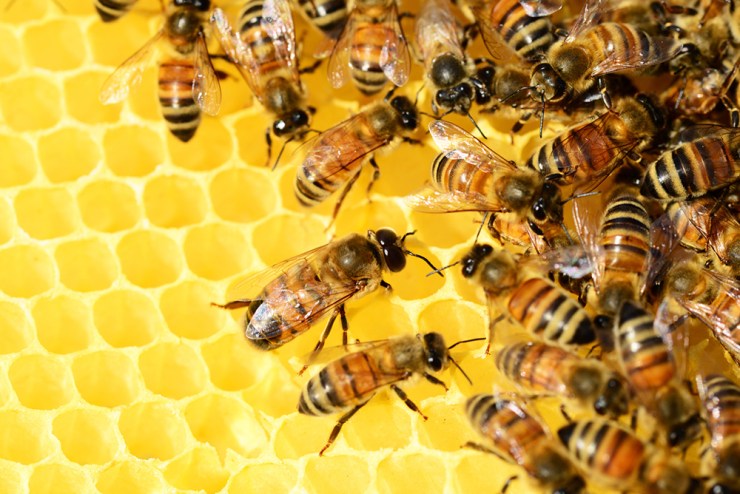
Honey bees working inside a hive

More than machines

Honeybees have a higher social complexity than many other species. Alongside the waggle dance communication, each hive has a division of labour where different workers have responsibility for a variety of tasks – such as foraging for pollen, nursing the young, building hives and even removing the dead.

Prof. Giurfa is co-leading the BrainiAnt project, which looks at how this type of complex social behaviour evolved and how it affected the structure of insect brains. He said that when ‘you understand how bees perceive the world, it is easier to find ways to protect them’.

Through the work of researcher Dr Sara Arganda, the project is investigating a part of the insect brain called the mushroom body, where learning occurs and long-term memories are stored. Researchers analysed bee behaviour and gave them memory tests, such as navigating paths using colour cues, in order to learn more about the structure of insect brains.

The project strengthened the argument that bee brains are more complex than previously thought. ‘Most findings are saying that insects are more than simple machines, which comes from studies in the honeybee,’ said Prof. Giurfa. ‘(But) the entrance region of the mushroom body shows a level of complexity and the studies show that this complexity is not rigid, it is plastic.’

This means its structure is changing all the time, which mirrors how human brains work. ‘(Bee) brains are capable of sophisticated performances such as learning concepts and rules; they are incredible organs and they need to be defended,’ said Prof. Giurfa

To further advance understanding of the mushroom bodies and how they function in different species, the project is being co-led by Professor James Traniello at Boston University in the US, an expert in ant evolutionary neurobiology.

Ants, which are related to honeybees, have brains that may be 100 times smaller, and due to their minute size, provide insights into how insect brains are structured.

‘What happens to neural tissue at an extremely small size?’ asked Prof. Traniello. ‘Are you losing neurons, are neurons becoming more efficient in their actions, how many neurons do you have to string together to form a circuit that enables behaviours as complex as what you would see in ants? How does the collective intelligence of an ant colony impact the structure of the brain?’

If BrainiAnt can answer these questions, it would provide a clearer picture of the evolution and function of ant brains.

‘The next step is trying to understand the genes that are involved in regulating brain size, compartment variability, metabolism and other functions,’ said Prof. Traniello.

He added that a better understanding of neural tissue could also help to guide attempts to genetically engineer bees so their brains are resistant to environmental threats like neonicotinoids. Although far off, it could mean that bees, and the benefits they bring to the environment, will have a more secure future.

The research in this article was funded by the EU.

*

The issue

One in ten pollinating insects is on the verge of extinction, and a third of bee and butterfly species are in decline.

On 1 June, the European Commission launched a proposal to tackle this problem at an EU level. It includes a new monitoring process to collect quality data and identify trends, action plans to protect insect habitats and incentives for businesses such as those in the agrifood sector, to contribute to conservation.

The proposal, known as the EU Pollinators Initiative, has a number of short-term actions to be taken before 2020, at which point the progress will be reviewed.

This post Decoding the honeybee dance could lead to healthier hives was originally published on Horizon: the EU Research & Innovation magazine | European Commission.
Odd egg out

This is a great time of year to hear the distinctive call of the Cuckoo (Cuculus canorus) as it spends the summer in the UK. Collections Manager Eileen Westwig recently shared Cuckoo specimens with the public in one of our Spotlight Specimens sessions. You missed it?! No problem, here she is with the fascinating story of this threatened bird…

Cuckoos could be described as absent mothers, laying their eggs into the nest of a ‘host bird’, such as Dunnocks, Meadow Pipits, Garden Warblers, Whitethroats or Flycatchers. When she finds a suitable nest, the female Cuckoo will remove one of the host’s eggs and lay hers in its place. She lays between 12 and 22 eggs in a season, all in different nests. No worries befall her about building a nest, brooding out any eggs or raising her young as she leaves it all to strangers. One challenge for the Cuckoo is to make sure her trickery is not discovered.

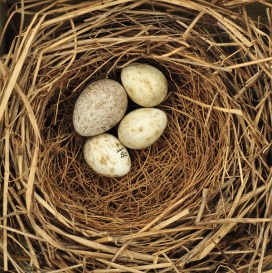
When the female host returns to her nest, she will inspect it for any changes and if she discovers the intruder’s egg, she will simply toss it out. So the female Cuckoo has to be pretty good at forgery and mimic the host bird’s egg ‘signature’, copying the colour, pattern and shape of the original eggs. This is the only way to get away with her ‘brood parasitism’. Around 20% of Cuckoo eggs never make it. In the top picture, you can see the nest of a Garden Warbler with three Warbler eggs and one larger Cuckoo egg, on the top left.

An adult Garden Warbler (Sylvia borin borin) can reach a weight of 16-22g with a wingspan of 20-24.5cm

After twelve days, the Cuckoo hatches and pushes the other nestlings out. As the single remaining occupant of the nest, it has the full attention of the host parents, which try to feed a nestling soon outweighing. An adult Cuckoo is more than 6 times the weight of an adult Garden Warbler. The Cuckoo young will leave the nest after 19 days, but gets fed by the parents for a further two weeks. That is one busy summer.

OUMNH.ZC.11868_Cuculus_canorus_canorus_Eileen_Westwig
An adult Cuckoo (Cuculus canorus) can reach a weight of 105-130g with a wingspan of 55-65cm.

According to the RSPB, there are about 15,000 breeding pairs in the UK and Cuckoos are now included on the Red List, giving them the highest conservation priority. Ten years ago, numbers of this migrant bird fell by 21% and more than half of the population has disappeared in the past 25 years. Threats include damage to the bird’s winter habitats and a decline in large insect species that are its major food source.

Cuckoos migrate to West Africa over the winter months and can be seen in the UK from late March or April through July or August. Young birds leave a month or so later to give them time to grow and prepare for the long journey ahead. Wintering grounds are not exactly known but include Cameroon, Gabon and other African nations.

What is a tree of life?

A phylogeny? An evolutionary tree? A cladogram? We see the branching lines of these diagrams in many museum displays and science articles, but what do they tell us and why are they helpful?
Duncan Murdock, research fellow, explains. 

You are a fish.

Starfish, jellyfish and cuttlefish are not fish.

Actually, no, there’s no such thing as a fish. Let’s take a step back…

The Jackson 5 – the ultimate singing family tree?
Credit: Wikimedia Commons

It all comes down to common ancestry. All life is related, and we can think of it in terms of a family tree (or ‘phylogeny’): Jackie, Tito, Jermaine, Marlon and Michael were all Jacksons. United not only by a collective inability to control their feet, but also by common descent – they are all their parent’s children*.

By tracing further and further back in MJs family tree we could define ever larger groups united by common ancestors, first cousins (grandparents), second cousins (great-grandparents), all the way to every human, every mammal, every animal, and eventually all life – we are family (ok, that was Sister Sledge, but you get the point).

In the case of the tree of life, species are at the tips of branches and their common ancestors are where branches meet. A true biological group consists of a common ancestor and all its descendants, and we can use characteristics common between two species to imply common descent. Siblings look a lot like each other because they have inherited much of their appearance via common ancestry (i.e. their parents). In a similar way, two closely related species will share lots of inherited characteristics.

However, things are not quite that simple. Wings of bats, birds and insects are not inherited from a common ancestor but independently evolved for the same purpose, in this case flight. To complicate things further, as species evolve they may lose features inherited from their ancestors that other descendants retain. Snakes have lost their limbs, but still sit in the same group as lizards. These problems can be overcome by looking at many characteristics at once, using genetic information to test predicted relationships, and adding fossils to the tree to track change or loss through time (as in snakes).

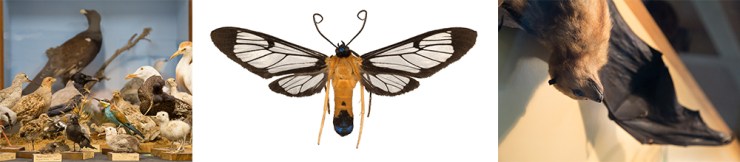
Birds, insects and bats have all evolved wings for flight, but did not inherit this feature from a common ancestor. This is a good example of convergent evolution.

So, what about fish? ‘Fish’ is used to refer to pretty much anything that swims in water, but this lifestyle in animals like starfish (a relative of crinoids and sea urchins), jellyfish (a relative of corals) and cuttlefish (a relative of squid and octopus) evolved independently from more familiar fish like cod and carp. So, they’re not really ‘fish’ at all. With that in mind, how can we be fish? Well, the last common ancestor of, say, hagfish, salmon, shark and lungfish, is also the common ancestor of frogs, lizards, cats and us! All four-limbed animals with backbones descend from a fish-like ancestor. To complicate things further some have adapted to life back into the water and look much more like a ‘fish’ again, like dolphins, seals and the extinct ichthyosaur. Without a tree of life, we could not begin to unravel the evolutionary path that lead to all the diversity of life we see today.

The Blue Fin Tuna on display in the Museum is definitely a fish… right?!

You are closer to a chimp than a monkey, closer to a starfish than a snail, and closer to a mushroom than a tree. And, of course, there’s no such thing as a fish, but they still go well with chips.

*Joseph Jackson and Katherine Scruse had ten children, including the members of the Jackson 5, twenty-six grandchildren and several great-grandchildren.


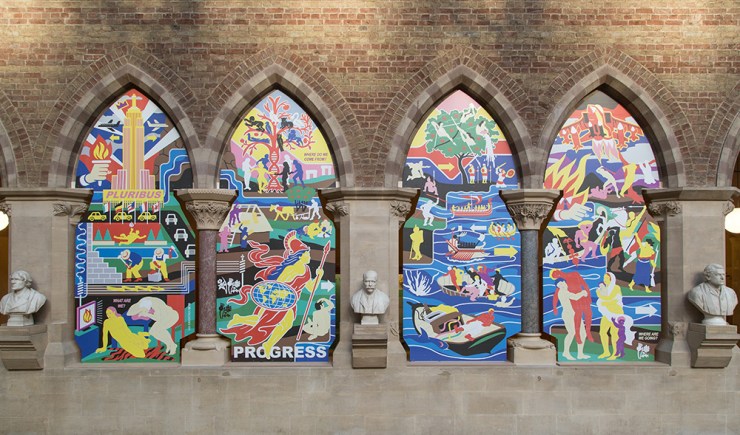
Where Do We Come From? What Are We? Where Are We Going?


These are some of the big questions asked in our current special exhibition, Settlers. It’s also the title of a new artwork by Ian Kirkpatrick that has just been commissioned by the Museum.

You may remember, back in July we put out a call for artists to respond to the main themes of the upcoming Settlers exhibition. We received an incredible response, with almost 100 proposals, so needless to say we were spoilt for choice! After several rounds of shortlisting, discussion and deliberation, we chose Ian Kirkpatrick, a Canadian artist now based in York.

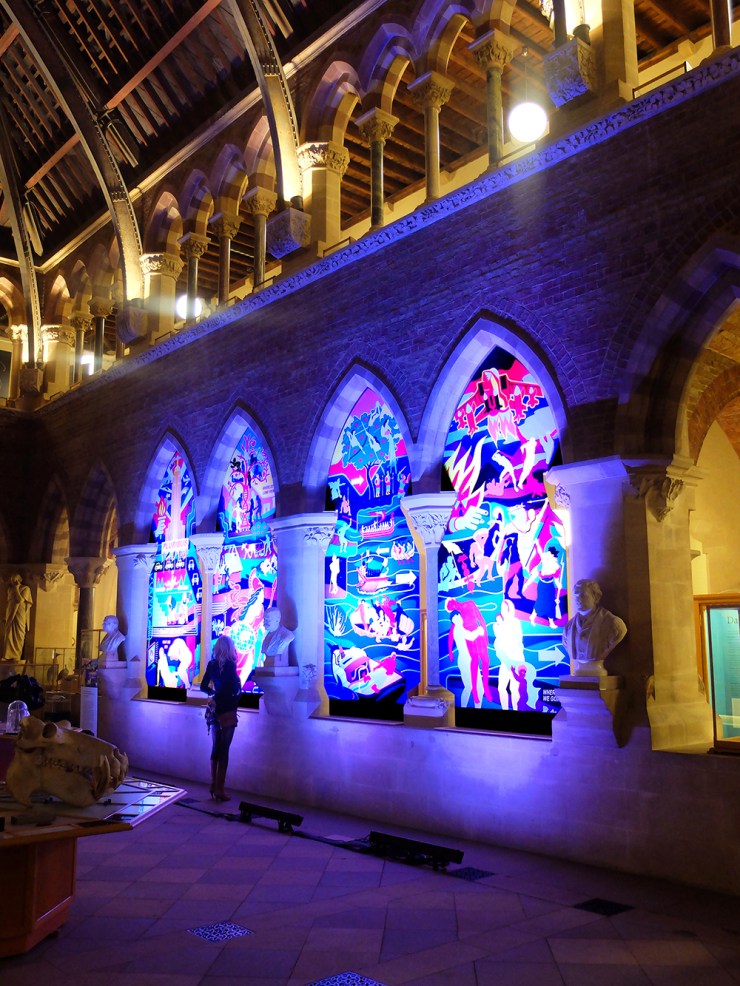
Lit up for the Settlers exhibition launch.
Credit: Ian Kirkpatrick

We were excited by Ian’s bold iconography and references to the history of art and design, while using shapes and colours usually seen on contemporary street signage. His approach to the themes and issues around migration, genetics and settlement were innovative and brave. We also couldn’t wait to see how his work would look in our Victorian neo-Gothic building.

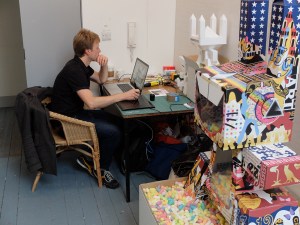
Ian working in his studio. Credit: Ian Kirkpatrick

Over a period of four months, Ian researched, planned and created his spectacular final piece Where Do We Come From? What Are We? Where Are We Going? Here he explains a little about his artistic process:


Most of my projects begin with a period of research – often looking at historical events or interesting facts related to the brief. I often sketch out a very rough layout of the design in my notebook, then create the actual artwork directly onto the iPad or computer. Because I use vector-based software, I can easily rearrange or modify graphics – so the design is constantly shifting until the artwork is finished.

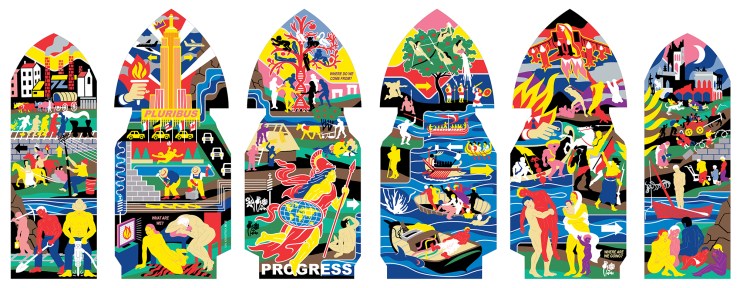
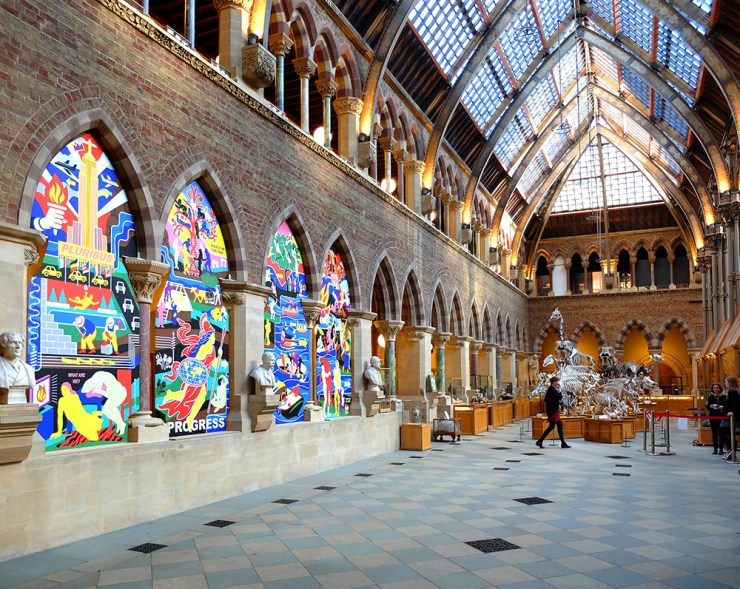
Ian Kirkpatrick’s final design. The two smaller panels (L and R) can be seen on display in the Settlers exhibition gallery.

Ian created a series of six panels that explores the social and natural causes behind human migration, both in ancient times and in the present day. It presents historical and modern peoples moving across a landscape in response to conflict, climate change and urbanisation, and remixes imagery from classical paintings alongside iconography from Great War postcards, Roman coins and the Bayeux Tapestry.

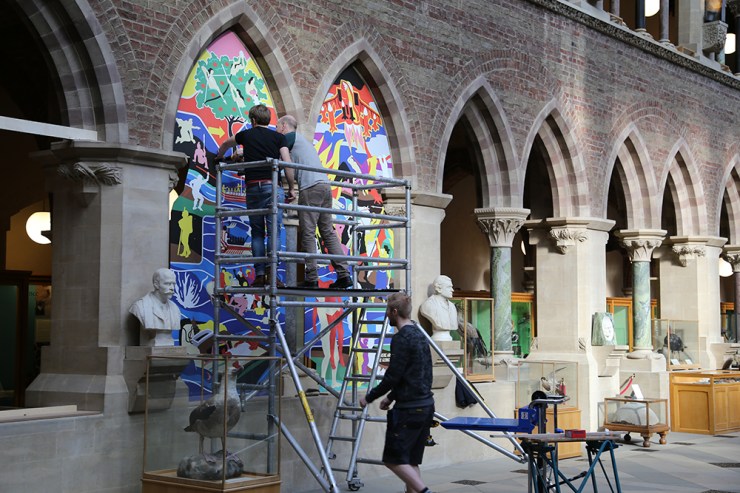
Ian, Peter Johnson and Adam Fisk installing the main panels of the artwork.

Of course, in a building like ours, the installation of such a large, bold piece of work would never be easy. Peter Johnson, the Museum’s Building Manager, came up with an ingenious solution to hold the panels into the arches, without damaging the masonry by drilling or glueing.

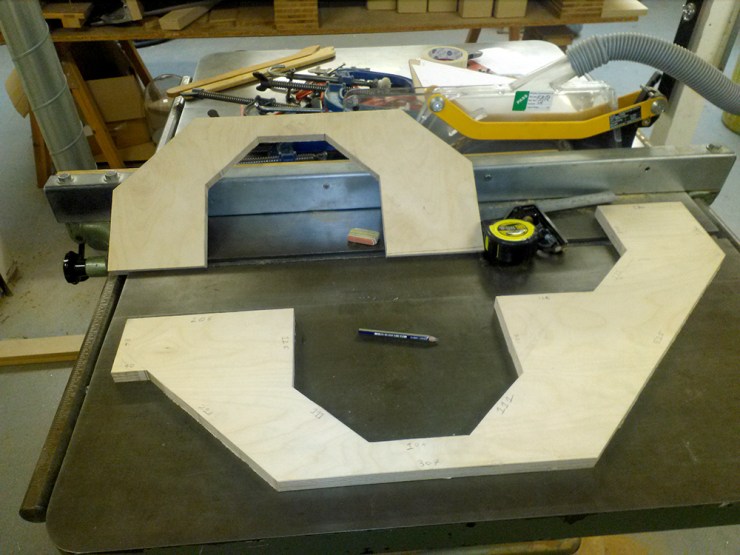
Pieces prepared in the workshop, to sit on the capitals and support the artwork

Hand-cut pieces of plywood were made to snugly fit round the capitals, so that the Dibond aluminium sheets don’t rest on the stone.

Credit: Ian Kirkpatrick

So, standing back and looking at the finished piece, looking resplendent in the winter sunshine and attracting the attention of hundreds of museum visitors, how does Ian feel?

The project was a lot of work – but it’s also been very satisfying to see it finally installed. Although the piece initially started as a comment on contemporary British settlement, it evolved into something that explored global migration throughout all of history.  Trying to find a way to tackle a theme that big, while still remaining visually coherent, is quite tricky!  But I was really pleased with the results and love seeing the finished piece housed within the magnificent neo-Gothic architecture of the Museum!


Kelp our corals!

Many people know about the importance of conserving coral reefs to protect marine biodiversity, but here at the museum we also need to conserve the corals that are in our collections. These specimens provide a valuable picture of the diversity of life in the ocean, and document changes seen over time, which is more important than ever. So it’s essential that our conservation team make sure these corals are in the best shape possible. Stefani Cavazos, an intern from UCL’s MSc in Conservation for Archaeology and Museums, tells us how they’re going to do it.

As part of the ongoing effort to improve the museum’s collections storage we decided to give our soft corals and sponges a bit of TLC through some repacking and reorganisation.

This collection – a mix of old display material and specimens not formally accessioned to the museum collection – isn’t currently stored as well as it could be and there is a danger of breakages and damage. The specimens are packed in non-conservation grade materials, such as cardboard boxes, which are notorious for creating acidic gases that can damage delicate specimens.

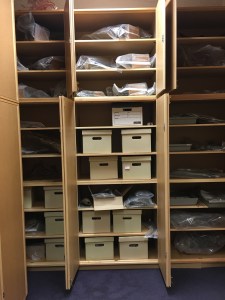
The current housing of our soft coral and sponge collection

So a new project, Kelp our Corals, will focus on two areas of improvement.

First, we’ll remove all old packaging and repack using new bespoke storage boxes made from conservation grade materials. At the same time, specimens will be photographed, catalogued, and given accession numbers.

The goal is not only to rehouse the coral and sponge collection, but to also make it more accessible to the public for use in teaching and for research. We don’t have a lot of documentation for these corals, so hopefully the project will help us fill in some gaps: Where did these specimens come from? What can they tell us about life on a reef?

Large specimens are improperly laid on their sides with no protection from the environment and dust, causing weight stress on the specimen

Would you like to kelp, er, sorry – help? We are looking to recruit volunteers to help us with the work. We’re aiming to start in mid-February and finish by May this year. If you are interested in gaining some museum and conservation experience, or like to work with your hands, please do get in touch at volunteering@museums.ox.ac.uk.

Credit for image at top of post: USFWS/Jim Maragos via Creative Commons

Amour for armour

If you pop in to the Museum at 2.30pm on a Monday-Thursday afternoon, you’ll meet one of our Museum experts with some of their favourite specimens. Here Eileen Westwig, Life Collections Manager, shares one of her recent Spotlight Specimens.

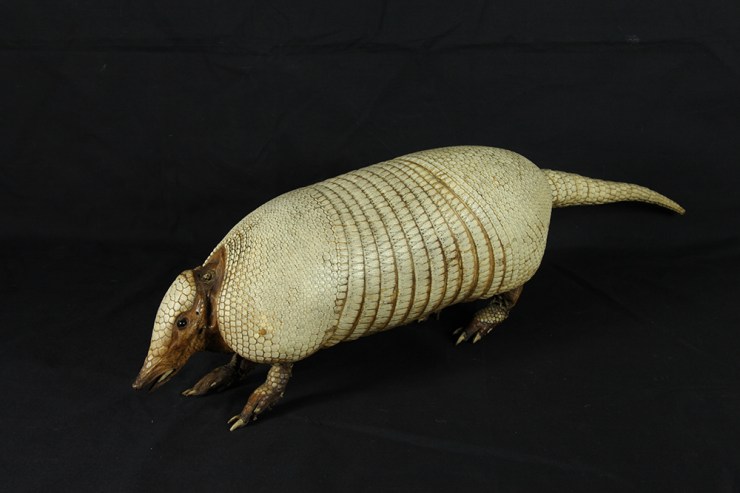
Last month, as part of our regular Spotlight Specimens activity, I chose to highlight armadillo specimens. They got lots of attention, which is not surprising considering how amazing armadillos are. The word armadillo is Spanish meaning ‘little armoured one’. It is true that all armadillos have armour wrapping around their body as protection. Their size, however, varies a lot. The smallest one is the Pink Fairy Armadillo (Chlamyphorus truncatus), which grows up to 18cm (including tail length) and weighs up to a tiny 100g. At the other end of the spectrum, the aptly named Giant Armadillo (Priodontes maximus) is the largest, and can grow up to 150cm (head to tail) and weigh up to 60kg.

Giant Armadillo from the OUMNH collection. Sharp, big claws help to scratch and dig for food, such as tubers and termites, and dig burrows for sleeping.

Armadillos are found in South and Central America. However, the common Nine-banded Armadillo (Dasypus novemcinctus) has spread over the last hundred years, all the way into the southern United States. What makes it so successful is its varied diet of tubers, termites, ant larvae and other insects, as well as snails and bird eggs found on the ground. The expanse of ranching and the absence of natural predators such as cougars have made it easy for this long-nosed armadillo to spread as far as Texas and Florida.

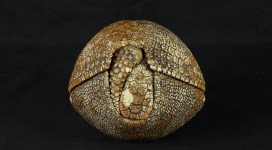
Beside their stiff protective armour, all armadillos are capable of curling up their body to some extent, in order to protect the soft and vulnerable underside. Only one armadillo is the true champion when it comes to rolling up tightly into a perfect sphere. This astonishing achievement can be found in the Southern Three-banded Armadillo (Tolypeutes matacus). In the picture at the top of this page, you can see two armoured triangles in the middle, which are its head (on the left) and tail (on the right).

Common Nine-banded Armadillo showing its body plates, which usually lie underneath a layer of horn.

The armour of armadillos is made out of two layers. There are bony scute plates (visible in white in the picture above) that are overlaid with horny plates. The horny plates are made of keratin, the same material as hair and fingernails.

Nine-banded Armadillo made into a basket as souvenir

Sadly the existence of this amazing creature is threatened by loss of habitat and hunting. Not only are armadillos widely eaten, they are also made into tourist souvenirs, such as this basket.

According to the Centers for Disease Control and Prevention, some armadillos from the southern USA are naturally infected with the bacteria (Mycobacterium leprae), that cause leprosy (Hansen’s disease). Most people (95%) are immune to it, but please use caution if you’re ever in a position to handle an armadillo!