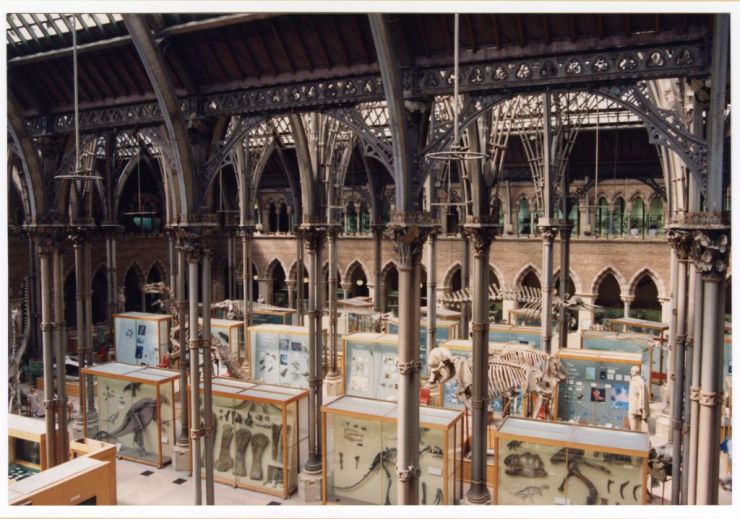
It goes without saying that 2020 has been a very unusual and troubled year, but it is also the 160th anniversary of the founding of the Museum, so we wanted to snatch a little breather from the difficulties of the pandemic, if possible, to take a positive look at the past and future of the Museum.
We have made a few special productions to mark this. Our new temporary exhibition – Truth to Nature – opens in the centre court on 18 October, and is accompanied by this online version for those who can’t make it to the Museum. The displays chart the philosophies and artistry underpinning the creation of the Museum in the mid-19th century and reflect on the role of natural history museums today, including the need for greater equity in science.
Taking a look at the unique and treasured building itself, this short film reveals some of the hidden secrets of the Museum’s architecture:
And finally, this week we have released a new five-part video podcast series looking in greater detail at the history of the Museum’s art and architecture, written and presented by John Holmes, Professor of Victorian Literature and Culture at Birmingham University, who is also an Honorary Associate of the Museum.
We’ll be sharing an episode a week here and on our social media channels, but you can dive into the series here or watch Episode 1, Oxford’s Pre-Raphaelite Natural History Museum, below.
With our Life, As We Know It redisplay project now underway, our Senior Archives and Library Assistant Danielle Czerkaszyn takes a behind-the-scenes look at how we captured the contents of the current displays for the Museum’s archive.
The archive here holds a unique collection of natural history books, journals and documents covering a wide range of subjects related to the Museum’s collections and research. It also contains papers and objects on the history of the building, providing an institutional memory of Oxford’s ‘University Museum’ since its foundation in 1860.
From an archive perspective it was really important to document the current layout of the cases, their specimens and text before they were removed from the court to make way for the new showcases in the first phase of our redisplay work.
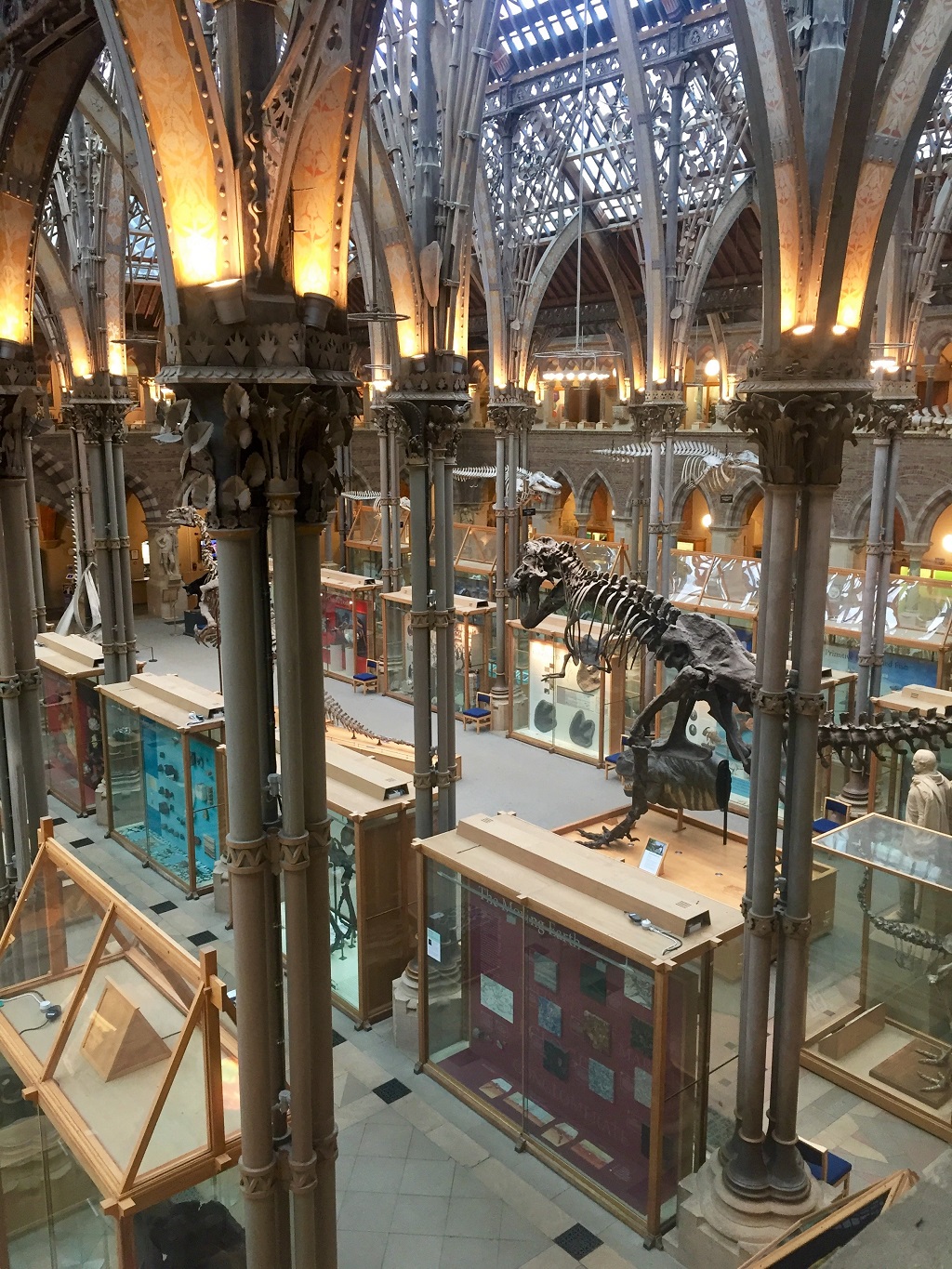
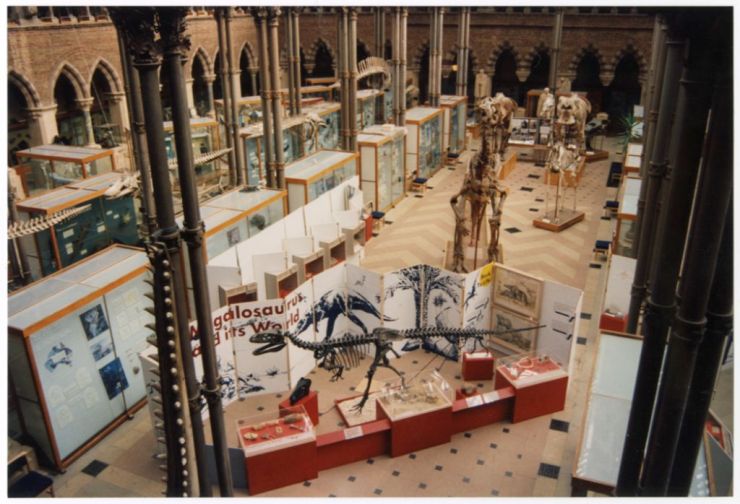
The museum in late 2019
The displays as we know them – with exhibitions on the Oxfordshire dinosaurs, Alice in Wonderland, the Oxford Dodo, and more – were last changed in 2000. For the last 20 years visitors to the Museum would remember their first time being wowed by the Megalosaurus jaw – the world’s first scientifically-described dinosaur – or charmed by the Dodo made famous in Lewis Carroll’s Alice Adventures in Wonderland.
Although after 20 years it is time for a change, the stories and information in the displays are too good to be forgotten. So before anything was removed we began to build the archive for the future.
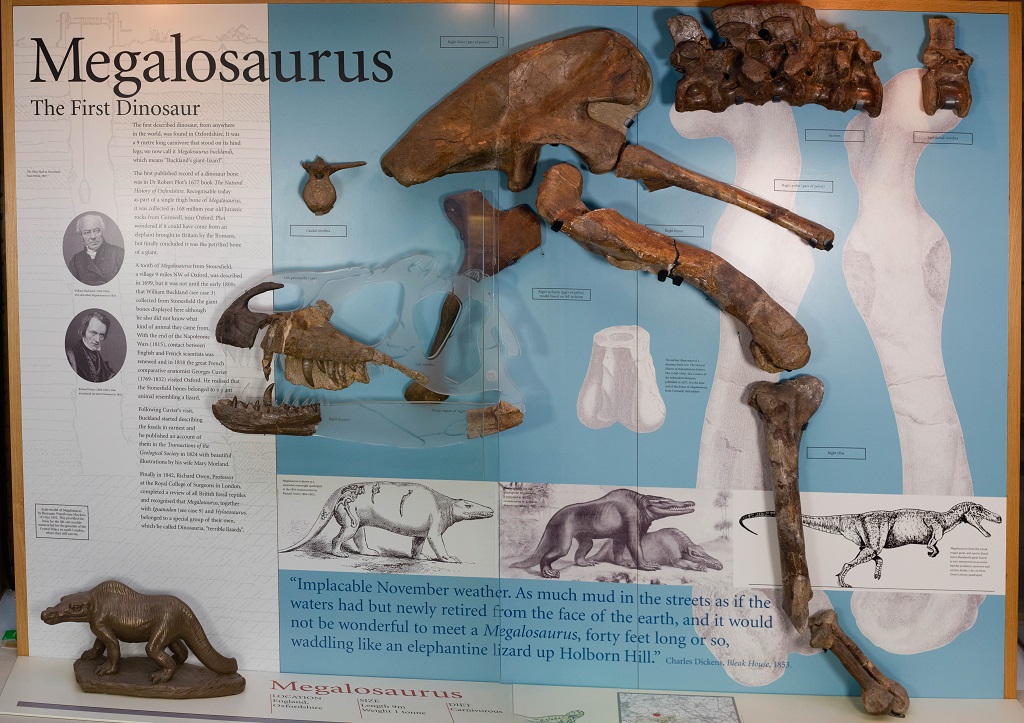
The previous display on Megalosaurus: The First Dinosaur
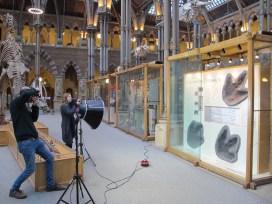
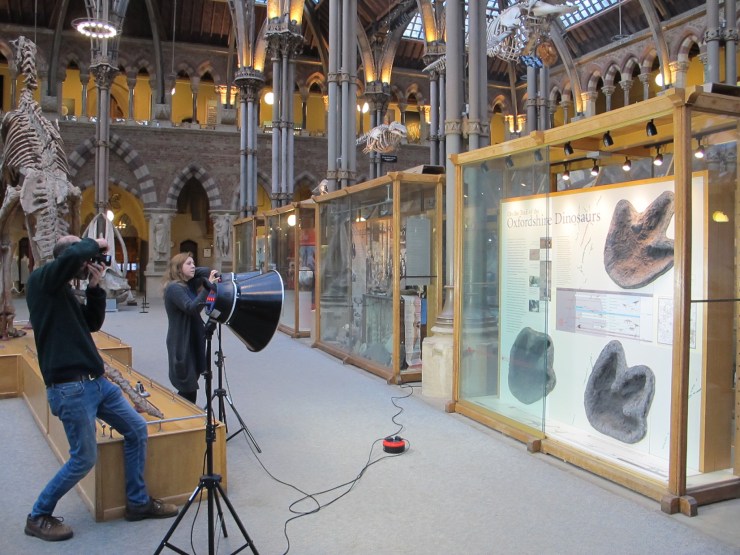
The best way to capture all the information of the displays was through high resolution photography, but this was not as straightforward as we hoped.
The first two obstacles to good photographs are pretty obvious to anyone looking at the cases: glass causes huge amounts of glare; and each case has a big dividing line down the centre where the two sliding glass doors meet, cutting what should be a lovely seamless image into two halves.
To avoid glare and the solve the problem of the dividing line, our photographer Scott opened each individual side of the case, photographed two or three images of the display, and then stitched the separate photos together using Photoshop.
Each case was photographed in two or three segmentsThe segments were then stitched back together and adjusted for exposure and colour balance to create the final image
Another obstacle to taking good photographs of the displays came from the Museum itself. Some of our larger display furniture, such as the glass case for the Atlantic Bluefin Tuna or the huge T. rex plinth – got in the way of a nice straight shot. Because these items are so large and heavy they were impossible to move, so we had to improvise and do our best.
Capturing the displays before the current cases were removed allowed us to keep an archival record of their contents
Thankfully, we managed to get shots of all 24 displays before they were removed and so a record of each case now rests with the Museum’s archive. If anyone wants to know what the display cases in the court looked like from 2000 to 2020, they will now be able to look back at the images in the archive and recall the magic of the Oxford Dodo exhibit that perhaps first made them fall in love with the Museum.
Our new displays are now in development, and will include some beautiful presentations of the diversity of life, looking at the importance and fragility of biodiversity and human impact on the environment. These new exhibits will show how the biological processes of evolution combine with the geological processes of our dynamic Earth to give rise to the immense, interconnected variety of the natural world.
We look forward to telling you more about that here as the project progresses.
The Life, As We Know It redisplay project is supported by a generous grant from FCC Communities Foundation.
As we embark on our Life, As We Know It redisplay project – the first substantial changes to the permanent exhibits in more than 20 years – our Senior Archives and Library Assistant Danielle Czerkaszyn takes a look back at 160 years of an ever-evolving museum, in the first of a series of posts around the redisplay.
On 15 June 1860, Henry W. Acland, Regius Professor of Medicine at the University of Oxford, wrote:
The Oxford Museum slowly approaches completion. The building will shortly sink into insignificance when compared to the contents it will display, and the minds it will mould.
The University Museum at Oxford, as the Museum was originally known, was established to bring together scientific teaching and collections from across the University under one roof. The doors opened in June 1860, and soon after several departments moved into the building – Geometry, Experimental Physics, Mineralogy, Geology, Zoology, Chemistry, Astronomy, Human Anatomy, Physiology, and Medicine.
Ground floor plan of the University Museum in 1866
When the University Museum opened, it was not simply a museum; each department got a lecture room, offices, work rooms and laboratories, as well as use of the library and display areas. According to Acland, a key figure in the Museum’s foundation, in 1860 the outer south aisle of the main court featured mineralogical specimens and chemical substances, while the inner aisle exhibited Oxfordshire dinosaurs.
Acland’s detailed descriptions of the central aisle highlighted zoological specimens with twelve parallel cases of taxidermy birds, four side cases of taxidermy animals, including animals on top of the cases, and six table cases down the centre showing shells, crabs, insects, corals and sponges, starfish and urchins. The inner north aisle presented reptiles and fish, while the outer aisle introduced the Ashmolean‘s zoology specimens, as well as anatomical and physiological collections.
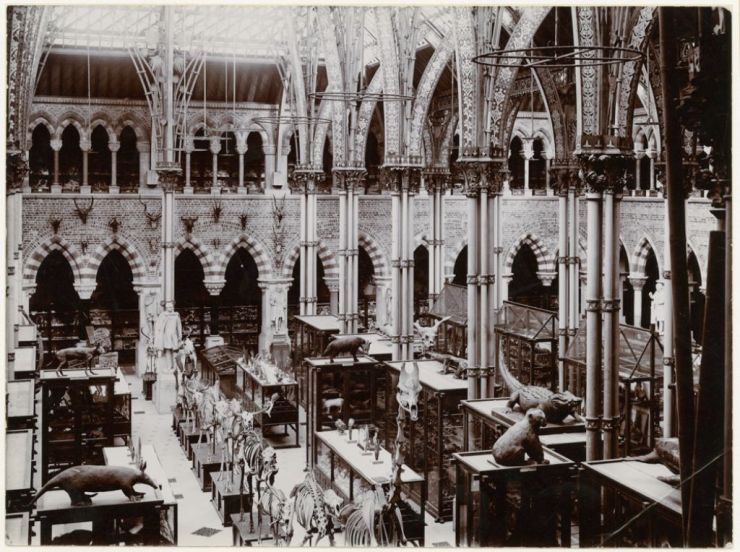
The Museum court in 1890
Although members of the public were welcome in the Museum from the start, the departments which inhabited the building were more concerned with teaching space, research facilities and the storage of their specimens than the needs of visitors. As a result, most of the early displays and cases were arranged in a systematic manner that focused on space-saving practicalities and communicating scientific knowledge, rather than aesthetics.
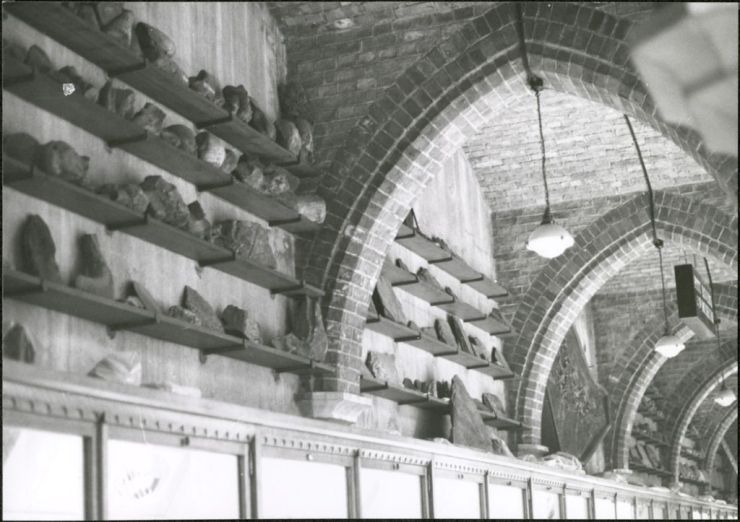
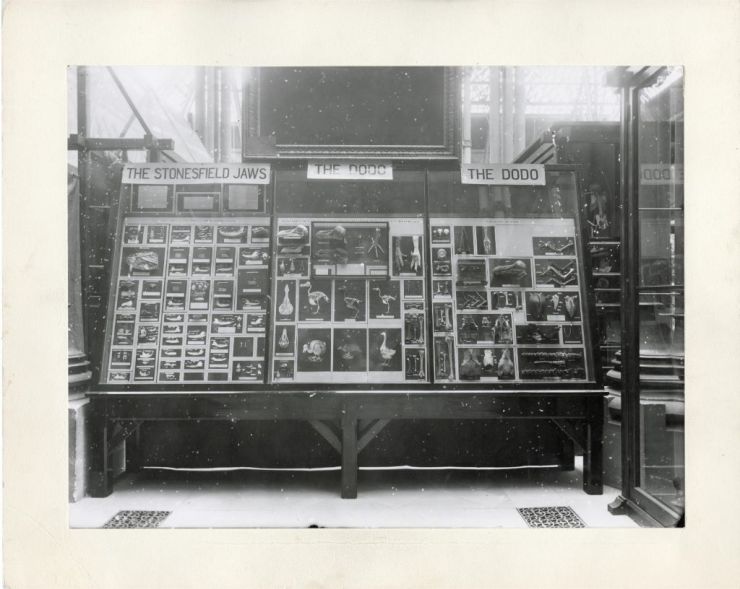
Geology specimens displayed on shelves on the wallsAn early display focused around the Museum’s famous dodo specimen
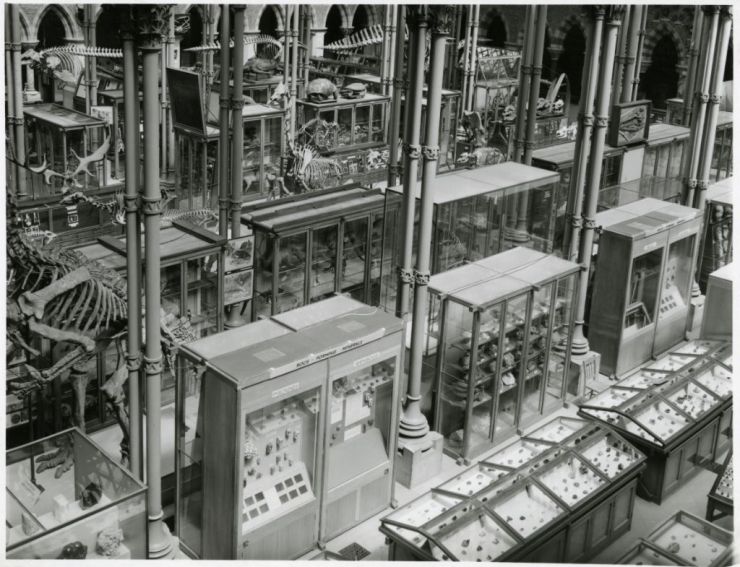
Tracing through old annual reports it is clear that cases in the main court have been almost constantly refreshed and updated, with displays highlighting new specimens and changes to scientific understanding, or through practical improvements to lighting, electricity points and environmental monitoring. Nonetheless, the overall layout of the cases remained the same until the early 1980s.
The Museum court, unknown date
From the early 1990s a focus on public engagement began to increase. Longer opening hours were introduced and displays were redesigned to link to both undergraduate teaching as well as the National Curriculum. Temporary exhibitions also regularly featured in the main court to increase the variety of specimens on display.
The Museum court in 1994A temporary exhibition about the Megalosaurus dinosaur in the 1990s
The turn of the millennium marked the start of a major project to update the main court displays. The central cases were reconfigured and a new set of introductory cases installed, including many themes familiar to visitors in recent years, such as exhibits on the Oxfordshire dinosaurs, Alice in Wonderland, and the Oxford Dodo.
T. rex makes its presence known
These showcases were complemented by the addition of an imposing cast of ‘Stan’ the Tyrannosaurus rex in the centre aisle, positioned behind the historic Iguanodon cast. The changes were well received and attendance in the month of July 2000 was the highest ever recorded. The Museum also introduced live insects for the first time in 2000, with Upper Gallery tanks containing Madagascan Hissing Cockroaches, South American Burrowing Cockroaches, a variety of stick insects, and some large tarantulas.
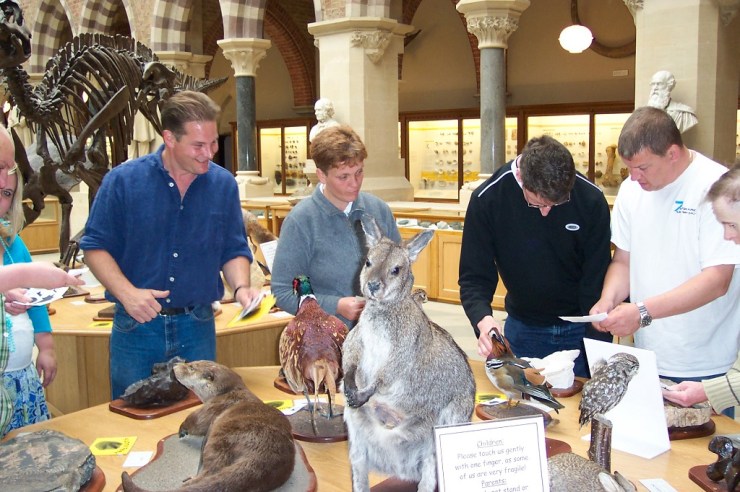
The project completed in late 2005 when the displays on Evolution, the History of Life, and Invertebrate Biodiversity were installed. Touchable specimens were also given their own permanent display area, allowing visitors the opportunity to physically interact with natural history material. These and other public engagement activities were recognised when the Museum won The Guardian newspaper’s Family Friendly Museum of the Year Award for 2005.
New tables of touchable specimens were introduced for visitors in the 2000s.
The last substantial update to the fabric of the building took place in 2013, when the Museum closed for a year to fix the leaks in the glass roof. Taking advantage of the closure, a major piece of conservation work was undertaken on the seven whale specimens suspended from the roof. Having been on display for over 100 years, the whales were in need of considerable TLC.
A conservation team worked on the whale skeletons during the Museum’s closure for roof repairs in 2013.
Today, new and exciting changes are afoot as we embark on the first major changes to our permanent displays in almost 20 years. New high-end showcases will present displays under the concept of Life, As We Know It– beautiful presentations of the diversity of life, and the importance and fragility of biodiversity and human impact on the environment. The new exhibits will look at how the biological processes of evolution combine with the geological processes of our dynamic Earth to give rise to the immense, interconnected variety of the natural world.
Looking back across the decades we can see that the Museum is never static, but instead constantly changing and adapting, shifting from its foundation as a Victorian centre of academia to the accessible and engaging space we know and love today.
by Danielle Czerkaszyn, Senior Archives and Library Assistant, and Kiah Conroy, placement student from Oxford Brookes University
James Charles Dale (1791-1872) was a pioneering English naturalist who devoted most of his life to entomology. Dale’s specimen collection and archive represent a unique historical record of the insect fauna of Great Britain and everyday life in the 19th century. Originally housed in more than 30 cabinets in the Museum’s entomology department, the Dale collection contains many notable specimens, including the world’s oldest pinned insect and several species now extinct in Britain.
Dale was also a prolific writer and the Museum archive holds his notebooks, manuscripts and around 5,000 letters from over 250 correspondents. They form one of the most important historical legacies left by any British entomologist. The individual letters were numbered by Dale and tied into bundles relating to the correspondents. While the bundles were great from an organisational point of view; in terms of long term preservation and accessibility this wasn’t exactly ideal. We were lucky enough to have a placement student from Oxford Brookes University who helped facilitate the first stage of reorganising the letters and rehousing them to ensure their longevity. Kiah shares her experience of working in the archives:
During my placement at the Oxford University Museum of Natural History I was working in the Library and Archives department. The work I did whilst I was there consisted of helping sort through the letters of entomologist James Charles Dale. This was a huge opportunity for me because I had never worked with archival materials before and it was something I was hugely interested in. Some might say archiving letters can be boring, but sometimes you stumble across really interesting finds. For example, when I was working on the letters I found one that Dale had addressed as ‘the most insulting letter I have ever received.’ This is fascinating because his letters gave an insight into the relationships he had with fellow entomologists.
James Charles Dale (1791-1872)
The letter Kiah describes was from Reverend Henry Burney, an amateur entomologist who corresponded with Dale between 1837 and 1847. Although the correspondence is one-sided since we only have Burney’s letters to Dale, it is clear the two had a falling out over money which Burney owed to Dale. As Kiah was rehousing the letters she noticed that the correspondence between Dale and Burney became increasingly tense.
Dale had a habit of annotating many of the letters he received and his annotations on Burney’s letters are curt and cold- he was clearly unimpressed that Burney took so long to pay him back- culminating in his final comment that this was ‘the most insulting letter I have ever received.’ Oh, the drama of the 19th century!
Along with archiving the letters, I also learnt how to catalogue archive material to a high standard as well as learning how to put the James Charles Dale Letters into the museum’s collection management database Emu. This was the most challenging aspect for me, because I had no idea how intricate museum databases could be. Luckily, the whole Library and Archive team were very supportive and showed me the steps. Overall, I really enjoyed my time at the Natural History Museum and I am very grateful I was given the chance to work there.
Today is the 250th birthday of the remarkable English geologist William Smith, creator of the first geological map of England and Wales – ‘the map that changed the world’. Here Danielle Czerkaszyn, Senior Archives and Library Assistant, tells us more about Smith’s achievements and his relationship to the Museum.
William Smith (1769-1839)
William Smith (1769-1839) began his career as a land surveyor’s assistant in his home village of Churchill, Oxfordshire. He soon travelled the country working on mining, canal and irrigation projects. This gave him the opportunity to observe the patterns in layers of rock, known as strata, and to recognise that they could be identified by the fossils they contained. This would earn him the name ‘Strata Smith.’
Smith’s observations of strata over hundreds of miles led to the ground-breaking 1815 publication of his map A delineation of strata of England and Wales (pictured top) that ultimately bankrupted him.
Smith’s map set the style for modern geological maps and many of the names and colours he applied to the strata are still used today. While Smith’s accomplishment was undoubtedly remarkable, he was only officially recognised for his discoveries late in life. His lack of formal education and his family’s working class background made him an outcast to most of higher society at the time.
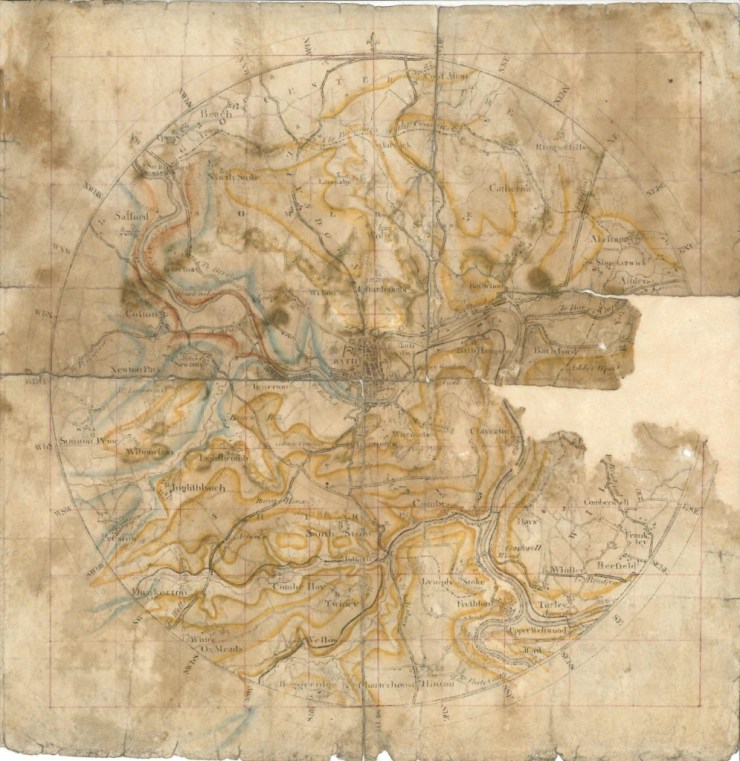
Geological Map of Bath, 1799. This map is considered to be one the earliest geological maps ever created. It demonstrates an early use of Smith’s ‘fading’ colouring technique which emphasised the outcrops of each stratum. The yellow tint represents the Bath Oolite, the blue marks the base of the Lias, and the red the base of the Trias.
It wasn’t until a few years before he passed away that Smith received any recognition for his contribution to the science of geology, receiving a number of awards, including the prestigious Wollaston Medal from the Geological Society of London in 1831, and an honorary degree from Trinity College Dublin in 1835.
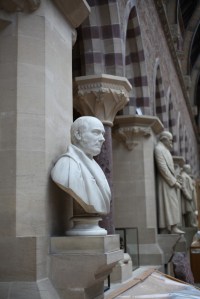
A bust of William Smith is on display in the Museum’s court
His legacy lived on with his nephew John Phillips, one of our Museum’s founders and Professor of Geology at Oxford. Recognising its importance, Phillips left Smith’s archive to the Museum on his death in 1874. Thanks to generous funding from Arts Council England a few years ago, the Smith collection has been catalogued, digitised and is available online to the public.
Few men in the history of science contributed as much, but are as little known, as William Smith. He was a hardworking and determined man who dedicated his life to understanding the world beneath us. So here’s a big Happy 250th birthday to William Smith – the ‘Father of English Geology.’
by Danielle Czerkaszyn, Senior Archive and Library Assistant
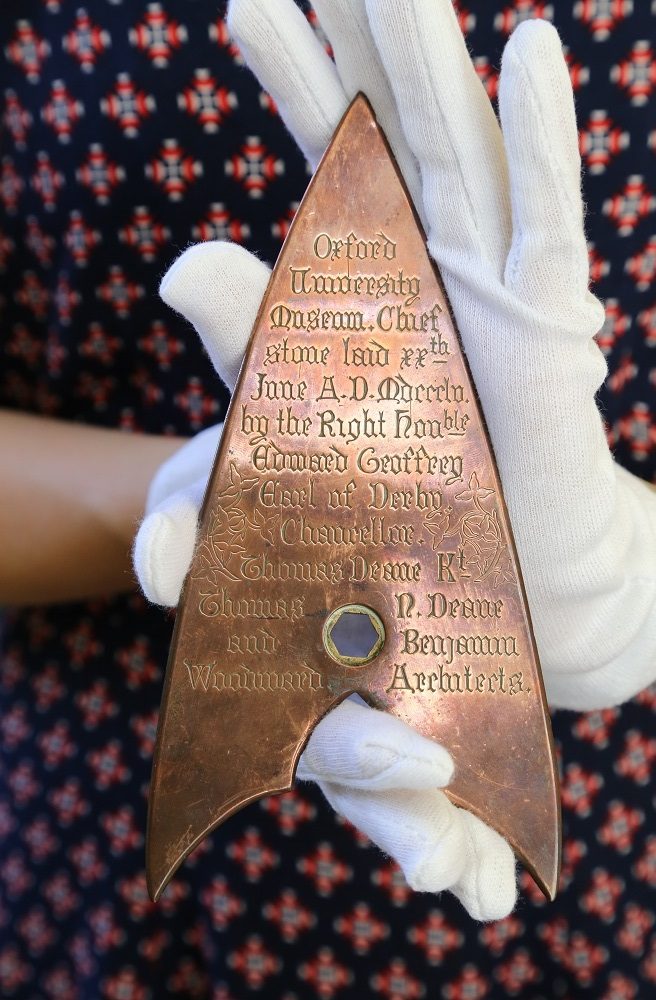
Working day in, day out in the Museum of Natural History’s archive, we like to think we know a lot about our collections. The truth is, with the sheer number of items in our archive and the many nooks and crannies which exist in a historical building, we sometimes need some help rediscovering items in our collections. One such item is the engraved trowel used to set the Museum’s foundation stone.
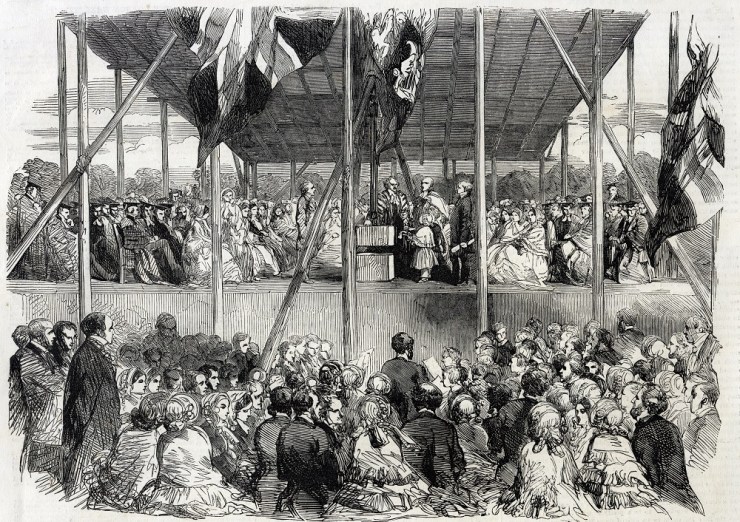
The Earl of Derby lays the foundation stone at the 1855 ceremony. Engraving from Illustrated London News.
The story began when we received an enquiry from a museum enthusiast in America. He had read an article from an 1855 edition of the Illustrated London News, about the foundation stone ceremony. This was the moment that construction began on the Oxford University Museum, as it was then known. It seems that a small trowel was used as part of this ceremony. The article describes the trowel as follows:
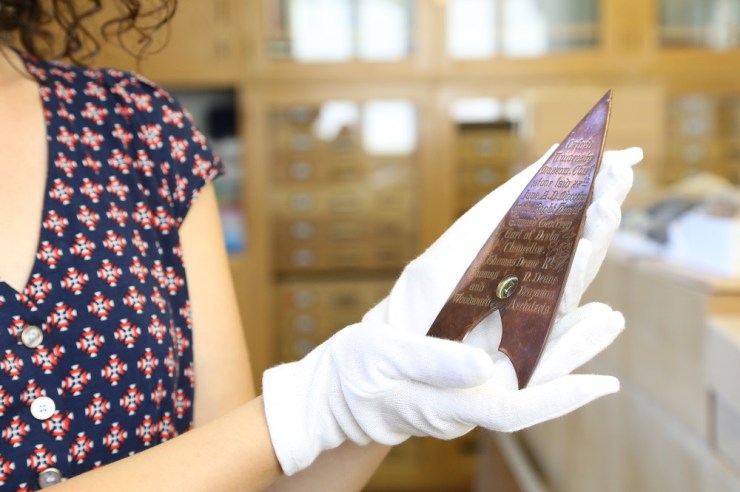
The trowel, which is of silver and bronze, is highly finished, and novel in form. It is enriched by an engraved Gothic pattern on the upper, or silver, side. It was made by Skidmore, of Coventry, who has contracted for the foliated wrought-iron work which will decorate the quadrangle of the building. The trowel bears the following inscription-
Oxford University Museum. Chief Stone laid 20th June, 1855, by the Right Hon. Edward Geoffrey Earl of Derby, Chancellor; Thomas Deane, Knt; Thomas N. Deane, and Benjamin Woodward, Architects.
Look carefully at the engraving from Ilustrated London News and you’ll see that children were also involved in the ceremony. They were likely to be Sarah and William Acland, the two eldest children of Dr. Henry Acland, who was instrumental in the founding of the Museum:
The trowel, borne on a cushion by two interesting children (the son and daughter of Dr. Acland), was then handed to the Earl.
The article does not say what happened to the trowel so our enquirer wanted to know; did the trowel end up in our archival collection or does it sit in the void under the stone?
Details from the Museum’s wrought iron roof decoration. Both the metalwork and the trowel were designed by Francis Skidmore.
As far as any of the Museum staff were aware, there was no trowel in our collections. With little to go on, we momentarily put the enquiry to one side and hoped for some good luck. The rediscovery came by accident just one week later, as we were rearranging boxes in the archive to make additional room for art storage. The trowel was spotted at the top of a box of items that had yet to be sorted and catalogued. With the recent enquiry on our minds, we recognised the trowel from its description and instantly knew what a special find this was.
Danielle Czerkaszyn holds the newly-discovered trowel. Her next challenge is to track down the missing silver handle.
Our enquirer was pleased to hear of the trowel’s rediscovery and thrilled to know the part that his enquiry played. Without his curious question, we might not have recognised the trowel for what it was. The trowel is now undergoing conservation treatment and cataloguing, and as an important part in the history of the Museum, it will hopefully be on display in the near future.
The Museum archive and library is open by appointment to anyone who would like to visit, and we welcome enquiries at library@oum.ox.ac.uk.