Today marks the 247th birthday of William Smith. “Who’s he?”, you may well ask. William Smith is perhaps one of the least well-known, yet very significant, figures in the history of the science. Among other things, he created the very first geological map of England and Wales, 200 years ago.
Smith’s work as a land surveyor and mining engineer in the early days of the Industrial Revolution allowed him to understand first-hand how the layers, or strata, of rock beneath the earth are related to those above and below them. From this, he realised you could predict those three-dimensional layers in other locations and also represent the whole thing on a two-dimensional map.
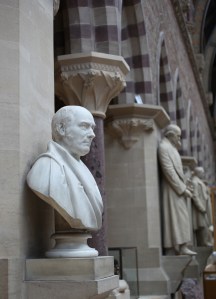
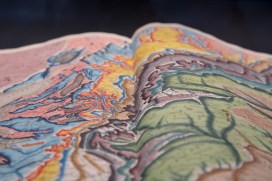
A section of the famous 1815 geological map of England and WalesWilliam Smith’s bust in the Museum court
If you visited us in the past few months you may have seen lots of Smith’s maps and other material in Handwritten in Stone, our special exhibition which celebrated his life and work. Now, a new exhibition featuring copies of items from our collections is opening in Smith’s birthplace of Churchill, Oxfordshire.
The displays at the Heritage Centre in Churchill take a very different look at the ‘father of English geology’, offering a rare glimpse of Smith’s personal correspondence with his family.
In honour of Smith’s birthday, we showed off his most famous work, the beautifully coloured 1815 map, in front of his bust in the Museum court today. As one of the Museum’s treasures not normally on display, it is a real treat to see it being admired by visitors.
Visitors get a close look at the original 1815 map with Chris Jarvis
Today, across the world, a birthday is celebrated. It’s that of Charles Darwin, perhaps the best-known naturalist to have ever lived, and he would have been 207 years old this year. This Darwin Day, Kate Diston, Head of Archives and Library shares a very special letter from the man himself.
**
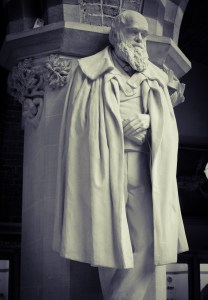
The Museum’s statue of Darwin
In 1859 Darwin published his best-known book, On the Origin of Species, which presented his theory of evolution for the first time. While his book caused quite a stir, Darwin’s conclusions were the result of years of travel, observation and communication with other scientists in various fields.
One of those scientists was Oxford Professor of Geology, John Phillips. In 1859, Phillips was overseeing the final stages of the construction of this Museum, before taking up the position as its first Keeper.
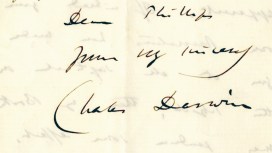
A record of correspondence between Darwin and Phillips was recently rediscovered in the archive and highlights an interesting relationship between the two iconic men of science. Strikingly, the letter was sent less than two weeks before ‘On the Origin of Species’ was to be released.
I fear that you will be inclined to fulminate awful anathemas against it.
John Phillips, a few years after the book’s publication
Darwin knew that Phillips was not going to like his book. He had corresponded with him over many years about geology, recognizing that Phillips was one of the leading minds on the geological timescale. Phillps’ work had provided him with an understanding of the potential age of the Earth, and the implications this may have had on his theories. Phillips, however, would remain a man of faith.
Yours very sincerely
While Darwin knew that Phillips was not necessarily going to take his work at face value, it is clear from the letter that Darwin respected him immensely. This letter is almost a perfect snapshot of what was happening in science at that precise moment in history. Darwin’s book was about to call into question not just what was commonly understood about the natural world at the time, but also the very core of beliefs for most of society.
It is also a letter that reminds me how remarkable the collection I have the privilege to care for really is.
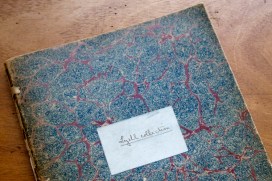
Scouring the archives, and receiving an unexpected package, help our documentation officer Sarah Joomun in her investigations into the Museum’s Lyell collection of fossil material.
Read more on the latest post from Past to Present…
When I started work on the Lyell project in July of this year, I was very keen to know more about the history of the collection, both before and after it arrived at the museum. Collections often arrive at the Museum with associated material such as catalogues, letters or notebooks and after they arrive any activity related to the collection should be documented.
The first step in investigating the history of the collection was to find out what was in the Museum’s records. I began by looking at the donors database; this recorded the date that the Lyell collection arrived (1903) and the donor, Sir Leonard Lyell, Charles Lyell’s nephew. There was a little more information in the donors card index, which mentioned the fact that the collection came in two parts, the bulk of the collection in 1903 and then additional Italian specimens in 1907. The Collections Manager, Eliza…
Followers of our Once in a Whale blog a while back may be aware of the huge task that faced our Life Collections conservator Bethany Palumbo and her team as they set out to clean, restore and repair the whale skeletons that hang from the Museum roof.
In my first week here, I received an enquiry about the history of these specimens, and digging through the archives I was pleased to find that they are not just ‘prop’ skeletons acquired for the purpose of display – they are important in the history of whale biology too. So this article is something of a postscript to the Once in a Whale project.
Surprisingly, it wasn’t until the mid-19th century that much was understood about the science of the largest animals to have lived on Earth. Some species were known from strandings; others from accounts – varying in reliability – from fishermen.
Yet difficulties in preserving and transporting such large creatures (as well as the penchant for eating stranded whales at community festivals) meant that the biology and behaviour of whales was poorly-described and documented until fairly recently. So much so, that in early scientific literature just a few scientists are singled out as having actually seen the animals they were studying.
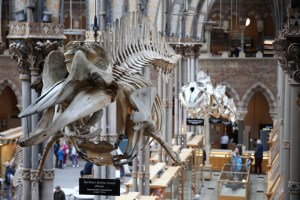
In the Museum there are five whale skeletons suspended from the roof, along with the skull of a Humpback Whale and the mandible of a Sperm Whale. Some of the earliest ‘whaleologists’ made the trip to Oxford to see these specimens in a race to formally describe new species or new aspects of whale biology.
In particular, two 19th-century anatomists competed to make new discoveries about whales. Dr John Edward Gray, keeper of zoology at the British Museum (Natural History), and Professor Daniel Frederick Eschricht, a Danish comparative anatomist, were so competitive that Gray made sniping comments in formal papers, questioning Eschricht’s observations.
John Edward Gray ‘destroying’ Eschricht’s observations. From Gray, J. E. 1864, On the Cetacea which have been observed in the seas surrounding the British islands
But perhaps this competition was more sporting than malicious: Gray did name the gray whale, Eschrichtiusrobustus,in Daniel Eschricht’s honour.
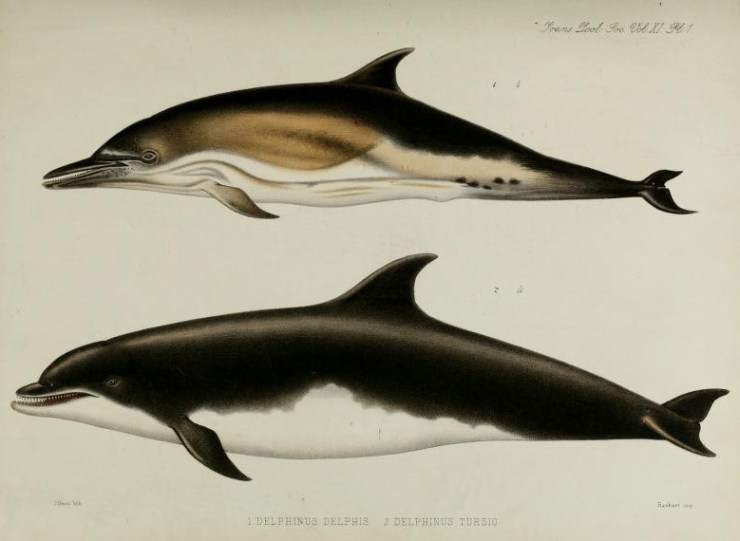
Eschricht actually presented the Museum with two of the specimens now on display: the Humpback Whale skull at the entrance and the suspended Minke Whale skeleton. Of the others, the Bottlenose Dolphin skeleton was caught near Holyhead in 1868 and was drawn by another notable natural historian, William Henry Flower, before being skeletonised for the Museum.
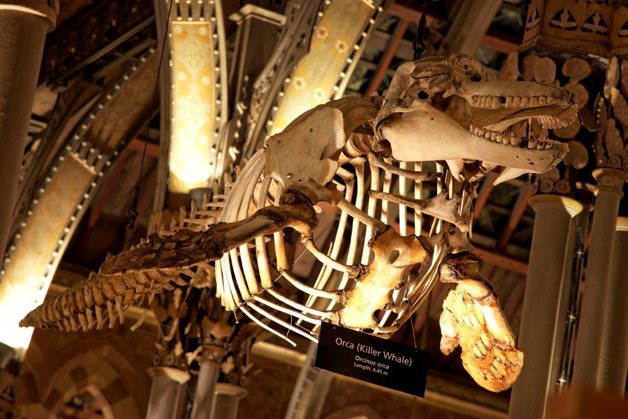
The Orca skeleton is from an individual killed in the Bristol Channel by fishermen in 1872, and the Beluga Whale was collected from Spitsbergen, Norway in 1881 and presented by Alfred Henge Cocks, who donated a range of mammal specimens to the University of Oxford.
The female Northern Bottle-nosed Whale skeleton has been harder to track down. It’s possibly a specimen shot in Weston Super-Mare in 1860 mentioned by Gray, but it isn’t clear. Lastly, there’s the large Sperm Whale mandible that greets visitors at the entrance. It doesn’t have much of a recorded history, but is allegedly one of the largest specimens in the UK according to a ‘researcher’ whom I’ve yet to track down.
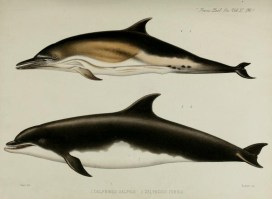
William Flower’s drawing of the Bottle-nosed Dolphin (lower); the skeleton from this individual is on display in the Museum
The next time you are in the Museum, do look up: the skeletons there are not simply representing ‘whaleness’ but are also individual animals and important specimens in the early discovery and description of whale biology.
Handwritten in Stone 9 October 2015 – 31 January 2016
Today sees the opening of our new special exhibition – Handwritten in Stone – celebrating the life and work of William Smith on the bicentenary of his publication of the first geological map of England and Wales.
Dubbed ‘The Map that Changed the World’ in Simon Winchester’s book of that title, the beautifully hand-coloured map revealed a three-dimensional arrangement of rock layers, or strata, along with a fourth dimension – time.
This work earned Smith the moniker ‘the father of geology’, an accomplishment all the more impressive given that Smith achieved it single-handedly and with very little formal education.
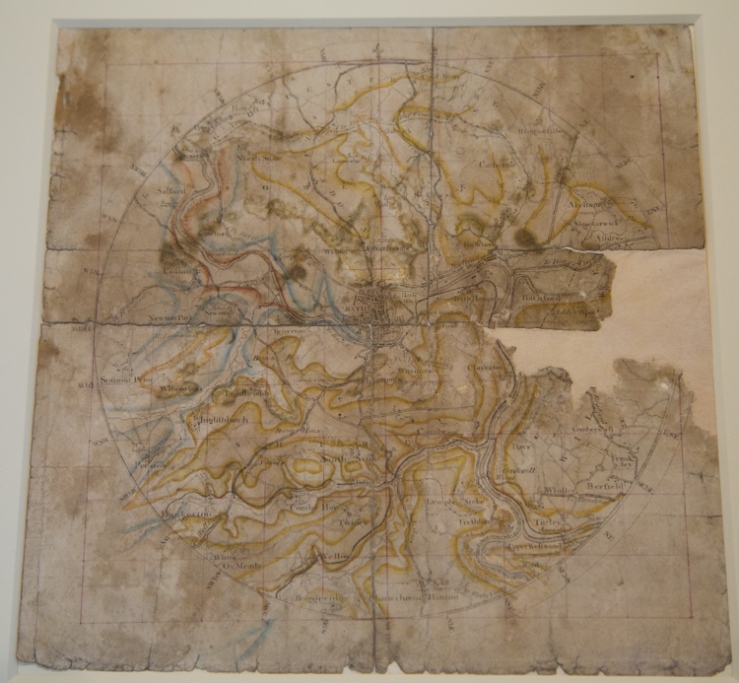
This 1799 map of Bath, on display in the exhibition, is the oldest geological map in the world
The Museum holds the largest archive of Smith material in the world. Alongside the famous 1815 map, shown at the top of the article, are personal papers, drawings, publications, maps and geological sections, most of which are being displayed for the first time. With these we have some fossil material from the collections: Smith realised that particular combinations of fossils were unique to different rock formations and could be used to date the strata.
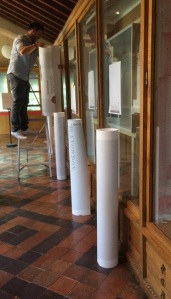
Design work on the ‘drawing board’, created by Claire Venables at Giraffe Corner. Photo: Claire Venables
Handwritten in Stone, supported by the Heritage Lottery Fund, is the first show in our new special exhibition gallery on the upper east side of the building. Working out how to use the space was a learning process, and the final, elegant design is the work of local consultancy Giraffe Corner.
To bring the final exhibition together we collaborated with writer Rebecca Mileham, an installation team from the Ashmolean Museum, and more than 50 volunteers. Look out for more about the volunteers’ contributions on this blog soon.
Applying the graphics in the gallery. Photo: Claire Venables
The 1815 map itself takes centre-stage in the exhibition, flanked on one side by the history of Smith’s work building up to its publication, and on the other by the legacy of his techniques, which are still used today.
To discover the full story of William ‘Strata’ Smith head over to the upper east side of the Museum before 31 January.
And don’t forget to look out for our What’s On programme which includes lots of William Smith and geology-focused events, including a public talk by author Simon Winchester on 13 October.
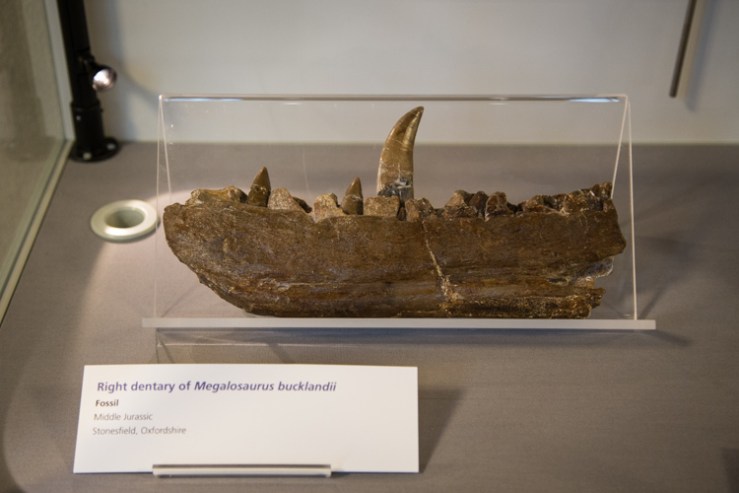
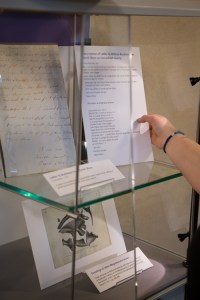
One of the Museum’s most significant specimens is the iconic jaw bone fossil used in the first scientific description of a dinosaur – Megalosaurus – in 1824. For the latest in our Presenting… series of displays we are showing this ‘first dinosaur’ along with some archival material documenting its discovery and description.
The fossil was acquired by William Buckland (1784-1856), Reader in Geology at the University of Oxford, after being found in a slate quarry in Stonesfield, just a few miles north of this Museum. Buckland soon realised it was something out of the ordinary and showed it and other Stonesfield bones to comparative anatomist Georges Cuvier, who noted similarities with living lizards. The name Buckland chose, Megalosaurus, means ‘great lizard’.
The Presenting… display of Megalosaurus bucklandii, on show until 17 May 2015
Later, in 1842, Richard Owen coined the term ‘dinosaur’ to describe a group of animals including Megalosaurus and other recently found ‘great lizards’ such as Iguanodon.
The dentary bone was just the front half of the lower jaw. The blade-like, serrated teeth tell us that Megalosaurus was a meat eater. Its teeth were often damaged, worn out or lost in battles with prey or rivals. Fortunately, Megalosaurus could replace its teeth several times during its lifetime. In this specimen six of the teeth are only partially erupted, with two just emerging along the gum-line and only one fully erupted tooth remaining.
The single-case Presenting… display is located near to the Welcome Desk and the Megalosaurus material will be on show until 17 May – see it while you can. If you miss this, don’t worry as casts of the fossils are on permanent display in the main court.
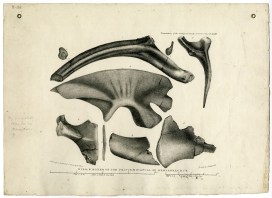
These drawings, by William Buckland’s wife Mary Morland, featured in Buckland’s “Notice on the Megalosaurus or great Fossil Lizard of Stonesfield” in the Transactions of the Geological Society of London, Series 2, vol. 1, pp. 390-396.







 Yet difficulties in preserving and transporting such large creatures (as well as the penchant for eating stranded whales at community festivals) meant that the biology and behaviour of whales was poorly-described and documented until fairly recently. So much so, that in early scientific literature just a few scientists are singled out as having actually seen the animals they were studying.



 More Than A Dodo