The fossils of Stonesfield

A Spotlight Specimens special for Oxford Festival of Nature

By Eliza Howlett, Earth Collections manager

There was a time, more than 160 million years ago, when most of Oxfordshire was covered by a warm, clear, shallow sea. Offshore, the waters were agitated by waves and storms, but closer to land these forces were buffered by a submerged sandbank, and calm lagoons developed.

The area that is now Stonesfield was part of this lagoonal environment, and the fossils that have been found there provide a wonderful window into the living world of this Middle Jurassic sea.

So how would these sea creatures compare with British marine life today? Some things would have been very familiar. On the sea bed you would have found a huge variety of bivalves, or clams, along with lobsters, crabs and sea urchins; the waters above would have been full of fish, including several different types of shark.

IMG_9086
This fossilised limpet shell has its original colouration preserved

But there would have been other things too: squid-like belemnites, and nautiloids and ammonites with coiled shells, and tentacles like an octopus. Instead of dolphins and porpoises there would have been sea crocodiles and sea turtles, and in the skies above, flying reptiles known as pterosaurs rather than the usual sea birds.

And there’s more. Stonesfield fossils also include plants and animals washed in from nearby land: the leaves and seeds of conifers and cycads, beetle wing cases, reptile eggs, and the remains of both dinosaurs and mammals.

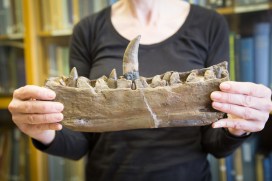
The jaw of the first named dinosaur, Megalosaurus bucklandii, found in Stonesfield, Oxfordshire
The lower jaw of the first named dinosaur, Megalosaurus bucklandii, found in Stonesfield, Oxfordshire in the early 19th century

One particularly spectacular find was the lower jaw of the carnivorous dinosaur Megalosaurus, nine metres long in life and weighing about a tonne. Megalosaurus became the first creature to be named a ‘dinosaur’, in 1824. Less obvious, but equally significant, are the tiny jaws of some of the shrew-like mammals that would have lived alongside the dinosaurs: Phascolotherium, Amphitherium, Amphilestes and Stereognathus – the first Jurassic mammals known to science.

Along with the preservation of delicate items such as dragonfly wings and the leg of a cricket, and the original colour patterns on some sea snails, limpets and barnacles, the fossil material from Stonesfield is really quite special.

OFoN_logo_green block_small

A plesiosaur named Eve

A Spotlight Specimens special for Oxford Festival of Nature

by Juliet Hay, Earth Collections preparator and conservator

I feel myself very lucky to have a job that involves working with the fossil remains of long-extinct animals. One of the things my colleagues and I are currently working on is a plesiosaur – a marine reptile that lived in the sea millions of years ago.

This particular specimen was found in a clay pit near Peterborough by members of the Oxford Clay Working Group in 2014, and is a near-complete example of its kind. The palaeontologists who found the specimen named it Eve, although we don’t know if it was male or female, and perhaps never will.

The discovery of large fossil vertebrates like this is rare, so we are fortunate to have had the specimen donated to the Museum by the quarry owners Forterra.

Juliet at work on the plesiosaur skull

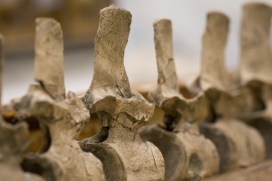
The plesiosaur is 165 million years old and, when alive, was around 5.5 metres long. It had a long neck, a barrel-shaped body, four flippers and a short tail. The find is particularly exciting as the skull was also discovered. It is encased in a clay matrix, which is relatively easy to remove, but the work has to be carried out under magnifying lenses and microscopes.

As the skull is quite small relative to the size of the body, the features are very delicate and it is a painstaking process to remove the sediment without damaging the fossil bone or losing any tiny fragments. Fortunately, pictures of the skull have been produced using CT scanning technology, and the images are proving invaluable as an aid to assist in its preparation. It’s a bit like having a jigsaw puzzle with the picture on the lid to refer to!

sdfsd
A belemnite hooklet at 12x magnification, found with the plesiosaur remains and possibly part of Eve’s last meal

The clay covering the skull is being sieved and examined and tiny hook-shaped fossils have been found. These came from the arms of squid-like creatures called belemnites, which may have formed a large part of the plesiosaur’s diet.

It is too early to say for sure, but Eve could represent a species new to science, as some features, such as the shape of the flipper bones and some of the surfaces of the bone in the skull, are quite unusual. Further research needs to be done before the findings can be published in scientific journals – watch this space.

And if you’re visiting the Museum before 25 July, you can see some of the fossilised remains of Eve for yourself, in our Presenting… display case.

OFoN_logo_green block_small

From worms to stars

A Spotlight Specimens special for Oxford Festival of Nature

by Imran Rahman, Research Fellow

Starfish are among the most distinctive animals found along the seashore today. Together with other well-known forms such as sea urchins, sea cucumbers and brittle stars, they belong to a major group called the echinoderms, which is characterized by a unique type of symmetry — called fivefold symmetry. This means they can be divided into five roughly equal parts.

IMG_9013

In contrast, the closest living relatives of echinoderms are worm-like animals that have bilateral or mirror-plane symmetry, where they are divisible into mirror-image halves. It’s widely-thought that the common ancestor shared by echinoderms and other animals also had bilateral symmetry. Because they are so different to all other living animals, deciphering the evolutionary history of echinoderms, and their path from worms to stars, has proven a major challenge for scientists.

IMG_9006
The closest living relatives of echinoderms are worm-like animals like these acorn worms Balanoglossus sp.) from Naples

Fortunately, fossils can shed light on echinoderm evolution. Echinoderms have an excellent fossil record because they possess a hard, mineralized skeleton, which greatly enhances their chances of being preserved as fossils compared to soft-bodied organisms. The first fossil echinoderms are over half a billion years old, and include extinct groups that show both bilateral and five-fold symmetry.

In addition, fossils are known that exhibit three-fold symmetry, as well as others that lack a clear plane of symmetry – they are asymmetrical. These fossils document the earliest history of echinoderms, and so could help us to better understand their evolution.

The fivefold symmetry of the starfish
The fivefold symmetry of the starfish (Randasia granulata from Madagascar)

Based on our understanding of living animals, and using modern methods for reconstructing the relationships of different species, it’s possible to infer that the early fossil echinoderms with bilateral symmetry belong at the base of the echinoderm evolutionary tree.

Print

The next branches in the tree lead to the asymmetrical fossil groups, and these are followed by those forms that show three-fold symmetry. Lastly, we see the diversification of forms with fivefold symmetry, including species belonging to the groups that still exist today, such as the starfish.

Using the fossil record, we can therefore see a clear picture of how echinoderms evolved from worm-like organisms into star-shaped creatures.

OFoN_logo_green block_small


The museums are migrating!

Night falls in the Museum

by Hannah Allum, Project Assistant

The film ‘Night at the Museum‘ is not as far from the truth as you might think. Museum specimens may not come back to life at night, but they are moving all the time. Whether we’re putting on a new display, loaning a specimen to another museum or using them for teaching sessions, our collections are very active, despite being long dead.

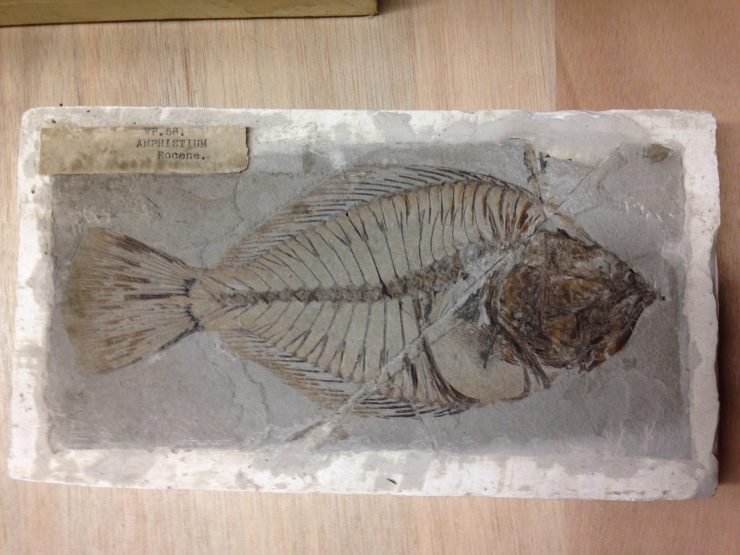
Amphistium fossil fish; an early relative of the flatfish and part of the Earth collection

The Oxford University museum collections are about to begin a huge migration as they move from various off-site stores to a new facility. Generally, museum stores are not open to the public and often house important reference and research specimens, which make up a huge proportion of natural history collections. These valuable stored collections require specific environmental conditions to make sure that they last for generations to come. Taxidermy and articulated skeletons make for eye-catching displays, but tend to be a relatively small part of the collection. In fact, having just 1% of your natural history specimens on public display is the norm.

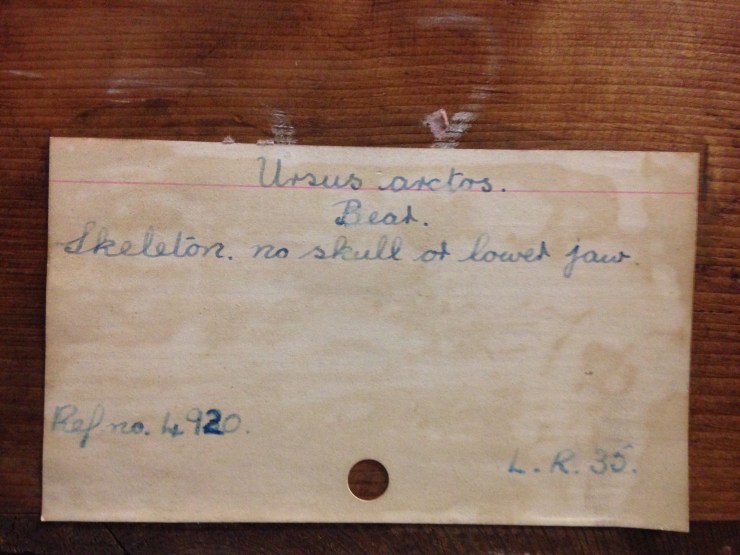
Lured in by Life Collection labels; this headless brown bear will soon have a new home.

As well as improving the storage conditions and ease of access for staff and researchers, this will also be the first time that the Oxford University museums have shared a storage space. It will be a challenging but rewarding project to re-home such a huge variety of artefacts and specimens that have come from all over the world; each with their own unique story.

Hannah profileAs the new Project Assistant working for the Museum of Natural History, I am the lucky person who gets to discover some of these stories. I will be working with specimens from both Earth and Life collections, as well as some material from the Library and Archives. The first stage will be making a detailed list of everything that needs to be moved, then I can go on to prepare the new store and get the supplies I’ll need to document, pack and transport everything safely.
Some enticing titles from the Library

As you can see, I have already come across some fascinating specimens and look forward to getting stuck in to this project.

There will be blog posts throughout the year to update you on our progress and to reveal some exciting stories from the stores.

You can also follow the hashtag #storiesfromthestores on the Museum’s Twitter feed: @morethanadodo

Introducing the Dodo Crew

IMG_7579

by Carly Smith-Huggins, Education Officer

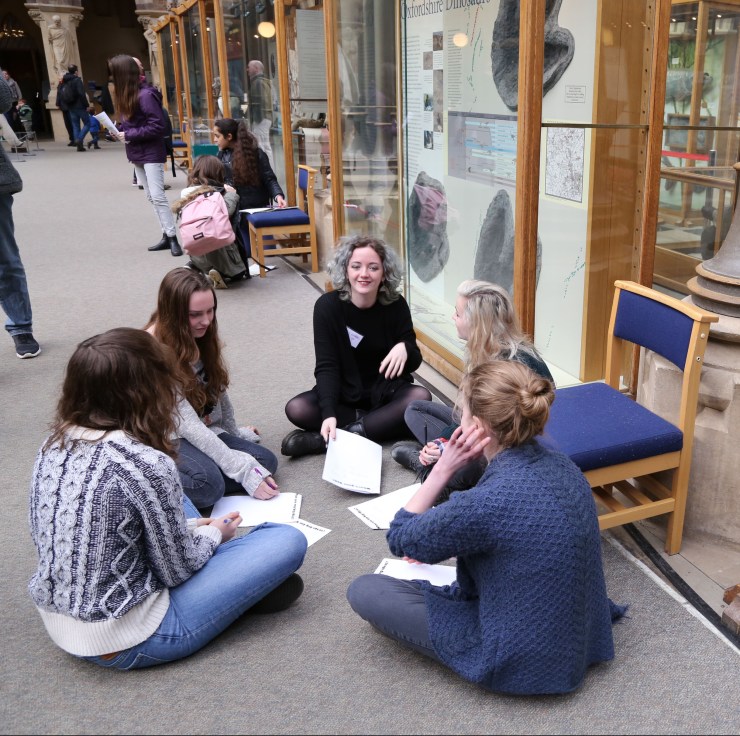
Over the past six months we’ve been trying something new at the Museum, working with an enthusiastic group of young people who have come to call themselves The Dodo Crew. Otherwise known as the Museum Youth Forum, the group meets up with us once a month to discuss ideas, plan events, see the collections, and generally have a dialogue about the Museum and its activity.

Dodo crew stickerThe Crew is made up of eleven 14-19 year olds who are already passionate about natural history and we’re really pleased to have them on board. Many museums across the UK run youth forums to engage the young people within their community, who are often underrepresented in museum audiences.
In fact, I was on a Museum Youth Forum at Norwich Castle Museum and found the experience very valuable as I had the opportunity to express my opinion, contribute and be part of a community, and make new friends. The group also enabled me to find my passion for working in museums, which I did not get from formal education or at home.

By joining the forum our Dodo Crew gets a chance to be involved in what we do as a museum, which I think is very important. And it will hopefully help us to be more successful in attracting people aged 14-19 years.

Going behind the scenes is great- seeing objects and talking to people.

It really felt like a unique opportunity and made me feel special.

IMG_7458
Members of the Dodo Crew get down to some planning in the Museum court

So what exactly have we been doing? The Crew has been enjoying taking part in various activities, from live animal handling and taxidermy demos, to planning events and meeting scientists. They will also be helping with programmed events, designing their own events, contributing to temporary exhibitions, and much more.

And their very first event is this Saturday 16 April, all about skin and bones. Everyone is welcome between 2-4pm, so come and meet the Dodo Crew and see their great ideas in action (and if that doesn’t entice you, there will also be a live chameleon!).

IMG_7576
Getting up close and personal with a friendly skunk

The ancient ‘Kite Runner’

72dpi Press%205

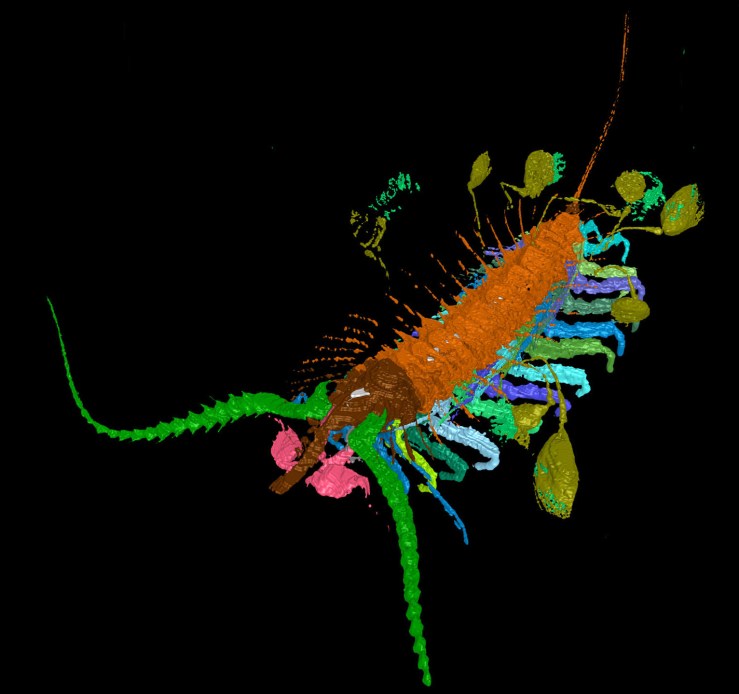
An ancient creature which carried its young like tiny, swirling kites is the latest discovery by researchers at the Museum, working with Yale Peabody Museum of Natural History, Leicester University, and Imperial College London.

Found in a deposit of rocks known as the Herefordshire Lagerstätte, which preserves ancient remains with superb detail, the 430 million year old fossil shows that the marine animal carried its young in kite-like capsules tethered to the parent’s body, earning it the moniker “Kite Runner” after the 2003 novel by Khalid Hosseini.

The small creature has been officially named Aquilonifer spinosus, from “aquila”, meaning eagle or kite, and “fer” which means carry. It grew to just over a centimeter long, not including the tail spines, and there is only one known fossil of the animal.

Kite runner. Anterior oblique.The arthropod Aquilonifer spinosus
Reconstruction of Aquilonifer spinosus

Modern crustaceans employ a variety of strategies to protect their eggs and embryos from predators — attaching them to limbs, holding them under a carapace, or enclosing them within a special pouch until they are old enough to be released — but this example is unique. We know of nothing alive today which attaches the young by threads to its upper surface; perhaps this strategy was less successful and became extinct.

Kite runner. Two young in capsules of the arthropod Aquilonifer spinosus
Two capsules of juveniles tethered to the parent’s body

Aquilonifer spinosus lived on the seafloor during the Silurian period, with a variety of other animals including sponges, brachiopods, worms, snails and other mollusks, a sea spider, a horse-shoe crab, various shrimp-like creatures, and a sea-star.

The researchers were able to describe Aquilonifer spinosus in detail thanks to a virtual reconstruction. They reconstructed the animal and the attached juveniles by stacking digital images of fossil surfaces that were revealed by grinding away the fossil in exceptionally thin increments. You can see this animation here:

The Yale Peabody Museum of Natural History, the Natural Environmental Research Council, the John Fell Oxford University Press Fund, and the Leverhulme Trust supported the research.