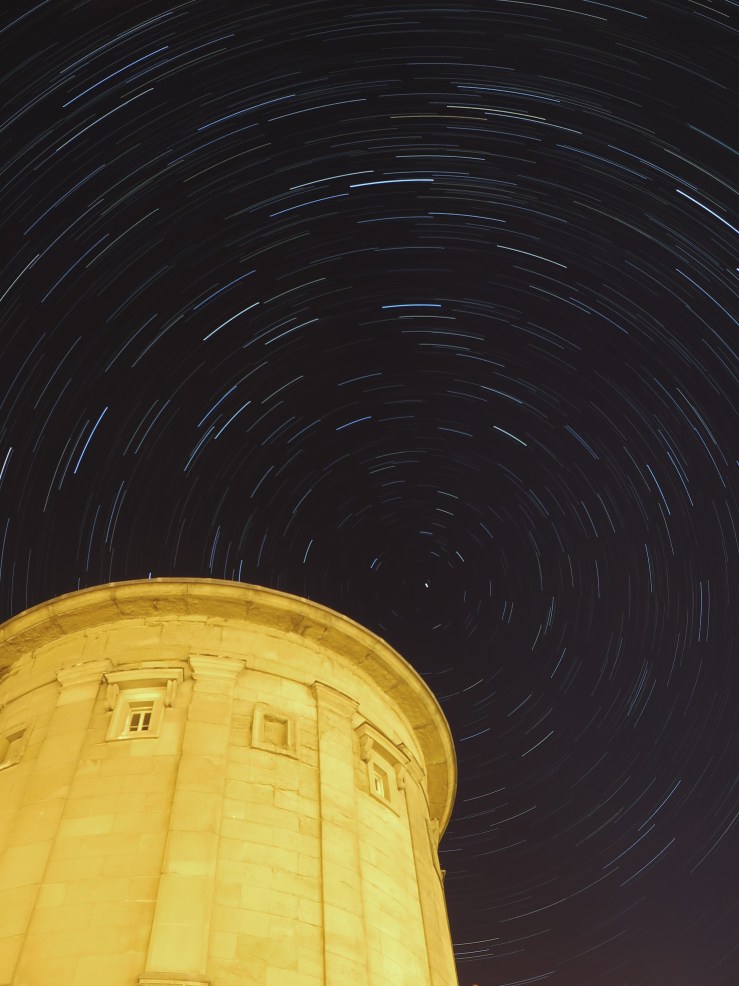
This dazzling photograph has just been awarded third prize in the Geological Society’s 100 Great Geosites Photo Competition and will feature as the December image in their 2016 calendar. It shows a building close to our hearts, the Rotunda Museum in Scarborough. In fact, the photo was taken by a member of our Earth Collections team, Phil Hadland at the Yorkshire Fossil Festival back in September.
On day 2, after a busy day sharing collections and knowledge with the festival-goers, the cloudless skies revealed a dark starry night. So Phil ventured out to do bit of photography, envisaging a beautiful trail of stars apparently rotating above the Rotunda. Conditions could not have been much better.
Using the Google Sky Map app he found Polaris (also known as the North Star), the star which sailors once used to navigate at night. He carefully positioned his camera and tripod for a 45 minute exposure to capture both the Rotunda and the stars. The image that resulted is spectacular. Phil explains;
Of course it is the rotation of our planet that causes the effect of star trails, but it shows that we are constantly on the move on a tiny speck within the universe, which we call Earth.
The timing of the success is ideal. This year marks the 200th anniversary of the publication of William Smith’s Geological Map, which we are celebrating with our current exhibition Handwritten in Stone. Smith also went on to conceive and design the The Rotunda Museum as the ideal place to display fossils and interpret geology.
Credit: Philip Hadland
Phil is understandably proud of the attention that his photograph has received:
I’m thrilled to be among the winners and it is a great feeling when the effort (which is usually required to take great photos) pays off. It’s also nice to know that so many people will get to see and appreciate the photo over Christmas 2016.
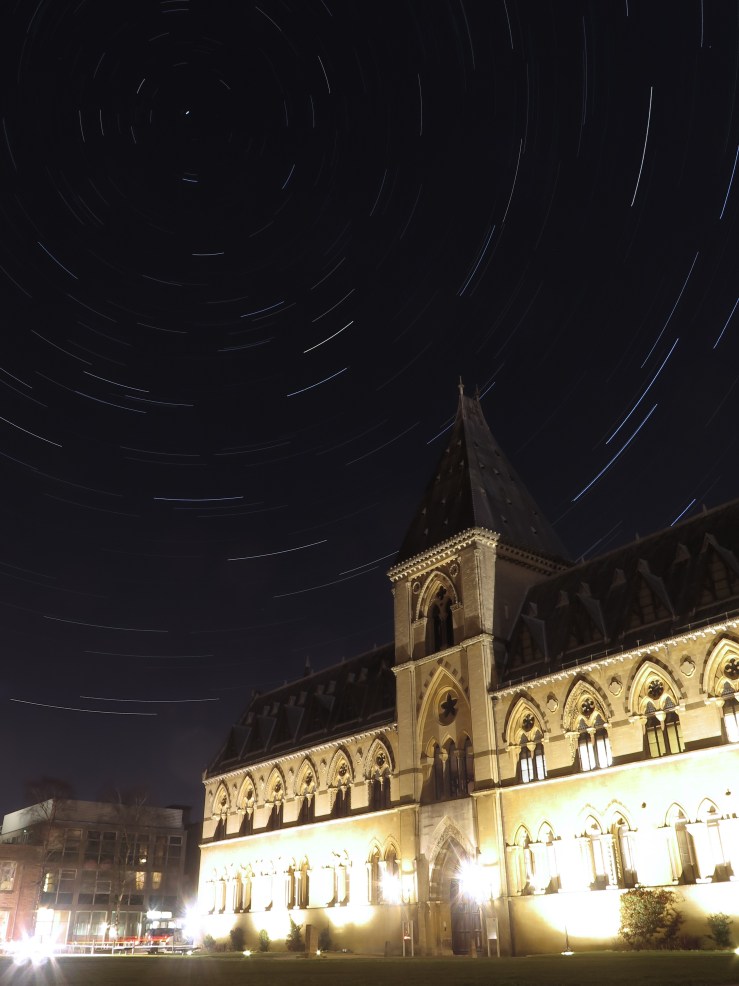
This isn’t the only long exposure image that Phil has created; here you can see a photo of this very museum treated in a similar way. Perhaps a testament to the long-lasting importance of natural history.
Rachel Parle, Interpretation and Education Officer
Handwritten in Stone 9 October 2015 – 31 January 2016
Today sees the opening of our new special exhibition – Handwritten in Stone – celebrating the life and work of William Smith on the bicentenary of his publication of the first geological map of England and Wales.
Dubbed ‘The Map that Changed the World’ in Simon Winchester’s book of that title, the beautifully hand-coloured map revealed a three-dimensional arrangement of rock layers, or strata, along with a fourth dimension – time.
This work earned Smith the moniker ‘the father of geology’, an accomplishment all the more impressive given that Smith achieved it single-handedly and with very little formal education.
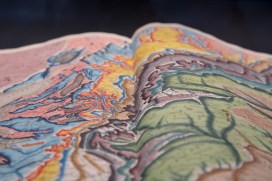
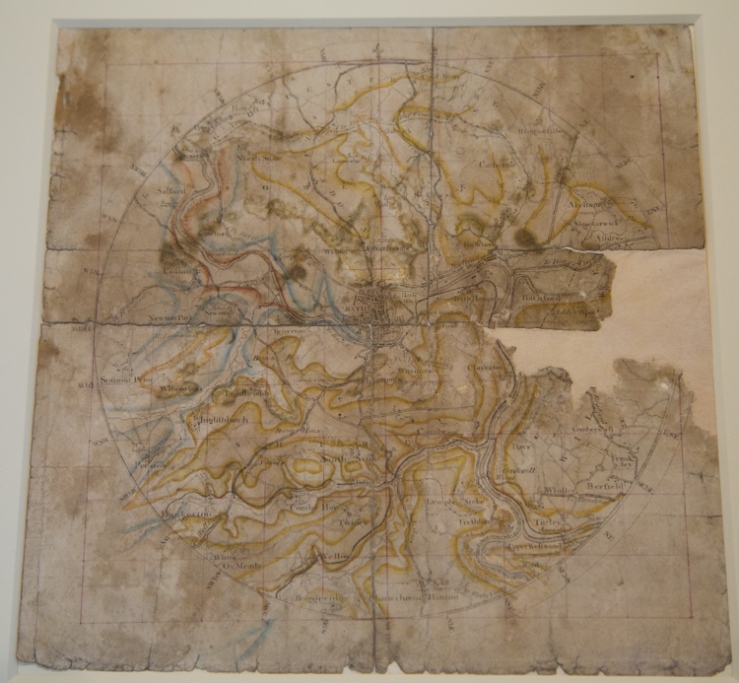
This 1799 map of Bath, on display in the exhibition, is the oldest geological map in the world
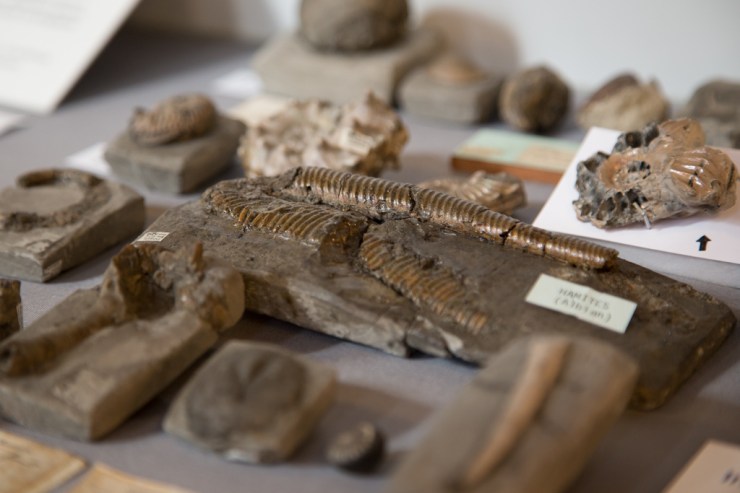
The Museum holds the largest archive of Smith material in the world. Alongside the famous 1815 map, shown at the top of the article, are personal papers, drawings, publications, maps and geological sections, most of which are being displayed for the first time. With these we have some fossil material from the collections: Smith realised that particular combinations of fossils were unique to different rock formations and could be used to date the strata.
Design work on the ‘drawing board’, created by Claire Venables at Giraffe Corner. Photo: Claire Venables
Handwritten in Stone, supported by the Heritage Lottery Fund, is the first show in our new special exhibition gallery on the upper east side of the building. Working out how to use the space was a learning process, and the final, elegant design is the work of local consultancy Giraffe Corner.
To bring the final exhibition together we collaborated with writer Rebecca Mileham, an installation team from the Ashmolean Museum, and more than 50 volunteers. Look out for more about the volunteers’ contributions on this blog soon.
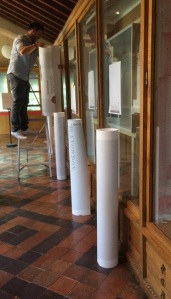
Applying the graphics in the gallery. Photo: Claire Venables
The 1815 map itself takes centre-stage in the exhibition, flanked on one side by the history of Smith’s work building up to its publication, and on the other by the legacy of his techniques, which are still used today.
To discover the full story of William ‘Strata’ Smith head over to the upper east side of the Museum before 31 January.
And don’t forget to look out for our What’s On programme which includes lots of William Smith and geology-focused events, including a public talk by author Simon Winchester on 13 October.
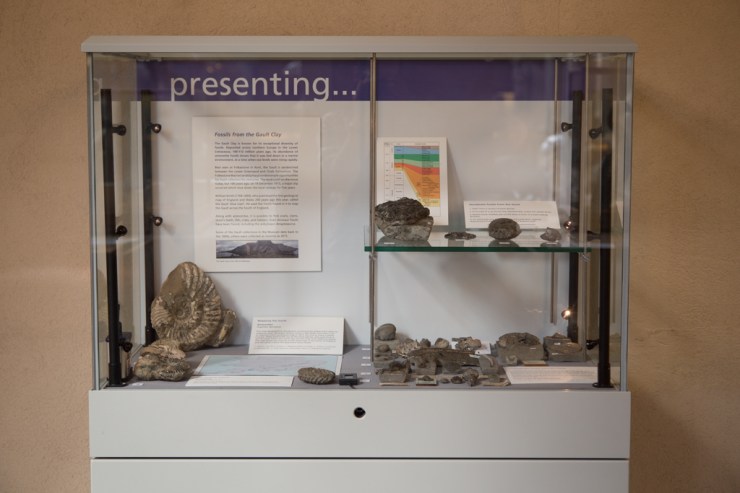
Our changing Presenting…display offers a look at highlights, themes and topical material drawn from the Museum’s collections. The current display presents a rich selection of fossils taken from a formation known as the Gault Clay. This will be on show until 21 September (Madagascar is up next), so it’s almost your last chance to see it.
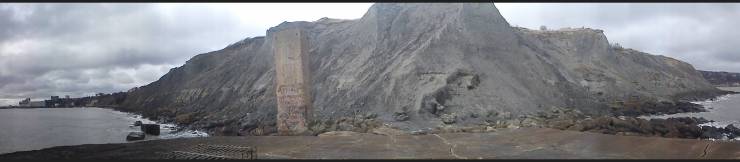
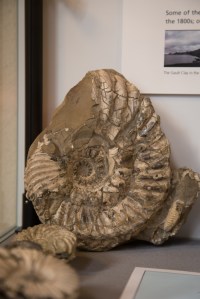
The Gault Clay is known for its exceptional diversity of fossils. Deposited across northern Europe in the Lower Cretaceous, 100-112 million years ago, its abundance of ammonite fossils shows that it was laid down in a marine environment, at a time when sea levels were rising rapidly.
The Gault Clay in the Cliffs at Folkestone
Best seen at Folkestone in Kent, the Gault is sandwiched between the Lower Greensand and Chalk formations. The Folkestone Warren landslip has provided ample opportunities for fossil collectors for centuries. The land is still on the move today, but 100 years ago, on 19 December 1915, a major slip occurred which shut down the local railway for five years.
Ammonite (Hoplites dentatus)
William Smith (1769-1839), who published the first geological map of England and Wales 200 years ago this year, called the Gault ‘blue marl’. He used the fossils found in it to map the Gault across the South of England.
Along with ammonites, it is possible to find snails, clams, shark’s teeth, fish, crabs, and lobsters. Even dinosaur fossils have been found, including the ankylosaur Anoplosaurus.
Some of the Gault collections in the Museum date back to the 1800s; others were collected as recently as 2015.
The Presenting… display, near the entrance to the Museum
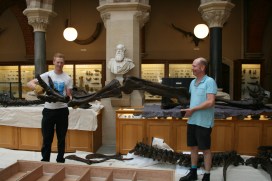
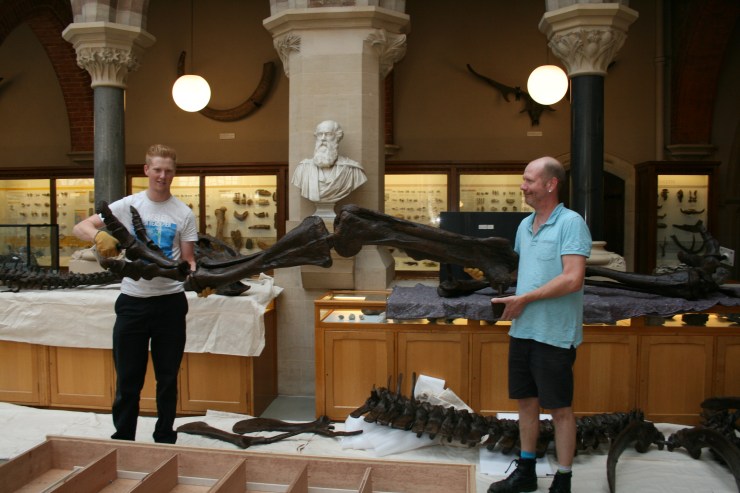
Adam (left) and Pete carrying a hind leg, presided over by the statue of Henry John Stephen Smith, Keeper of the Museum 1874 -1883
Fossil Fridays don’t get much bigger than this. This morning a team from the Museum have started the process of reinstating our large Edmontosaurus cast. The 49 pieces that make up the skeleton were brought back into the Museum after going out on the road, and now sit ready and waiting in the middle of the Museum.
For many of the team, lugging dinosaurs around is an everyday challenge, but one member of staff is very new to this sort of thing. Meet Adam Fisk, our new apprentice who joined the Museum only 2 weeks ago. Working alongside his supervisor Pete Johnson, he’s already helped with all sorts of tasks around the building, such as removing old display panels and fixing lights, but this one has to be a new experience.
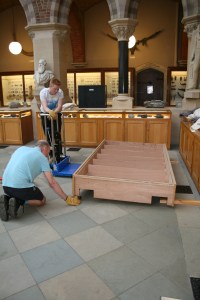
Returning the Edmontosaurus base to the Museum court with supervisor Pete Johnson
Adam is fresh into the Museum following his GCSEs this summer and he says it all feels like a dramatic change of scene;
Only 8 weeks ago I was sitting in a classroom – now look at me stride!
The Edmontosaurus was dismantled back in June and went to the Cheltenham Science Festival with Professor Phil Manning of Manchester University. It was displayed in the ‘Dinozone’ exhibition, which received 14,000 visitors over 6 days.
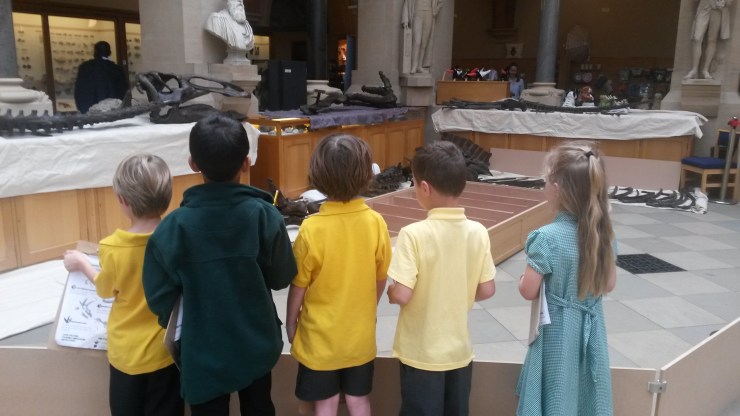
The Edmontosaurus bones attract attention from a visiting primary school.
The cast is made up of 15 sections (plus 34 ribs) which bolt together. First to go on are the back legs and pelvis, then the spine and the skull, followed by the upper limbs. Lastly, the 34 ribs can be carefully slotted into place. The giant puzzle of fitting it altogether will begin on Monday.
Here’s how Pete describes Adam’s Edmontosaurus experience:
One small step for A-dam, one giant leap for apprentice-kind!
Rachel Parle, Interpretation and Education Officer
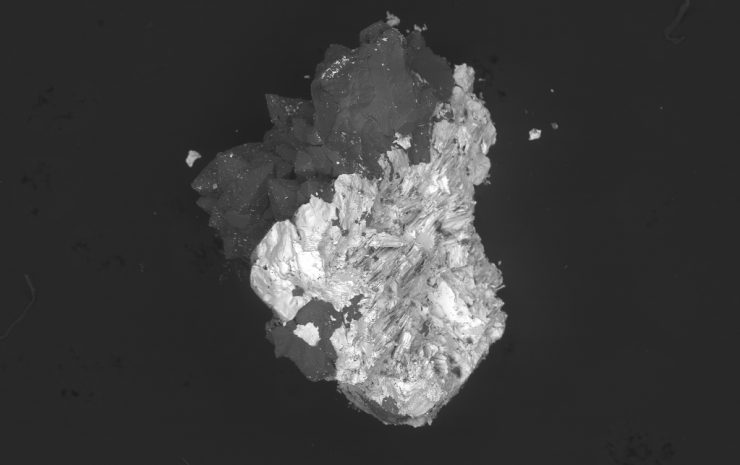
For the last six weeks, Oxford Earth Sciences undergraduate Charis Horn has been identifying mystery minerals in the Museum’s collections, and she’s struck gold! More precisely, she’s found rare gold-bearing crystals of nagyágite and sylvanite on a specimen which for centuries had been mis-labelled as the common lead mineral galena.
Nagyágite is composed of gold, lead, sulphur, antimony and tellurium and forms metallic grey crystals. Sylvanite is made up of gold and tellurium with a little silver, and is pale, silvery yellow. These minerals and their surrounding rock matrix indicate that the specimen is from the gold mines of Săcărâmb, in Romania, formerly known as Nagyág – the place where nagyágite was first discovered.
Charis using the scanning electron microscope
Charis is one of a number of interns funded by the Higher Education Funding Council (HEFCE) through the University’s Internship Programme to learn more about academic research.
Rocks and minerals have always fascinated me, which is the reason I chose to study Earth Sciences at university. I find it amazing that the history of this planet can be read in the geology beneath our feet.
Many of Charis’s samples were put aside for a bit of extra work many years ago because the minerals on the specimen were potentially more interesting than the labels might suggest. Some can be identified by looking at physical characteristics such as colour and crystal shape, or by testing for properties like hardness and magnetism.
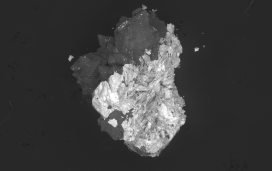
Others are much more challenging, and Charis has been using an analytical scanning electron microscope (SEM) to see close-up images of minute crystals to find out what chemical elements they are made of. There’s an SEM image of the nagyágite crystals, seen in white, at the top of the post.
Another of her discoveries has been a rare lead-bearing silicate mineral called hancockite, which was found on a specimen supposed to be from ‘Glen Coe, Argyllshire’. The orange-red crystals are less than a millimetre long, and hancockite is known from only one place in the world: Franklin mine, in New Jersey, USA.
It seems our specimen comes from Franklin mine too, and is the first sample of hancockite in the Museum’s collections. So both specimens must have had their labels muddled up in past centuries.
I have really enjoyed learning more about mineralogy during my time here at the Museum. Realising that something is far more exciting than it first seemed is definitely a great way to end this internship!
By Rachel Parle, Education and Interpretation Officer
Dinosaurs were living, breathing, moving animals, but that’s sometimes hard to visualise when standing in front of a skeleton. We may not be able to reincarnate dinosaurs in the style of Jurassic World, but an excellent illustration of the animals in their environment can go a long way to bringing them back to life.
Triceratops horridus
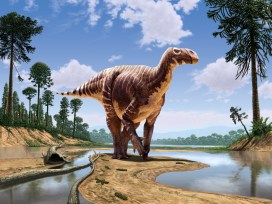
When Earth Collections Manager Hilary Ketchum and I set out to update the labels for our free-standing dinosaur skeletons, we wanted to present current science alongside scientifically accurate illustrations. They should be beautiful and show the dinosaurs as dynamic animals. We found just the person for the job. Julius Csotonyi is a paleoartist, wildlife artist and scientific illustrator who specialises in life-like restorations of prehistoric animals and habitats. He understood exactly what we wanted and set to work researching featured specimens.
Pachycephalosaurus wyomingensis
After several rounds of checks and suggestions from scientists in the Museum and the University, the illustrations are all complete and the new labels are on display in the Museum. So I asked Julius a few questions about his work and how he felt having completed the project.
**
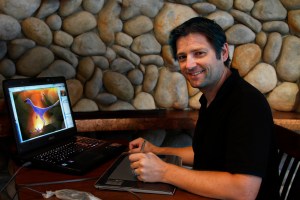
Julius working on a dinosaur reconstruction. Credit: Alexandra Lefort
How do you ensure your representations of dinosaurs are accurate?
Ultimately, all of my reference material comes from palaeontologists’ research. For all reconstructions, I rely heavily on published scientific literature. For reconstructions of newly discovered taxa, of which I am commissioned to do quite a few for press releases and scientific papers, I also have discussions with the palaeontologists who have made the discoveries, since the material is not yet published. This latter process is some of the most exciting, because I am able to participate in the process of scientific discovery, keeping a foot in both camps of science and art.
Struthiomimus sedens
How important do you think the dinosaur’s environment is in the representation?
The environmental context provides the opportunity to tell a more detailed story of the animal’s role in the biological community, its position in the food web, or interesting aspects of its behaviour. Depicting the animal’s environment provides me the opportunity to employ creative and interesting lighting conditions and composition to generate an image that is as aesthetically appealing as possible – this is art, after all, and I feel it’s important to make it as beautiful as I can.
How did you become a paleoartist and what do you enjoy about it?
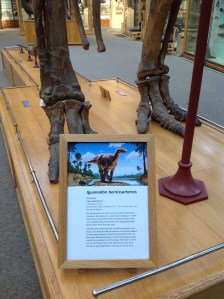
The new Iguanodon label on display at the dinosaur’s feet
I absolutely love my job. It’s wonderful to play a part in piecing together and visualizing worlds that are millions of times older than I am. It was during the completion of my PhD in the microbiology of extreme environments that my work in scientific illustration and paleoart really took off, when I was first contacted to help illustrate a book about dinosaurs by author Dougal Dixon. Ultimately I realized that scientific illustration provided me with a more consistent enjoyment, so I made scientific artwork my full time work as soon as I completed my degree. I know that I am in the right field of work because even when I am juggling projects under the extreme pressure of impending deadlines, I still find great enjoyment in the act of painting.
This up-to-the-minute T. rex has feathers!
How do you feel about your work being on permanent display here?
I feel greatly honoured to have my illustrations incorporated into a permanent display in this renowned and respected institution. It is my hope that my work will help in a small way to interest the public in the intriguing field of palaeontology, and this excites me, for I feel strongly about contributing to scientific outreach. Many thanks to the museum team for allowing me to participate!
**
Next time you call by the Museum, stand in front of a dinosaur, have a good look at its new label and see if it comes to life before your eyes.
Rachel Parle, Interpretation and Education Officer
All images are copyright Oxford University Museum of Natural History and Julius Csotonyi.









 More Than A Dodo