I’ve been to see the dinosaurs at the Pitt Rivers Museum!
It’s a common exclamation, but alas, there are no dinos in the Pitt Rivers, nor totem poles in the Museum of Natural History. Rather, there are two museums with a shared front door, and a fair amount of confusion.
To address this perpetual museum muddle we present a short play, Welcome to My Museum, where the Victorian founders of each institution come to life to discuss ‘two marvellous museums under one roof’.
A small grant from the Oxford University Museums Partnership allowed a collaboration between us, the Pitt Rivers Museum, Pegasus Theatre, and Film Oxford to produce two versions of the play – one for public performance and another for a film adaptation, which is the one you can watch below.
Ciaran Murtagh (left) as General Augustus Henry Lane-Fox Pitt Rivers and Andrew Jones as Henry Acland
Working with Pegasus Theatre, Rachel Barnett scripted an imagined conversation between the founders of the two museums, Henry Acland and General Augustus Henry Lane-Fox Pitt Rivers. Pegasus helped to source actors and costumes and even a prop-maker for Pitt Rivers’s fine pufferfish helmet.
Film Oxford spent several late nights with a very patient rent-a-crowd, immortalising their adaptation of the play on film. The public performance was well attended, with over 250 visitors dropping in to watch General Pitt Rivers rudely interrupt Henry Acland’s speech welcoming visitors to his museum. Pitt Rivers rightly points out that there must be two museums as the building has two gift shops and even two differently-branded pencil sharpeners for sale in them – ‘scientifically incontrovertible’ proof!
So if you think that you have ever been to the Pitt Rivers Museum to see the dinosaurs, or the Museum of Natural History to look at the totem-pole, watch the film below and you will discover that our building is actually ‘two sublime museums under one roof’.
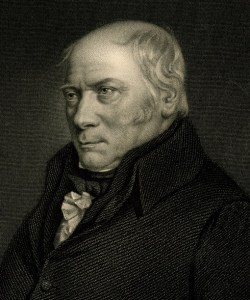
Today marks the 246th birthday of William Smith, the ‘father of English geology’. While the Museum has been marking this important day for a number of years, 2015 also happens to be a particularly special year for this remarkable man.
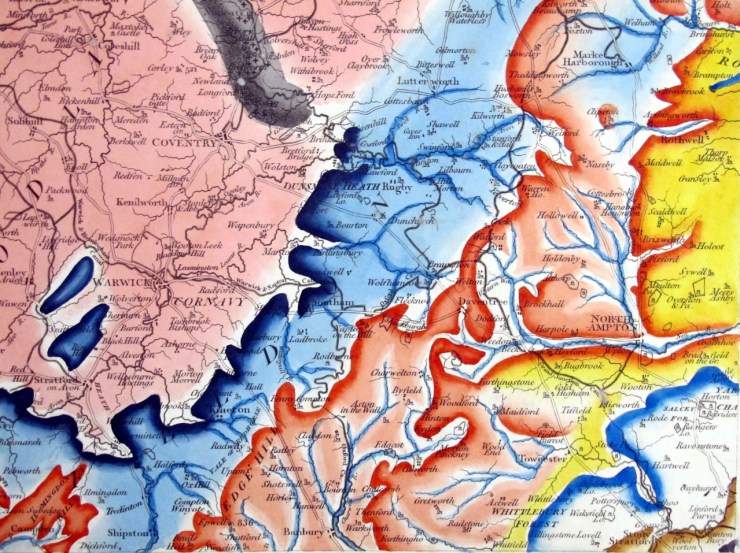
William Smith is perhaps most famous for publishing the first geological map of England and Wales in 1815, making this the bicentenary of the incredible feat.
Though Smith single-handledly mapped the geology of the country, and created a map that would change the way we understood the world beneath our feet, too few people know his name and what he achieved.
To celebrate the bicentenary, and also in the hope that Smith will become a wider-known figure in the history of science, a number of organisations across the world, including us here at the Museum of Natural History, will be holding events during the year.
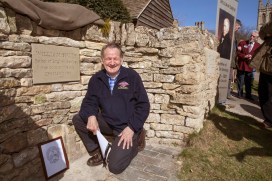
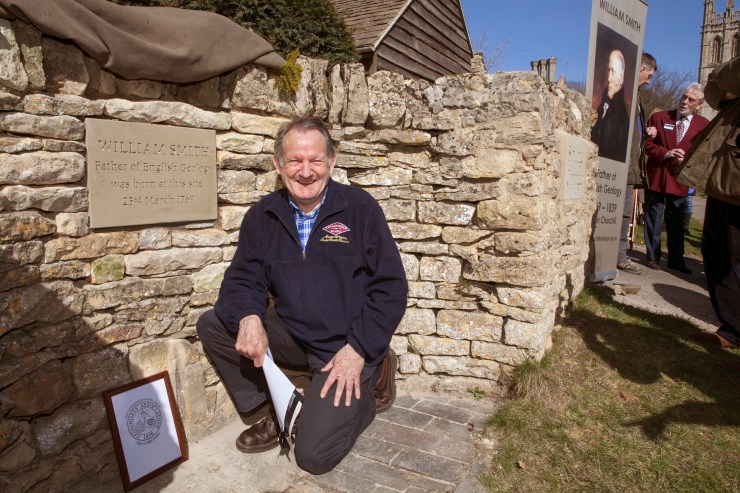
This weekend marked the official kick-off of events with the opening of the Churchill Heritage Centre special exhibition, curated by the Museum and displayed in the heart of Smith’s home town. A plaque to mark the place where he was born in 1769 was also unveiled, which you can see in the photo at the top of this post.
The plaque, sponsored by the Curry Fund was unveiled by Professor Hugh Torrens, the leading expert on William Smith. A large crowd gathered for the event, with a mix of local people proud of their connection to one of their most famous residents, as well as a familiar group of Smith academics, experts and enthusiasts.
Smith enthusiasts and Churchill residents gather for the exhibition launch
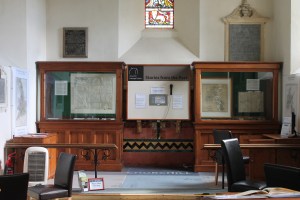
The exhibition, which is open weekends and bank holidays, will run until the end of September.
It includes well known publications from the William Smith archive here at the Museum of Natural History such as his geological map of Oxfordshire. Rarely seen items such as letters between himself and his niece, an excerpt from his diaries and the marriage deed of his grandparents will also be on display.
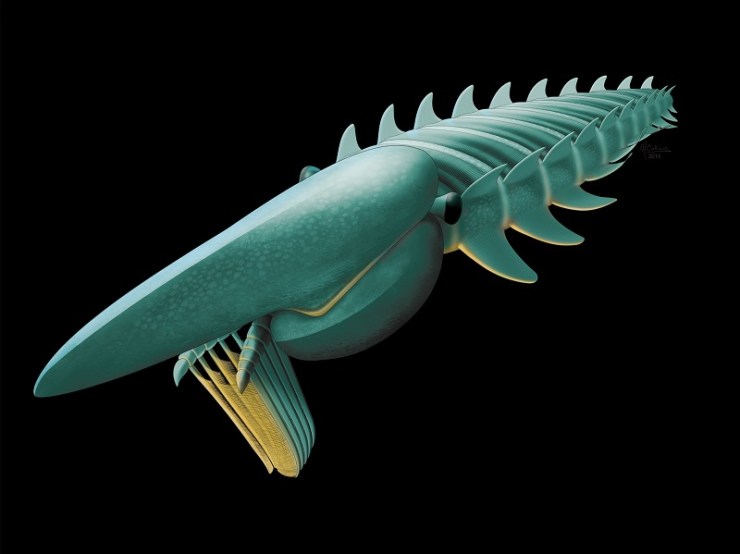
Meet Aegirocassis benmoulae – a 480 million year old, two-metre sea monster. This unlikely looking creature has been described, and imagined in this illustration, thanks to the work of one of the Museum’s research fellows, Dr Allison Daley.
Through collaboration with Dr Peter Van Roy and Professor Derek Briggs at Yale University, Allie has published a paper on Aegirocassis that is published in Naturethis week. Here, Allie tells us a little bit more about it…
*
In December 2012, I met Peter Van Roy at the Palaeontological Association annual general meeting in Dublin. He told me about a new specimen that had just been unearthed in Morocco, and I almost couldn’t believe what I was hearing. Peter was working with professional fossil hunter Mohamed Ben Moula, discovering ancient Cambrian-type animal communities in the much younger rocks of the Ordovician period. What you can see above is a recreation of one of their finds, which was spectacularly preserved in three dimensions. Peter invited me to join him in studying this material, and I accepted with great excitement.
Reconstruction of the giant filter-feeding Aegirocassis benmoulae feeding on a plankton cloud in the sea approximately 480 million years ago. Aegirocassis grew to over 2 meters. Reconstruction by Marianne Collins, ArtofFact
Aegirocassis benmoulae belongs to a group of long extinct sea-dwelling animals called anomalocaridids. These were fearsome looking things: segmented bodies with wide swim flaps, a head bearing large eyes, a circular jaw with sharp teeth, and a pair of large claws. Anomalocaridids first appear in the fossil record during the Cambrian Explosion, a major evolutionary event that saw the rise of all animal life in a relatively rapid period of time.
They were early ancestors of the arthropods, the animal group that today includes spiders, insects, centipedes and lobsters. When they first evolved, in the Cambrian, anomalocaridids were apex predators and the biggest animals around, reaching up to about 50cm in size, but Aegirocassis benmoulae is a very different breed indeed.
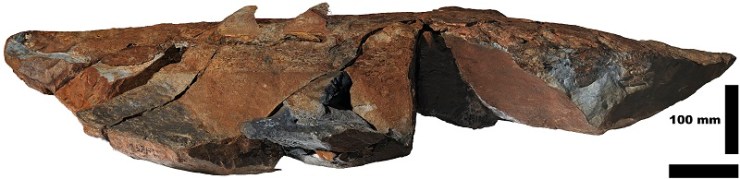
Side view of a complete Aegirocassis benmoulae fossil, showing the pointed ‘flaps’ on the animal’s back. Photograph by Peter Van Roy, Yale University.
Most Cambrian anomalocaridids have one set of triangular swim flaps sticking out the side of the body, but the new Ordovician animal, Aegirocassis, shows us that the anomalocaridids actually had two pairs of body flaps. These two flaps correspond to the two branches of a limb that is characteristic of crustacea and represents an evolutionary stage before the two branches had fused. In other words, It allows us to trace the evolution of one of the key body features that made arthropods such a successful group of animals right through to the present day.
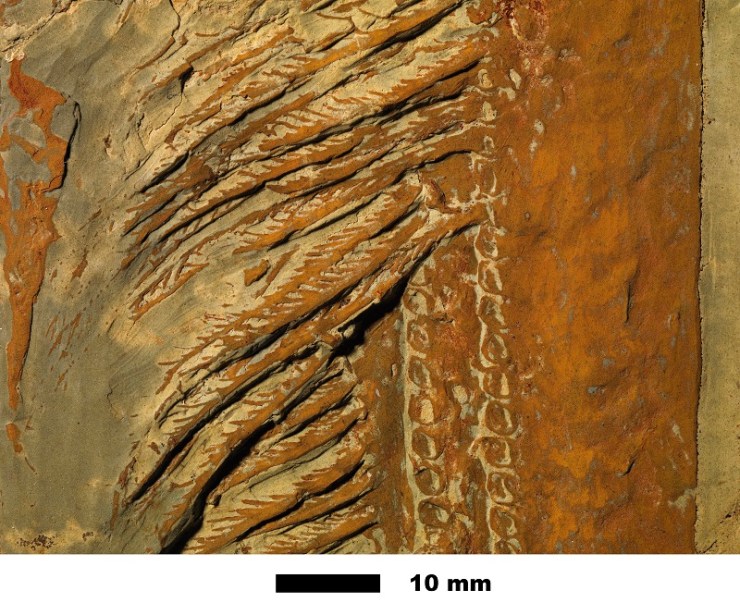
A side view of the fossilized spiny ‘net’ which Aegirocassis benmoulae used to filter its plankton food from sea water. Photograph by Peter Van Roy, Yale University.
As if that wasn’t enough, Aegirocassis also had a very different ecology from most anomalocaridids. While the Cambrian forms were mostly apex predators, this animal was a filter feeder – it used fine comb-like spines on its head appendages to filter plankton from the sea water. Only one Cambrian anomalocaridid also used filter feeding, but it remained a relatively modest size, while Aegirocassis was one of the largest arthropods ever to have existed.
This combination of gigantic size and filter feeding evolved from a previously predatory animal group is similar to the type of evolution seen later in whales. It makes Aegirocassis a very important animal for understanding both ecology and evolution in the oceans 480 million years ago.
Allison Daley holds up an Anomalocaridid fossil at the Burgess Shale in Canada. This area has yielded many previous Anomalocaridid fossils. Photograph by Parks Canada
Allison Daley – Research fellow You can also listen to an Oxford Sparks podcast with Allie, where she talks about the Cambrian Explosion, in the player here.
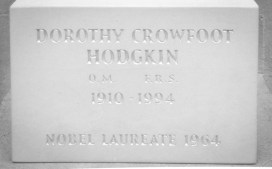
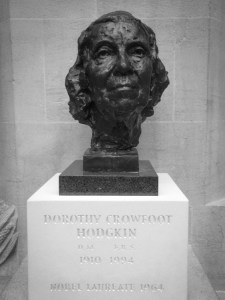
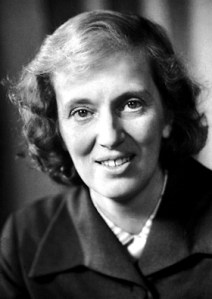
For International Women’s Day, the Museum of Natural History celebrates the life and career of Dorothy Hodgkin, one of its most eminent researchers. Hodgkin was awarded the Nobel Prize for Chemistry in 1964, and is still the only UK woman to have been awarded one of the science Nobels.
When the Museum of Natural History was designed in the 1850s, the building was intended not just to house a museum but also the burgeoning science departments of the University. The lettering above the doors facing the court continues to record these early affiliations: ‘Department of Medicine’, ‘Professor of Experimental Philosophy’, and so on.
Dorothy Mary Hodgkin (1910–1994) Image: Nobel Prize
As individual departments grew they moved into their own buildings across the science campus. One of the last research groups left in the Museum was the Department of Mineralogy & Crystallography, which, from the 1930s onwards, was the research home of the outstanding X-ray crystallographer Dorothy Hodgkin (1910-1994), winner of the Nobel Prize for Chemistry in 1964.
The Daily Mail famously celebrated her success with the headline ‘Oxford housewife wins Nobel’, but The Observer was no more enlightened, commenting that Hodgkin was ‘an affable looking housewife’ who had been awarded the Nobel Prize for ‘a thoroughly unhousewifely skill’. That socially disruptive ability was an unparalleled proficiency with X-ray analysis, particularly in the elucidation of the structure of biological molecules.
Hodgkin undertook her first degree at Oxford from 1928 to 1932, initially combining chemistry and archaeology but later focusing on the emerging technique of X-ray crystallography. Her undergraduate research project was carried out using this technique in a Museum laboratory within what is now the Huxley Room, the scene of the 1860 Great Debate on evolution between Bishop Wilberforce and T. H. Huxley. She then journeyed across to Cambridge for her PhD before returning to Oxford in 1934 and resuming her association with the Museum.
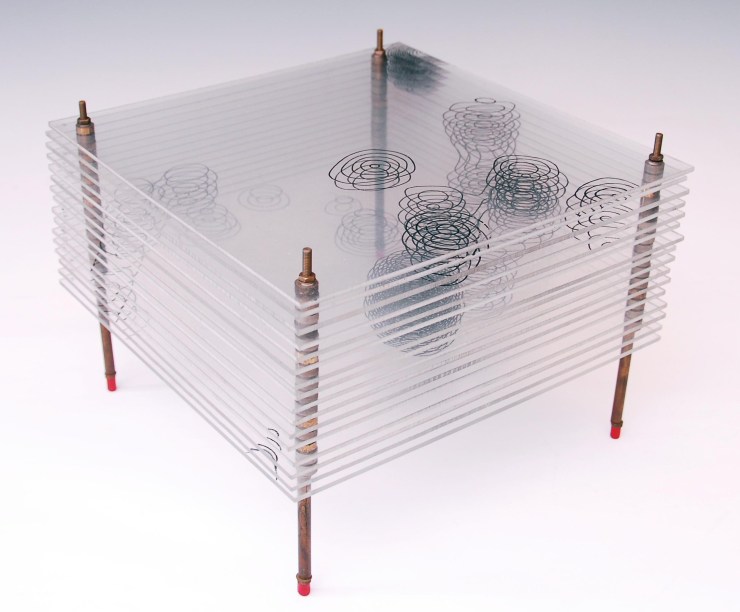
Back in Oxford, Hodgkin started fundraising for X-ray apparatus to explore the molecular structure of biologically interesting molecules. One of the first to attract her attention was insulin, the structure of which took over 30 years to resolve – a project timescale unlikely to appeal to modern research funders. Other molecules proved more tractable, including the newly discovered penicillin, which Hodgkin began to work on during the Second World War, and vitamin B12. It was for the determination of these structures that she was awarded the Nobel Prize.
Dorothy Hodgkin’s new X-ray laboratory was set up in a semi-basement room in the north-west corner of the Museum. The room is now a vertebrate store but was once also the research home of Prince Fumihito of Japan, when he was based in the Museum for his ichthyological research (and It is still the only room in the Museum with bulletproof windows).
Initially, Hodgkin’s only office space consisted of a table in this room and a small mezzanine gallery above, which housed her microscopes for specimen preparation. Once prepared, she then had to descend a steep, rail-less ladder holding the delicate sample to the X-ray equipment below. Later, Hodgkin had a desk in the ‘calculating room’ (now housing the public engagement team) where three researchers and all of their students sat and undertook by hand the complex mathematics necessary after each analysis to determine the crystal structures of organic molecules.
Paul Smith – Director
If you would like to learn more about Dorothy Hodgkin and her work, then read Georgina Ferry’s excellent biography ‘Dorothy Hodgkin: A Life’ which has just been re-issued as an e-book and new, print-on-demand paperback by Bloomsbury Reader.
This year’s Dorothy Hodgkin Memorial Lecture will be held in the Museum at 5 pm on Thursday 12 March, and is open to all. The lecture will be given by Dr Petra Fromme (Arizona State University) who is an international authority on the structure of membrane proteins.
Ever wondered what we get up to all day? This video offers a nice flavour. Thanks to Tom Wilkinson and Tom Fuller in the University of Oxford Public Affairs Directorate for putting this together.
One of the most remarkable fossil sites in the world is located in Chengjiang in China, where exquisitely-preserved fossils record the early diversification of animal life. The 525 million year old mudstone deposits in the hills and lakes of Yunnan Province, South China are so fine that they have preserved not only the shells and carapaces of Cambrian animals, but also the detail of their soft tissue. In recognition, the site was added to the World Heritage list by UNESCO in 2012.
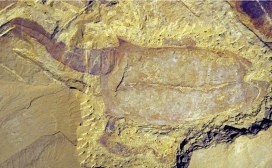
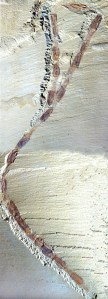
A vetulicolian – a fossil which broadly speaking probably lies on the evolutionary lineage that leads to the vertebratesThe arthropod Synophalos showing numerous interlocking individuals in a chain
Professor Derek Siveter, a senior research fellow at the Museum, has been studying this material for a number of years, authoring a book – The fossils of Chengjiang, China: The flowering of early animal life – in 2004. But the rate of discovery of new fossils over the last decade has led to a wealth of new material to be documented.
So Derek recently headed back to the University of Yunnan for a two-week visit, where he began work on a revised edition of the book. Much of the documentation of these important fossils is currently in Chinese, so the new edition will bring the material to English-speaking researchers and fossils enthusiasts too. It introduces both the professional and the amateur palaeontologist – and all those fascinated by evolutionary biology – to the aesthetic and scientific quality of the Chengjiang fossils, many of which represent the origins of animal groups that have sustained global biodiversity to the present day.



 William Smith is perhaps most famous for publishing the first geological map of England and Wales in 1815, making this the bicentenary of the incredible feat.
 This weekend marked the official kick-off of events with the opening of the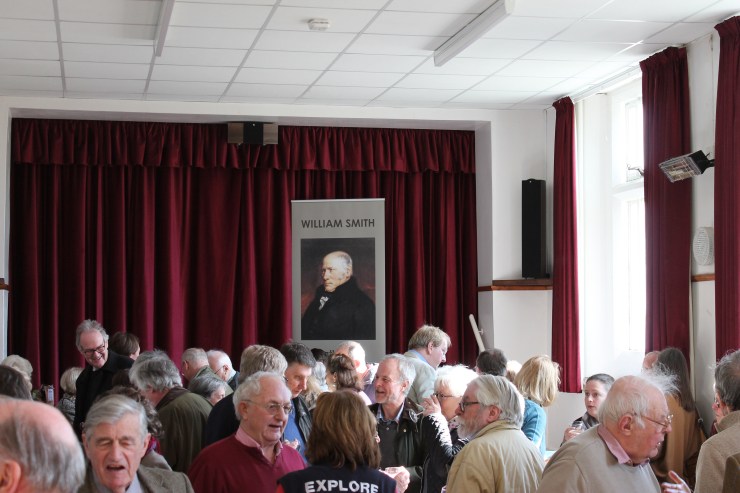
 It includes well known publications from the William Smith archive here at the Museum of Natural History such as his geological map of Oxfordshire. Rarely seen items such as letters between himself and his niece, an excerpt from his diaries and the marriage deed of his grandparents will also be on display.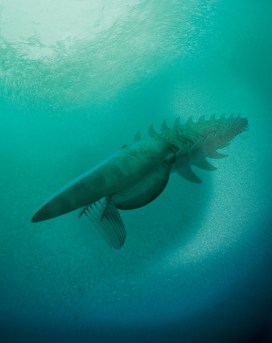
 Meet Aegirocassis benmoulae – a 480 million year old, two-metre sea monster. This unlikely looking creature has been described, and imagined in this illustration, thanks to the work of one of the Museum’s research fellows, Dr Allison Daley.


 One of the most remarkable fossil sites in the world is located in Chengjiang in China, where exquisitely-preserved fossils record the early diversification of animal life. The 525 million year old mudstone deposits in the hills and lakes of Yunnan Province, South China are so fine that they have preserved not only the shells and carapaces of Cambrian animals, but also the detail of their soft tissue. In recognition, the site was added to the World Heritage list by UNESCO in 2012.
 More Than A Dodo