Animating the extinct

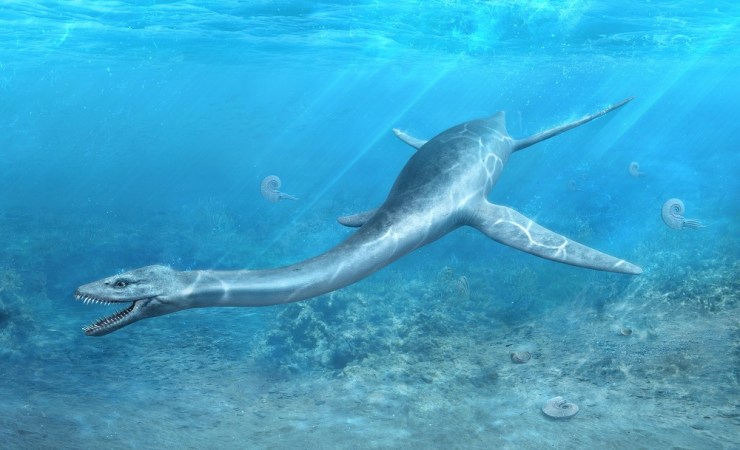
This sumptuous video features on our brand new Out of the Deep display and brings to life the two large marine reptile skeletons seen in the cases. The Museum exhibition team worked with Martin Lisec of Mighty Fossils, who specialise in palaeo reconstructions. Martin and his animators also created a longer video explaining how the long-necked plesiosaur became fossilised, as well as beautiful illustrations of life in the Jurassic seas. 
Martin explains the process of animating these long-extinct creatures:

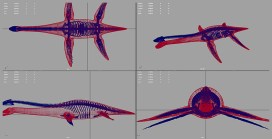
The first step was to make 3D models of all the animals that would appear in the films or illustrations. After discussion with the Museum team, it was clear that we would need two plesiosaurs (one short-necked, known as a pliosaur, one long-necked), ammonites, belemnites and other Jurassic sea life. Now we were able to define the scale of detail, size and texture quality of the model.

In consultation with Dr. Hilary Ketchum, the palaeontologist on the project, we gathered important data, including a detailed description of the discovered skeletons, photographs, 3D scans, and a few sketches.

This slideshow requires JavaScript.

We created the first version of the model to determine proportions and a body shape. After several discussions with Hilary, some improvements were made and the ‘primal model’ of the long-necked plesiosaur was ready for the final touches – adding details, mapping, and textures. We could then move on to create the other 3D models.

This slideshow requires JavaScript.

The longer animation was the most time-consuming. We prepared the short storyboard, which was then partly changed during the works, but that is a common part of a creative job. For example, when it was agreed during the process that the video would contain description texts, it affected the speed and length of the whole animation – obviously, it has to be slower so that people are able to watch and read all important information properly.

A certain problem appeared when creating the short, looped animation. The first picture had to precisely follow the last one – quite a difficult goal to reach in case of underwater scenery. Hopefully no-one can spot the join!

This slideshow requires JavaScript.

At this moment we had a rough animation to be finalised. We had to make colour corrections, add effects and sound – everything had to fit perfectly. After the first version, there were a few more with slight adjustments of animation, cut and text corrections. The final version of both animations was ready and then rendered in different quality and resolution for use in the display and online.
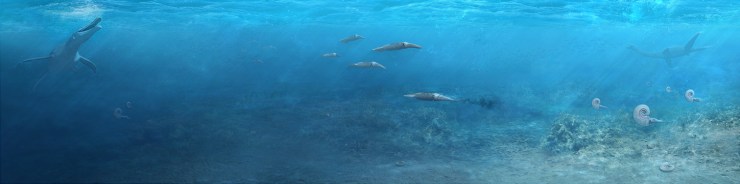
The last part of the project was creating a large illustration, 12,000 x 3,000 pixels, which would be used as a background for a large display panel. Text, diagrams and a screen showing the animations would be placed on this background, making the composition a little tricky. We agreed that the base of the illustration would be just the background. The underwater scene and creatures were placed in separate layers so that it would be easy to adjust them – move them, change their size, position etc.

This slideshow requires JavaScript.

In the first phase, we had to set the colour scale to achieve the proper look of the warm and shallow sea, then we made rough sketches of the scene including seabed and positions of individual creatures. We had to make continuous adjustments as the display design developed.

Then we finished the seabed with vegetation, gryphaea shells and plankton floating in the water. The final touch was to use lighting to create an illusion of depth for the Jurassic creatures to explore.

*

More Out of the Deep videos are available on the Museum website.

Pieces of a plesiosaur

We’ve just opened a brand new, permanent display called Out of the Deep, featuring two beautifully preserved plesiosaur skeletons. Remarkably, both of these marine reptile fossils have skulls, which is more unusual than you might think. Dr Hilary Ketchum, collections manager in the Museum’s Earth Collections and curator of Out of the Deep, describes how the skull of the long-necked plesiosaur made it safely from a quarry to a museum display.

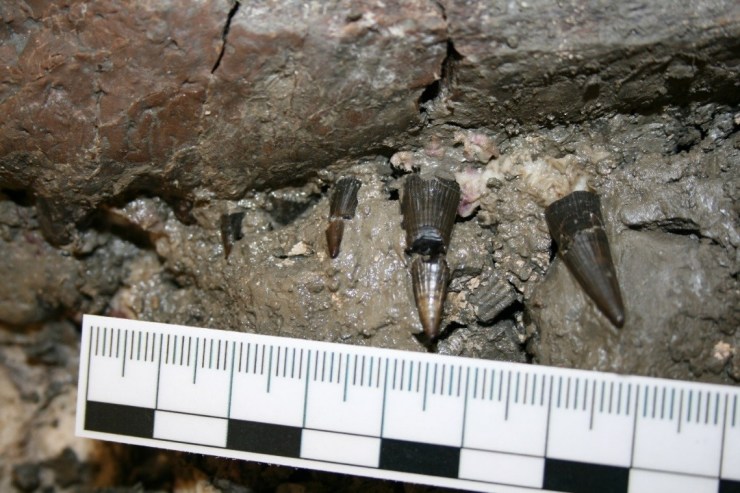
At the bottom of a clay pit in 2014, palaeontologists from the Oxford Clay Working Group discovered a 165-million-year-old fossil plesiosaur skeleton, and they knew they had found something special. Plesiosaur bones are fairly common in the quarry, but skeletons are rare. Skeletons with skulls are rarer still. Fantastically, at the end of their newly-found plesiosaur’s neck was a skull. Barely visible underneath the clay, only the tip of the snout and a few teeth were exposed.

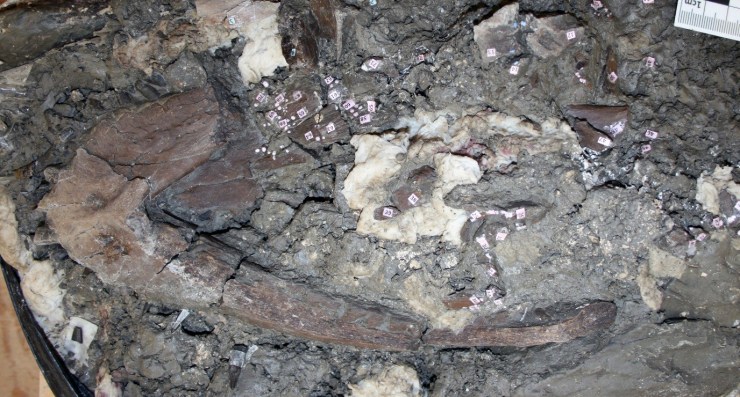
Can you see the skull? Fossil hunting in the quarry takes time, patience and a good eye to distinguish between bones and clay. Image: Mark Wildman, Oxford Clay Working Group.

Plesiosaur skulls are usually made up of around 33 bones, not including the tiny bones from inside the eye sockets, called the sclerotic ring. The skull bones are among the smallest and most fragile in the entire skeleton. This means they are much less likely to be preserved, and less likely to be discovered, than the larger and more robust backbones and limb bones.

A plaster jacket was made around the skull while still in the quarry.
Image: Mark Wildman, Oxford Clay Working Group.

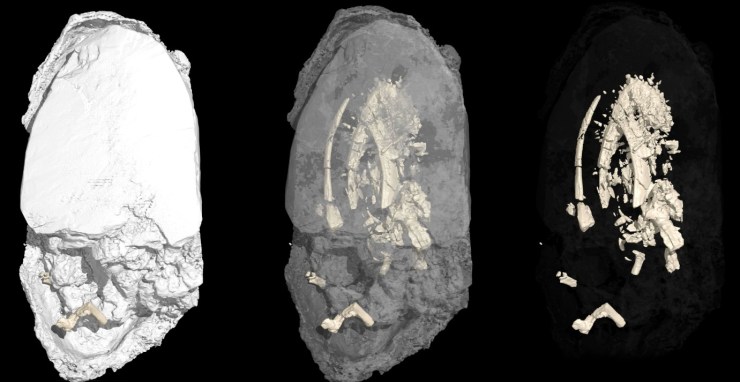
When the plesiosaur skeleton arrived in the Museum in 2015, the skull and some of the surrounding clay was encased in its protective plaster field jacket. As tempting as it was, instead of cracking open the jacket straight away, we decided on a more technological approach. Professor Roger Benson and Dr James Neenan took the specimen to the Royal Veterinary College to use their enormous CT scanner, normally used for scanning horses and other large animals, and took thousands of X-rays of the jacket. This allowed them to build up a 3D model of the fossil inside – our first tantalising glimpse of the whole skull!

The CT scan of the plaster jacket (left) revealed the location of the skull inside the jacket (middle). The jacket was then digitally removed (right) to reveal a 3D image of the skull.

Having the CT scan of the skull was like having a picture on a puzzle box
Juliet Hay, Earth Collections conservator and preparator

Although the CT scan was incredibly useful, we still had to proceed with the preparation with caution. It was possible that not all of the bones had not been detected by the scanner, especially the incredibly thin bones of the palate.

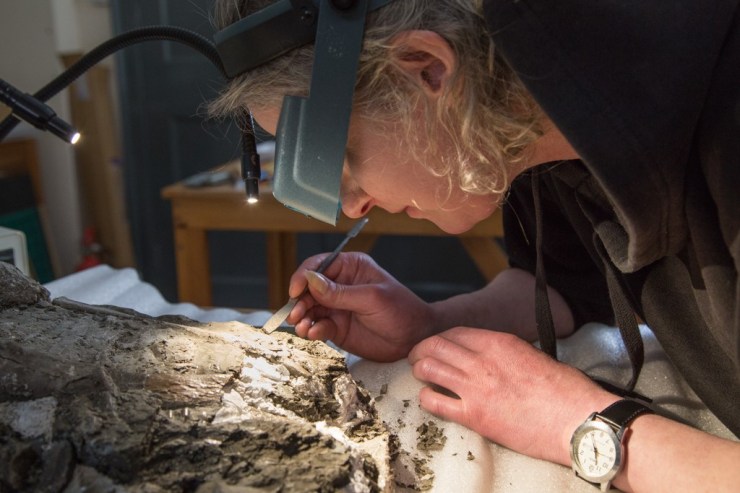
After opening the plaster jacket, Juliet began to carefully remove the clay from around the fossil bone.

Slowly and carefully, Juliet and I removed the soft clay from around the skull. The weight of clay pressing on top of the skull for millions of years had crushed it, breaking some of the bones into a lot of smaller pieces. In order to keep track of them we attached a number to each piece of bone and photographed it from several different angles before removing it from the jacket.

Each individual bone was mapped using a numbering system. The numbers were attached with the conservation adhesive Paraloid B72 in acetone, so that they could be easily removed later.
The plesiosaur’s pointed teeth being revealed.

When all the bones had finally been removed from the clay, we had over 250 pieces. Next came the challenge of the three-dimensional jigsaw!

With knowledge about plesiosaur skulls from my PhD, and some extra expert help from Roger Benson and Dr Mark Evans, Curator of Natural Science and Archaeology, New Walk Museum and Art Gallery, I was able to build up the skull, piece by piece, until it was nearly whole again.

After many months of painstaking work, the beautifully preserved skull of this long-necked plesiosaur can finally be seen in the Out of the Deep display.

Amazingly, the skull is even more complete and more beautifully preserved than we could tell from the CT scan. The sutures between the individual bones can be seen in exquisite detail, and even though I work with fossils every day, I still find it amazing that it is 165 million years old.

*

With special thanks to:

Oxford Clay Working Group: Mark Wildman, Carl Harrington, Shona Tranter, Cliff Nicklin, Heather Middleton, and Mark Graham, who uncovered and excavated the long-necked plesiosaur.

Forterra, for generously donating the plesiosaur skeleton to the Museum, after it was discovered in a Forterra quarry. 

How to build a plesiosaur, in 836 easy steps

By Rachel Parle, Public Engagement Manager

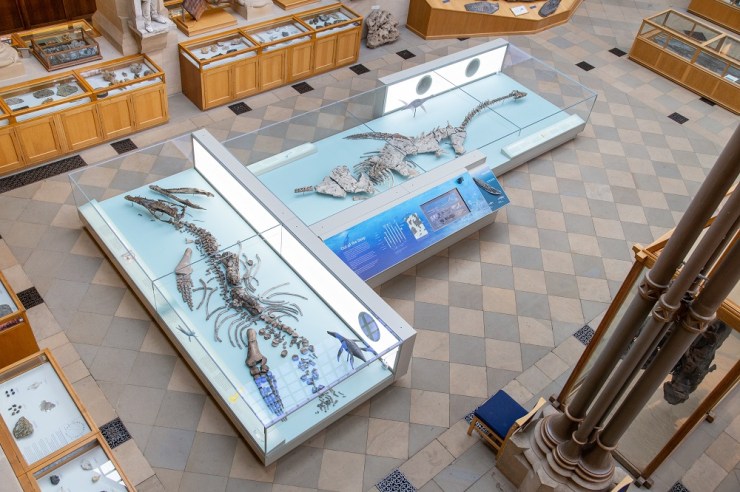
Fitting together the remains of long-dead sea creatures is no easy job. A brand new permanent display, Out of the Deep, has brought together two Jurassic marine reptiles in the largest new display in the Museum for decades. But getting them out on show was a long, delicate process that took hundreds of careful steps.

The specimens are rare and remarkably complete, and on full display for the first time. The short-necked plesiosaur, known as a pliosaur, was discovered by a former Museum curator in the 1990s in Yarnton, Oxfordshire, just a few miles from the Museum.

The larger long-necked plesiosaur was found in a quarry in Cambridgeshire in 2014 by the Oxford Clay Working Group, and donated to the Museum’s collections by the quarry’s owner Forterra. You might remember this fossil from our excited article when the specimen first arrived at the Museum, back in 2016.

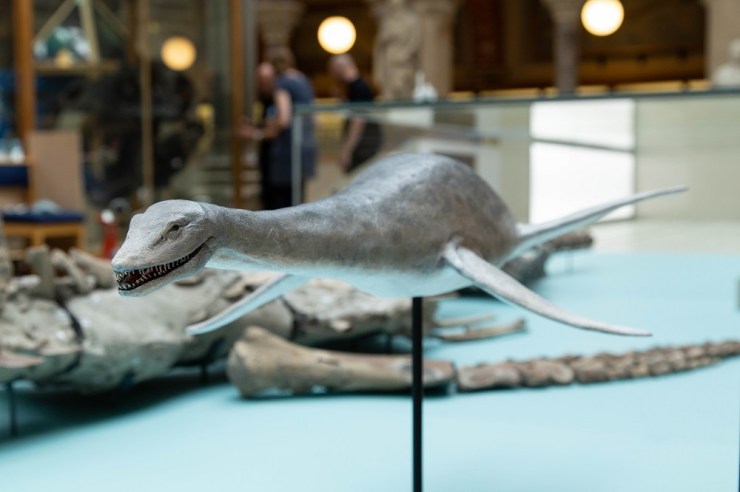
Model of the long-necked plesiosaur, made by Crawley Creatures

Before the fossils could take centre stage, their set had to be built, in the shape of two enormous display cases, designed and constructed to house these special specimens. Every day, for two weeks, the team from showcase specialists Click Netherfield pieced together slabs of glass, built walls, installed lights and fitted portholes. Yes, portholes!

A young visitor peers at the plesiosaur through a porthole

The display is positioned in the south aisle of the Museum – if you know the building, this is on the right as you come in, alongside large dinosaur skeletons. We’d measured and planned the space again and again, with our designers Calum Storrie and Pat O’Leary, but couldn’t quite picture this huge display sitting alongside the other cases. Each specimen is almost five metres in length, so the cases really are whoppers. Once the pieces started to come together, we could see that this was going to a really dramatic addition to the Museum. We chose a clean, contemporary look, with lots of glass and powder-coated steel. The colour of the metal case was carefully chosen to stand out (no oak-effect), but sit well in amongst the warm tones of the stone and brick work – RAL 7032 if you’re interested!

Here’s a time-lapse video to show you how the cases were built, piece by piece over two weeks.

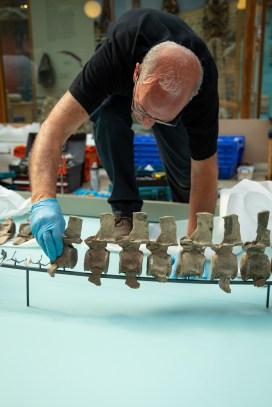
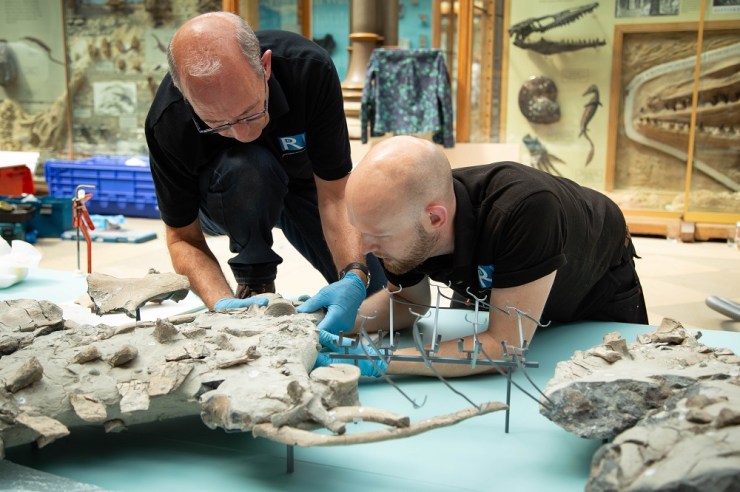
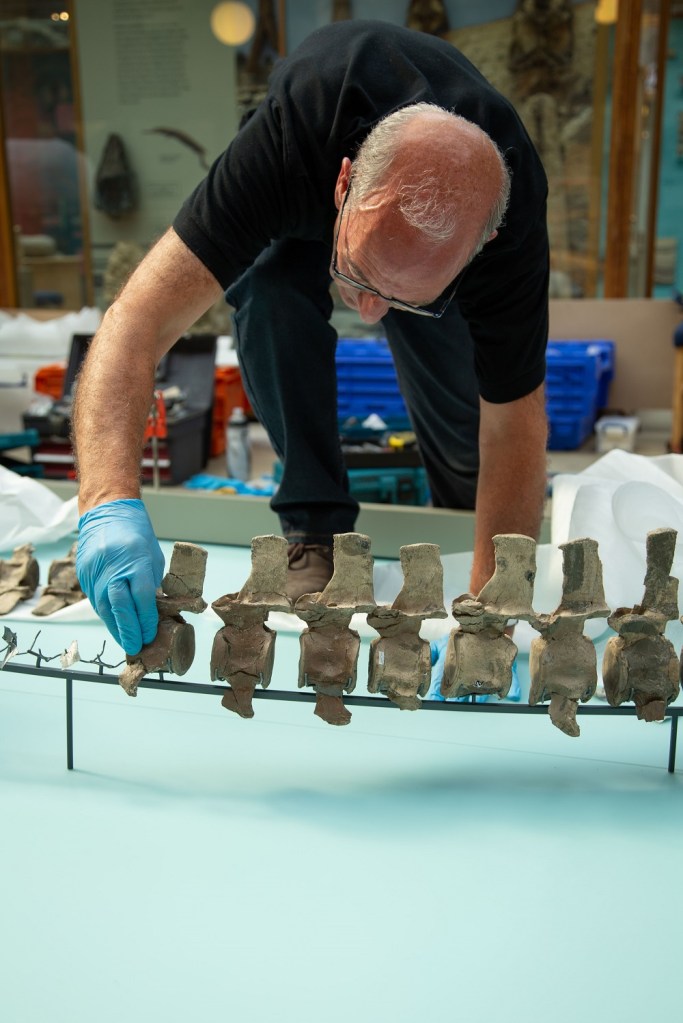
Once the enormous cases were in place, we could start installing the stars of the show – the two plesiosaur skeletons. Museum staff had worked closely with Richard Rogers Conservation to build an intricate web of steel that would hold each fragment of the skeleton in place, showing it off to its full potential. This mount was screwed into place on the acrylic base board then the individual bones were gently slotted into place.

Richard Rogers slots a vertebra into place on the carefully-crafted mount
Richard Rogers and James Dawson position plesiosaur ribs

Here’s a glimpse of the installation process in a handy time-lapse film:

After countless of hours of excavation, preparation, planning, measuring (measuring again) and installing, Out of the Deep is ready! It’s open now in the Museum and the specimens are accompanied by specially commissioned digital reconstructions (more about that soon), videos that share the stories behind the specimens’ discovery and even a touchable 3D print of a plesiosaur flipper. Come along and meet the Jurassic beasts that deserved all this care and attention.

The finished Out of the Deep display is open now

**

The project has been generously supported by grants from the DCMS/Wolfson Museums and Galleries Improvement Fund, and WREN’s FCC Community Action Fund.

Life’s big bang?

by Harriet Drage and Scott Billings

You may have heard of the Cambrian Explosion, an ‘event’, starting roughly 540 million years ago, when all the major animal groups suddenly appear in the fossil record, an apparent explosion of life and evolution.

But was there really an evolutionary explosion of all these animal groups, or is the lack of evidence from earlier periods due to some peculiarity of the fossilisation process? The debate has rumbled on for a number of years.

Now, a new study from our research team, the University of Oxford’s Department of Zoology, and the University of Lausanne, claims that the early Cambrian saw the origins and evolution of the largest and most important animal group on Earth – the euarthropods – in a paper which challenges two major pictures of animal evolution.

Euarthropoda contains the insects, crustaceans, spiders, trilobites, and a huge diversity of other forms alive and extinct. They comprise over 80 percent of all animal species on the planet and are key components of all of Earth’s ecosystems, making them the most important group since the dawn of animals over 500 million years ago.

Exceptionally preserved soft-bodied fossils of the Cambrian predator and stem-lineage euarthropod Anomalocaris canadensis from the Burgess Shale, Canada. Top left: Frontal appendage showing segmentation similar to modern-day euarthropods. Bottom right: Full body specimen showing one pair of frontal appendages (white arrows) and mouthparts consisting of plates with teeth (black arrow) on the head. Images: A. Daley.

A team based at the museum, and now at Lausanne, conducted the most comprehensive fossil analysis ever undertaken on early euarthropods, to try and establish whether these animals really did emerge in the early Cambrian period, or whether fossilisation just didn’t occur in any earlier periods.

In an article published today in the Proceedings of the National Academy of Sciences they show that, taken together, the total fossil record does show a gradual radiation of euarthropods during the early Cambrian, 540-500 million years ago, challenging other ideas that suggest either a rapid explosion of forms, or a much slower evolution that has not been preserved in the fossil record.

Each of the major types of fossil evidence has its limitation and they are incomplete in different ways, but when taken together they are mutually illuminating
Professor Allison Daley

Reconstruction of the Cambrian predator and stem-lineage euarthropod Anomalocaris canadensis, based on fossils from the Burgess Shale, Canada. Reconstruction by Natalia Patkiewicz.

By looking at a huge range of fossil material the researchers ruled out the possibility that Pre-Cambrian rocks older than around 541 million years would not have preserved early euarthropods. The only plausible explanation left is that the origins of this huge animal group didn’t evolve until about 540 million years ago, an estimate which also matches the most recent molecular dating.

The timing of the origin of Euarthropoda is very important as it affects how we view and interpret the evolution of the group and its effects on the planet. By working out which groups developed first we can trace the evolution of physical characteristics, such as limbs.

Exploring all the evidence like this allows us to make an informed estimate about the origins of key animal groups, leading to a better understanding of the evolution of early life on Earth.

Model of the Cambrian stem lineage euarthropod Peytoia, based on fossils from the Burgess Shale. Top left: Closeup of the mouth parts and frontal appendages. Bottom right: Overall view of the body. Model and image: E. Horn.

What is a tree of life?

A phylogeny? An evolutionary tree? A cladogram? We see the branching lines of these diagrams in many museum displays and science articles, but what do they tell us and why are they helpful?
Duncan Murdock, research fellow, explains. 

You are a fish.

Starfish, jellyfish and cuttlefish are not fish.

Actually, no, there’s no such thing as a fish. Let’s take a step back…

The Jackson 5 – the ultimate singing family tree?
Credit: Wikimedia Commons

It all comes down to common ancestry. All life is related, and we can think of it in terms of a family tree (or ‘phylogeny’): Jackie, Tito, Jermaine, Marlon and Michael were all Jacksons. United not only by a collective inability to control their feet, but also by common descent – they are all their parent’s children*.

By tracing further and further back in MJs family tree we could define ever larger groups united by common ancestors, first cousins (grandparents), second cousins (great-grandparents), all the way to every human, every mammal, every animal, and eventually all life – we are family (ok, that was Sister Sledge, but you get the point).

In the case of the tree of life, species are at the tips of branches and their common ancestors are where branches meet. A true biological group consists of a common ancestor and all its descendants, and we can use characteristics common between two species to imply common descent. Siblings look a lot like each other because they have inherited much of their appearance via common ancestry (i.e. their parents). In a similar way, two closely related species will share lots of inherited characteristics.

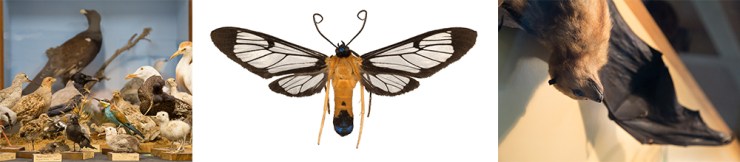
However, things are not quite that simple. Wings of bats, birds and insects are not inherited from a common ancestor but independently evolved for the same purpose, in this case flight. To complicate things further, as species evolve they may lose features inherited from their ancestors that other descendants retain. Snakes have lost their limbs, but still sit in the same group as lizards. These problems can be overcome by looking at many characteristics at once, using genetic information to test predicted relationships, and adding fossils to the tree to track change or loss through time (as in snakes).

Birds, insects and bats have all evolved wings for flight, but did not inherit this feature from a common ancestor. This is a good example of convergent evolution.

So, what about fish? ‘Fish’ is used to refer to pretty much anything that swims in water, but this lifestyle in animals like starfish (a relative of crinoids and sea urchins), jellyfish (a relative of corals) and cuttlefish (a relative of squid and octopus) evolved independently from more familiar fish like cod and carp. So, they’re not really ‘fish’ at all. With that in mind, how can we be fish? Well, the last common ancestor of, say, hagfish, salmon, shark and lungfish, is also the common ancestor of frogs, lizards, cats and us! All four-limbed animals with backbones descend from a fish-like ancestor. To complicate things further some have adapted to life back into the water and look much more like a ‘fish’ again, like dolphins, seals and the extinct ichthyosaur. Without a tree of life, we could not begin to unravel the evolutionary path that lead to all the diversity of life we see today.

The Blue Fin Tuna on display in the Museum is definitely a fish… right?!

You are closer to a chimp than a monkey, closer to a starfish than a snail, and closer to a mushroom than a tree. And, of course, there’s no such thing as a fish, but they still go well with chips.

*Joseph Jackson and Katherine Scruse had ten children, including the members of the Jackson 5, twenty-six grandchildren and several great-grandchildren.


Death, decay and fossilization

By Duncan Murdock, Research Fellow

Our oceans, rivers and lakes teem with life of all shapes and sizes, and have done so for hundreds of millions of years. We can get a glimpse of the wonderful diversity of life deep in the Earth’s past from fossils that can be found in the rocks beneath our feet. But the fossil record is as much a history of death as it is of life.

All animals die, in huge numbers every day, but the sea beds and forest floors of the Earth are not filling up with their remains. Decay is as inevitable as death. This is good news for those left behind, but bad news for fossil hunters.

Being preserved as a fossil is very much the exception, not the rule, and the chances of anything surviving the various processes by which the component parts of an animal are lost forever are vanishingly small, even for hard parts like shells, teeth and bones. For the ‘soft’ parts of animals, such as the muscles, eyes, guts and nerves, it is nearly impossible.

But ‘nearly impossible’ is good enough when you can consider every animal that ever lived, or more importantly, died. In exceptional circumstances ‘soft’ tissues do become fossils, and when they do they invariably give an unrivalled view of an otherwise completely lost world.

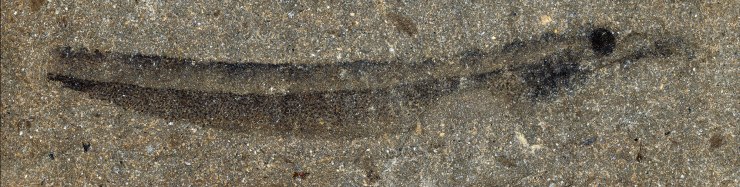
Although exceptionally well preserved, this fossil of a jawless fish is not entirely complete. Some features have been preserved, like the prominent dark eye spot and gill supports just beneath, but others, such as the guts and fins, have rotted away before they could be preserved. Image: Mark Purnell, Sarah Gabbott, Robert Sansom (University of Leicester)

We know from these exceptional fossils that the path from death to fossil is not random. Yes, you have to be lucky, but the odds are very much stacked towards certain combinations of who, what, where and when.

Furthermore, decay is not the whole story. Not only does anatomical information have to survive decay, it has to undergo parallel (but distinct) processes of preservation – conversion into materials that are stable over millions of years as part of a rock. It is the balance between the loss and retention of information that seals the fate of an organism’s remains.

Three hundred million years ago, a small worm gulped its last breath and died. Its body began to rot and, were it not for the peculiar conditions of the sediments it was laid to rest in, would have been lost forever. Fortunately for us, what remained was preserved in rock – a rotten fossil. But how much rotted away before it was fossilized? By decaying modern relatives in the lab we can model this missing history, and build better-informed reconstructions of extinct animals. Image: Duncan Murdock

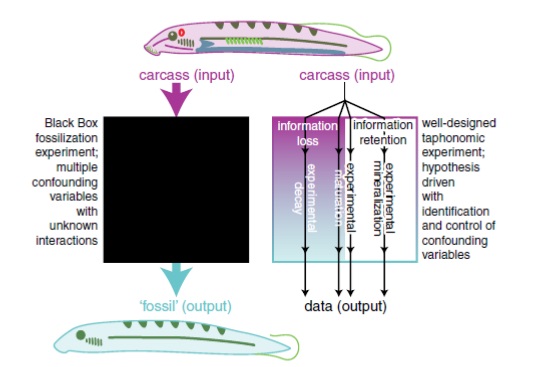
Left with only the lucky few, the parts of animals where retention exceeded loss, the fossil record is profoundly biased. One way to unravel this lost history of loss is it to conduct experiments, replicating decay and preservation. However, trying to make fossils in the lab, by contriving one particular set of conditions, is fiendishly complex – there are simply too many variables to set.

I have been working with researchers from the Universities of Leicester, Bristol, Manchester and University College Cork, and together we have described an alternative approach to unpack the ‘black box’ of fossilization and take each variable in turn, individually examining the different processes that result in retaining information as potential ‘fossils’ and, crucially, those that result in loss.

This cartoon illustrates the difference between experiments that attempt to replicate fossilization, treating the process as a black box, and the approach we are taking. The black box approach reveals little about the processes of information loss and information retention, the cumulative effects and interactions which ultimately results in a fossil (or, more often, not). Image: Purnell et al. 2018.

Ultimately this approach will allow more and more complex experiments to be designed, to unpick the interactions between the who, what, where and when in the lost history of death.

The techniques described here are published in Palaeontology today as ‘Experimental Analysis of Soft-Tissue Fossilization: Opening the Black Box‘, Purnell et al. 2018.