Is it real? – Skeletons and bones

One of the most common questions asked about our specimens, from visitors of all ages, is ‘Is it real?’. This seemingly simple question is actually many questions in one and hides a complexity of answers. 

In this FAQ mini-series we’ll unpack the ‘Is it real?’ conundrum by looking at different types of natural history specimens in turn. We’ll ask ‘Is it a real animal?’, ‘Is it real biological remains?’, ‘Is it a model?’ and many more reality-check questions.

This time: Skeletons and bones, by Mark Carnall

Them bones, them bones… They are all over the place in most museums of natural history: suspended above you, parading around you, or towering menacingly over you in the case of the attention-grabbing Tyrannosaurus rex. When it comes to skeletons you might think the ‘Is it real?’ question is pretty easy to answer; the bones are there, tangibly real, right?

The articulated skeleton of a Barn Owl

Bones are only found in fish, amphibians, reptiles, birds, and mammals. Other animals possess hard parts which can confusingly be named using similar language, such as the cuttlebone of cuttlefish, or the ‘skeletons’ of corals. These hard parts may resemble bone but are formed in different ways to true bone like the ones we possess.

Unlike taxidermy, discussed in the previous instalment, on the face of it bones are less easy to manipulate and so less likely to be subjectively represented. But individual bones did not exist individually in life, and articulated skeletons, where bones have been attached together, have been manually reassembled to illustrate the shape of the whole animal. The accuracy of an articulated skeleton can depend on a number of things, including the skill and knowledge of the person doing the assembly, the completeness of the bone material, and even the preparation of the bones themselves.
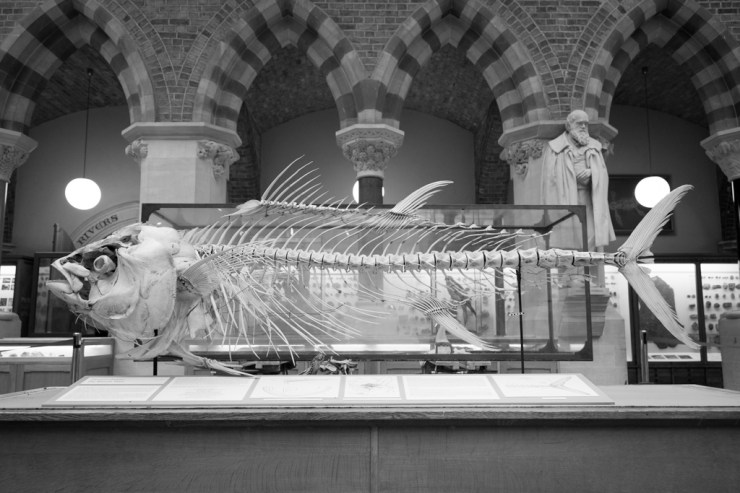
The skeleton of an Atlantic Bluefin Tuna, on display in the Museum

In life, the skeletons of the bony animals are also supported by hard but spongy cartilage and tendons which are not so easily preserved after death. Yet it is the support of the cartilage and tendons, and the form of the surrounding muscle tissue, which gives an animal its natural appearance.

Some articulated skeletons do not account for this non-bony connective tissue. For example, all of the vertebrae in an articulated backbone may be touching each other, whereas in life there would actually be a disc in between each vertebra. Articulated skeletons are often positioned so that parts of the skeleton can be easily seen and accessed, even if the positioning is not realistic or even physiologically possible.
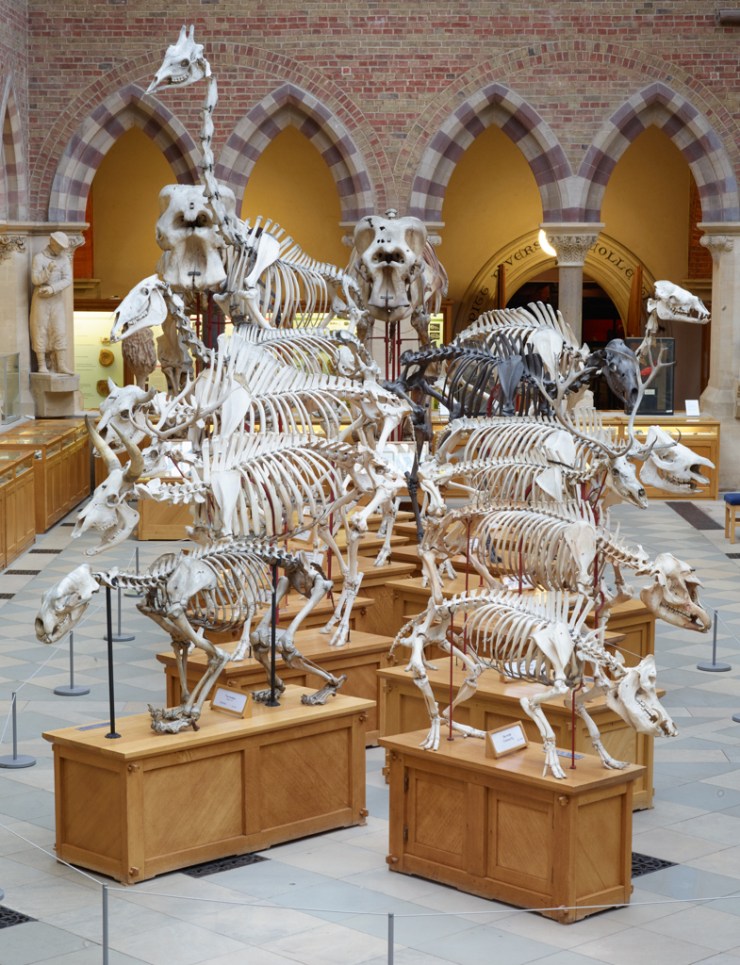
The Museum’s parade of articulated mammal skeletons – no cartilage or tendons in sight…

There are also lots of smaller bones which often aren’t preserved as they are too fragile or don’t attach to other bones in life. Examples include clavicles, or collar bones, penis bones, and the hyoid, a bony structure in the neck that supports the tongue. Some skeletons are composite specimens, so they may be made up of bones from multiple individuals to replace missing or damaged parts. Other parts of skeletons on display in museums may have been reconstructed with plaster or filler.

The way that a specimen is ‘skeletonised’ – the processes used to prepare a skeleton from a carcass – can also have a huge effect on the size and shape of bones, altering the size by up to 10 per cent, which can introduce errors in bone measurement, especially for small-boned bats, rodents, lizards, frogs, and fish.

So while there’s a tendency to assume that skeletons are more ‘real’ than other kinds of preserved specimens, they too have their biases. The next time you look at a skeleton try to imagine what is natural and unnatural about its construction, and ask yourself – is it real?

Next time… Fossils
Last time… Taxidermy

Going, going… not gone?

by Darren Mann, head of Life Collections

Extinct or not extinct; that is a question raised by a report into the status of the beetles of Great Britain, published last year by Natural England. It may sound easy to determine whether a species is extinct or not, but tiny insects can be very hard to spot, despite the best efforts of many people.

The results of the report were alarming: using the International Union for Conservation of Nature criteria, just over half of our dung beetles are in decline, five have gone regionally extinct, and a further four were classified as Critically Endangered (Possibly Extinct) in Great Britain.

Prompted by this assessment, targeted surveys were made at known historic sites for some of our rarest and possibly extinct species. Over the past two years we have already made some exceptional discoveries, including new sites and new county records for several rare dung beetles.


My favourite finds from recent field exploits are the discovery of two new populations in Gloucestershire for the Critically Endangered Aphodius quadrimaculatus, and the rediscovery of Heptaulacus testudinarius in the New Forest, Hampshire after 35 years with no records. But sadly we have failed to find four of our target species at their last known sites.

Finally, after ten years of repeated site visits, we did finally find one of our rarest species, the Ainsdale dung beetle Amoecius brevis. This small beetle, just 3.5-4.5 mm long, was first found in Britain in 1859. It’s restricted to the Ainsdale and Birkdale sand dunes of Lancashire, where there were several records from the early 20th century, one record in 1962, and four records from the 1990s.

A specimen of Amoecius brevis from the Museum, collected in 1903

The last known record was of a single specimen caught in 1996. The lack of recordings for the past 20 years, despite a large number of surveys, led us to proclaim it Critically Endangered and ‘Possibly Extinct’ in the Natural England report.

Unlike many of our other dung beetles, which prefer fresh dung, Amoecius brevis breeds in older dung of large herbivores, such as cattle and horses, and rather unusually, in the UK it is also found breeding in rabbit latrines.

So it was in pursuit of rabbit latrines that we spent five days walking up and down sand dunes, covering an area of about 5km2. We then used a fine mesh sieve and tray to search through the dung and sand beneath. When our first beetle appeared it took a few minutes for the euphoria to fade, and then to our delight a further three were found in the next handful of sand and rabbit dung, along with a few more a little way down the coast.

In one sense, proclaiming a small, inconspicuous and evidently hard to find beetle as ‘Possibly Extinct’ is premature, but without that designation who would bother to go and look? Would wildlife conservationists give it any attention?

Since the Natural England Status Review was published, surveys have been commissioned for four rare dung beetles; in the case of the Ainsdale dung beetle at least, this has proven very successful.

I hope that the rediscovery of this very rare beetle will highlight the importance of invertebrate conservation as a whole. In the meantime, our data will feed in to conservation management plans for the Ainsdale site, safegaurding this little beetle’s future.


Comedy rears its ugly head

Logo blob fish
Is the Blobfish the ultimate ugly animal?

Animals with big eyes, fluffy tails and cute noses are easy to love. But what about those with tentacles, slimy skin or a large throat pouch?! Luckily the Ugly Animal Preservation Society is here to fight their corner. Education Officer Chris Jarvis shares some tales from a special event…

Comedy met conservation on Saturday night, as the Museum teamed up with Berkshire, Buckinghamshire & Oxfordshire Wildlife Trust, compere Simon Watt and the Ugly Animal Preservation Society. During the evening, six comedians put the case for their own neglected animals in need of conservation: the Scrotum Frog; Christmas Island Frigate Bird; Kaluga Sturgeon; Slimehead; Okapi, and Yak. The audience then voted to choose the official mascot for Oxford, but which of these lovely uglies did they choose?

The Scrotum Frog

Par Samuel Garman (1843-1927) [Public domain], via Wikimedia Commons
Image: Samuel Garman via Wikimedia Commons

Chosen by Iszi Lawrence, this unfortunately-named amphibian’s population in Lake Titicaca is now dwindling. It’s threatened by the introduction of alien salmon for the angling fraternity and is also blended to make a medicinal frog frappe by Andean locals with strong stomachs!

Christmas Island Frigate Bird

By Charlesjsharp (Own work) [CC BY-SA 3.0 (http://creativecommons.org/licenses/by-sa/3.0)], via Wikimedia Commons
Photo: Charlesjsharp via Wikimedia Commons
Some may find its inflatable throat pouch off-putting (in the same way the Scrotum Frog brings certain disturbing images to mind), but not advocate Eleanor Morton. This critically endangered seabird is one of a family of only five species that grace our oceanic skies and deserves our attention.

Kaluga Sturgeon

By User:Cacophony [GFDL (http://www.gnu.org/copyleft/fdl.html), CC-BY-SA-3.0 (http://creativecommons.org/licenses/by-sa/3.0/) or CC BY 2.5 (http://creativecommons.org/licenses/by/2.5)], via Wikimedia Commons
Photo: Cacophony via Wikimedia Commons
Hideous and aggressive, these formidable fish grow to a ton in weight and have suffered a population decline of 80% over the last 90 years: we humans like to eat their eggs and their spawning grounds are now severely polluted. Without action we may lose one of the largest fresh water fish in the world. Kaluga Sturgeon champion Paul Duncan McGarrity made the case for this fugly fish.

Slimehead

By Pengo (Own work) [CC BY-SA 3.0 (http://creativecommons.org/licenses/by-sa/3.0) or CC BY 3.0 (http://creativecommons.org/licenses/by/3.0)], via Wikimedia Commons
Photo: Pengo via Wikimedia Commons
Nigel Lovell chose this sociable, deep sea fish which has been severely overfished due to the remarkable success of a rebranding campaign. You might know it better as the ‘Orange Roughy’ seen in fishmongers since the 1970s. But just remember it’s a ‘Slimehead’ – your dinner guests might not want to see that on their menu!

Okapi

By Raul654 (Own work) [GFDL (http://www.gnu.org/copyleft/fdl.html) or CC-BY-SA-3.0 (http://creativecommons.org/licenses/by-sa/3.0/)], via Wikimedia Commons
Photo: Raul654 via Wikimedia Commons
A rather beautiful (to my mind) relative of the giraffe, which looks like it put on a zebra’s pyjama bottoms by mistake! Rosie Wilby’s case for the Okapi was strengthened by a wonderful demonstration of its courtship behaviour involving a member of the audience and an 18-inch purple tongue*!

*Photographs cannot be shared.

Yak

Photo: travelwayoflife via Wikimedia Commons

Chosen by Teiran Douib, and not to be confused with the domestic yak, the wild yak is listed as vulnerable in its native Himalayas due to poaching, cross-breeding and climate change. These wonderful creatures are blessed with electrically non-conductive fur to survive electrical storms. They are one of the largest of all cow species, reaching up to 2.2 metres at the shoulder. However, their udders and scrotums are particularly small and hairy as protection against the cold.

Once the comedians had made their pitch it was time to decide on an ugly animal mascot for Oxford. Voting was frenetic and passionate as the issues at stake clearly hit home. But finally a champion emerged…

The winner was…the Kaluga Sturgeon! Yes, it’s official, Oxford’s Ugly Animal Mascot is a one-ton, aggressive fish that occasionally upends boats. As Paul Duncan McGarrity pointed out, it’s a shame that Oxford doesn’t have a long-standing boating rivalry with another city where this might come in handy…

Imitation game

Last month we had the pleasure of hosting artist and scientist Dr Immy Smith as part of her week-long takeover of @IAmSciArt on Twitter. Drawing inspiration from the Museum’s collections, Immy has created some beautiful paintings. Here she tells us a little more about her interests and work…

My current artwork is focused on crypsis and mimicry – the ways that animals and plants disguise themselves or pretend to be something they’re not. Cryptic camouflage helps animals to avoid being seen, often to help them catch prey – or to avoid becoming prey themselves! Mimicry is also often about trying not to get eaten: the harmless hornet moth, for example, mimics a stinging insect to deter predators. I use these themes to develop print art projects, and also public workshops to help people learn more about the ecology of cryptic animals.

Cryptic Cards by Immy Smith

In my arts practice I try to imagine how animals and plants might evolve to camouflage themselves on human-made materials, and what they might look like. Will we one day find moths adapted to hide on advertising hoardings, or beetles mimicking litter? I made an entire deck of Cryptic Cards as a response to this kind of question.

Another project I’m working on at the moment is called Emergent Crypsis. This is a collaboration with Norweigan generative artist Anders Hoff who makes art using algorithms executed by a computer. I’m imagining how creatures might adapt to an extreme example of human-made patterns – computer generated abstract images.

Violin Beetle (Mormolyce phyllodes) by Immy Smith

My work requires me to closely study many animals and plants, but how do I learn about all these species in order to draw their imaginary relatives? How do I make my art a convincing representation of how life might find ways to hide on human-made art?

One answer is of course, the internet. I’ve been lucky enough to find many wildlife photographers online who are kind enough to let me use their images as reference. But photographs alone are not always enough to get to know the fine details and defining characteristics of a species: the joints and articulations of small insects, for example, are best studied from specimens. And some species are rare, or even extinct, and it can be hard to find photographic a reference.

Leaf-footed Bug (Diactor bilineatus) by Immy Smith

This is where scientific collections come into the picture. The collections held in museums and other institutions are not only essential for scientists and scientific illustrators, they are also an invaluable resource for artists of many disciplines, science communicators, and educators of many kinds. In the collections at the Oxford University Museum of Natural History I can photograph and sketch leaf-mimicking insects, for example, that are native to the forests of South America which I may never visit. I can study in minute detail the articulation of beetles that are rarely seen, and which might be difficult to find – and irresponsible to collect – myself.

A display of terrestrial bugs (Heteroptera) in the Museum, including the Leaf-footed Bug painted by Immy Smith

Not only do I find specific species that I want to study in natural history collections, I often see new ones – animals I didn’t know about or hadn’t thought of drawing before. In the same week that I visited Oxford, I also made a trip to Herbarium RNG in Reading to study plant mimicry, and found similar inspiration there. I can channel all this into both aesthetic art destined for print and sciart workshops that communicate the wonders of insects or plants with the wider community.

Working on sciart projects and educational workshops helps me appreciate the multitude of ways in which collections benefit research and education. We must try to communicate the plethora of roles they play, and the host of ways they cross into our lives – whether through scientific research on insects pollinators of the crops we eat, or via a deck of cards made by someone like me for mainly recreational purposes. We must fight to protect scientific collections because they are a resource that benefits all of us as a society.

Stories from Stone, Body and Bone

rosehill exhibition postcard image for web

Each year the Museum works with members of the community on a wide variety of projects using our collections to enthuse and engage people in natural history. These projects often result in some amazing outcomes but until now we have been unable to find the right space to celebrate this work in the Museum. So this month we are very happy to unveil our new Community Case, dedicated to doing just that.

Community case front for web
Stories from Stone, Body and Bone in the new community case

Our opening display focuses on the Children in Need-funded Story Makers programme. In partnership with Fusion Arts, this initiative helps Oxford primary school pupils to develop their communication skills by taking inspiration from museum collections. And this year they teamed up with us to create Stories from Stone, Body and Bone.

Pupils from New Marston, Wood Farm, and Rose Hill Primary schools worked with Story Makers founder and arts psychotherapist Helen Edwards in two visits to the Museum, stimulating and developing imaginative ideas, stories and artwork.

During these visits the Story Makers met with our education officer Chris Jarvis and together they looked at rocks and minerals, tectonic plate formation, and the evolution of skeletons and animal posture. They explored the collections creatively through sensory observation, using the hands, body and senses to develop self-awareness and self-confidence.

story makers work 3 for web
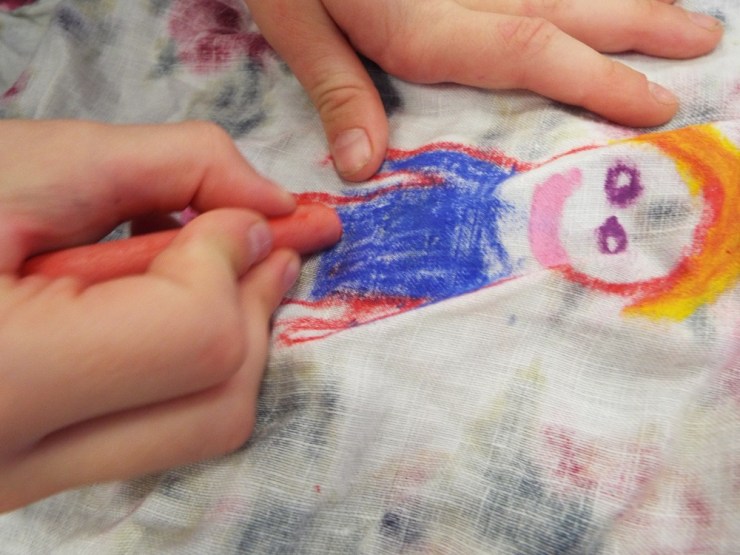
Getting creative with chalks and textiles

We work with the children as artists and we carefully designed a series of sessions that enabled them to have direct sensory engagement with objects in the museum. We then used art processes to portray their experiences and feelings about their interactions.
Helen Edwards, Integrative Arts Psychotherapist

Back at school, the pupils used visual art, drama, movement and modelling to communicate feelings and ideas that emerged from these museum encounters, sharing thoughts with the group in a playful and trusting atmosphere.

story makers students for web cropped

Group sessions back at school involving movement, drama and art

story makers work 4 for web
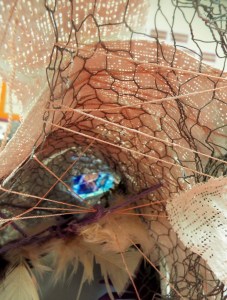
Detail from one of the Stone Age caves

Each Story Maker then created a Stone Age character – someone who might dream up and pass on stories full of meaning and myth. They imagined places in which their Stone Age characters might live, thinking about what they might see looking out from these spaces, through the cracks, crevices and windows in their caves.

From these ideas emerged beautiful, bright, and colourful models of these fictional abodes, as well as stories and poetry about their characters.

Story Makers built the children’s capacity to think reflectively, enriching their speech and language, and helped them to develop their writing skills as the stories were compiled into Story Makers books.

story makers artwork for web
Stone Age houses and landscapes as part of the Stories from Stone, Body and Bone project

Everyone should get to do this, it is like a dream come true
Story Maker, from the Stories from Stone, Body and Bone project

Stories from Stone, Body and Bone is on display until Sunday 21 May in our new Community Case. The next display, installed on 22 May, will feature artwork by our community of artists who use the collections as inspiration for their work.