I’ve been to see the dinosaurs at the Pitt Rivers Museum!
It’s a common exclamation, but alas, there are no dinos in the Pitt Rivers, nor totem poles in the Museum of Natural History. Rather, there are two museums with a shared front door, and a fair amount of confusion.
To address this perpetual museum muddle we present a short play, Welcome to My Museum, where the Victorian founders of each institution come to life to discuss ‘two marvellous museums under one roof’.
A small grant from the Oxford University Museums Partnership allowed a collaboration between us, the Pitt Rivers Museum, Pegasus Theatre, and Film Oxford to produce two versions of the play – one for public performance and another for a film adaptation, which is the one you can watch below.
Ciaran Murtagh (left) as General Augustus Henry Lane-Fox Pitt Rivers and Andrew Jones as Henry Acland
Working with Pegasus Theatre, Rachel Barnett scripted an imagined conversation between the founders of the two museums, Henry Acland and General Augustus Henry Lane-Fox Pitt Rivers. Pegasus helped to source actors and costumes and even a prop-maker for Pitt Rivers’s fine pufferfish helmet.
Film Oxford spent several late nights with a very patient rent-a-crowd, immortalising their adaptation of the play on film. The public performance was well attended, with over 250 visitors dropping in to watch General Pitt Rivers rudely interrupt Henry Acland’s speech welcoming visitors to his museum. Pitt Rivers rightly points out that there must be two museums as the building has two gift shops and even two differently-branded pencil sharpeners for sale in them – ‘scientifically incontrovertible’ proof!
So if you think that you have ever been to the Pitt Rivers Museum to see the dinosaurs, or the Museum of Natural History to look at the totem-pole, watch the film below and you will discover that our building is actually ‘two sublime museums under one roof’.
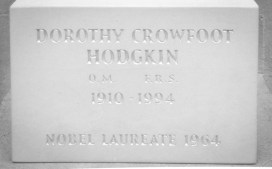
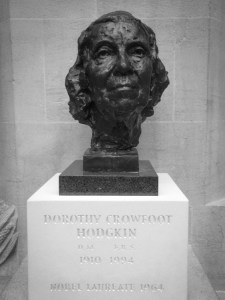
For International Women’s Day, the Museum of Natural History celebrates the life and career of Dorothy Hodgkin, one of its most eminent researchers. Hodgkin was awarded the Nobel Prize for Chemistry in 1964, and is still the only UK woman to have been awarded one of the science Nobels.
When the Museum of Natural History was designed in the 1850s, the building was intended not just to house a museum but also the burgeoning science departments of the University. The lettering above the doors facing the court continues to record these early affiliations: ‘Department of Medicine’, ‘Professor of Experimental Philosophy’, and so on.
Dorothy Mary Hodgkin (1910–1994) Image: Nobel Prize
As individual departments grew they moved into their own buildings across the science campus. One of the last research groups left in the Museum was the Department of Mineralogy & Crystallography, which, from the 1930s onwards, was the research home of the outstanding X-ray crystallographer Dorothy Hodgkin (1910-1994), winner of the Nobel Prize for Chemistry in 1964.
The Daily Mail famously celebrated her success with the headline ‘Oxford housewife wins Nobel’, but The Observer was no more enlightened, commenting that Hodgkin was ‘an affable looking housewife’ who had been awarded the Nobel Prize for ‘a thoroughly unhousewifely skill’. That socially disruptive ability was an unparalleled proficiency with X-ray analysis, particularly in the elucidation of the structure of biological molecules.
Hodgkin undertook her first degree at Oxford from 1928 to 1932, initially combining chemistry and archaeology but later focusing on the emerging technique of X-ray crystallography. Her undergraduate research project was carried out using this technique in a Museum laboratory within what is now the Huxley Room, the scene of the 1860 Great Debate on evolution between Bishop Wilberforce and T. H. Huxley. She then journeyed across to Cambridge for her PhD before returning to Oxford in 1934 and resuming her association with the Museum.
Back in Oxford, Hodgkin started fundraising for X-ray apparatus to explore the molecular structure of biologically interesting molecules. One of the first to attract her attention was insulin, the structure of which took over 30 years to resolve – a project timescale unlikely to appeal to modern research funders. Other molecules proved more tractable, including the newly discovered penicillin, which Hodgkin began to work on during the Second World War, and vitamin B12. It was for the determination of these structures that she was awarded the Nobel Prize.
Dorothy Hodgkin’s new X-ray laboratory was set up in a semi-basement room in the north-west corner of the Museum. The room is now a vertebrate store but was once also the research home of Prince Fumihito of Japan, when he was based in the Museum for his ichthyological research (and It is still the only room in the Museum with bulletproof windows).
Initially, Hodgkin’s only office space consisted of a table in this room and a small mezzanine gallery above, which housed her microscopes for specimen preparation. Once prepared, she then had to descend a steep, rail-less ladder holding the delicate sample to the X-ray equipment below. Later, Hodgkin had a desk in the ‘calculating room’ (now housing the public engagement team) where three researchers and all of their students sat and undertook by hand the complex mathematics necessary after each analysis to determine the crystal structures of organic molecules.
Paul Smith – Director
If you would like to learn more about Dorothy Hodgkin and her work, then read Georgina Ferry’s excellent biography ‘Dorothy Hodgkin: A Life’ which has just been re-issued as an e-book and new, print-on-demand paperback by Bloomsbury Reader.
This year’s Dorothy Hodgkin Memorial Lecture will be held in the Museum at 5 pm on Thursday 12 March, and is open to all. The lecture will be given by Dr Petra Fromme (Arizona State University) who is an international authority on the structure of membrane proteins.
Beautiful gemstones are always popular with the public when they’re brought out for Spotlight Specimens. Monica Price talks about some she’s been showing off recently at our daily drop-in sessions.
**
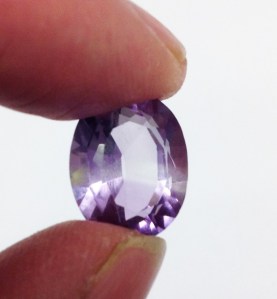
Now here’s a mineral that most people recognise straight away when I bring it out for Spotlight specimens. It is amethyst, and it is the most popular of all purple gem minerals. By a happy coincidence it is very common too, so jewellery made with amethyst need not be very expensive.
But that wasn’t always the case. In the past, fine, large, transparent crystals of amethyst could only be found in Germany, Russia and a few other places in the world. In Europe, the colour purple is traditionally associated with royalty and wealth, and so rare amethyst gems would feature in crowns and jewellery worn by heads of state and religious leaders.
Amethyst is actually a variety of one of the Earth’s most common minerals, quartz. Quartz is composed of silicon dioxide and helps form many different kinds of rock…. it even makes up most beach sands! Amethyst is the kind of quartz that contains a little bit of iron to turn it purple.
So how did amethyst suddenly become so common? During the 18th century, huge flows of volcanic lava were found by explorers in Brazil and Uruguay. Some had air bubbles which were lined with superb purple crystals of amethyst. Soon, these crystal-filled cavities were being sent to Europe, and today, they are sold all over the world. The biggest bubbles were a metre or more in size – huge! Nowadays, nearly all the amethyst you see for sale comes from those 135 million year-old South American lava flows.
My spotlight specimens include an amethyst gemstone and some lovely examples of those gas bubble cavities lined with crystals. One rather curious thing is that the crystals are rarely purple all the way through. The colour typically concentrates towards the tips of the six-sided crystals. If you come when I next show my ‘gas bubble gems’, you will see exactly what I mean!
At the end of 2013, the Museum closed for a 14-month roof refurbishment project. On 15 February 2014 – a year ago yesterday – we reopened and returned to the light. Here’s what happened…
Amo Spooner from the Museum’s Life Collections has been out in the Museum sharing some of her favourite objects. Here’s the latest in our Spotlight Specimens series…
**
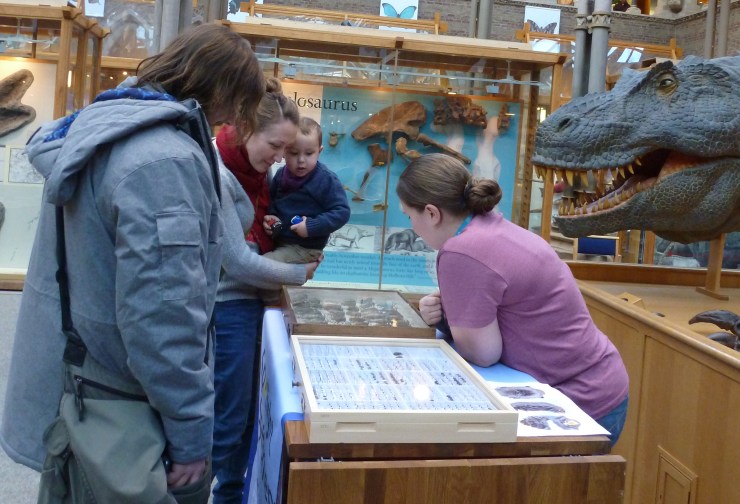
Big impressive beetles or small shiny ones? That is the question. For me it’s all about the small ones, but here I am getting people’s (and the T. rex’s) attention with the big ones. It’s my tactic for engaging their interest before I try to convince them that the small ones are so much cooler!
Monday – Thursday at 2.30pm a member of the Museum’s collections staff can be found out in the Museum talking about something interesting. For my latest session of Spotlight Specimens I chose to show off drawers of my favourite beetles.
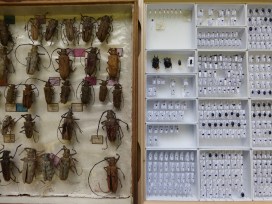
The big ones are from a family of beetles called Cerambycidae or Longhorn Beetles. This family is found all over the world and varies greatly in size and colour. These ones are particularly interesting to me because of the historic collection they are from. The vast Baden-Sommer collection, containing many different beetle families, came to the museum via a dealer in 1910 and unusually it is still in its original layout. The labels you can see in the drawer were written by the two entomologists that collected the specimens, J. Baden and M. Sommer.
The one you see in my hand (above) is in the subfamily Lamiinae – also charmingly known as Flat Faced Longhorns.
Part of my job is to re-curate and move historic specimens into pest-proof housing – I am currently writing a blog post explaining this, so watch this space! In a nutshell, the Baden-Sommer Longhorns are a good example of drawers in need of some TLC. This leads me nicely on to my second choice of drawer, the Histeridae.
These are my first love when it comes to beetles. The Histeridae, or Clown Beetles, vary a lot in size; the one in my hand (below) is about as big as they get, but they can be as small as 1 mm in length.
I have re-curated all of the Museum’s historic Histeridae specimens and mounted up many modern ones, like you can see above. This modern system of trays and pest proof drawers ensures the longevity of specimens, as well as making them easier to access.
So what makes the little ones so special? During the afternoon I met visitors from home and abroad, young and old. I convinced them to to look a little closer, admiring their shiny black armour and fascinating adaptations. I think they finally agreed that big isn’t always best.
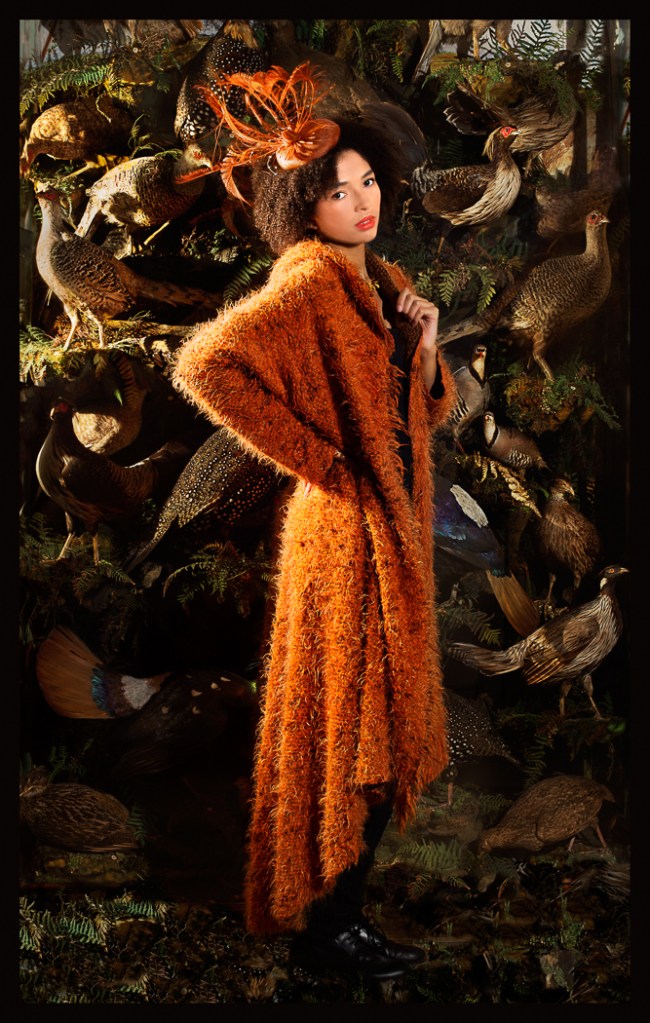
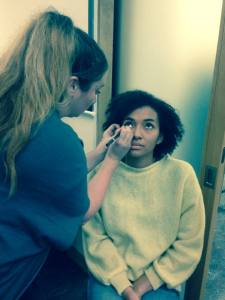
I’ve just received some fabulous pictures from a photo shoot here in the Museum. The building and its specimens are shown at their very best and the model’s striking looks add a sheen of glamour to each photo. But what makes these images really special is that the model is one of our own; Aisling Serrant is better known to Museum staff as a trainee education officer on the HLF Skills for the Future programme.
Aisling spent four months in the Public Engagement team in 2014, largely working with school groups and families. Not always the most glamorous job. In November 2014 we had the opportunity to see her in a completely new light. Oxford Fashion Week was coming to the Museum and they were running open casting sessions for models. Aisling remembers how she got involved:
**
When the initial meetings started taking place between the Fashion Week organisers and the Museum staff, my ears pricked up. Alongside studying or working I have modelled for years. My degree is in archaeology, so people have always found the combination with fashion modelling quite funny – perhaps imagining me standing knee-deep in a muddy trench in stilettos! It seemed too good to be true – could there really be a chance for me to bring my two contrasting types of work together?
Aisling in the Oxford Fashion Week shows. Credit: Mark Hemsworth
I was delighted when I was asked to model in all three shows that were to be held at the Museum. They took place on Friday 7 and Thursday 8 November.
Friday night was a busy one with two shows in one night. I felt right at home, with the familiar faces of old friends like the T.rex and Iguanodon (oh and some of the staff members too!). However it did all feel a bit surreal.
Getting ready backstage
The Museum Annexe had been transformed into the backstage area, but the last time I had spent so much time there I’d been running an archaeological dig activity with year 6 children in the Making Museums project. Now the place couldn’t have looked more different with rails upon rails of clothes, photographers’ flashes and the distinct smell of hairspray in the air.
Saturday night was the big finale to the week – the Birds of Paradise show in the Museum central court. The skeleton parade was parted so we could walk down the middle and the Triceratops skull was moved to become the backdrop for the first part of our walk. The museum was transformed into another world for the evening.
On the runway at the Birds of Paradise show. Credit: Mark Hemsworth
The addition of atmospheric music and such stunning outfits was truly breathtaking – enchanting at times, slightly eerie at others – but always fantastically dramatic. The nature-inspired outfits, some smothered in black feathers, others twinkling with jewel beetle shells, served as a reminder of how extraordinarily beautiful the natural world is.
Photographer Julia Cleaver was here for the shows and was so inspired by the venue and so enjoyed working with Aisling that she returned recently to do an extra photo shoot. These photos are the stunning outcome of that session. Many thanks to Julia for letting us share them here.
Rachel Parle, Interpretation and Education Officer





 Beautiful gemstones are always popular with the public when they’re brought out for Spotlight Specimens. Monica Price talks about some she’s been showing off recently at our daily drop-in sessions.
 Now here’s a mineral that most people recognise straight away when I bring it out for Spotlight specimens. It is amethyst, and it is the most popular of all purple gem minerals. By a happy coincidence it is very common too, so jewellery made with amethyst need not be very expensive.
 So how did amethyst suddenly become so common? During the 18th century, huge flows of volcanic lava were found by explorers in Brazil and Uruguay. Some had air bubbles which were lined with superb purple crystals of amethyst. Soon, these crystal-filled cavities were being sent to Europe, and today, they are sold all over the world. The biggest bubbles were a metre or more in size – huge! Nowadays, nearly all the amethyst you see for sale comes from those 135 million year-old South American lava flows.
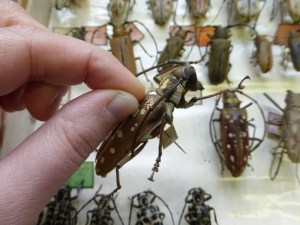 The big ones are from a family of beetles called Cerambycidae or Longhorn Beetles. This family is found all over the world and varies greatly in size and colour. These ones are particularly interesting to me because of the historic collection they are from. The vast Baden-Sommer collection, containing many different beetle families, came to the museum via a dealer in 1910 and unusually it is still in its original layout. The labels you can see in the drawer were written by the two entomologists that collected the specimens, J. Baden and M. Sommer.
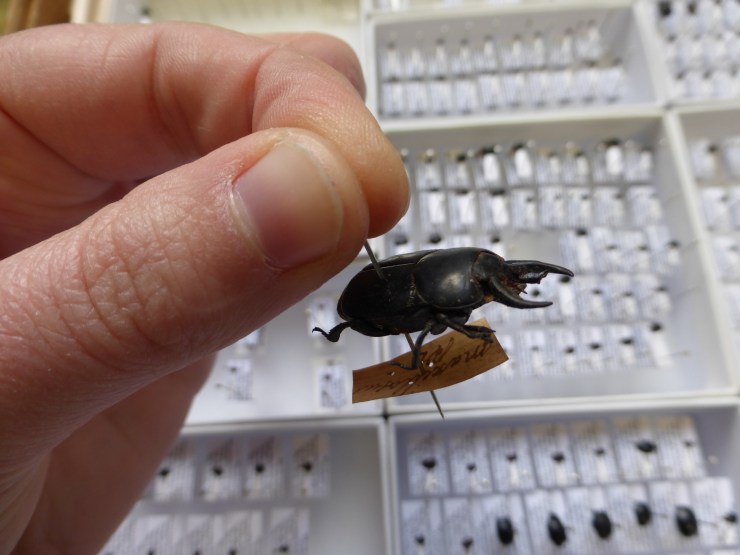 These are my first love when it comes to beetles. The Histeridae, or Clown Beetles, vary a lot in size; the one in my hand (below) is about as big as they get, but they can be as small as 1 mm in length.
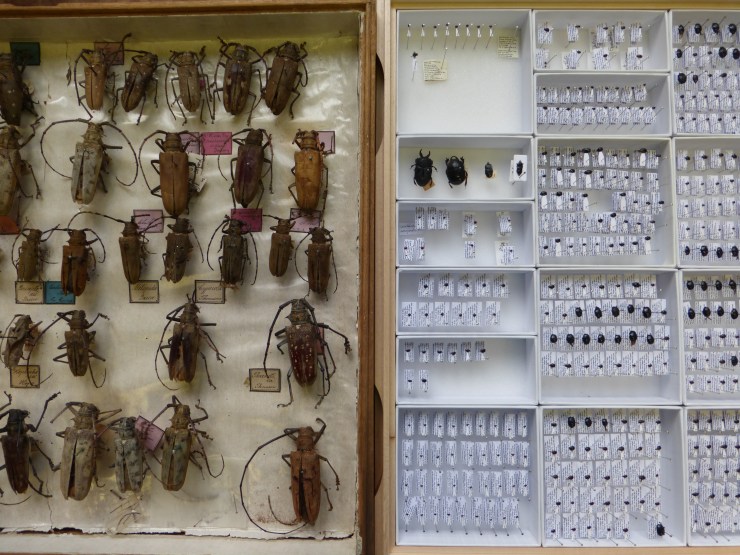 I have re-curated all of the Museum’s historic Histeridae specimens and mounted up many modern ones, like you can see above. This modern system of trays and pest proof drawers ensures the longevity of specimens, as well as making them easier to access.