Get on your soapbox


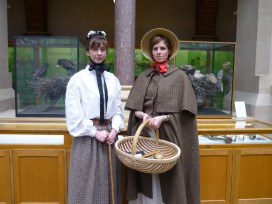
Mary Kingsley (l) and Mary Anning (r) prepare for their appearance in Soapbox City
Mary Kingsley and Mary Anning prepare for their appearance in Soapbox City

As April draws to a close, Oxford prepares for the traditional May Morning celebrations. Alongside the choir singing on Magdalen Tower, the reckless students leaping from the bridge and morris dancing in the medieval streets, you will find staff from Oxford University Museums joining in with the revelries.

An early-morning dung beetle will be taking to the soapbox

The Museums have taken charge of a one hour slot, from 8-9am, with staff from the Museum of the History of Science, Pitt Rivers Museum and, of course, the Museum of Natural History taking to the stage during the hour. If you’re willing to get up bright and early, you’ll be able to see a giant dung beetle arguing the value of his species, a T rex in a rap battle with a dodo, and two dignified ladies visiting from the past to remind everyone just how significant they really were.

Ellena Smith, ASPIRE Assistant across the Museums, is co-ordinating the Museums’ slot. She says;

Soapbox City is a fantastic opportunity to share knowledge and insight from Oxford University Museum staff in a fun and exciting way, and a great chance for the Oxford University Museums to reach out to a new audience.

Here’s the full timetable for the Museums’ shift:

08:00 Shooting Holes in Pitt Rivers Myths, Helen Adams (Pitt Rivers Museum)

08:05 Music in the Museum, Kelly Smith (HLF Trainee)

08:10 Conservation Station, Bethany Palumbo (Museum of Natural History)

08:15 Cockroaches: Pets or Pests, Darren Mann (Museum of Natural History)

08:20 Why the World needs Dung Beetles, Chris Jarvis (Museum of Natural History)

08:25 Natural History Stand-up, David Legg (Museum of Natural History)

08:30 T rex Vs the Dodo Rap Battle, Steven Williams (Museum of Natural History)

08:35 A Tale of Two Marys, Caroline Cheeseman and Rachel Parle (Museum of Natural History and Joint Museums Volunteer Service)

08:40 Why older people are radical, Helen Fountain (Museum of Oxford)

08:45 Geek is Good, Scott Billings (Museum of the History of Science)

08:50 When History Goes Wrong, Stephen Johnston (Museum of the History of Science)

08:55 You think you are smart?! Silke Ackermann (Museum of the History of Science)

If you’re up early for the festivities (or still awake from the night before!), do join us on Broad Street for a little May Morning museum madness.

Rachel Parle, Interpretation and Education Officer
 

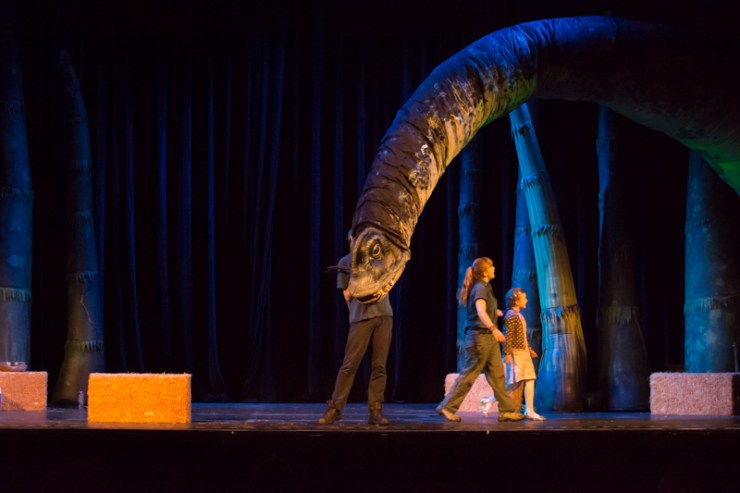
He’s behind you…

Dino Zoo

Last weekend the dinosaurs rumbled into town; a whole menagerie of them. Indeed, it was a veritable Dinosaur Zoo. They’d come a long way too – all the way from Australia – and so their names were not so familiar to us: the Australovenator, the Titanosuar (above), the Dryosaur, and the cutely-named Leaellynasaura, so-called after the discoverer’s daughter Leaellyn (Leaellyn’s lizard, see?).

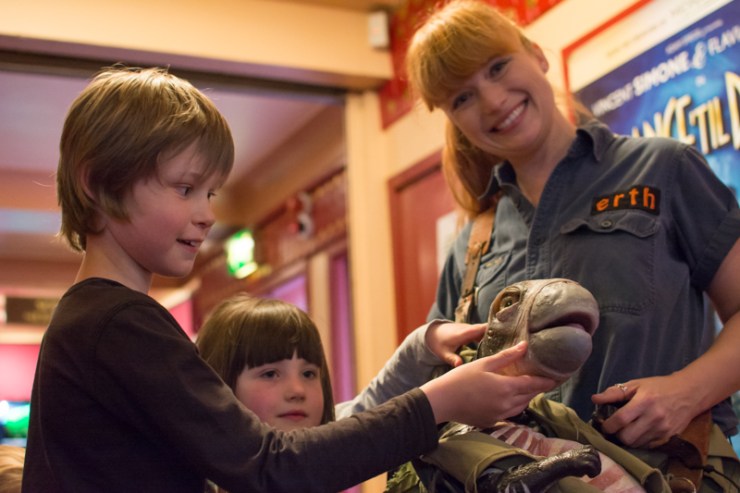
If you didn’t catch it, these creatures were all part of a show at Oxford’s New Theatre. There was a sneak preview of this in the Museum earlier in the year. Produced by Australian company Erth Visual and Physical, the Dinosaur Zoo Live production mixes the thrill of brilliant puppetry with facts and explanations about the adaptations, environments and possible behaviours of these long-lost Australian lizards.

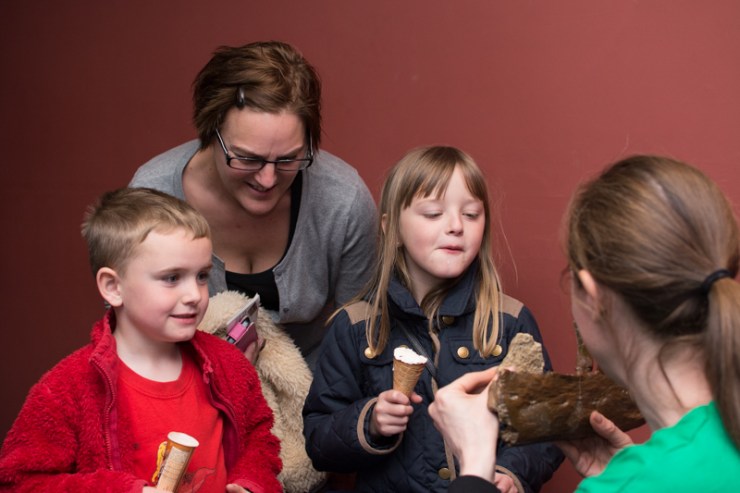
This wasn’t an opportunity to be missed, so we teamed up with the New Theatre and the show’s production team to bring some of our own fossil specimens to the event. With a handling table set up in the theatre’s bar area, families spent up to an hour before the show examining our selection of theropod and sauropod material, getting up close to teeth, eggs, jaws, and more.

We had the lower jaw and fossilised tooth from Oxfordshire’s very own Megalosaurus, famous for being the first dinosaur to be scientifically described, by William Buckland in 1824 (actually the term Dinosauria came later, coined by Richard Owen in 1842). As it was Easter we had some ancient eggs too, including the fossil of an egg laid, probably, by a sauropod dinosaur, cracks in the shell still clearly visible.

A family enjoy pre-show ice creams while learning about the Megalosaurus

To represent the the Cretaceous period, which is when the Australian beasts in the show were around, we brought the teeth and a hefty vertebra of an Iguanodon. Unlike the still-serrated Megalosaurus tooth fossil, the flat Iguanodon teeth show that this dinosaur was a herbivore. There’s a nice story, possibly apocryphal, that these teeth were actually spotted not by Gideon Mantell, the geologist who described Iguanodon in 1825, but by his wife Mary Ann as she waited in their carriage for her husband to visit a patient in Sussex.

Meeting the stars after the show with brilliant host Lindsay Chaplin
Meeting the stars after the show with brilliant host and zoo-keeper Lindsey Chaplin

We threw in a couple of tricksy things too. On the handling table there were two non-dinosaur specimens – could people work out which they were? In many cases, yes they could: if there’s one thing we learnt it’s that young kids know a heck of a lot about dinosaurs. The two red herrings were an ichthyosaur skull, because ichthyosaurs were marine reptiles rather than dinosaurs; and the fossil imprint of a leathery egg, probably laid by a prehistoric crocodile or turtle.

All in all, everyone had a great big dinosaur overdose. Still, better that than chocolate eggs.

Scott Billings, Communications coordinator

A little piece of history

Glass tiles

Regular readers of our closure blog, Darkened not Dormant, will know all about our Goes to Town project, where twelve plucky specimens escaped from the Museum for an eight month holiday in venues all around Oxford city centre. Like any good treasure hunt, the Goes to Town trail presented a competition which promised a valuable prize…

The framed fragment of roof tile, presented to the Goes to Town competition winners

Each of the twelve specimens carried two ratings, one for Danger and one for Rarity. To enter the competition, trail hunters needed to find all the displays and then tell us which specimen was rated most dangerous and which most rare. The most dangerous was the Snowy Owl, the sharpest living predator on the trail; and the rarest were the animals from Alice’s Adventures in Wonderland which are, of course, completely fictional. If you entered without checking all the specimens and guessed that the Dodo would be the rarest then we caught you out – sorry!

Winners also got a cuddly dinosaur.
Which is best – piece of glass, or cuddly dino?

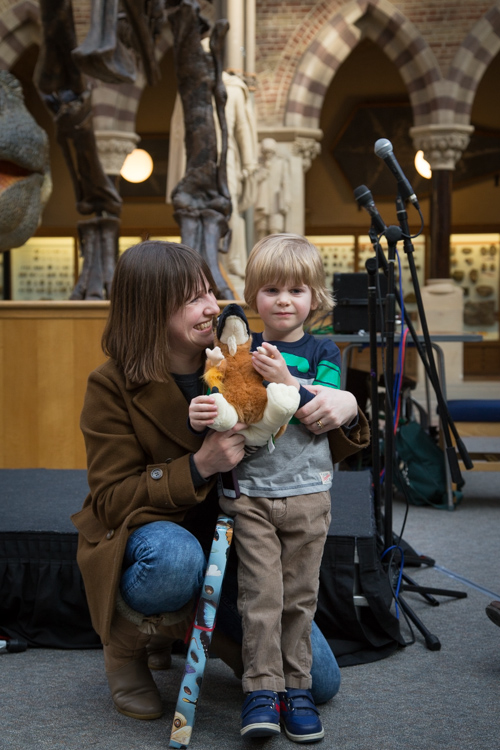
Around 80 people entered the competition and three winners were chosen at random. We held a little award ceremony on our reopening day on Saturday 15 February, where all three winners attended to receive their prizes. And the prizes were quite special. One was a cuddly dinosaur toy (always special, right?) and the other was a small framed, cut fragment of one of the glass tiles from the Museum’s roof.

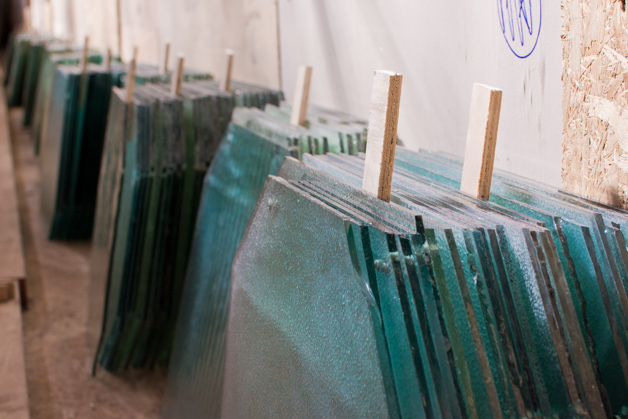
The whole reason for our closure last year was to have the original Victorian roof repaired, so we felt that it was a fitting prize to present a little piece of the fabric of the roof – a little piece of history – to the winners. Congratulations again to the three winners and we hope those small fragments of the Museum are now hanging proudly on three walls somewhere in Oxford.

IMG_0883
Adults get the cuddly dino too, of course.
Museum directo Professor Paul Smith presents the prizes
Museum director Professor Paul Smith presents the prizes.

By the light of the Moon

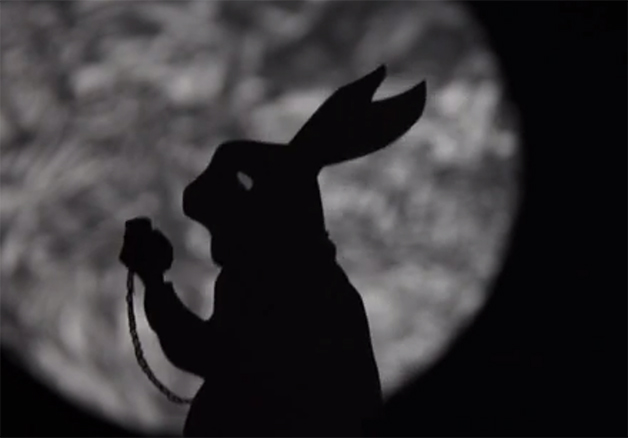
White rabbit

We recently brought you the breaking news that the animals on our Goes to Town trail had escaped from their cases and were planning to return here to reopen the Museum on Saturday 15 February.

We can now reveal that these creatures have been sighted, skulking by the light of the Moon, and making their final preparations for this reopening party. It seems that the Museum will be Darkened no longer, and most certainly not Dormant.

See you there…

Breakout!

8.Ident

I bring you breaking news from the Museum of Natural History. As you all know, the Museum has been closed for over a year and, during that time, a number of our specimens have been popping up in unlikely places around Oxford city centre.

The Goes to Town project has seen a penguin in the fish mongers, a bank vole in the bank and a book worm in a book shop. All was going swimmingly until today.

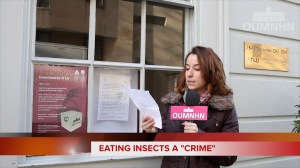
3.RachelSeriousWe’ve been receiving reports from several of our Goes to Town venues that there’s been a breakout. The snowy owl has vanished from the University Church, the edible insects have escaped from the Turl St Kitchen and a white rabbit is on the loose from the Central Library. There’s trouble afoot.

We’ve put together a special bulletin of Oxford University Museum of Natural History News.

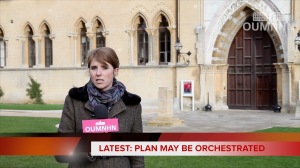
Scott Billings at St Mary the Virgin Church
Scott Billings at the University Church

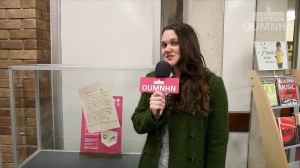
Reporters Bethany Palumbo, Jess Suess and Scott Billings joined me to bring you the latest story direct from the scene.

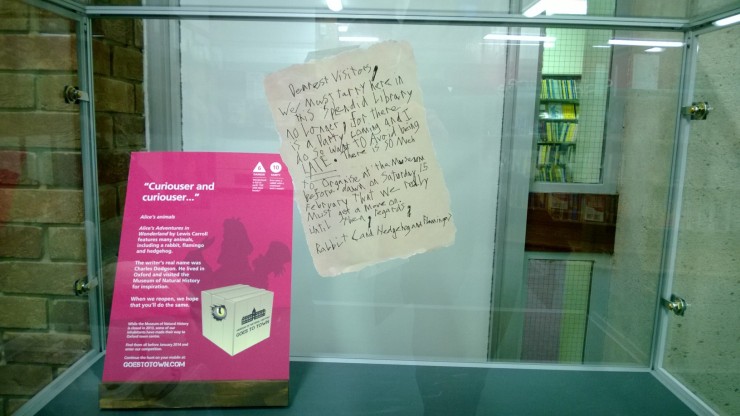
The mystery has been give an even more intriguing twist by the appearance of letters left behind by the escaped specimens. Each creature has its own motive for abandoning its case, but there is a definite theme throughout; they’re all coming home!

A note left behind by the white rabbit, Oxford Central Library
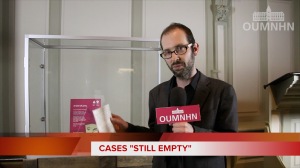
Bethany Palumbo at Turl St Kitchen

As each report unfolds, it’s clear that the specimens have escaped in order to return to the Museum, ready for our re-opening on Saturday 15th February.

So, who is behind this mass escape? Watch the report video to find out.

Jessica Suess at Oxford Central Library

The Museum of Natural History will be the place to be on Saturday 15th February. Even the Goes to Town specimens don’t want to miss out on the action! Join us then, dawn till dusk.

Rachel Parle, Interpretation and Education Officer
Natural Histories: On Tour

Order

In May this year we opened Natural Histories, our collaborative exhibition with the Museum  of the History of Science on Oxford’s Broad Street, who hosted the displays. As we wrote at the time, it was a great opportunity to put on view some lovely and important specimens while we were closed. It also linked nicely with the long history of the museums in Oxford, beginning as far back as 1683.

Lost and FoundIt was a lot of hard work pulling together all the material, themes, and displays for Natural Histories so we were particularly pleased when Banbury Museum, one of the University museums’ development partners, approached us asking if the exhibition might tour there…

And so it has. It’s a short, one-stop tour admittedly, but with a bit of jiggling and reconfiguration here and there, the whole Natural Histories show is now open to the public in Banbury.

Banbury MuseumSo if you missed it at the Museum of the History of Science, head over to Banbury Museum by 22 February 2014 and have a look.

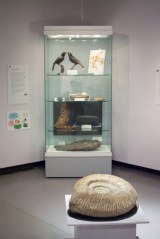
There’s plenty to see, including the jawbone of the Oxfordshire Megalosaurus, the world’s first scientifically-described dinosaur; creatures collected by Charles Darwin; and a meteorite the age of the Earth itself. With touchable specimens too (of course), Natural Histories explores some big themes and ideas that have shaped our understanding of the natural world.

But as the finished exhibition is now on display for all to see, here instead are a few behind-the-scenes shots of the late night measuring, painting, fixing and adjusting that were needed to get everything ready for opening day last Saturday. Thanks very much to everyone who mucked in and helped out.

_DSC1117
Making a few adjustments…
An almost-closed case
Almost ready for closure
_DSC1126
Finding the spot
Glass cleaner at the ready

_DSC1138

Scott Billings – Communications coordinator